-
Team 19- Nourish Together Project
-Group 19, Hallways to Home
-Nourish Together Project Submission
-Innovation Sprint: Preventing Youth Homelessness
Inspiration- We were inspired by the growing number of high-school students experiencing food insecurity and the strong evidence linking early nutrition support with better academic and social outcomes. When we learned how stigma prevents many youth from accessing free meals, we wanted to design a program that felt welcoming, universal, and community-driven. Our goal was to create a model that supports students before challenges escalate into crises like homelessness.
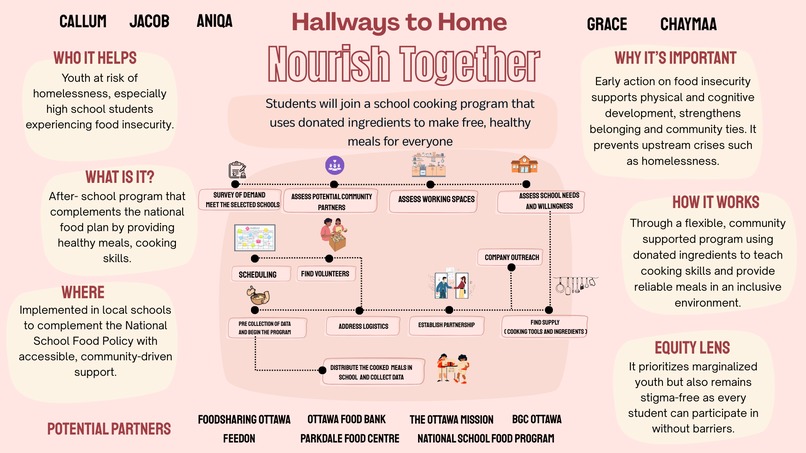
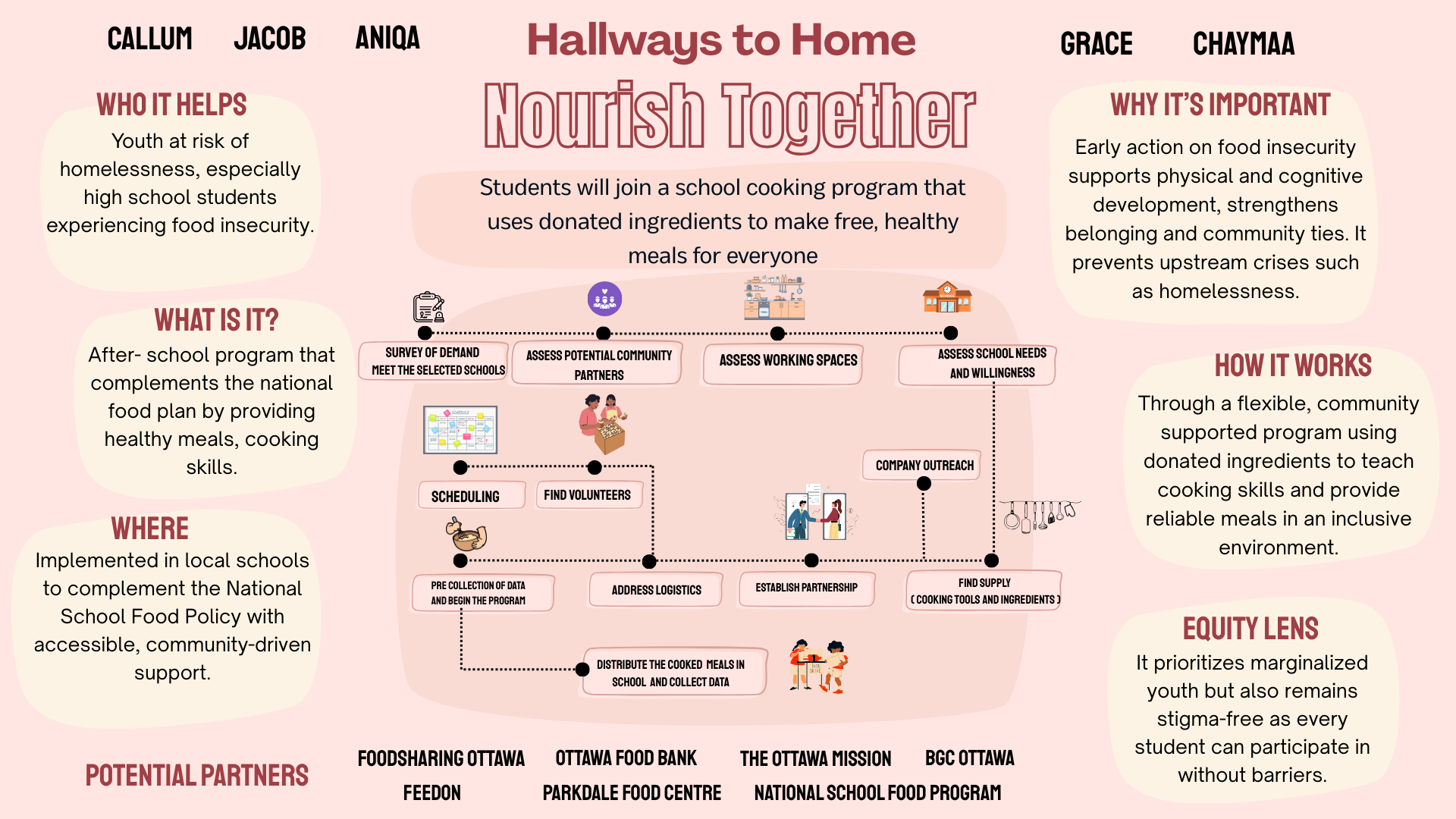
What it does- Nourish Together is an after-school cooking program where students use donated ingredients to prepare healthy, free meals that are shared within their school community. The program teaches cooking skills, builds peer connection, and ensures that food is accessible without stigma. It also complements the National School Food Policy by filling gaps with community-supported resources.
How we built it-We started by identifying the needs of students in vulnerable neighborhoods and researching existing barriers in school food access. Then we mapped out a full implementation pipeline, from surveying schools and securing community partners to organizing scheduling, volunteer recruitment, logistics, and distribution. By integrating input from local food organizations, we created a flexible, scalable program model.
Challenges we ran into- One of our main challenges was designing a system that prioritizes marginalized youth without singling them out or increasing stigma. We also had to consider logistical barriers such as variable school kitchen spaces, inconsistent donation supply, and volunteer capacity. Ensuring sustainability across diverse schools required careful planning and adaptability.
Accomplishments that we're proud of-We’re proud of creating an end-to-end program model that is realistic, community-oriented, and aligned with national policy. Our team successfully integrated equity, accessibility, and practical logistics into one coherent pathway. The final roadmap clearly shows how this program could be implemented in real schools across Ottawa.
What we learned- We learned how deeply food insecurity impacts academic performance, health, and long-term stability for youth. Our research also showed that universal programs dramatically reduce stigma and increase participation. Finally, we learned how to collaborate effectively as a team—combining policy analysis, community research, and practical design thinking.
What's next for Team 19- Our next step is to refine the program with feedback from school administrators, youth workers, and local food organizations. We hope to develop a pilot proposal for one or two Ottawa schools and gather preliminary feasibility data. Long-term, we envision scaling the model to become a sustainable complement to the National School Food Policy.
Built With
- canva
- researchgate

Log in or sign up for Devpost to join the conversation.