-
-
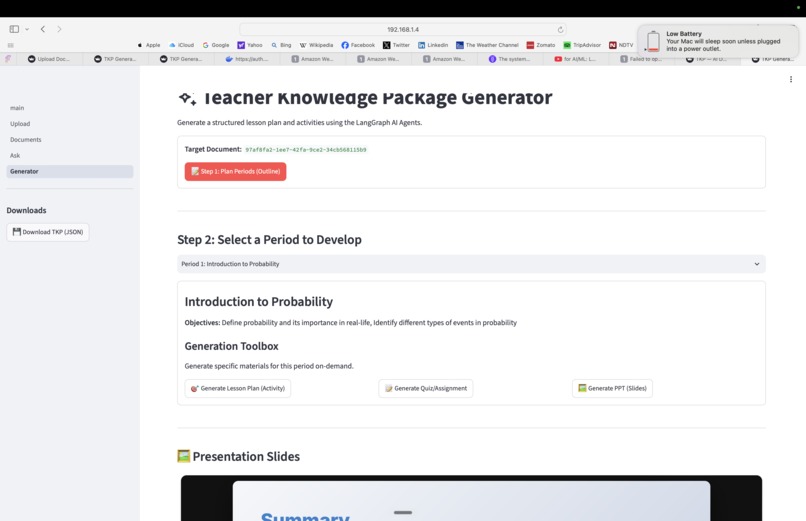
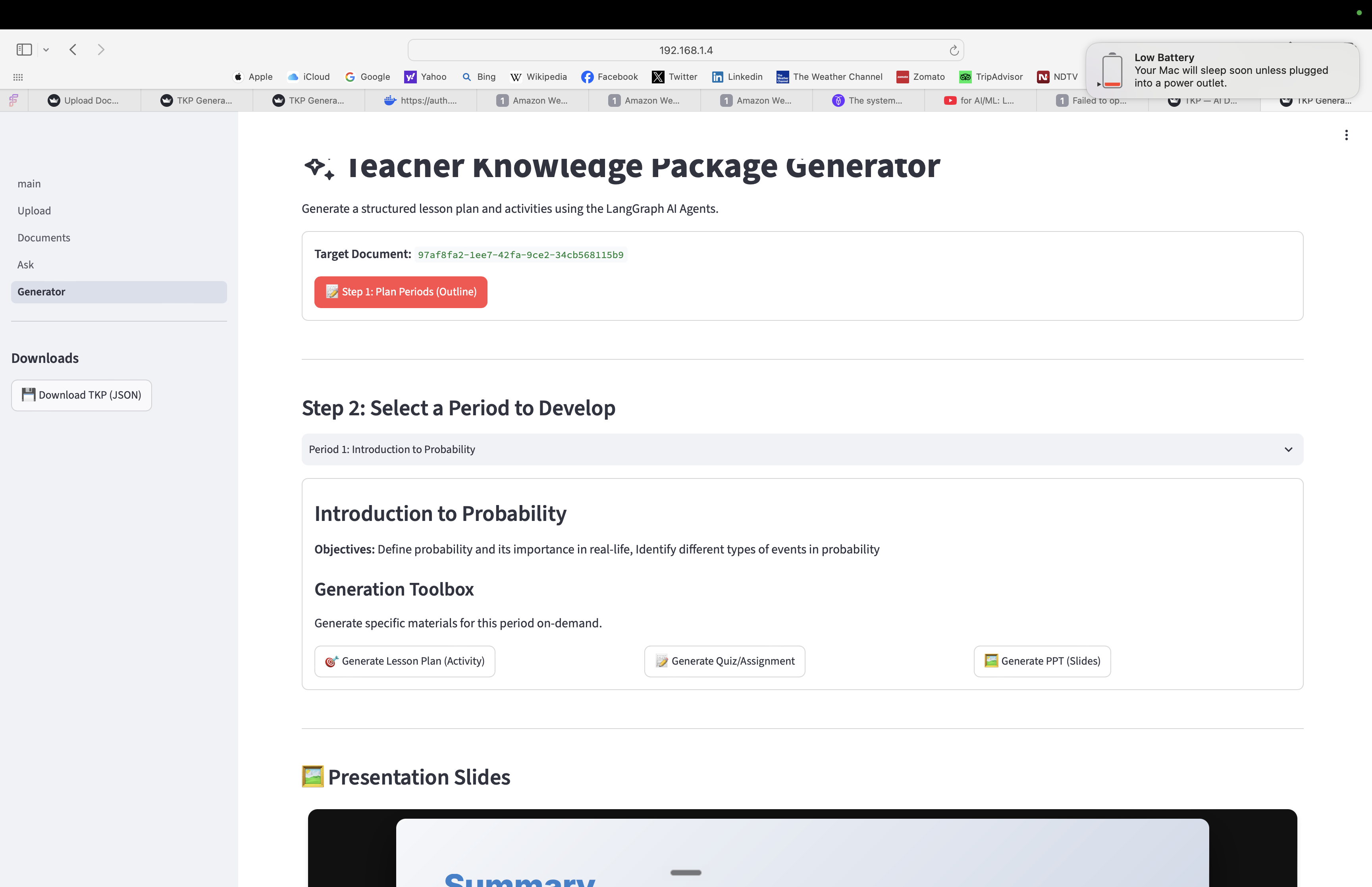
Generator Page
-
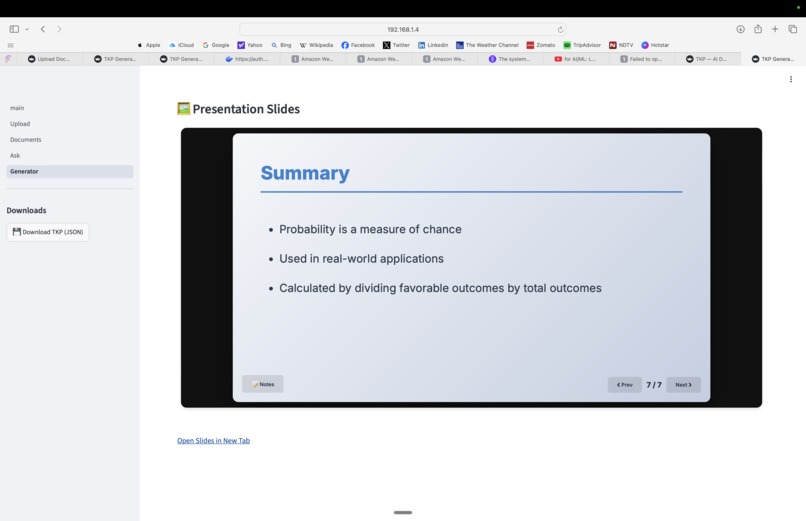
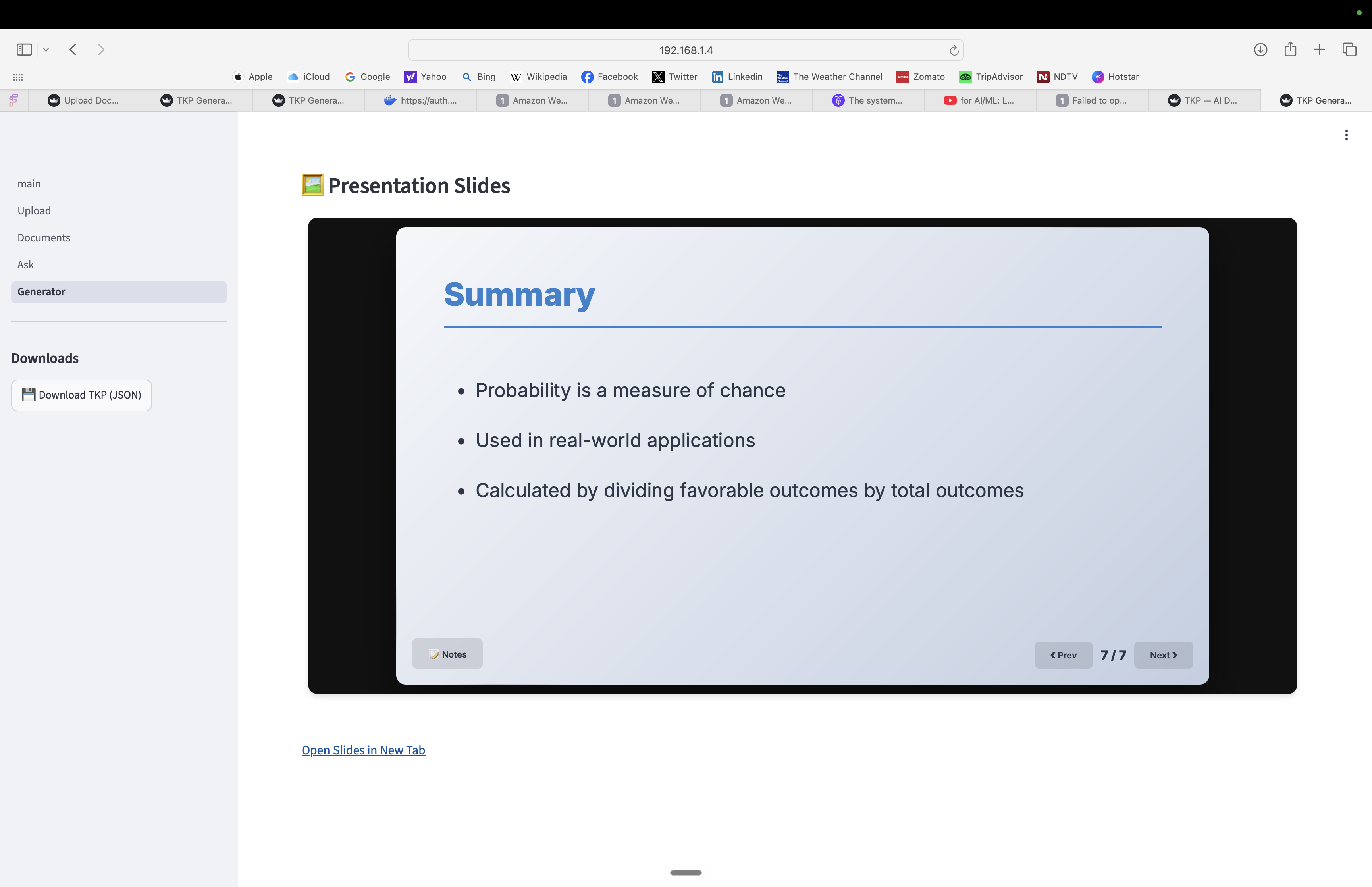
Slides page
Inspiration Enterprise knowledge is often scattered across documents, databases, and internal resources, making it difficult for users to quickly find reliable information. We wanted to build a GenAI solution that could understand user intent, retrieve the right information, and provide useful answers instead of forcing users to manually search through large amounts of data.
What it does TKP is an AI-powered knowledge solution that uses LLMs, RAG, and agentic workflows to help users interact with enterprise knowledge using natural language.
It can understand a user's request, retrieve relevant information from connected knowledge sources, and generate highly contextual responses. The system uses graph-based retrieval and semantic search to improve the relevance of retrieved information and supports multi-step AI workflows through LangGraph.
How we built it We built TKP around an agentic AI architecture using LangGraph to orchestrate multi-step workflows.
The core technology stack includes:
LLMs for understanding queries and generating responses LangGraph for agentic workflow orchestration LangChain for building LLM-based components and retrieval pipelines CockroachDB for vector-based semantic search and data storage Embeddings for representing documents and queries in a searchable vector space RAG pipelines for retrieving relevant context before generating responses Document processing (chunking, embedding, similarity search, and retrieval) to connect user queries with relevant enterprise knowledge The system combines semantic retrieval with graph-based relationships so that the model can use both relevant content and the relationships between pieces of information.
Challenges we ran into One of the biggest challenges was making sure the system retrieved the right information before asking the LLM to generate an answer. Poor retrieval can directly lead to inaccurate or incomplete responses (hallucinations).
We also had to design the workflow so that multiple AI steps could work together reliably rather than treating the application as a simple question-and-answer chatbot. Integrating semantic search, graph retrieval, and agentic orchestration while keeping the workflow efficient was another significant hurdle.
Accomplishments that we're proud of We are proud of building an end-to-end GenAI solution that goes far beyond a basic chatbot.
The project seamlessly combines RAG, semantic search, knowledge graphs, and agentic workflows into a single system. Using LangGraph allowed us to structure the AI workflow into multiple steps and make the system more capable of handling complex knowledge-retrieval tasks.
We are also proud of creating an architecture that can easily be extended with additional tools, knowledge sources, and AI capabilities as the system evolves.
What we learned This project helped us understand that building a useful GenAI application involves much more than simply connecting an LLM to a prompt.
We learned exactly how critical retrieval quality, chunking strategies, embeddings, vector search, knowledge graphs, and workflow orchestration are for building reliable, production-ready AI systems.
We also gained practical experience with LangGraph and learned how agentic workflows can be designed to break complex tasks into smaller, coordinated steps.
What's next for TKP We want to make TKP more intelligent, reliable, and scalable by expanding its knowledge sources and adding more specialized tools and agents.
Our next steps include improving retrieval accuracy, strengthening evaluation and monitoring, optimizing latency and cost, and expanding the agentic workflows so TKP can handle more complex enterprise use cases with less human intervention.
CockroachDB Tools Used We used CockroachDB Distributed Vector Indexing as our core database to store and perform highly optimized semantic similarity searches on chunked curriculum documents, enabling the RAG pipeline's core retrieval mechanism. We also utilized the CockroachDB Agent Skills Repo by ingesting the cockroach_db/SKILL.md to ensure our AI agent built the vector schema and SQL queries following CockroachDB's strict best practices for performance and accuracy.
AWS Services Used We deployed our production environment (FastAPI backend and Streamlit frontend) as containerized microservices on Amazon EC2 (using t4g Graviton processors). The Docker images are securely stored and managed using Amazon ECR. We also utilized AWS Secrets Manager to securely inject our CockroachDB Connection URIs and OpenAI API keys into the containers at runtime, completely eliminating hardcoded credentials.
Built With
- amazon-web-services
- cockroach
- lagsmith
- langchain
