-
-
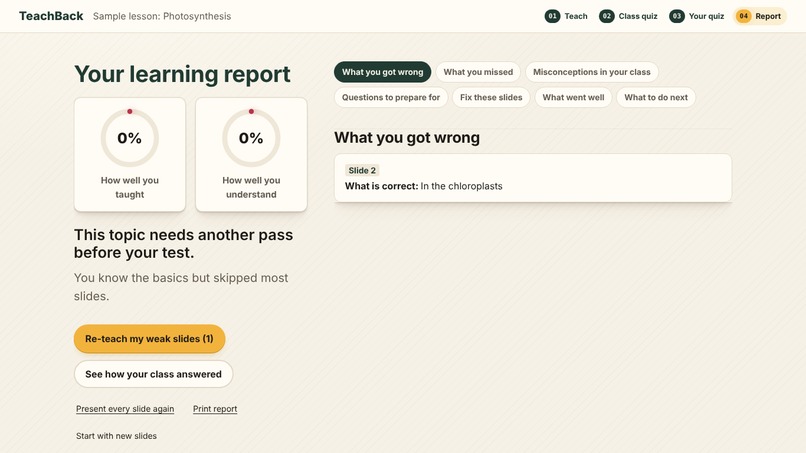
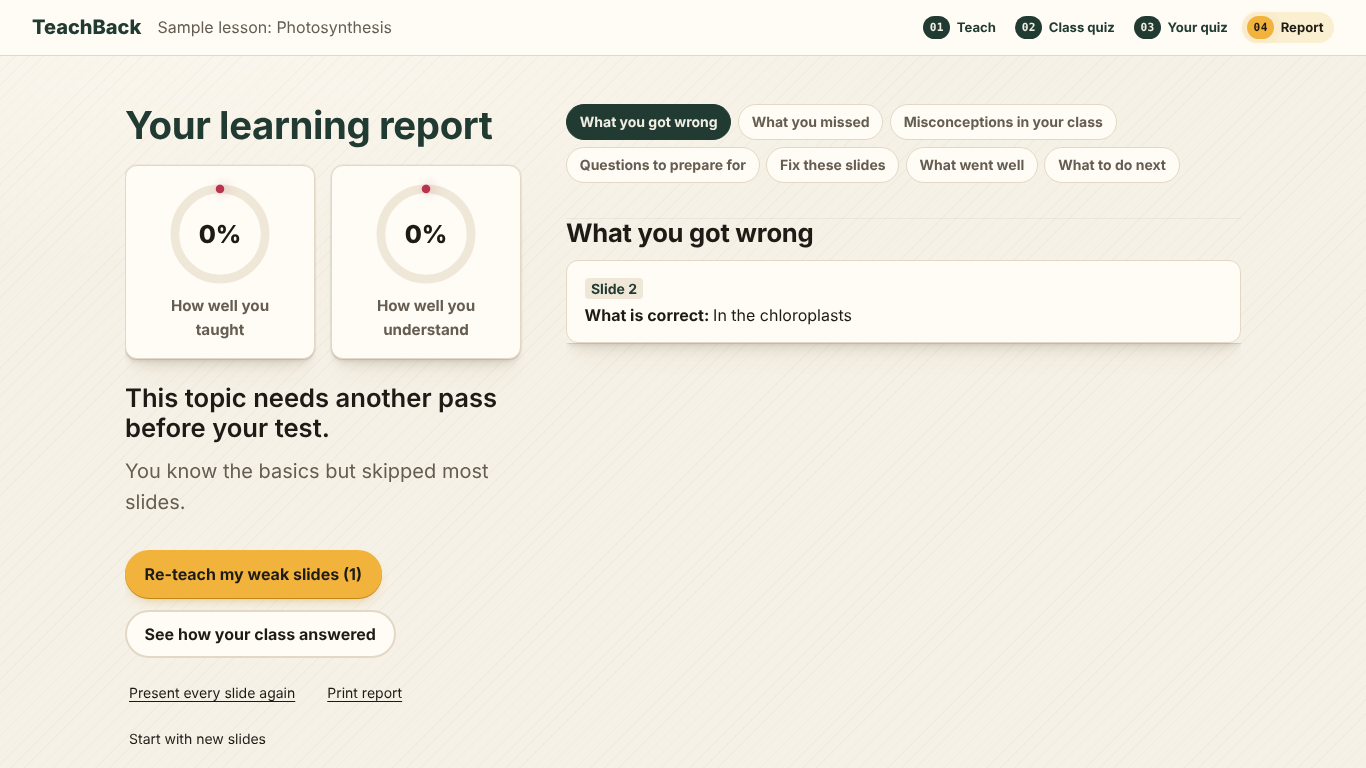
Learning report — what you missed, what you explained well, and what to re-teach
-
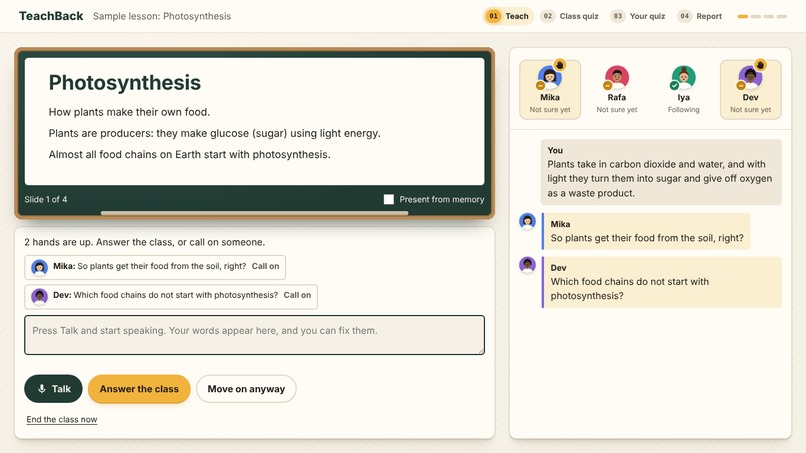
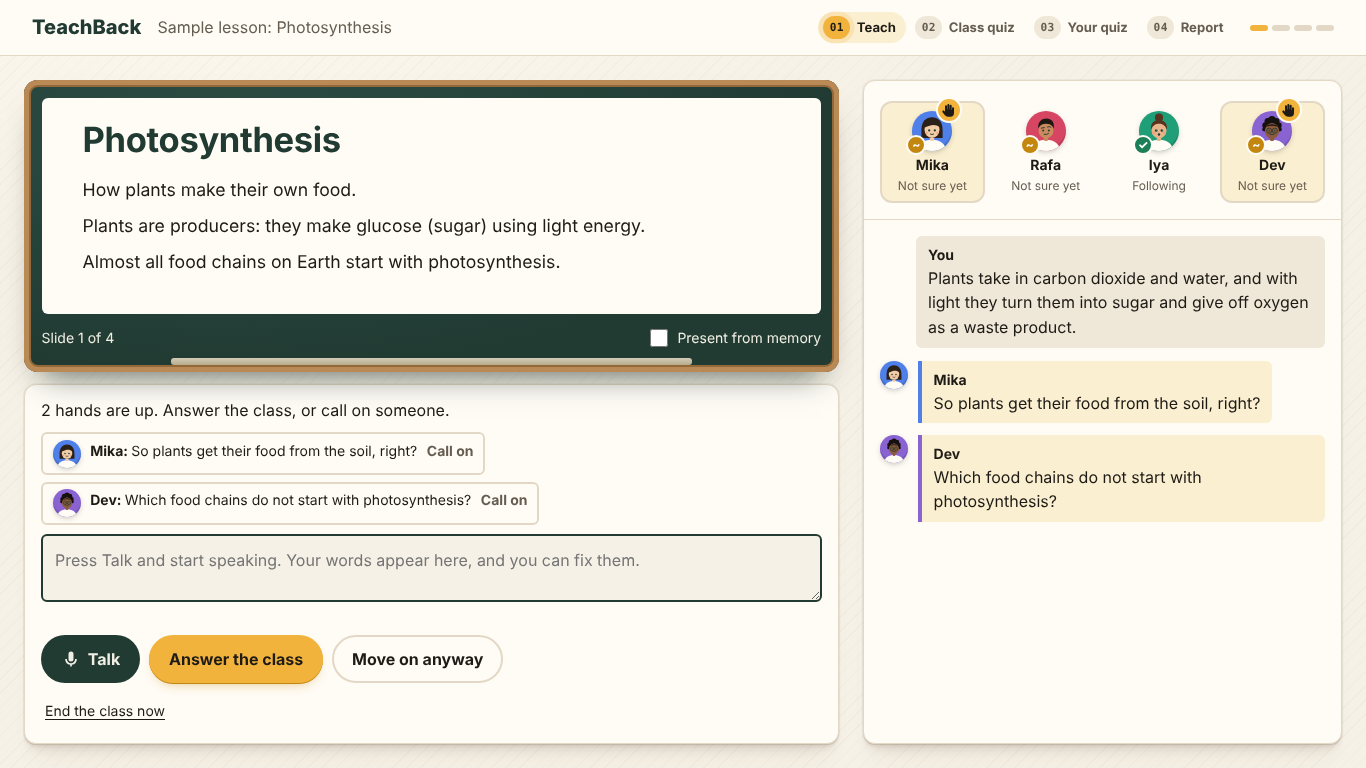
Teaching screen — present a slide out loud while classmates react and ask questions
-
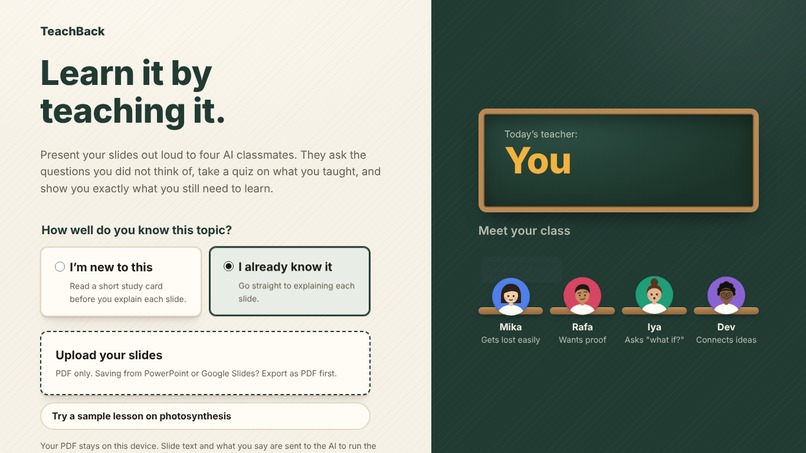
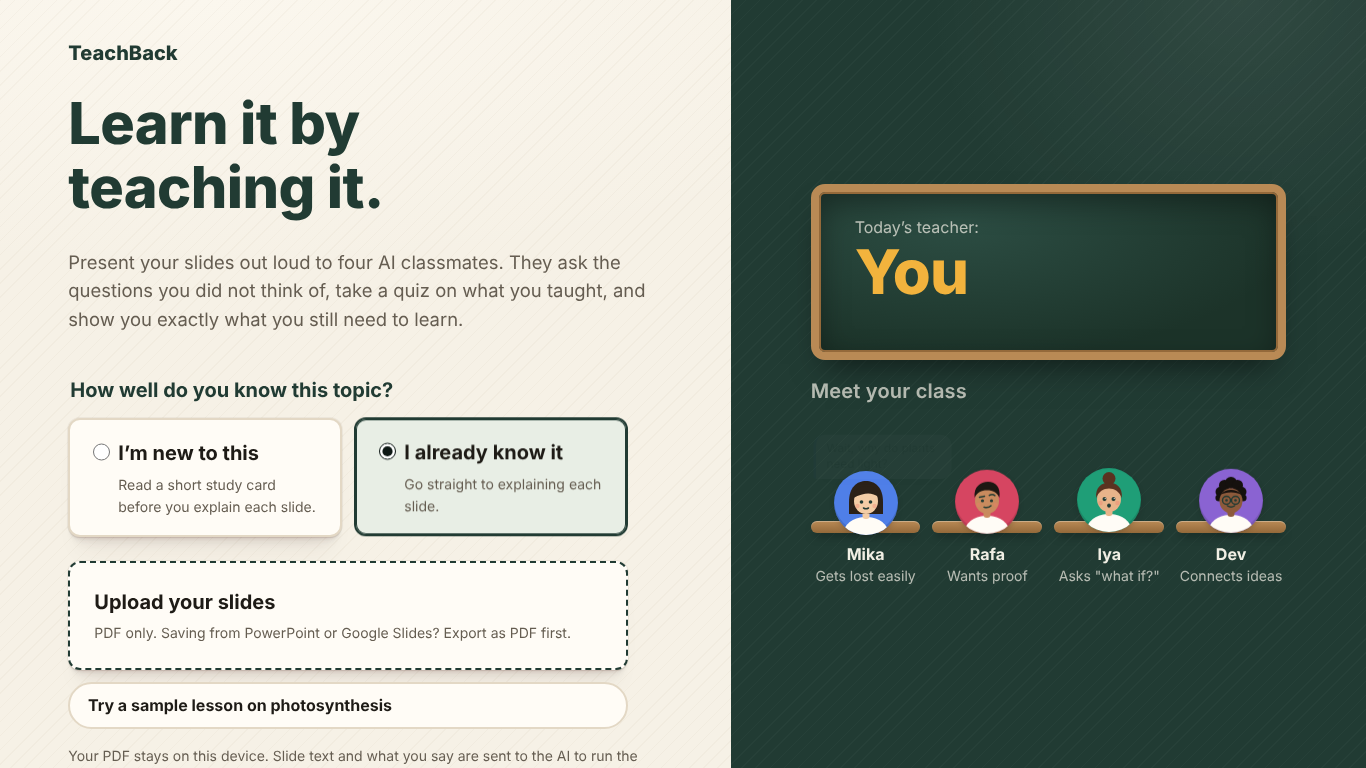
Start screen — meet your class and upload your slides
-
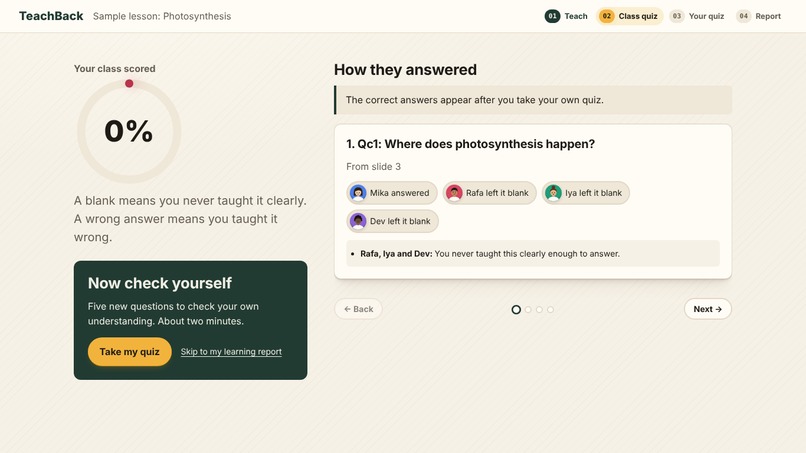
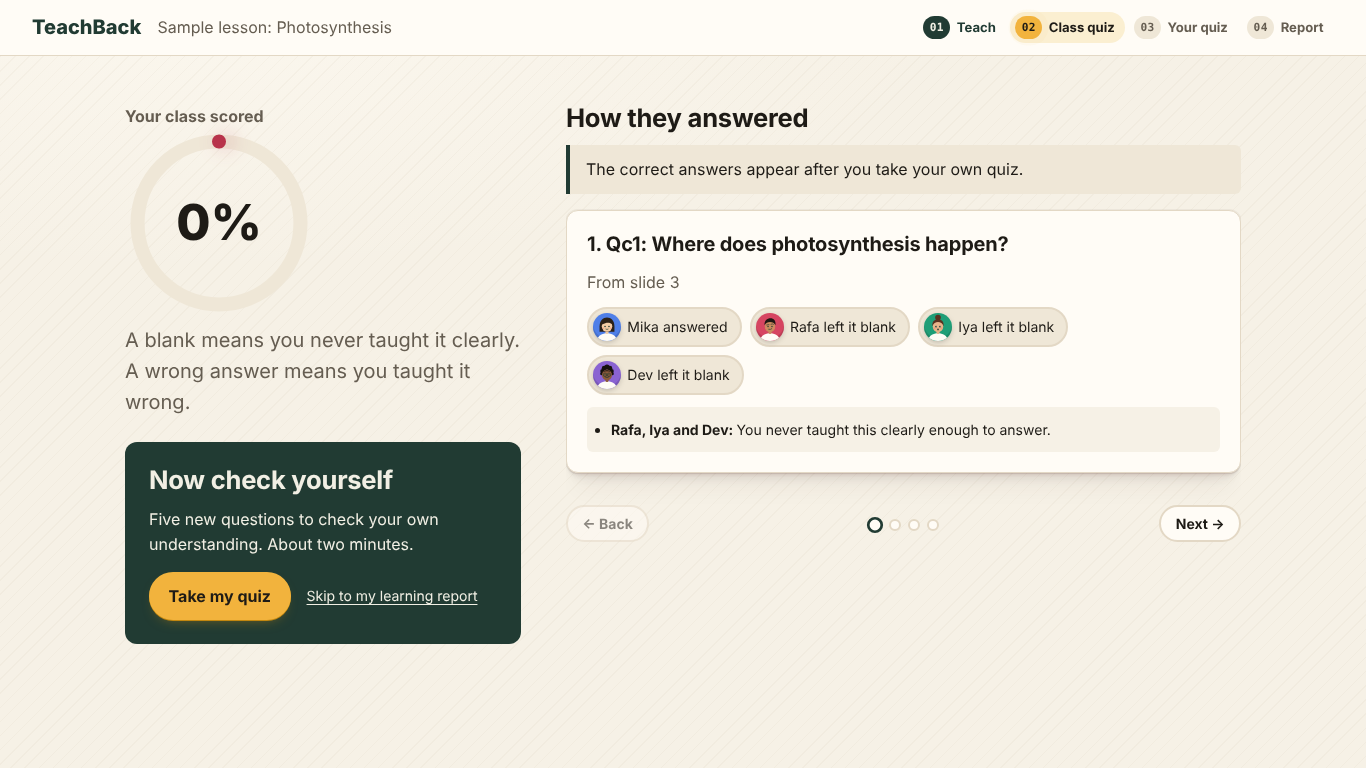
Class quiz results — classmates answer using only your own words
Learn it by teaching it. Upload your slides, present them out loud to four AI classmates, and find out what you really understand.
Inspiration
Students present reports and defend research all the time, and the best way to learn something is to teach it. But practicing alone gives no feedback. Nobody asks the question you didn't think of, and you only find out which parts you explained badly at the real presentation or the test.
We wanted a study tool where you can only pass if you really taught the idea.
What it does
- Upload your slides (PDF), or try the built-in photosynthesis lesson. The text on each slide becomes the answer key.
- Present each slide out loud to a class of four AI classmates. Turn on Present from memory to hide the slide while you explain.
- The class reacts like a real class. Each classmate has a personality:
- Mika gets lost easily and catches skipped steps.
- Rafa wants proof for every claim.
- Iya asks "what if?" and tests edge cases.
- Dev connects the topic to other ideas.
- Answer the whole room, or click a raised hand to call on one classmate. They never hand you the answer. When you are wrong, they push back so you have to rethink it. Some arrive with a common misconception (like "plants get food from the soil") and keep it until you correct it.
- The class takes a quiz using only your words. Every answer must quote something you really said. If you never taught it, they leave it blank. If you taught it wrong, they get it wrong.
- You take your own quiz, and for each question you miss you first write why the right answer is right.
- A learning report shows what you got wrong (quoting your exact words), what you missed, and which slides to fix.
- Re-teach your weak slides and see your score on those slides before and after, on brand-new questions.
New to a topic? Choose "I'm new to this" to read a short study card (written only from your slides) before explaining each slide.
How we keep the score honest
Three checks make sure the quiz measures what you taught, not what the AI already knows:
| Check | What it does |
|---|---|
| Real quote | Each answer must quote you, and the server confirms those words really appear in what you said. |
| Teaches the answer | A second model checks that the quote actually supports the option picked, not just that it is real. |
| No reading aloud | Answers that come only from slide text you read out don't count as teaching. |
The quiz itself is also checked against your slides by a stronger model before anyone answers it.
How we built it
- Node.js server with no framework and no build step, and browser ES modules for the frontend.
- Featherless API for all text AI, with a different model for each job: DeepSeek-V4.1-Flash for the live class, GLM-5.3 to check quizzes, and Kimi-K3 to grade the class quiz and write the report. If a model is slow, the next one takes over automatically.
- pdf.js (Mozilla) reads the PDF in your browser. The PDF never leaves your device.
- Web Speech API for live voice in Chrome and Edge, with Gemini Flash-Lite turning speech into text in other browsers.
- Hand-drawn SVG classmates and a chalkboard classroom, with CSS animations, score rings and a no-scroll layout that fits one screen.
- API keys stay on the server and are never sent to the browser. Nothing is saved.
Challenges
- Making the score trustworthy. An AI classmate can answer from general knowledge, so we force every answer to quote the presenter and verify the quote twice. Getting that strict without marking honest explanations as blank took the most iteration.
- Speed. The plan runs one big model request at a time, so we built a queue that puts the live class first and pauses background work, like writing your own quiz, until it's done.
- Classmates that behave like a class. Early on, everyone answered every question at once. We made them hold their hands up and wait when you call on someone.
What we learned
Teaching to a class that pushes back is hard, and that's the point. While building and testing this, we kept finding gaps in our own explanations of the sample lesson. We also learned that AI tools need strict rules and checks before you can trust the score they give.
Try it
Source code and setup steps are on GitHub. You need Node.js and your own Featherless key, and a free Gemini key if you use Brave or Firefox. Press "Try a sample lesson on photosynthesis" if you don't have a PDF.
AI use disclosure
- In the product: open models on Featherless play the four classmates, write the quizzes, take the class quiz from your words and write the learning report. Gemini transcribes voice in some browsers.
- While building: we used Claude (Anthropic) to brainstorm the idea and to help write and debug the code. We reviewed, tested and can explain every part of the project.
What's next
- Saved lessons: save each lesson with its slides, your explanations, quiz results and report, and organize them into your own categories, like subjects or exams, so you can reopen and re-teach them any time.
- Progress over time: see your scores on a topic improve across sessions.
- Panel mode: present to a panel of AI experts or examiners to rehearse a thesis defense or pitch.
- Teachers' view: share one set of slides with a class and see which ideas everyone finds hard.
- Adjustable difficulty: friendlier or tougher classmates, from first practice to exam prep.
- More languages: present and get quizzed in Filipino, Arabic and more.
- Spaced review: reminders to re-teach weak slides a few days later.

Log in or sign up for Devpost to join the conversation.