-
-
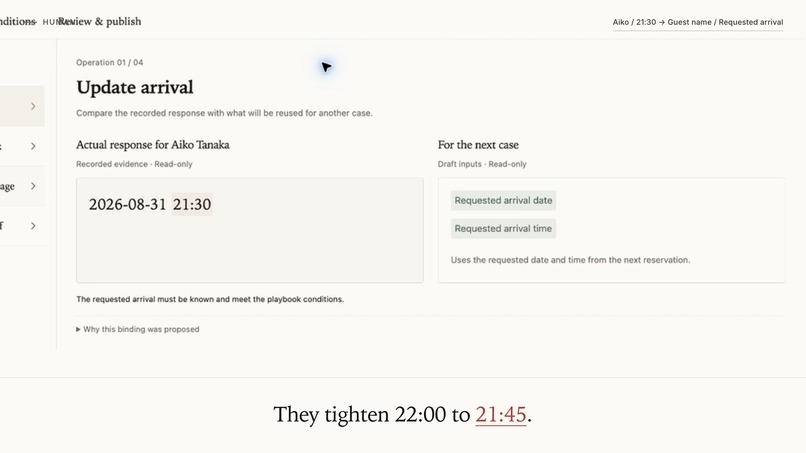
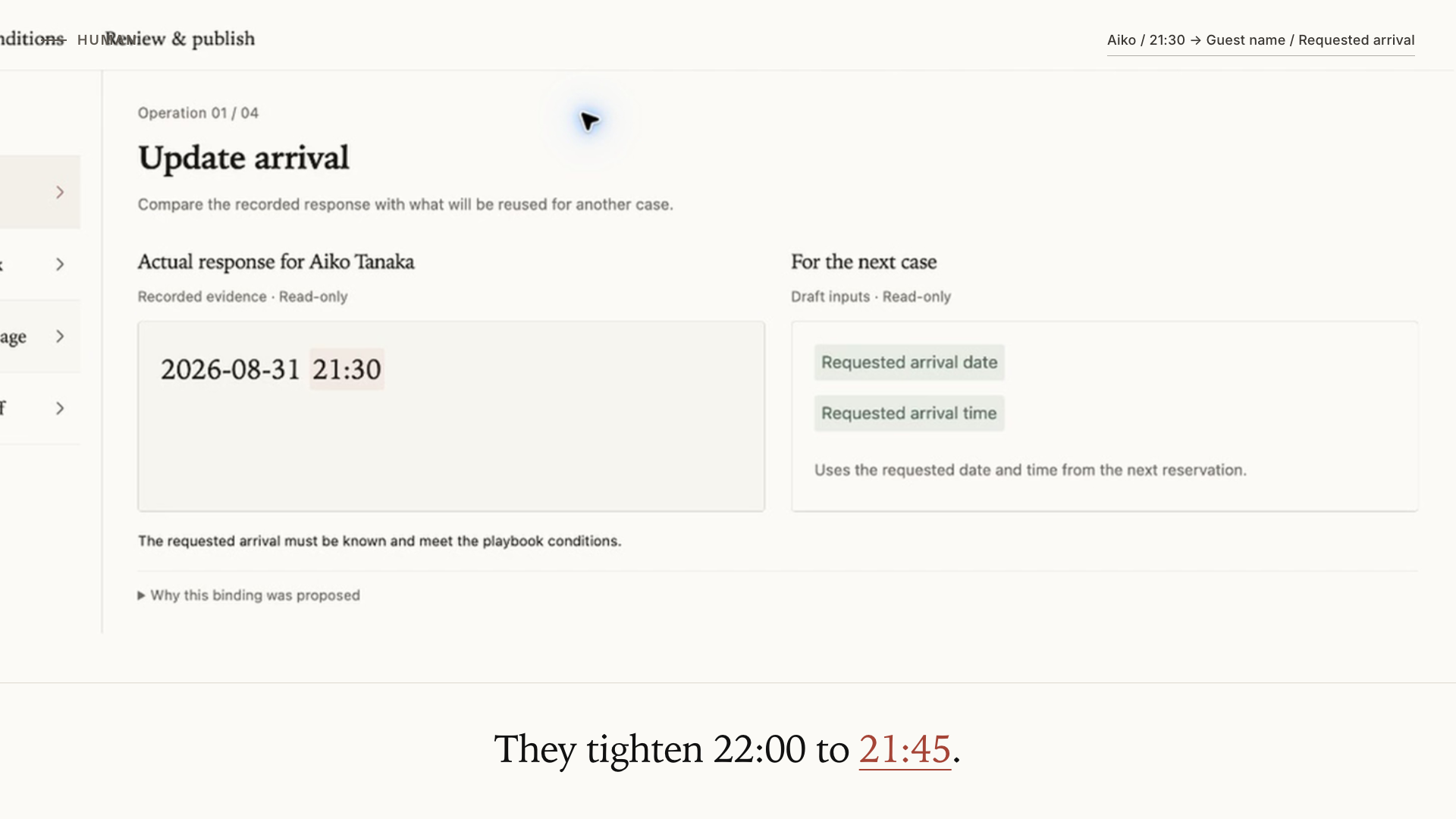
A person sets the reusable boundary by comparing source and proposal, then tightening the permitted arrival time.
-
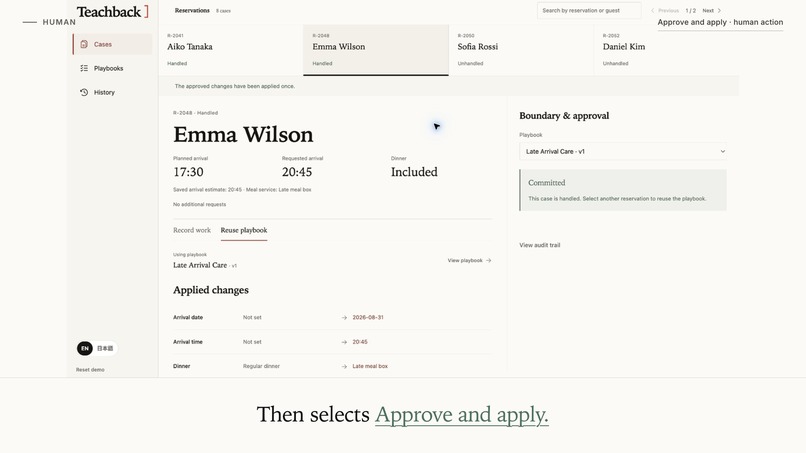
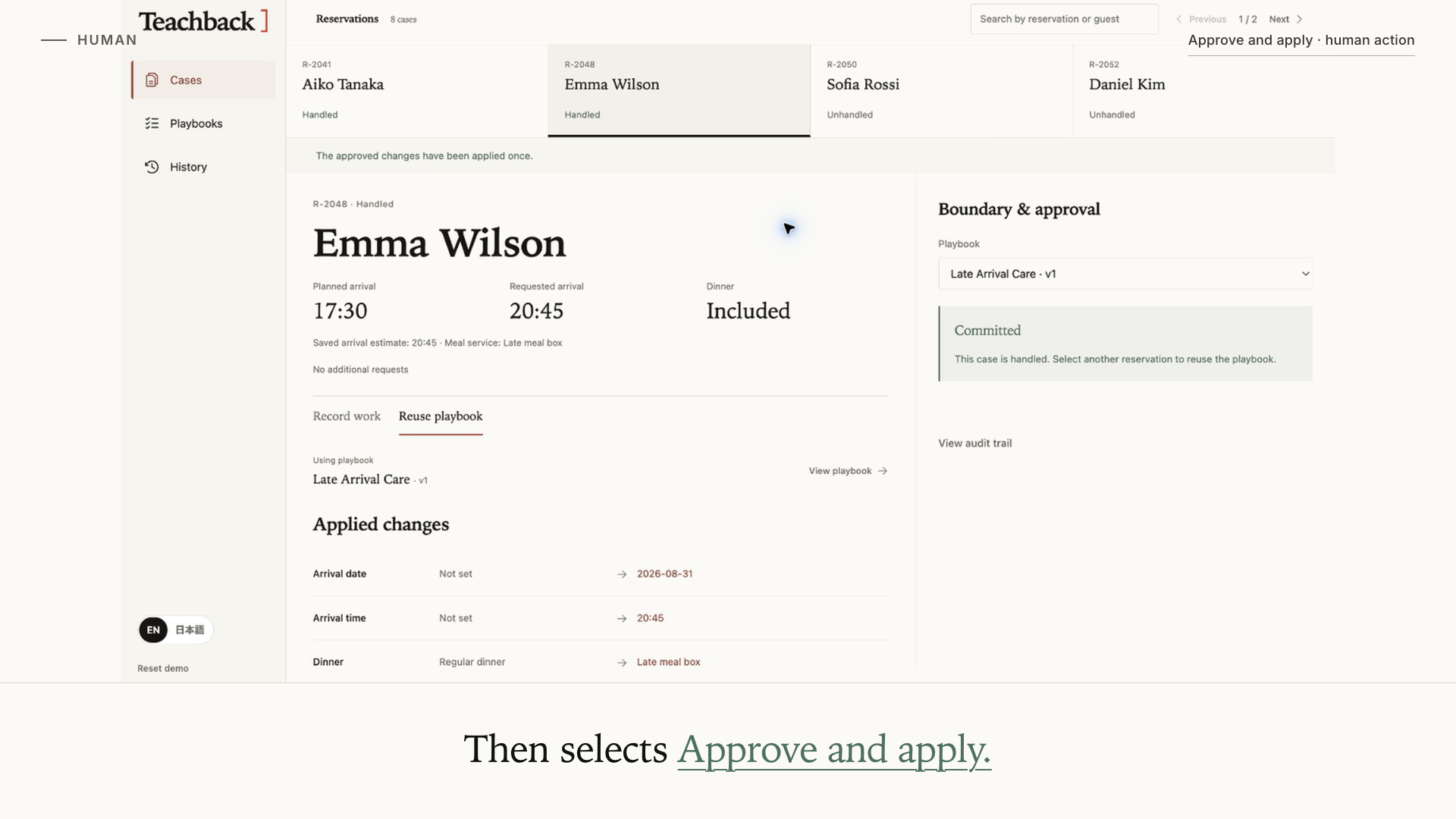
Human approval gates the commit. Only the exact approved run can be applied, with expiry, digest, version, and replay checks.
-
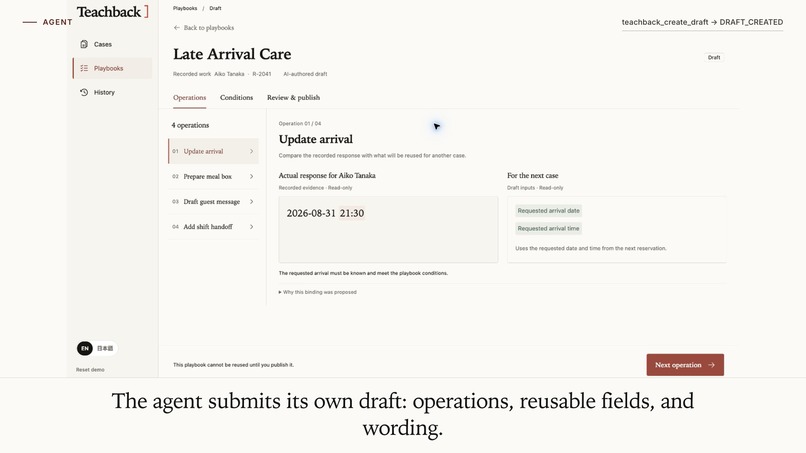
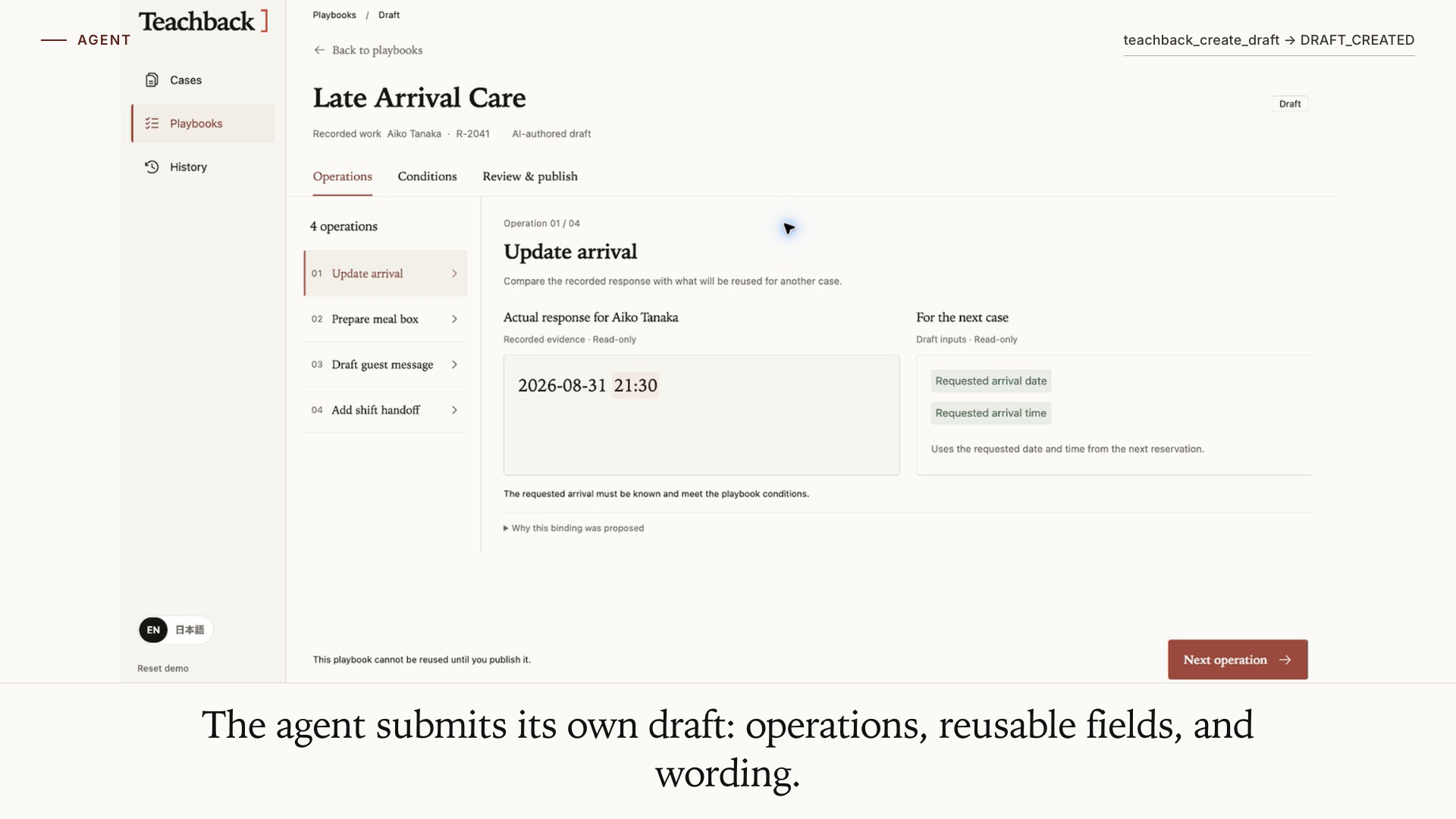
The agent drafts; the website keeps control. A WebMCP-capable agent turns the record into reusable operations and wording.
-
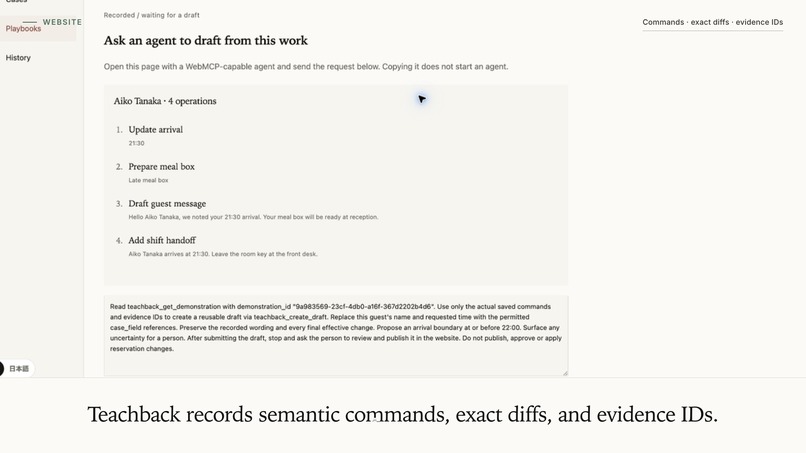
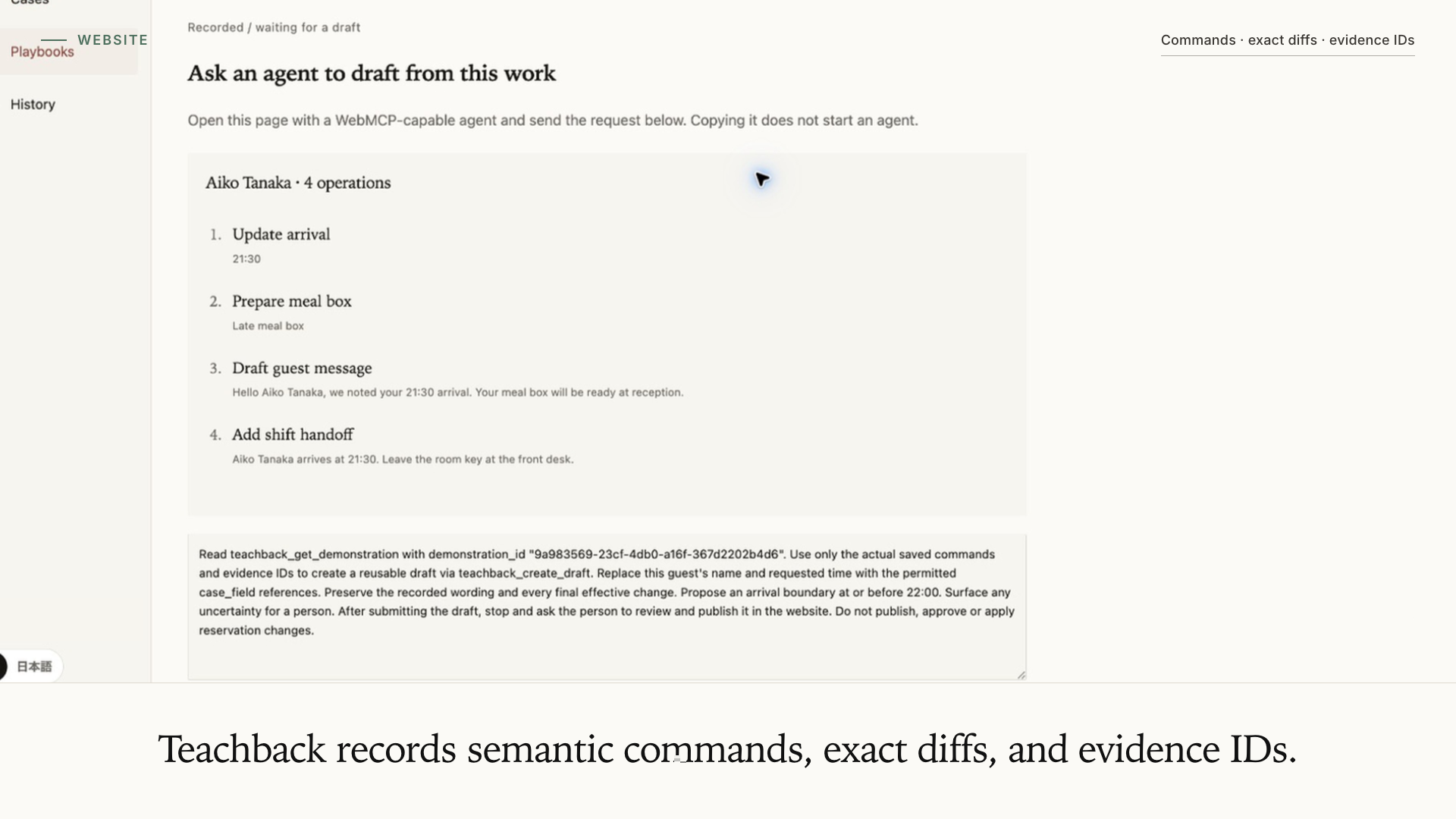
Recorded work becomes structured evidence. Teachback preserves saved operations, exact diffs, and evidence IDs—not clicks.
-
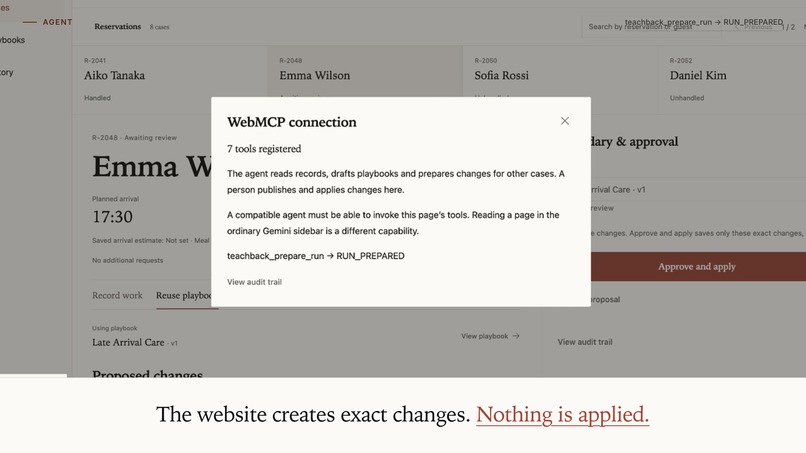
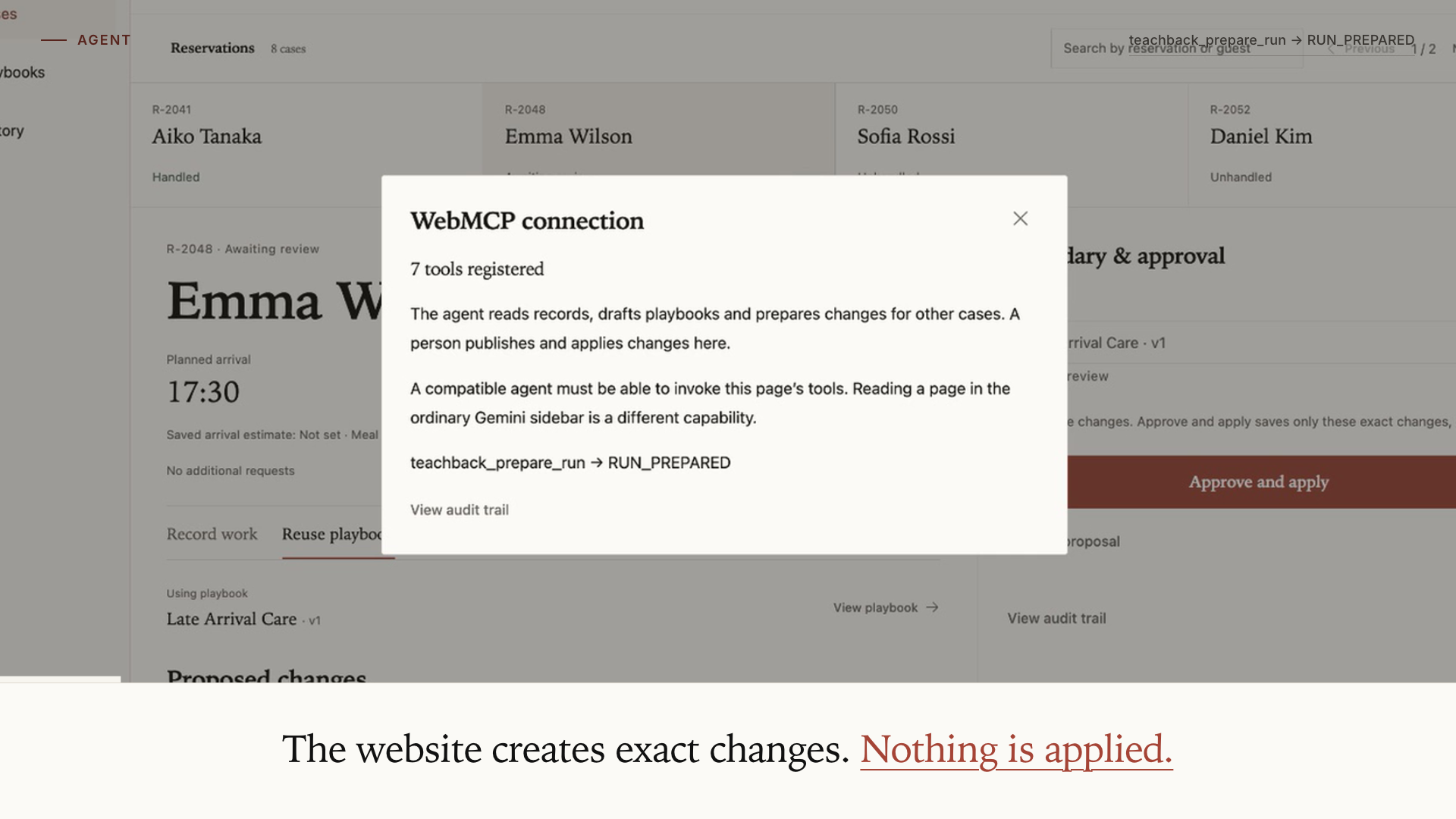
Preparation is not execution. WebMCP returns exact proposed changes while the reservation remains unchanged.
-
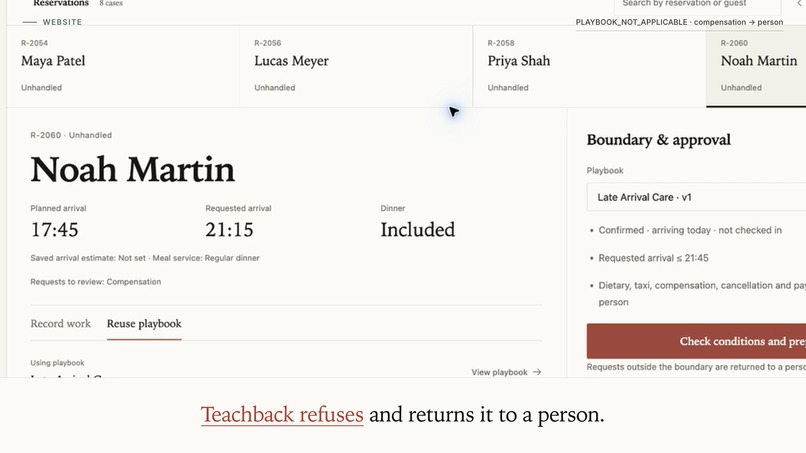
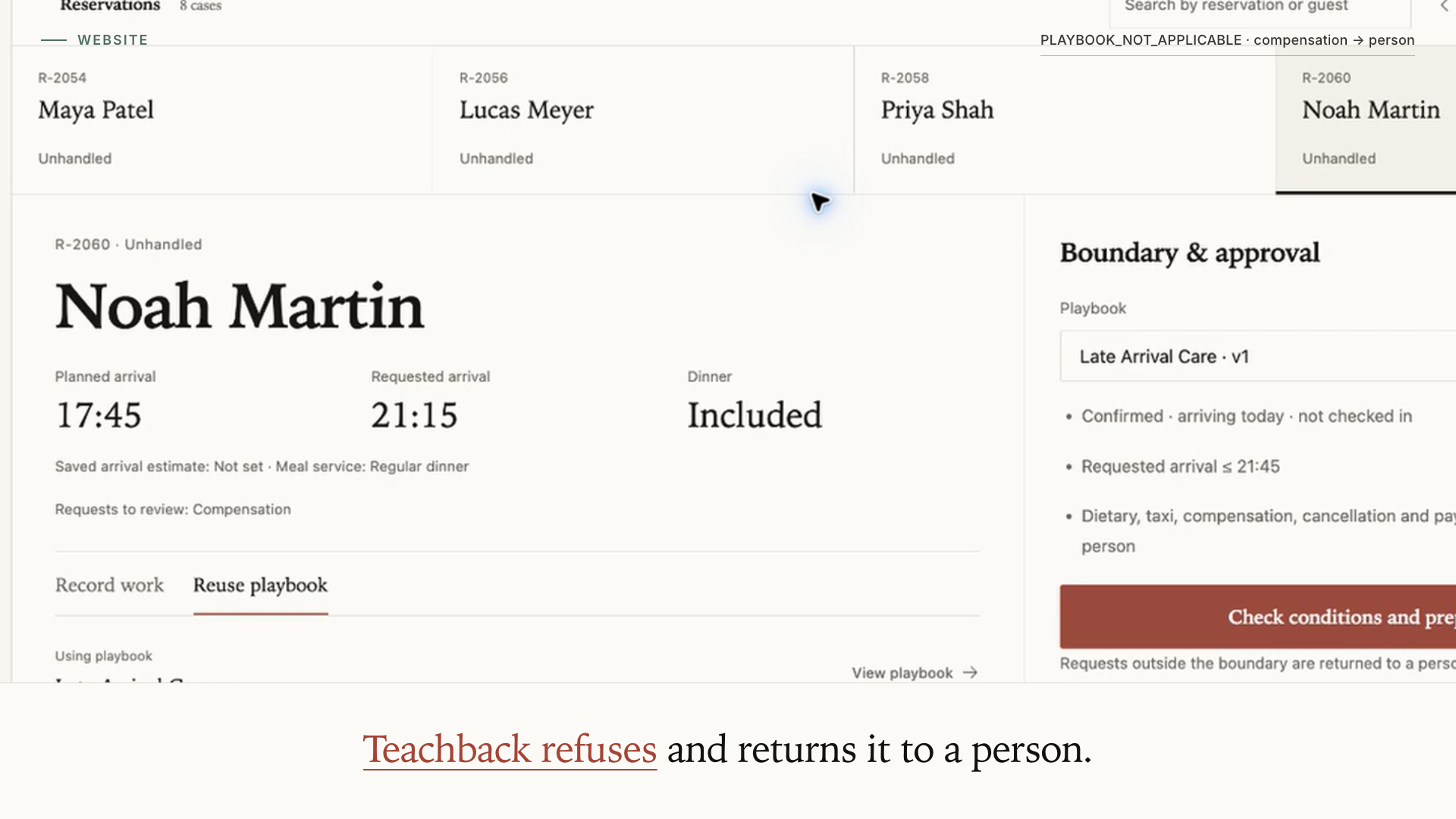
The website refuses work outside the published boundary and returns the compensation case to a person.
Teachback is a WebMCP app that converts one handled case into a reusable, approval-first workflow, so agents can suggest actions while humans keep control of execution.
What Teachback does
Teachback explores a practical question: how can a team reuse an experienced person's response without treating one successful case as unlimited permission?
The demo uses synthetic hotel reservations. A staff member handles Aiko's late arrival in the normal website and saves four operations: the arrival update, a meal box, a guest message, and a shift handoff. Teachback records semantic commands, exact before-and-after values, and evidence IDs—not click coordinates.
A WebMCP-capable agent reads that record and authors its own playbook draft. It must identify supported operations, replace Aiko's name and time with permitted case fields, preserve the recorded wording, and propose an arrival boundary. The website checks the proposal against the actual evidence. A person then compares source and reusable wording, tightens the cutoff, and publishes the reviewed version. Publication is deliberately not a WebMCP tool.
For Emma, the agent reads the published version and current case data, then asks Teachback to prepare a run. The website evaluates deterministic safeguards and produces the exact diff. Nothing changes until a person reviews that proposal and selects Approve and apply in the website. The agent can read the committed result afterward, but it has no approval or application tool. When the same playbook is tried on Noah's compensation request, the website returns PLAYBOOK_NOT_APPLICABLE and sends the case back to a person.
Why WebMCP is the right interface
The difficult part is not clicking hotel fields. It is turning concrete work into a proposed reusable structure, then carrying that structure into a new case without blurring who decides. A generic page reader sees labels and pixels; WebMCP exposes the concepts that matter: demonstrations, evidence-backed drafts, published versions, cases, and prepared runs.
This creates a clean division of responsibility:
the person demonstrates work, edits boundaries, publishes, and applies; the agent interprets the recording, drafts reusable wording, and prepares a case-specific proposal; the website validates evidence, enforces fixed safeguards, calculates exact changes, and refuses work outside the published boundary.
The result is an explicit handoff between interpretation and authorization. An agent can help with the genuinely ambiguous part—drafting from evidence—without receiving a generic mutation API or the authority to approve its own output.
How WebMCP is implemented
The TypeScript/React application registers seven typed tools with document.modelContext.registerTool():
teachback_get_demonstration teachback_create_draft teachback_update_draft teachback_list_playbooks teachback_list_cases teachback_prepare_run teachback_get_run
Tool input is schema-checked and size-limited. Draft steps must cite recorded evidence, reproduce the final saved operations, and parameterize source-specific names, dates, IDs, and times. Published playbooks are immutable versions. Preparing a run binds it to the case version and published-content digest. Human approval is bound to the exact run digest, expires after five minutes, and can be used once. Request IDs make mutating WebMCP calls idempotent, while compact receipts and session limits prevent unbounded browser storage growth. The audit trail separates Human, Agent, and Website decisions.
Prototype scope
Teachback is a client-side prototype with eight synthetic reservations and four supported operation types. It demonstrates recording, proposal validation, human publication, exact-diff approval, deterministic refusal, and audit semantics. It is not connected to a real hotel system and does not claim production authentication, authorization, multi-user storage, arbitrary browser automation, or autonomous batch execution.
Built With
- bun
- chatgpt-sites
- cloudflare-workers
- heygen
- hyperframes
- playwright
- react
- typescript
- vinext
- vite
- vitest
- webmcp


Log in or sign up for Devpost to join the conversation.