Inspiration We've all sat in lecture, highlighter in hand, convinced we understood the material — only to freeze when a real clinical question came up. That gap between passive knowledge and active reasoning is exactly what Teach the Bear was built to close. We kept asking ourselves: what if instead of answering questions about medicine, you had to teach it to someone else? That's where the bear came in.
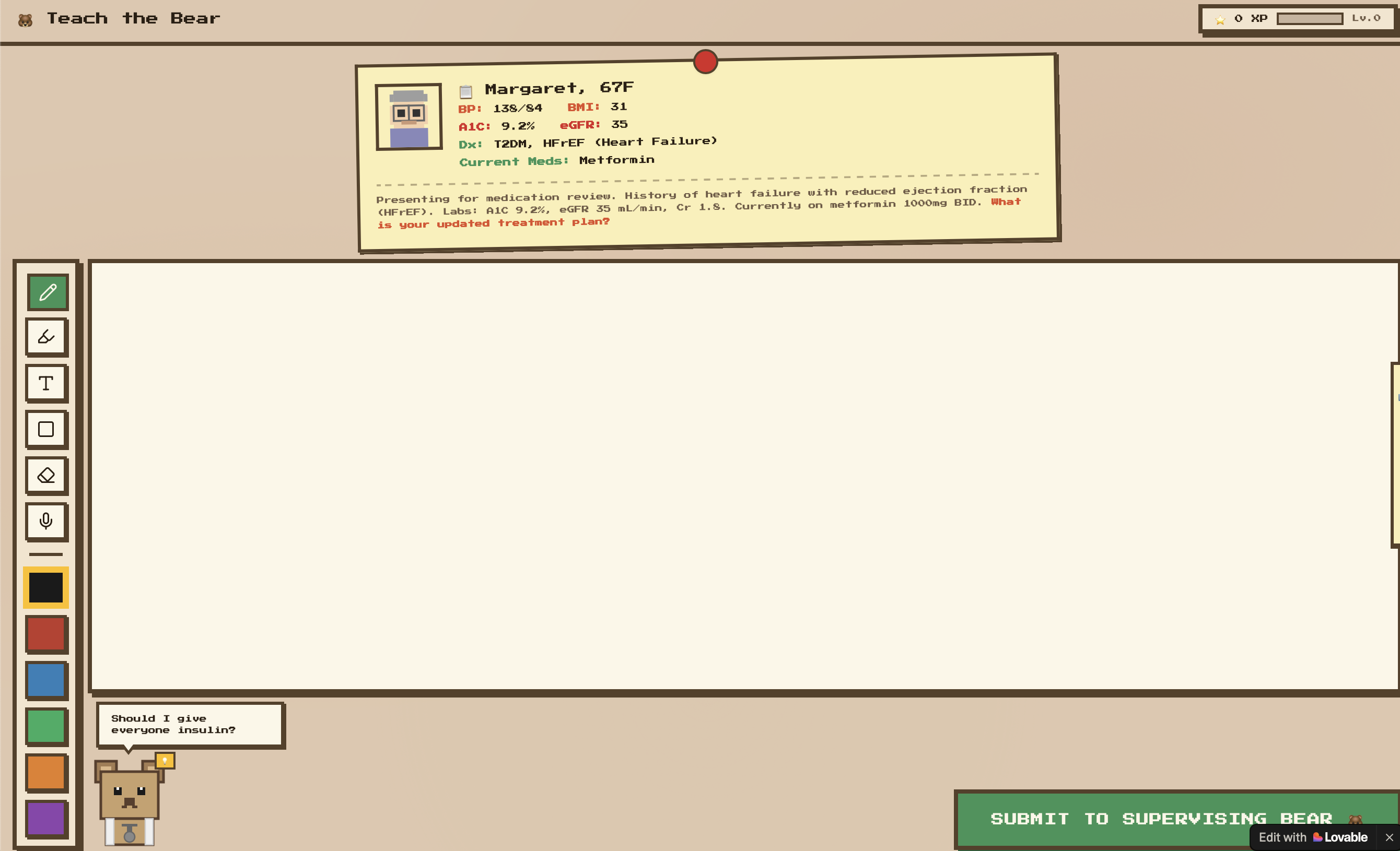
What it does Teach the Bear puts you in the role of a medical student whose job is to teach Dr. Teddy — a clueless, wide-eyed little bear who knows absolutely nothing about treating Type 2 Diabetes. You write a cheat sheet, draw diagrams, and explain your reasoning directly on his whiteboard clipboard so he can follow it when he sees a real patient. You can peek at synthesized clinical guideline notes if you're stuck, but the bear is watching and your score reflects every time you do. Once you submit, the Supervising Bear — his strict, glasses-wearing, arms-crossed attending — storms in and grades your teaching plan against the actual T2DM clinical guidelines, telling you exactly what you got right, what you missed, and why it matters clinically.
How we built it Teach the Bear is a single-page React web app with a pixel-art aesthetic. The whiteboard is built on an HTML5 Canvas where students can draw freehand, place draggable typed text boxes, highlight key points, and even speak their reasoning aloud using the Web Speech API. A slide-out notes panel on the right holds synthesized content from the T2DM clinical dataset, searchable by topic. On submission, the whiteboard — canvas image plus all text — is sent to the Anthropic Claude API, which evaluates the student's plan against the clinical criteria for that case and returns structured pass/fail feedback, a star rating, and specific commentary. The full stack is React, HTML5 Canvas, Tailwind CSS, the Claude API, Web Speech API, and Vercel for deployment.
Challenges we ran into The hardest challenge was making the AI feedback genuinely useful rather than generic. Early versions of the Supervising Bear were either too vague or too harsh without explanation — getting the prompting right so feedback was clinically accurate, specific to what the student actually wrote, and educationally actionable took many iterations. We also had to figure out how to read a freehand whiteboard: combining the canvas as a base64 image with typed text overlays gave the Claude API enough context to evaluate real reasoning rather than just keyword matching. Balancing a fun gamified aesthetic with a serious clinical tool was also a real design tension we had to navigate carefully.
Accomplishments that we're proud of We're proud that we built something that genuinely makes you think rather than just recall. The moment the Supervising Bear walks in and tells you that your plan would have given metformin to a patient with an eGFR of 35 — that lands differently than getting a multiple choice question wrong. We're also proud of the framing itself: flipping the student into the role of teacher is a deceptively simple idea that turns out to be a much more powerful learning experience than we expected, even just testing it on ourselves during the hackathon.
What we learned Building this taught us just as much as using it. On the clinical side, we went deep into the ADA/EASD 2022 consensus, Diabetes Canada 2024 guidelines, and the CCS cardiorenal risk framework — and genuinely understood for the first time why you reach for an SGLT2 inhibitor in heart failure, or why eGFR thresholds matter when choosing between agents. On the pedagogy side, we learned that the Protégé Effect is real: the act of preparing to teach something forces a depth of processing that passive review simply cannot replicate.
What's next for Teach the Bear The bear has a lot more to learn. Next, we want to expand the case library beyond T2DM to cover hypertension, CKD, and heart failure management — building a full internal medicine teaching companion. We'd love to implement true spaced repetition so the bear resurfaces your weakest cases automatically. A multiplayer mode where two students debate a treatment plan and the Supervising Bear decides who's right is high on the list. And longer term, we want to run a proper randomized controlled trial comparing retention in students who used Teach the Bear versus traditional question banks — because we believe the data will back up what we felt building it.
Built With
- claude
- loveabe

Log in or sign up for Devpost to join the conversation.