Inspiration
Retail checkout systems are the last mile of customer experience—when they fail, everything fails. Long lines, failed transactions, and unstable self-checkout lanes frustrate customers and cost businesses revenue.
We were inspired to build a system that helps operators see problems before they happen, not after. Instead of reacting to outages, we wanted to enable proactive decision-making with real-time data and AI explanations.
What it does
LanePulse.AI is a real-time operational intelligence platform for retail checkout systems that:
Predicts risk (0–100) for each device using live telemetry Auto-generates incident tickets when risk is elevated
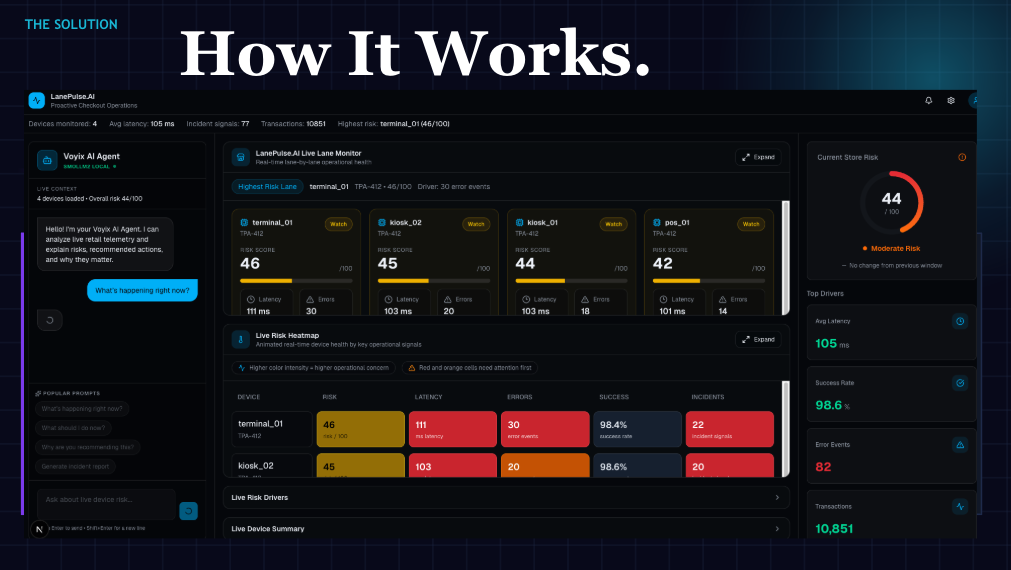
Displays a live lane-by-lane dashboard with: risk scores latency errors success rates
Provides a real-time animated heatmap showing system-wide health Includes a GenAI assistant that answers: What’s happening? What should I do now? Why?
It transforms raw telemetry into clear, actionable insights for store managers
How we built it
Frontend: Next.js + React + Tailwind CSS Visualization: Custom lane cards + animated heatmap Backend: Python FastAPI Database: Snowflake (synthetic but structured telemetry data) AI: Local LLM with real-time context injection Pipeline:
Snowflake → Python API → Next.js Dashboard → AI Assistant
We built a custom risk scoring engine based on:
latency error events success rate decline rate incident signals
This score drives:
lane prioritization incident ticket creation AI explanations
Challenges we ran into
Flat risk scores (everything = 50): Early threshold-based logic made all devices look identical. → Fixed with gradient-based scoring for better differentiation LLM not grounded in data: Initially, the assistant gave generic answers → Solved by injecting live telemetry into prompts Time-series aggregation issues: Metrics like transactions were misleading when summed across time → Fixed by using latest snapshot per device Cross-stack integration: Snowflake + Python + Next.js required careful handling of data flow and auth UX issues (scrolling, layout): Chat and visualization needed refinement to feel real-time and usable
Accomplishments that we're proud of
Built a full end-to-end system (data → prediction → action → explanation) Created a real-time lane monitoring dashboard aligned with real operations Designed a live animated heatmap for intuitive system-wide visibility Integrated a GenAI assistant that explains decisions, not just answers questions Delivered a clean, professional UI suitable for real-world use
👉 Most importantly: We turned monitoring into decision support
What we learned
Real value comes from interpreting data, not just displaying it AI is only useful when it has real context Good UX (layout, prioritization, animation) makes systems feel “alive” Aggregating time-series data correctly is critical for accuracy Explainability builds trust in AI-driven systems
What's next for LanePulse.AI
Predictive forecasting (next 1–4 hours risk, not just current state) Real-time alerts (Slack, SMS, email) Multi-store monitoring and benchmarking Smarter AI recommendations (root cause + automated playbooks) Human-in-the-loop controls before high-impact actions Historical analytics + anomaly detection
Built With
- fastapi
- nextjs
- python
- smollm2
- snowflake
- synthesized
- typescript

Log in or sign up for Devpost to join the conversation.