-
-
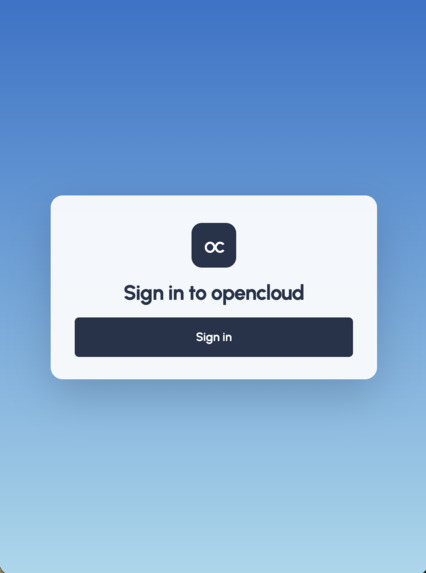
Opening the website first takes you to the sign in page, where you have the option to sign in with GitHub, Google, or create an account.
-
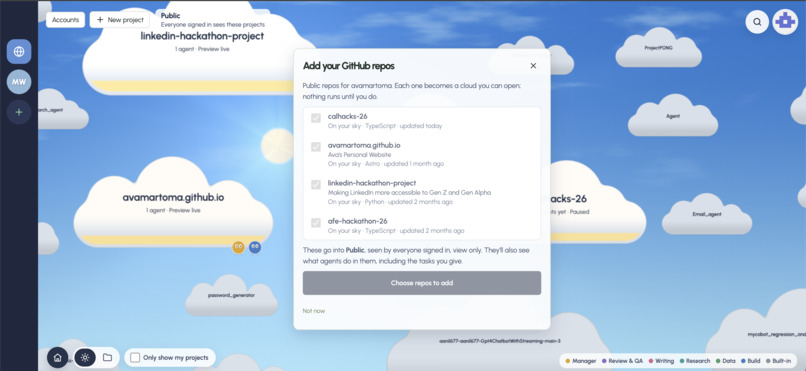
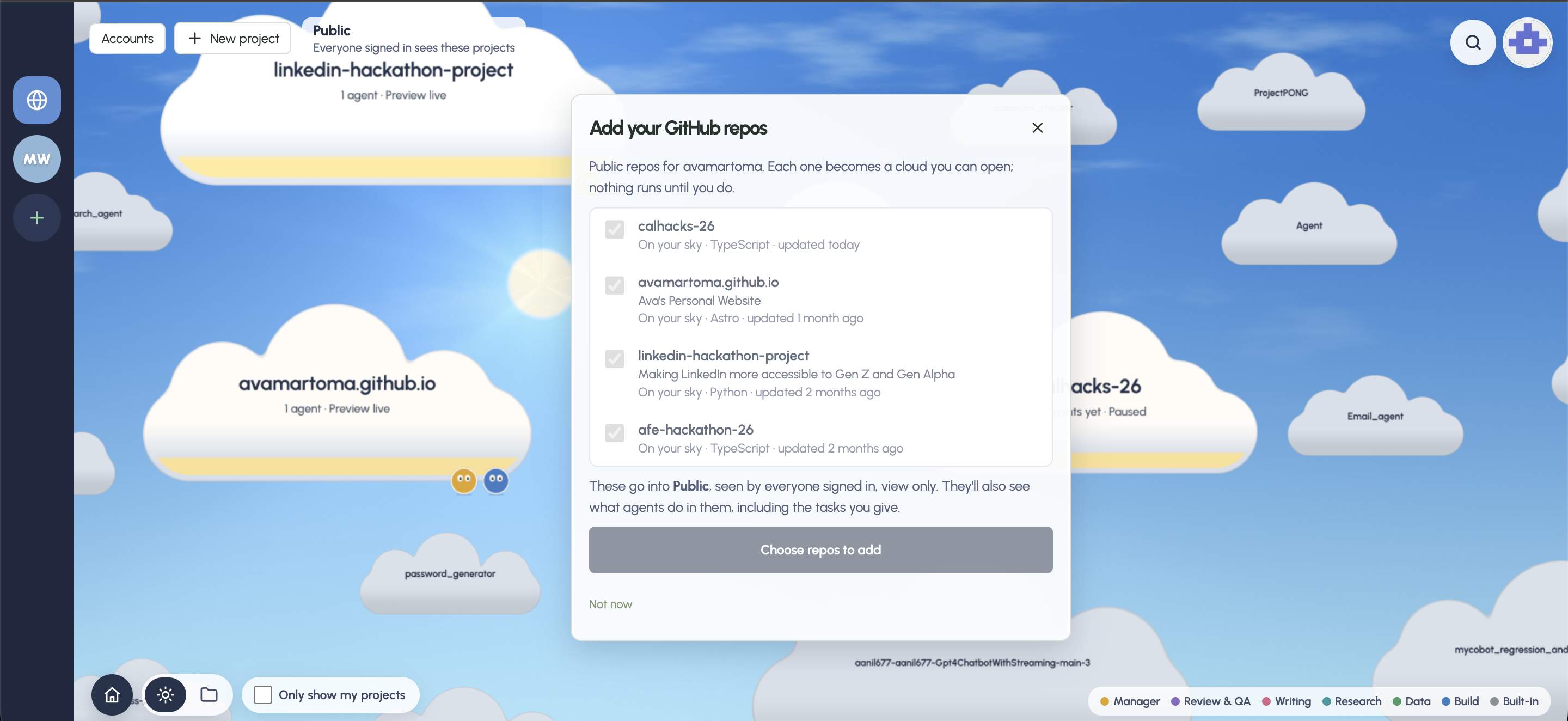
Once signed in, you are automatically prompted to add your public GitHub repos to your workspace. You can share whichever repos you want to.
-
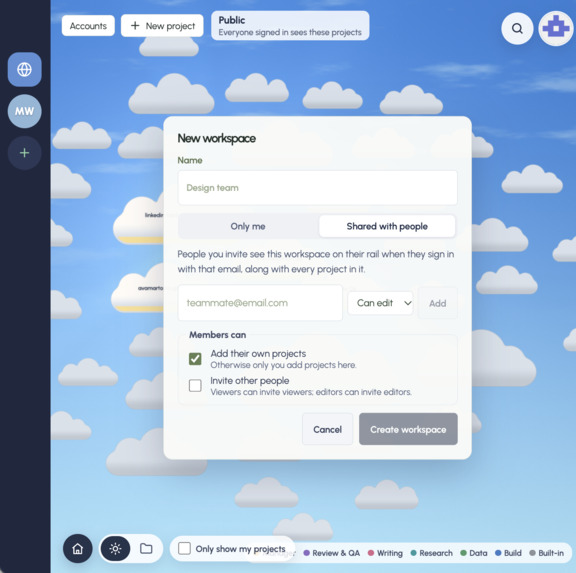
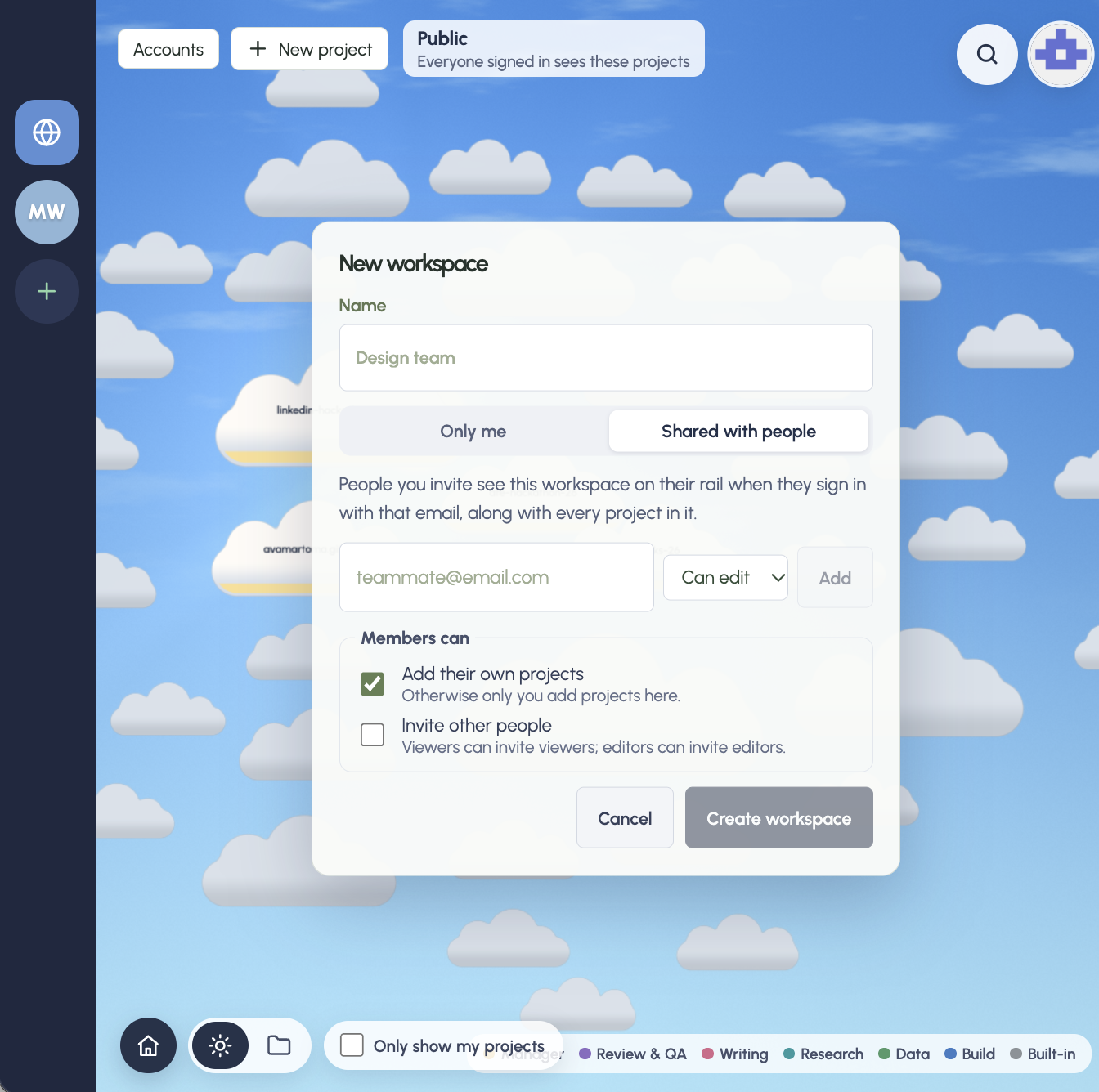
You can create new workspaces with customized permissions to work with a group of people, making this excellent for companies and teams.
-
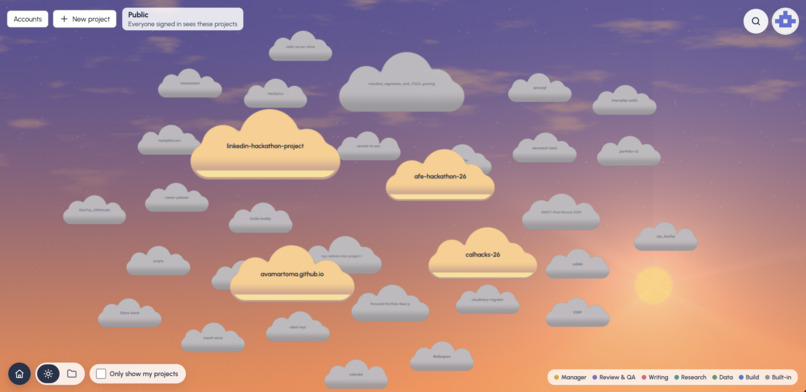
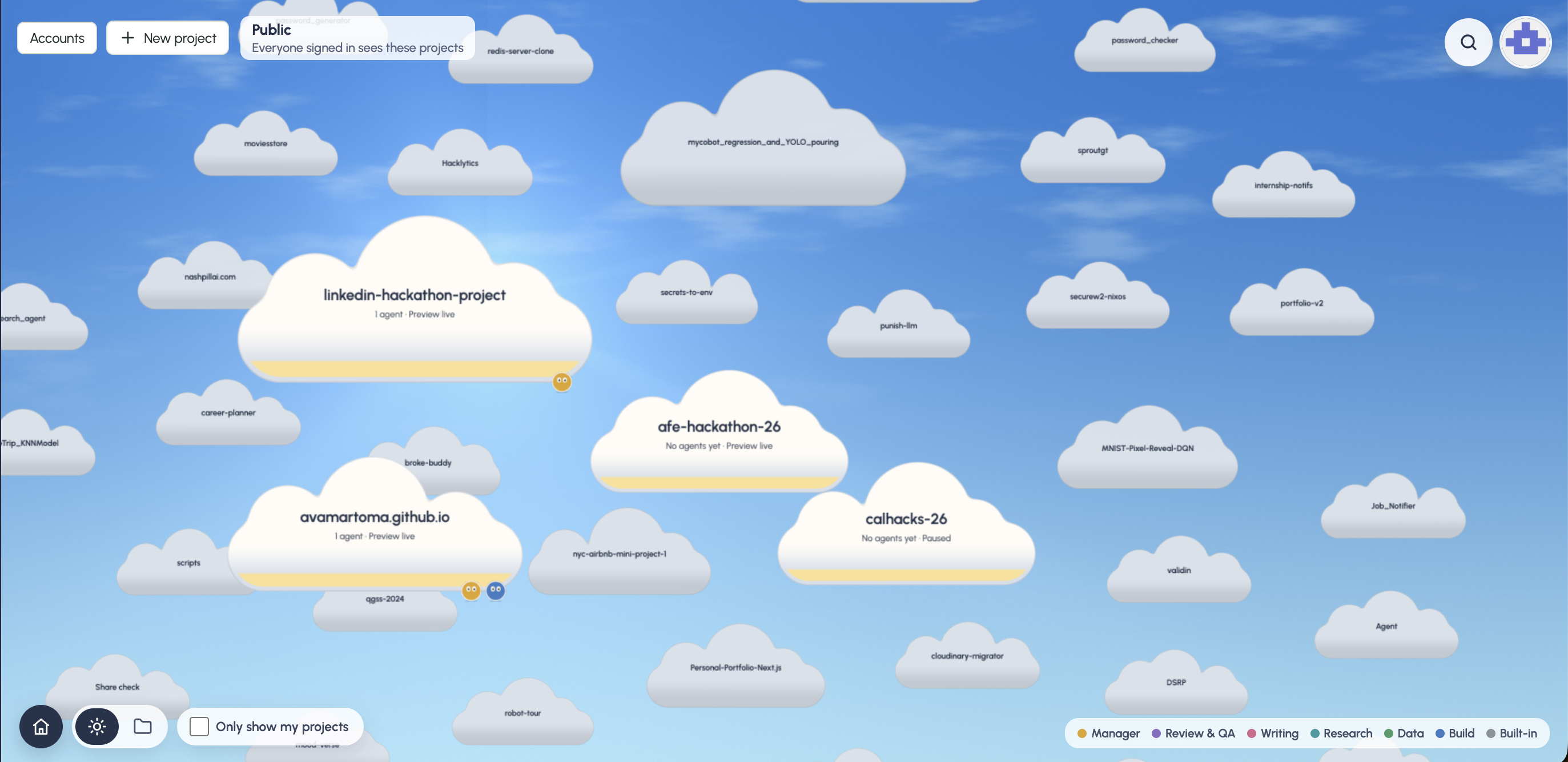
The sky view shows you all the projects in your workspace, including files you own and files that have been shared with you.
-
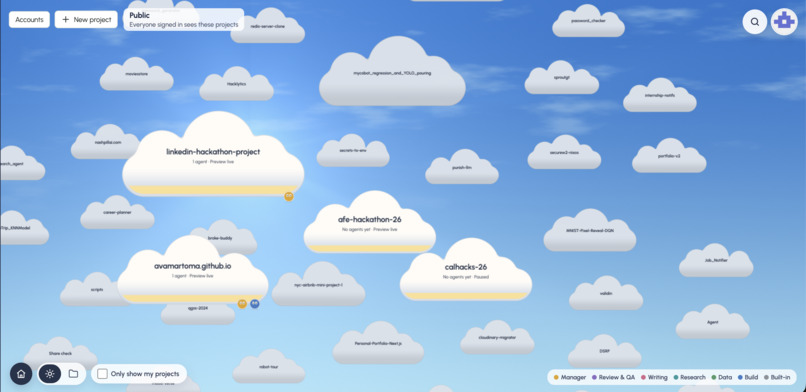
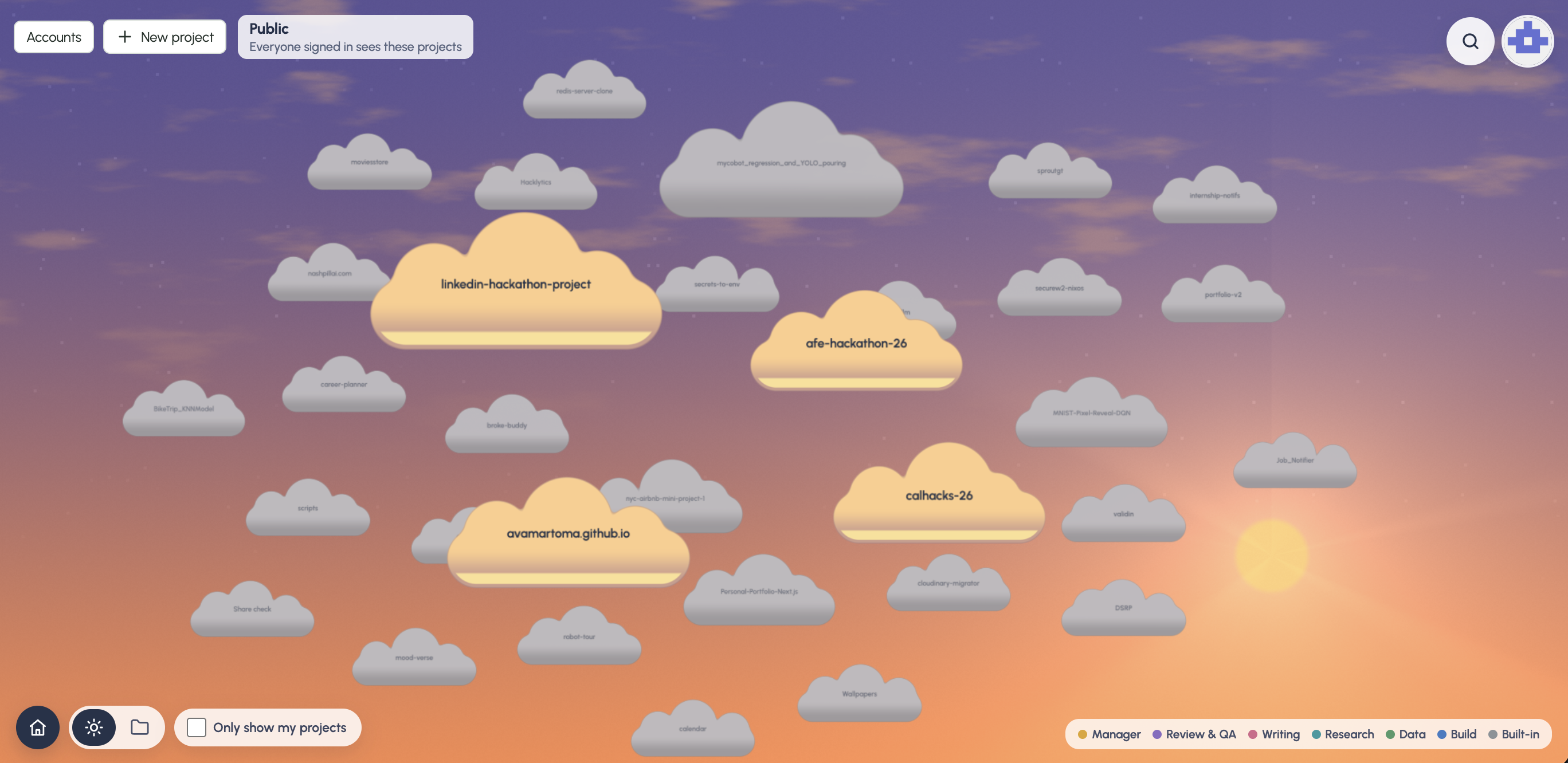
The color of the sky changes with the time of day & the projects in this workspace are all from CalHacks participants.
-
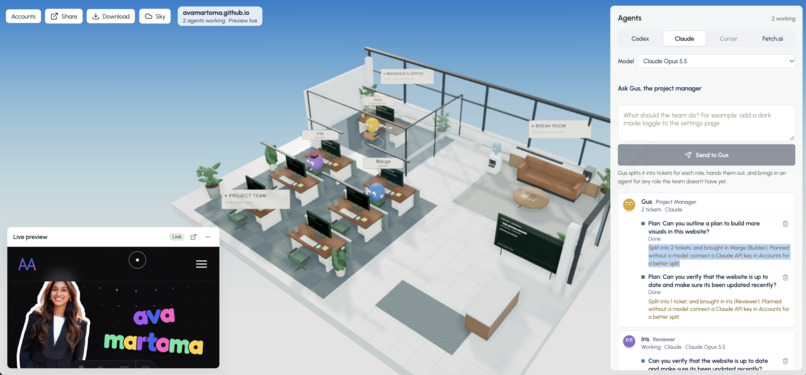
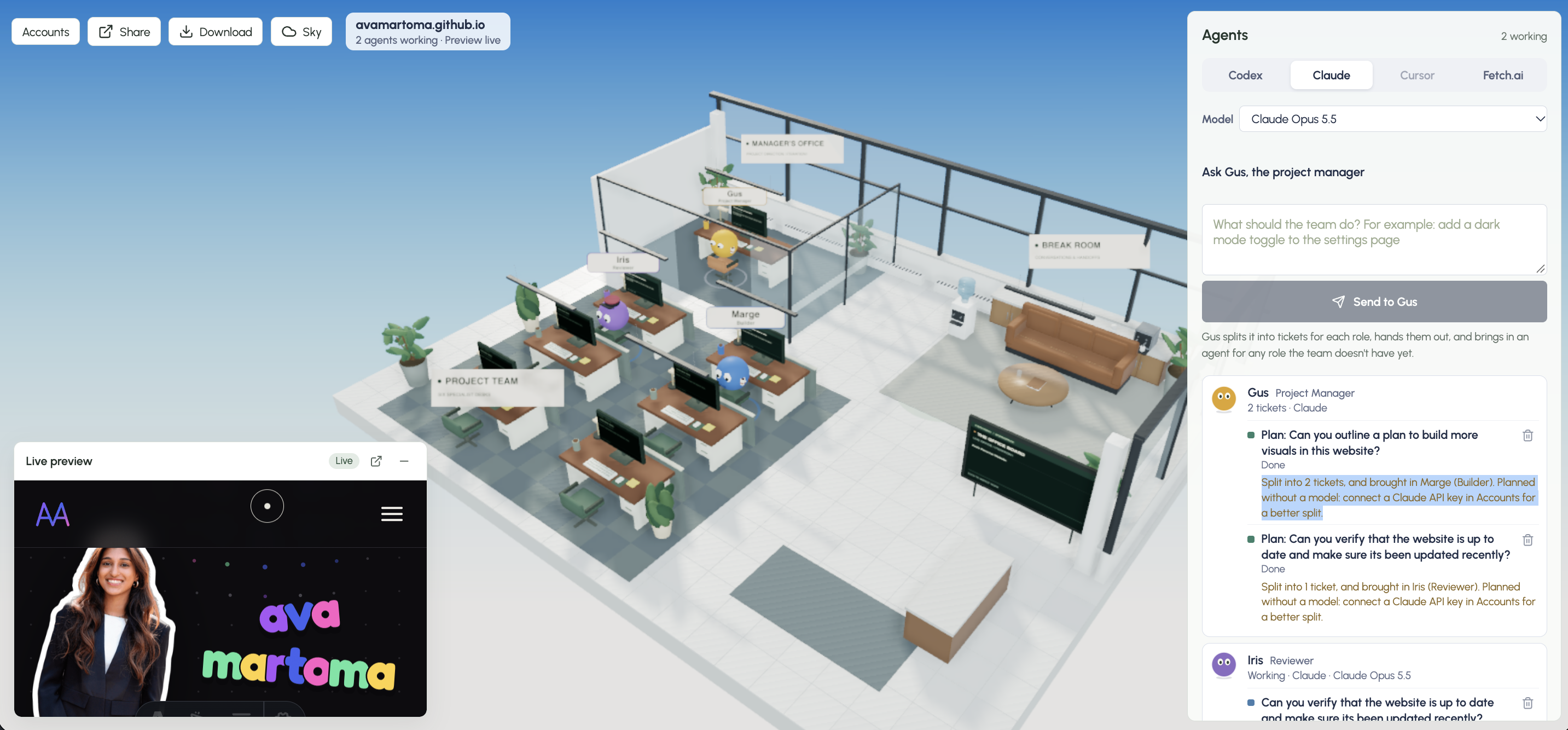
Zooming into a project takes you to the project (repo) homepage. You can connect to Codex/Claude/Cursor to create agents to complete tasks.
-
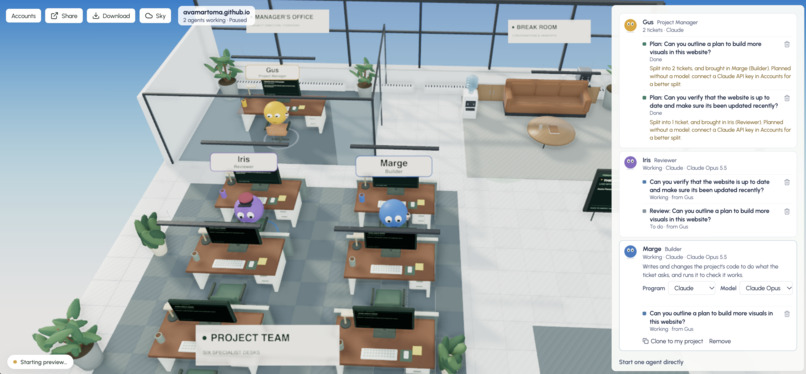
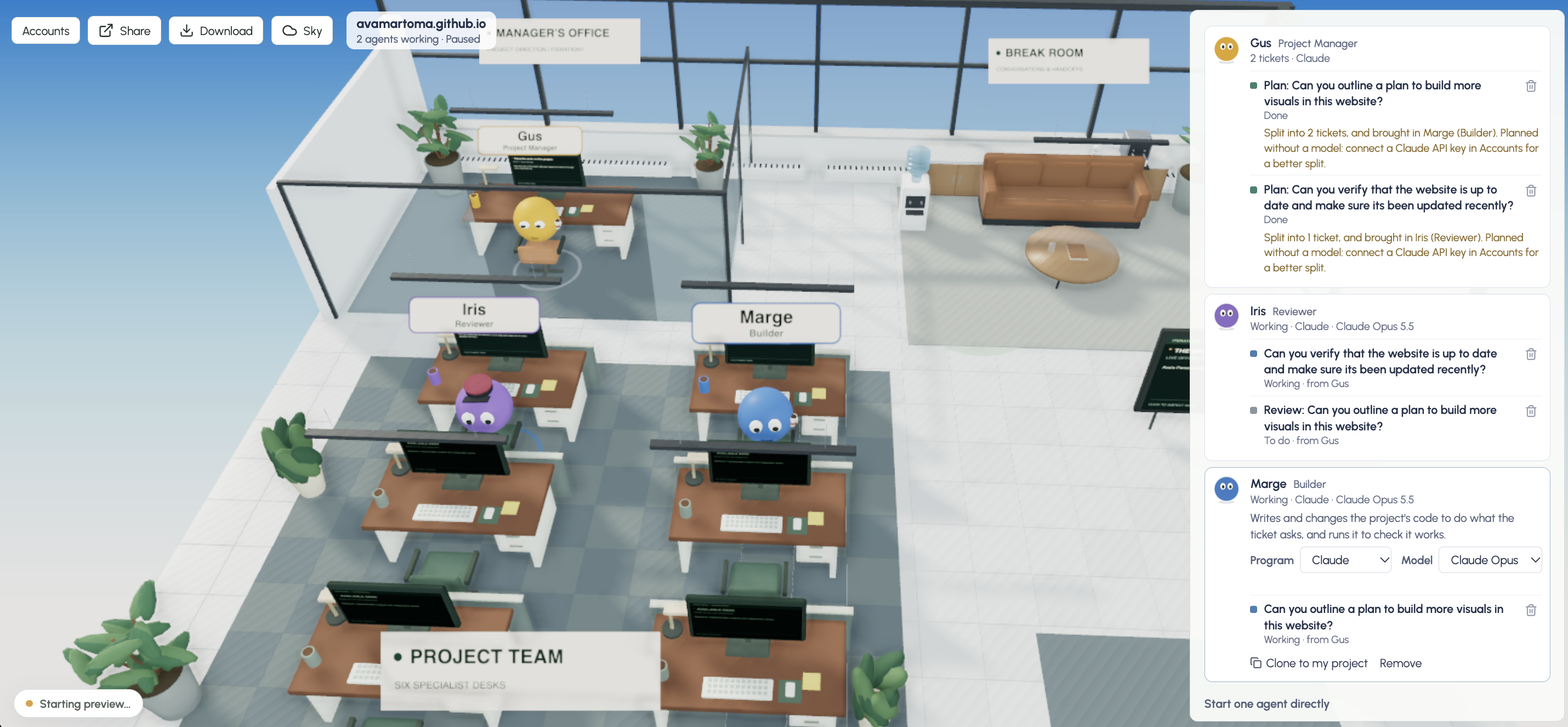
The project manager agent (Gus) delegates tasks to agents & you can watch their workflow in real time (graphics made with Blender).
-
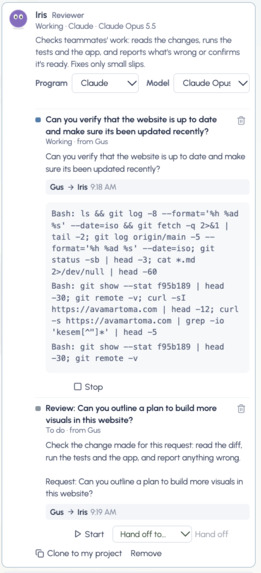
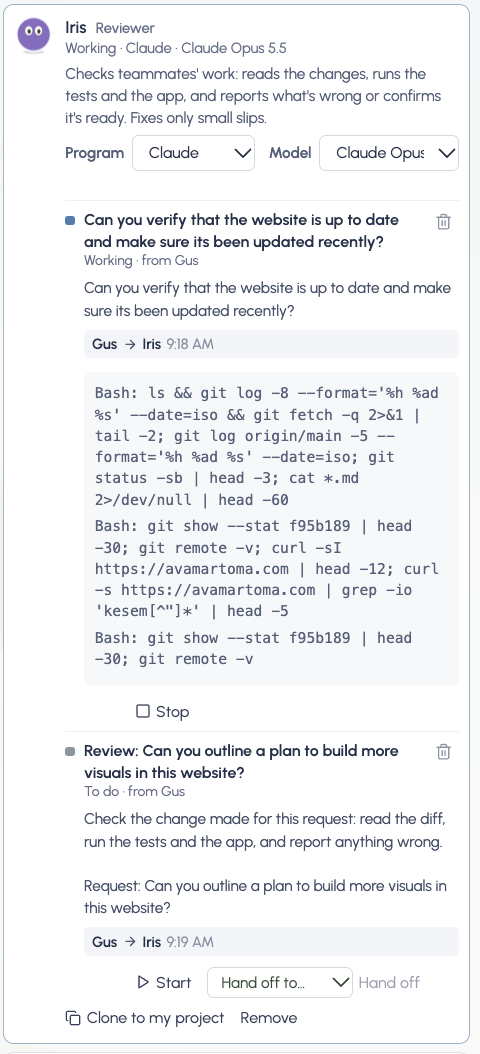
You can see detailed information about how agents complete tasks, and you can easily clone an agent to another project you are working on.
-
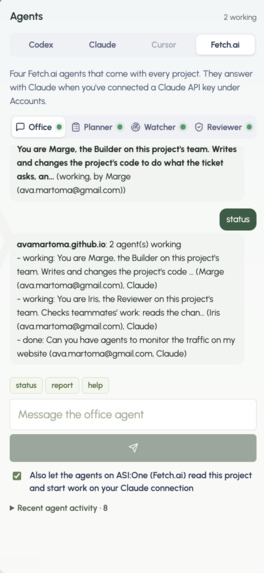
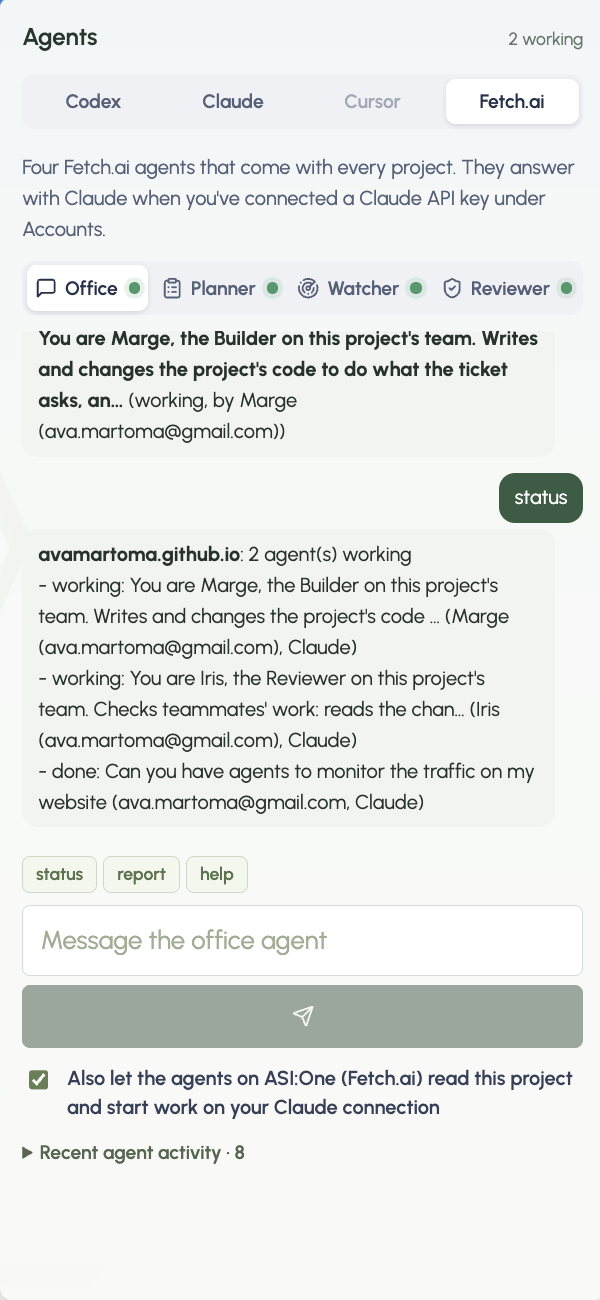
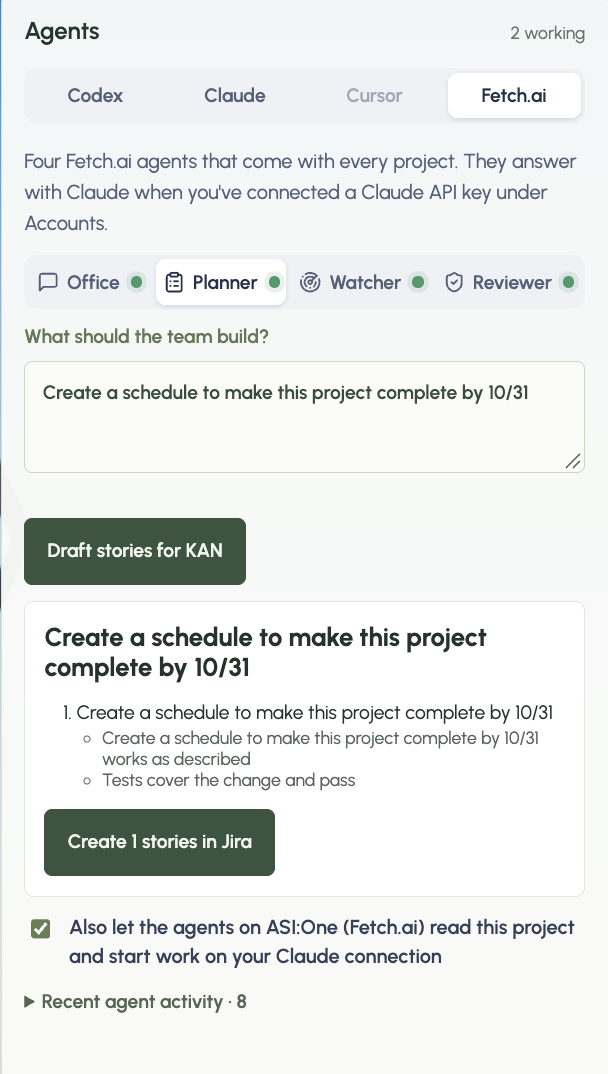
We also have specialized agent created using Fetch.ai to help improve our agent workflow by standardizing common organizational tasks.
-
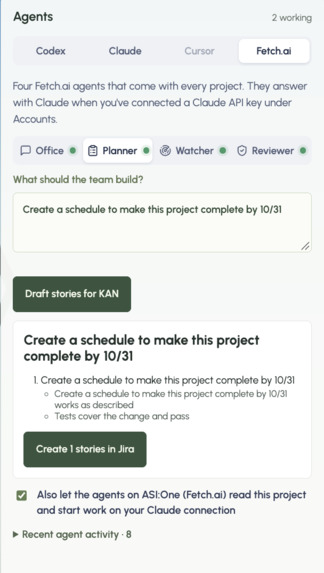
The planner agent integrates with Atlassian to create Jira tickets that can be used to track the progress of a certain project.
-
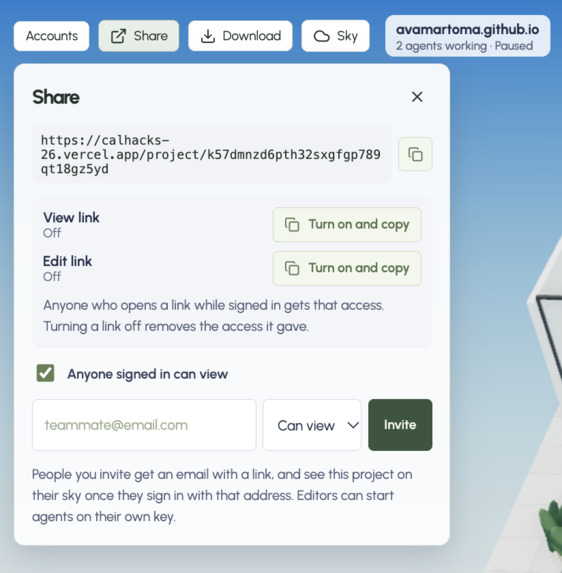
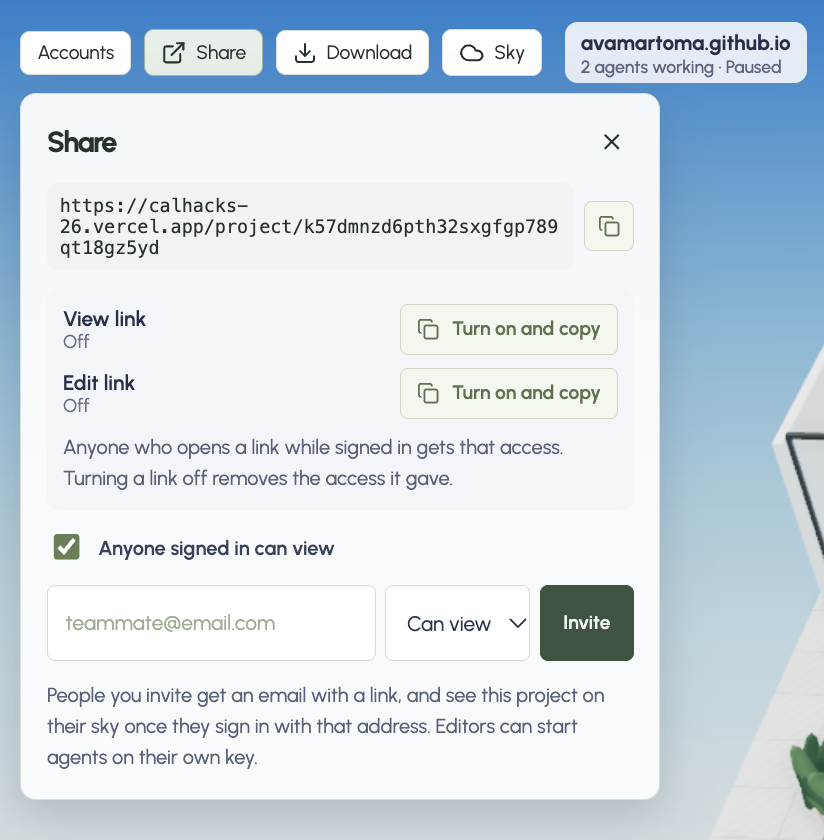
Lastly, we can share any specific project with other users so they can develop on the same GitHub repo without merge conflicts!
Try OpenCloud: www.open-cloud.us
Inspiration
Today's coding agents live in isolated terminals, each locked to one person's local setup. We wanted sharing an agent project to be as easy as sharing a Google Doc: a teammate should be able to jump into your live preview or reuse one of your agents without pulling your repo and fighting npm install. In OpenCloud, projects float like clouds in a shared sky. Zooming into one opens a live office of agents with verifiable receipts, and sharing a running cloud sandbox or cloning a teammate's agent into your own project takes a single click.
What it does
OpenCloud is a cloud-backed collaboration platform for agentic software development. Projects appear as clouds in a sky; zooming into one opens a 3D office where a Manager agent coordinates read-only Research and Review specialists, tracks tickets, and only marks work complete when there's evidence it passes. Agents can run on Claude, OpenAI Codex, or Cursor, alongside four Fetch.ai uAgents on ASI:One (office, planner, watcher, and reviewer) that sync with Jira and audit task receipts against acceptance criteria.
Local projects sync automatically into isolated E2B cloud sandboxes. Owners share a link (open-cloud.us/p/<slug>) and invite collaborators by email as viewers or editors. Anyone with access sees the live running app, the activity stream, and the agents at work, and editors can connect their own Claude Code, Codex, or Cursor agent to edit the project directly.
How we built it
- Frontend and spatial canvas: React 19, TypeScript, Vite, and Three.js (custom GLB office models and parallax cloud shaders) for the local app, plus a Next.js 15 share app deployed on Vercel.
- Real-time coordination and cloud sandboxes: Convex holds all shared state. E2B microVMs run each project's workspace and dev-server preview, pausing and resuming with snapshots.
- Identity and security: Auth0 issues OIDC ID tokens that Convex verifies directly.
- Agent protocols: Model Context Protocol (MCP) servers connect local Cursor, Claude Code, and Codex CLI sessions, while Python uAgents registered on Agentverse connect the office to ASI:One and Jira.
Challenges we ran into
Keeping files in sync in both directions between a developer's local checkout, the E2B sandbox, and remote agents connected over MCP took careful design: file leases, echo suppression, and conflict copies. Making a paused sandbox feel instant was another: we store a screenshot of the app's last state and show it during the second the sandbox takes to resume, so visitors never see a loading spinner.
Accomplishments that we're proud of
We're proudest of the cloud/local editing loop. In two clicks, someone can open a teammate's project and start editing it with their own agent, without either person leaving the tools they already use.
Our favorite feature is borrowing agents. If an agent on someone else's project is doing exactly what you need, you can clone it, with its model, instructions, and context, into your own project and put it to work there. Vibecoding should be a collective human effort.
What's next for OpenCloud
Try it at open-cloud.us. We want to bridge creativity and technical skill by making messy, half-built projects easy to share with anyone, including nontechnical people who just want to see and react to the running thing.
Tracks
Meta: Bringing People Closer Together with AI. OpenCloud turns solo AI prompting into multiplayer engineering. Teammates see each other's projects as clouds in a shared sky, walk into each other's agent offices, and clone each other's agents, all tied to real identities.
Microsoft: Built for the Real World. We target three blockers teams hit when adopting coding agents: agents overwriting each other's files, unverified "it works" claims, and lost context when an agent times out or switches models. Transactional file leases, a single write-owner per project, and an evidence gate that requires passing tests on the current source hash address all three, end to end today.
Atlassian: Best Agent / Best Security Solution for Agents. Our planner agent turns a product idea into Jira epics and stories with acceptance criteria, dispatches them to the office, and only moves an issue to Done once the reviewer verifies passing test receipts. On security, only the Manager can write, specialists run read-only in sandboxes, remote agents use hashed, revocable, project-scoped tokens, and every run is tied to a verified Auth0 identity, so no agent can approve its own commands or verify its own work.
Fetch.ai. Four uAgents registered on Agentverse (office, planner, watcher, reviewer) talk over the Agent Chat Protocol and use ASI:One's asi1 model to report office status, turn ideas into Jira stories, stream state changes, and give a verdict on whether a task's evidence meets its acceptance criteria.
Anthropic. Built for small teams of two to five developers running parallel Claude Code and Cursor sessions on one codebase, a problem we lived this weekend. Claude models serve as Managers and Workers through the Claude Agent SDK, and we designed around Claude's failure modes: bounded handoff packets instead of one endless context, and an evidence gate instead of trusting "done."
Convex. Convex is the real-time backbone: projects, sandbox sessions, presence, activity, and fork lineage are reactive queries, file leases are ACID transactions, crons expire leases and pause idle sandboxes, and file storage holds preview snapshots and workspace backups. Auth0 tokens are verified natively in auth.config.ts.
MLH Best Use of Auth0. One Auth0 tenant covers three surfaces: PKCE sign-in in the local app, @auth0/auth0-react on the share site with viewer/editor invites, and JWT verification inside Convex, which ties every agent action to a verified person.
MLH Best Use of Gen AI. OpenCloud combines Claude, OpenAI Codex, Fetch.ai's asi1, and Cursor agents in one shared, evidence-verified studio.
MLH Best Domain Name from GoDaddy Registry. open-cloud.us: every project is a cloud in your team's sky, and opening one drops you into its live office.
Built With
- agentverse
- anthropic
- asi-one
- auth0
- convex
- cursor
- docker
- e2b
- express.js
- fetch.ai
- jira
- mcp
- next.js
- node.js
- openai
- python
- react
- three.js
- typescript
- uagents
- vercel
- vite
- webgl
- webxr


Log in or sign up for Devpost to join the conversation.