Inspiration
GPUs are expensive, but a lot of them sit idle for most of the day. At the same time, developers, indie builders, and small teams keep running into the same problem: they need short bursts of compute for AI workloads, experiments, or batch jobs, but the existing options are either too heavyweight, too expensive, or too opaque.
We built GPUbnb to make compute feel more like a marketplace than infrastructure. The idea was simple: what if spare machines could be listed like rooms, and consumers could book GPU power on demand for lightweight AI and batch jobs?
What it does
GPUbnb is a marketplace for routing lightweight AI and batch jobs onto spare provider machines.
A consumer can browse available machines, choose where to run a job, submit a workload, and track the result through a clean dashboard. On the other side, providers can register machines, heartbeat them into the network, poll for work, execute approved demo workloads, and report status back to the platform.
The result is a full loop:
- list spare machines
- choose a machine
- submit a job
- execute it through the provider runtime
- stream progress and logs
- settle cost, payout, and platform fee
- show the full event trail in the web dashboard
How we built it
We built GPUbnb as a full-stack marketplace system with three connected surfaces:
- a Next.js web app for discovery, dashboards, and job submission
- a MongoDB + Mongoose backend for machines, jobs, payouts, and event history
- a Tauri provider app and worker runtime for machine registration, heartbeats, polling, and execution
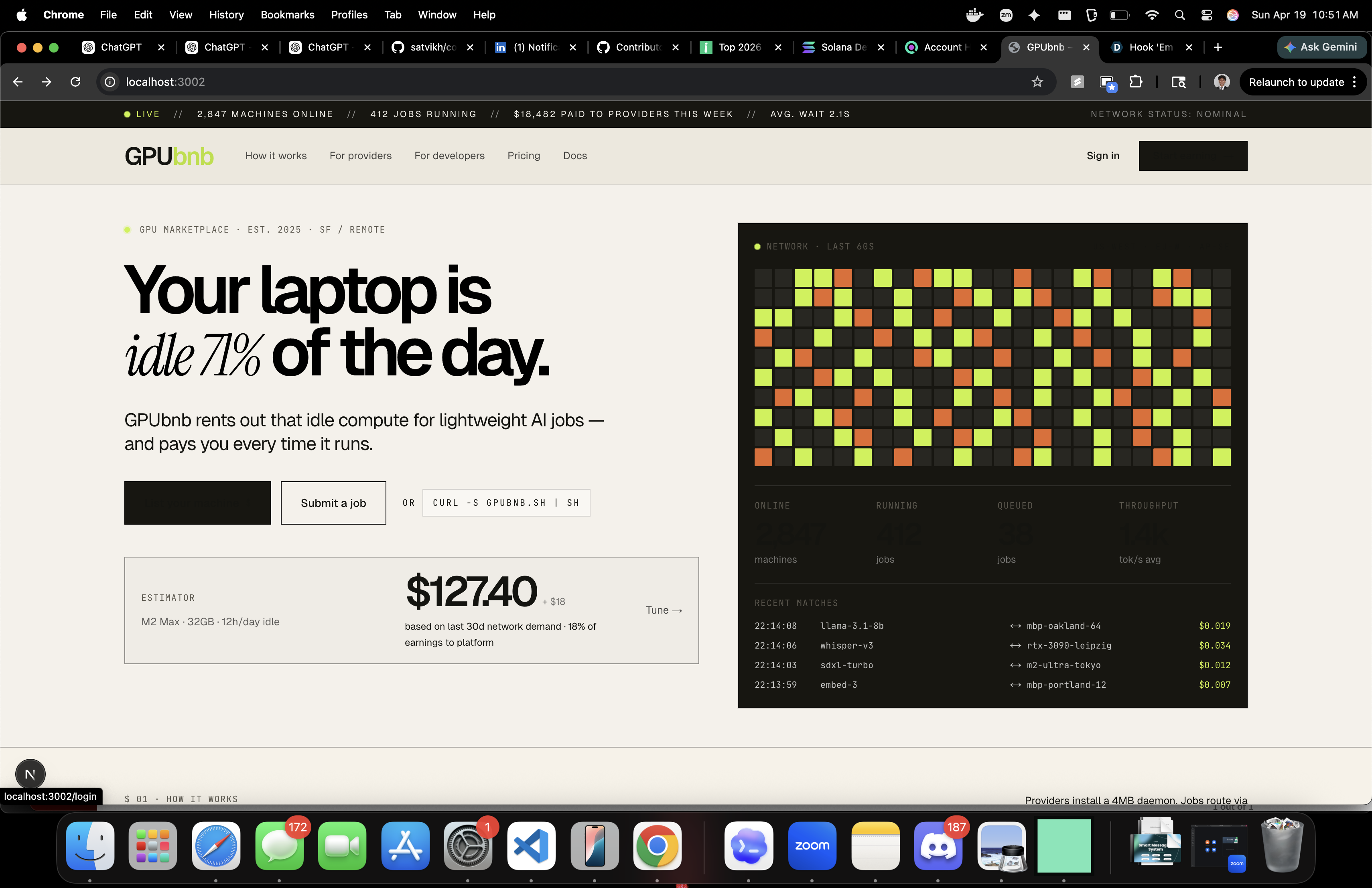
On the web side, we focused on making the product feel legible and real: a landing page, marketplace dashboards, provider views, job submission flow, and detailed results pages.
On the backend, we modeled the core marketplace entities and built APIs for machine registration, queue polling, job lifecycle updates, progress reporting, completion, failure handling, and ledger tracking.
On the provider side, we wired a desktop runtime that can register a machine, maintain heartbeats, poll for assigned work, and run approved demo workloads through a lightweight Docker sandbox runner.
We also added pricing logic, budget caps, payout splits, trust signals, and a complete event timeline so each job has a visible operational history instead of feeling like a black box.
Challenges we ran into
The hardest part was not building isolated screens or APIs. It was making the entire marketplace loop feel coherent end to end.
A few of the biggest challenges were:
- designing a job lifecycle that stayed simple enough for a hackathon, but still felt believable
- syncing machine heartbeats, queue polling, execution state, and dashboard updates
- keeping the product honest about scope instead of pretending we had solved production-grade sandboxing or global scheduling
- balancing marketplace UX with infrastructure realities like logs, failures, runtime cost, and provider trust
We spent a lot of time tightening the boundaries of the project so it would demo clearly and truthfully.
What we learned
We learned that good infrastructure products are as much about clarity as raw capability. Users need to understand where their job is running, what it costs, what happened during execution, and why they should trust the result.
We also learned how much product value comes from connecting multiple environments cleanly: a web app, a backend data model, a provider runtime, and a sandboxed execution path. Getting those systems to work together taught us a lot about state transitions, event-driven UX, and designing around operational constraints.
What's next for GPUbnb
If we keep building GPUbnb, the next steps are:
- real authentication and authorization
- stronger sandboxing and workload isolation
- file and artifact support
- smarter scheduling instead of manual machine selection
- better provider reputation and trust scoring
- production deployment and payments
GPUbnb started as a hackathon prototype, but the core idea still feels powerful: turn idle hardware into accessible compute, and make that experience feel as easy as booking a stay.

Log in or sign up for Devpost to join the conversation.