-
-
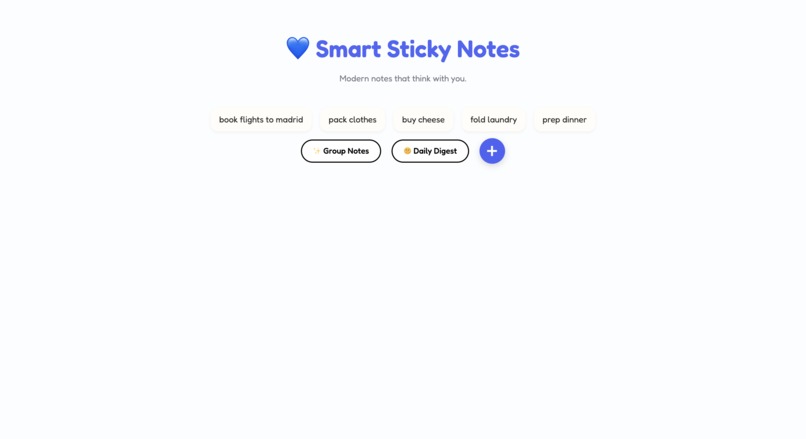
Landing page with a couple of notes made.
-
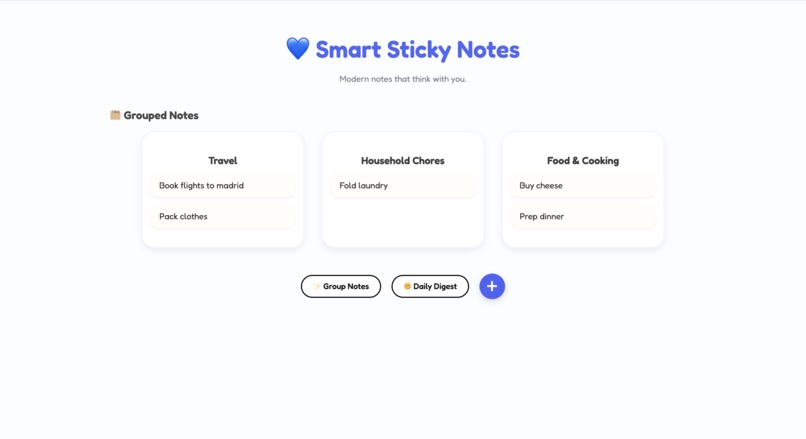
Page with grouped notes after using the AI.
Inspiration
We wanted to solve a simple but universal problem: information overload. People take dozens of notes every week — in meetings, while studying, or brainstorming — but those ideas often get buried or forgotten. We were inspired by how AI reasoning models can now understand context, relationships, and intent. What if notes could organize themselves — grouping by topic, setting reminders, and even sending daily summaries? That idea became Smart Sticky Notes — your intelligent sticky-note assistant that keeps your thoughts structured and your priorities clear.
What it does
SmartNote AI automatically organizes and manages your notes using AWS Bedrock. When you write a note (like “book flights to Madrid by Friday”), the system:
Stores it in DynamoDB.
Uses Bedrock Titan Embeddings and OpenSearch Serverless to find similar notes and suggest a group like “Travel.”
Extracts a due date (like Friday 5 PM) using Bedrock Nova reasoning and schedules a reminder.
Sends Slack or email notifications through SNS and EventBridge.
Generates a daily digest summarizing tasks due soon and active groups.
It’s a self-organizing workspace that helps users stay productive without extra effort.
How we built it
We designed the project around a serverless AWS architecture for speed, scalability, and minimal cost.
Frontend: Built with Next.js and deployed on AWS Amplify, offering a simple sticky-board interface.
Backend: Built with AWS Lambda and API Gateway, handling CRUD operations for notes and groups.
Database: Used Amazon DynamoDB to store users, notes, groups, and reminders.
Vector Search: Integrated Amazon OpenSearch Serverless to store embeddings generated by Bedrock Titan Embeddings for semantic note clustering.
AI Reasoning: Used Amazon Bedrock (Nova) to analyze, group, and prioritize notes, and to parse natural language due dates.
Automation: Employed EventBridge Scheduler and SNS to send timed reminders and daily digests.
Security: Implemented least-privilege IAM roles and used AWS Secrets Manager for Slack webhook credentials.
Challenges we ran into
Configuring Bedrock AgentCore: Getting the model to correctly use custom Lambda tools required multiple iterations of prompt tuning.
Vector indexing in OpenSearch Serverless: Mapping embeddings and ensuring they matched Titan’s dimension format was tricky.
Cross-service IAM permissions: Ensuring each Lambda had the right scoped access (especially for Bedrock and EventBridge) took careful debugging.
Time constraints: Balancing feature scope with stability — we focused on core functionality instead of advanced UI.
Accomplishments that we're proud of
Built a fully serverless AI-powered note system that integrates Bedrock, DynamoDB, and OpenSearch seamlessly.
Created a working pipeline where notes automatically cluster and trigger reminders.
Demonstrated real-world LLM use beyond chat — using reasoning and embeddings for automation.
Deployed a functional end-to-end demo within the hackathon timeframe.
What we learned
How to connect AWS Bedrock’s reasoning and embedding models with traditional serverless components.
The importance of data modeling in DynamoDB for flexible querying and performance.
How prompt structure affects LLM reliability when calling external tools.
What's next for TBD
Design event-driven systems with EventBridge and SNS for reliable background processing.
Integrate Cognito authentication for persistent user sessions.
Add multi-modal inputs (voice → note transcription).
Improve UI grouping visualization and real-time updates.
Explore fine-tuning the LLM for personalized reminders and productivity suggestions.
Built With
- amazon-dynamodb
- api
- javascript
- lambda
- next.js
- typescript

Log in or sign up for Devpost to join the conversation.