-
-
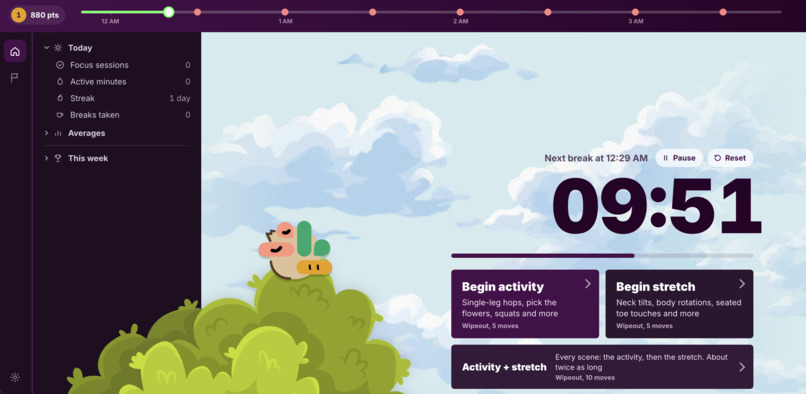
Slack Off landing page
-
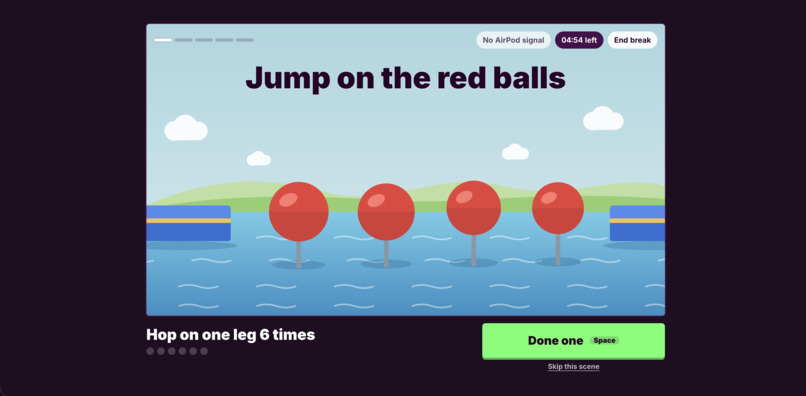
Slack Off activity
-
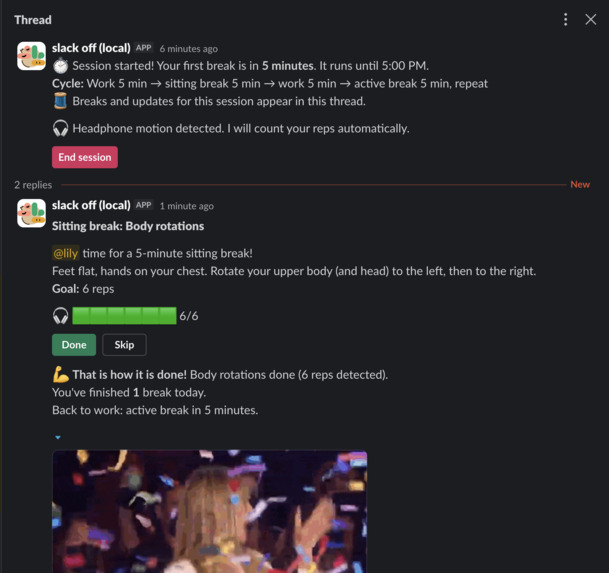
Slack Off Slack bot
Inspiration
Most of us spend hours a day with our AirPods in: coding, studying, sitting in calls. We realized we can go an entire afternoon without moving anything but our fingers, and break reminders don't help because they're easy to dismiss. We'd already been experimenting with AirPods head tracking, and that gave us the idea: the headphones we wear all day could tell when we've been still too long, and could confirm that we actually moved.
What it does
Slack Off is a Pomodoro timer that uses your AirPods to make sure you actually stretch and stay active on your breaks. We're hosting it on two platforms: the web and on Slack
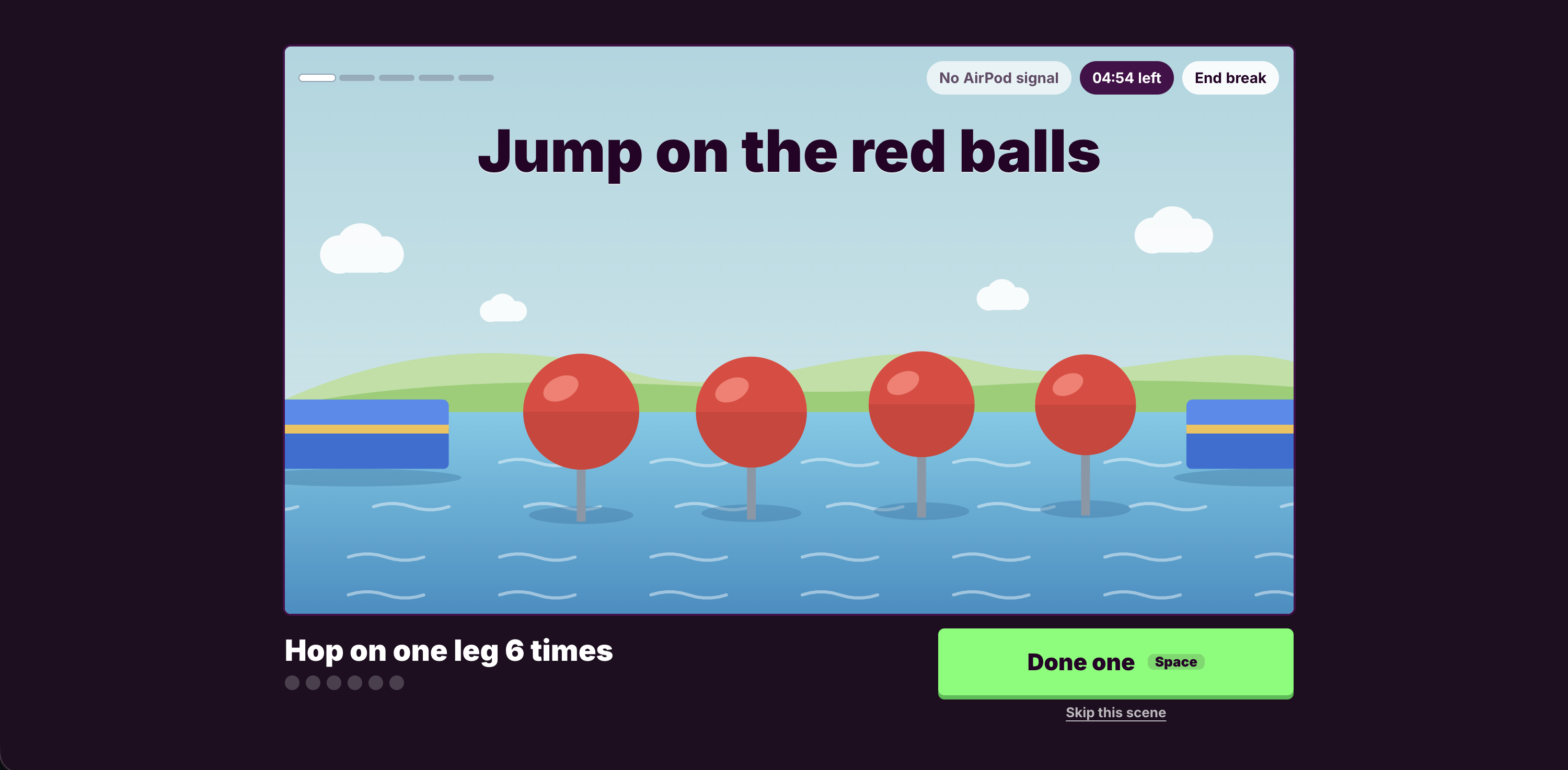
- You focus with a web-based Pomodoro timer. When a break starts, Slack Off gives you a short, desk-friendly exercise like neck tilts, head turns or chin tucks.
- Your AirPods track your head movement and count each rep live, so the break screen fills in as you move.
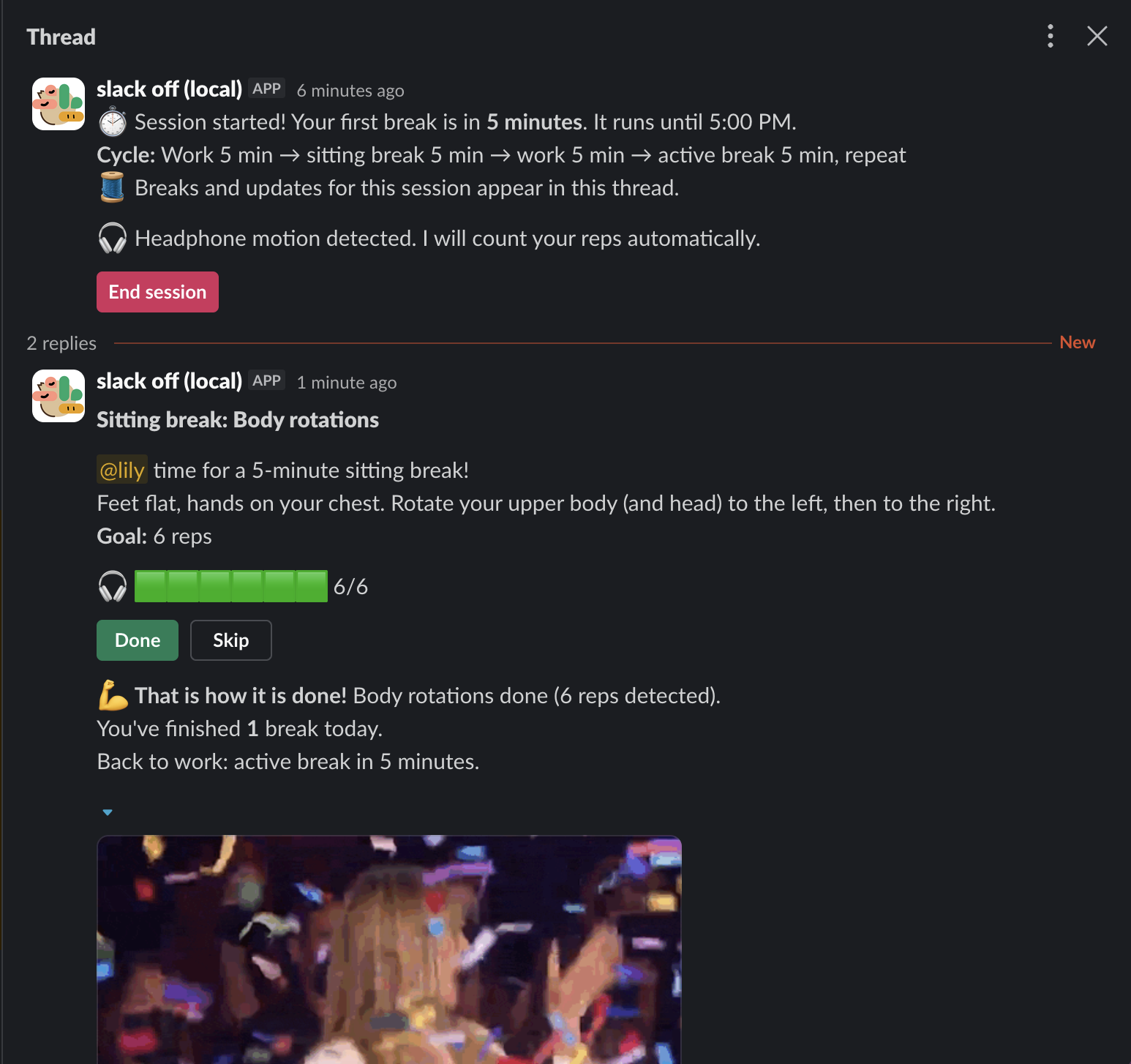
- A Slack bot sends your break in a DM and updates it as you complete reps, so the nudge reaches you where you already work.
- Your verified reps go into personal stats, streaks and a team leaderboard, which turns staying active into a friendly competition.
How we built it
- Mac menu bar app (Swift): reads AirPods head orientation and acceleration with Apple's CMHeadphoneMotionManager, calibrates a neutral head position, detects reps, and streams events over a local WebSocket server.
- Web Pomodoro (React): the focus timer, full-screen break exercises, live rep counter, settings and stats.
- Backend (Node + Socket.io): stores sessions and completions, keeps the timer state and calculates points.
- Slack bot (Bolt): sends break DMs, edits them live as reps come in, and posts leaderboard updates.
Challenges we ran into
- Calibration was difficult since head-tilting could be interpreted as many different actions by the airpod's movement. We resolved this by adding "deadzones" similar to how many real-world game controllers are programmed.
- Airpods provide a unique form of data called a UDP that requires a bridge websocket in order to process in the brower. Running the bridge websocket requires a local app instance that can't be processed on a cloud server (since the UDP input is low-level local). This meant that we were unable to host put the web app on a provide (i.e. Vercel).
Accomplishments that we're proud of
- Movement is verified by real head motion with no extra hardware: no webcam, no wearable, just the AirPods people already have in.
- Movements have se
- The whole loop works end to end: break starts, you stretch, reps count live on the web and in Slack at the same time.
- It stays low friction. A break is 30 seconds of seated moves you can do at your desk or in the library.
What we learned
- Swift/IOS as a whole is quite restrictive in terms of deployment. Androids could be an option if we want faster/easier deployment with alternative language options instead of swift
What's next for Slack Off
- More Physical Activities! (duh)
- Wipeout could have the potential for a ton of different maps. One idea we considered in production was a 3D first person perspective
- More slack features!
- Support for Bluetooth Gyroscopes. This would enable a wider range of potential products + people who don't like to use airpods.


