-
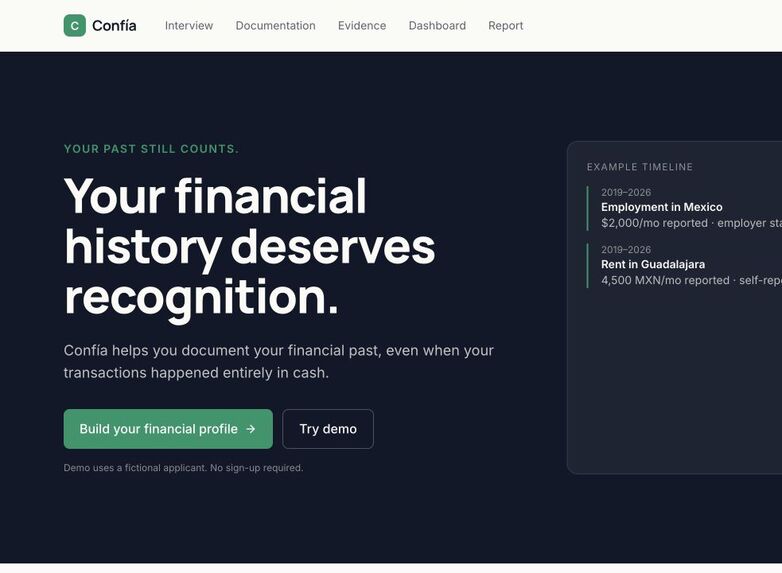
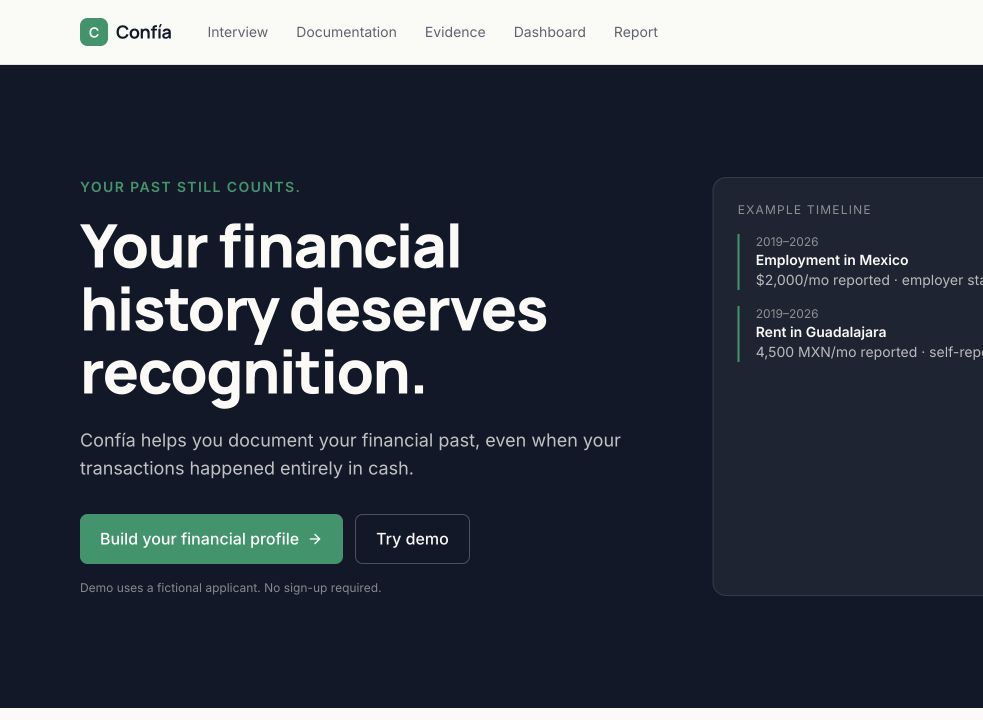
Confía homepage view
-
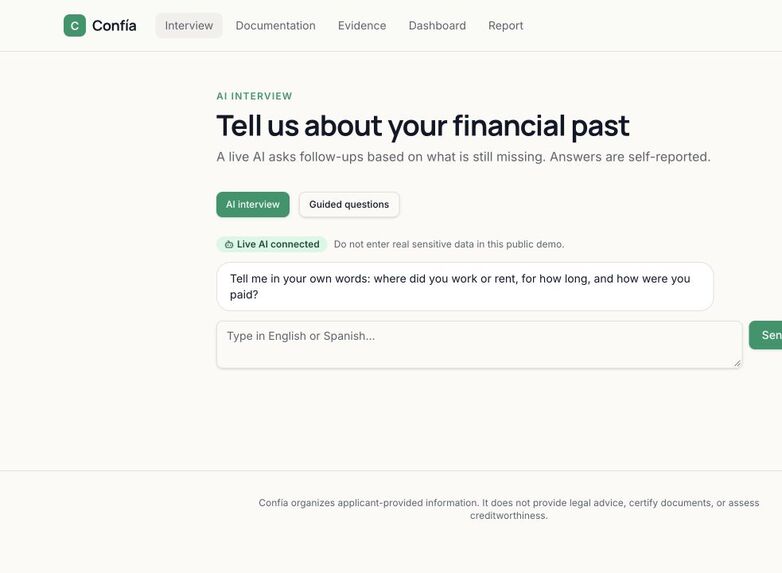
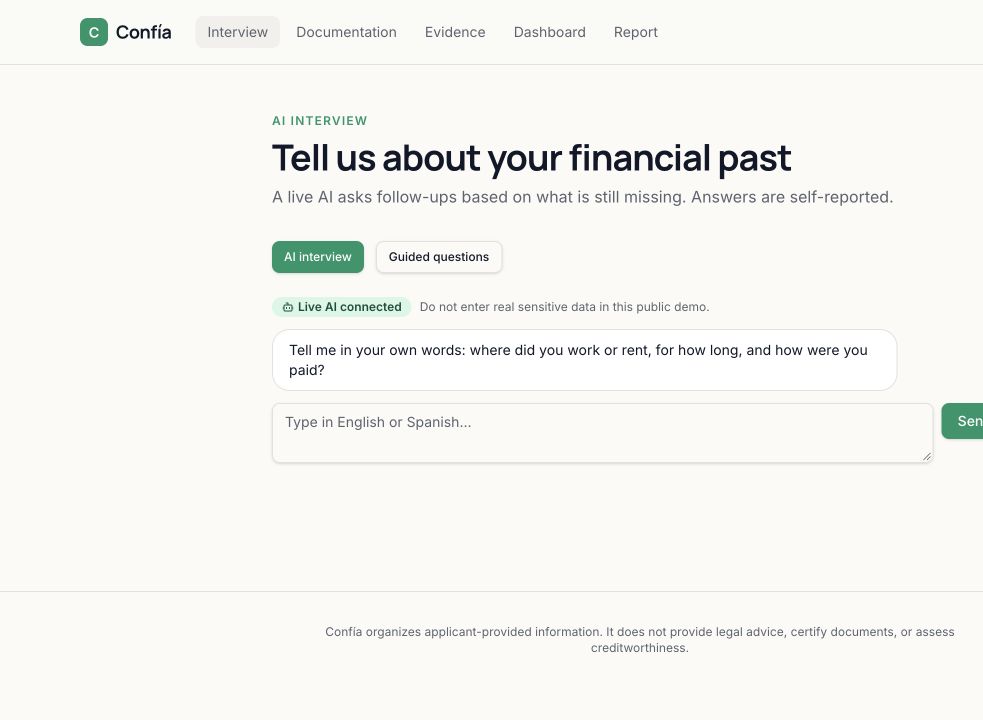
Adaptive financial interview
-
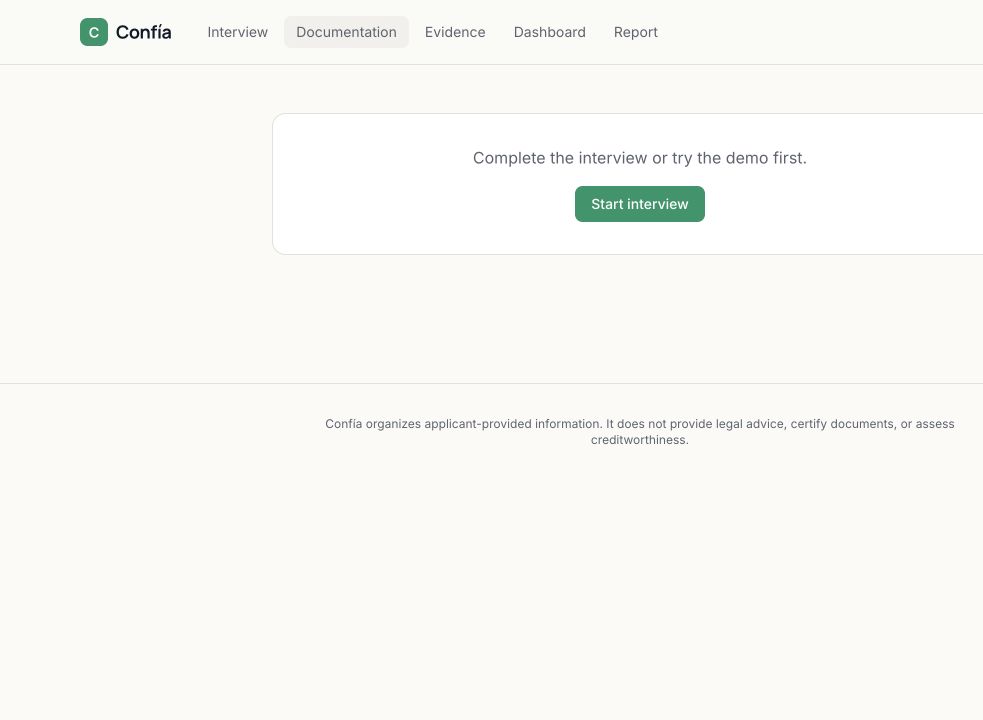
Documentation guidance view
-
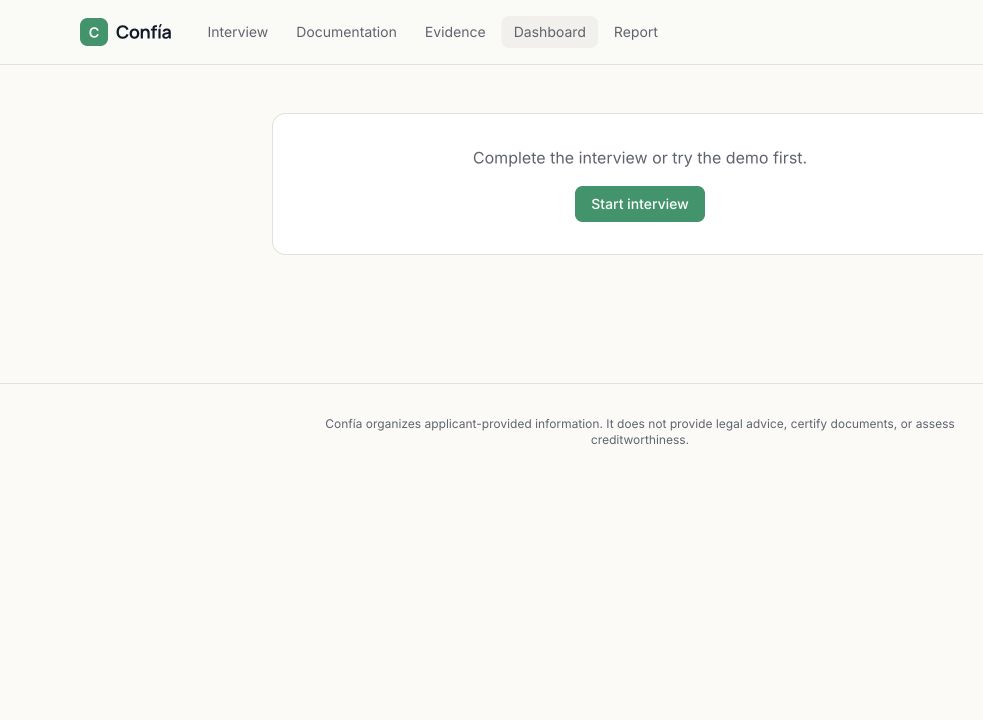
Confía dashboard view
Inspiration
Many immigrants, cash-based workers, and people with informal rental histories have real financial responsibility but little conventional paperwork to prove it. Confía was built for the moment when a person needs to explain that history clearly: to a landlord, lender, aid program, advocate, or future employer.
What it does
Confía is an AI-powered documentation tool that helps users reconstruct financial histories when traditional records do not exist or are incomplete.
The prototype includes:
- A live adaptive AI interview that asks guided follow-up questions about work, rent, income, payments, witnesses, and available evidence.
- A guided fallback interview flow so the product still works even when the AI interview is unavailable.
- Bilingual English and Spanish UI support.
- International documentation guidance for Mexico to U.S. and India to U.S. example workflows, with legal uncertainty clearly flagged instead of overstated.
- Printable employer and landlord verification request letters.
- Browser-based PDF/text document analysis using fictional sample documents.
- Dashboards that organize income, rent, evidence, witnesses, and documentation gaps.
- Downloadable financial history PDFs that summarize the user's reconstructed record.
Confía does not create independent proof, notarize documents, or guarantee that any institution will accept a user's history. It helps people organize what they already know, identify missing evidence, and produce clearer documentation requests and reports.
How we built it
We built Confía as a web prototype using Lovable, React, TypeScript, Tailwind CSS, TanStack Start, PDF.js, and jsPDF. The app combines a conversational interview experience with structured data capture, jurisdiction-aware guidance, local document text extraction, and report generation.
Challenges we ran into
The hardest part was designing around uncertainty. Cash-based employment and informal rent histories often do not have clean source documents, so we had to avoid pretending the app could verify more than it can. We focused on careful language, evidence organization, and documentation workflows that help users move forward without making false legal or financial promises.
Another challenge was making the experience useful across borders. We added Mexico to U.S. and India to U.S. examples to show how Confía can surface country-specific documentation ideas while still warning users that requirements vary and may need professional review.
What we learned
We learned that financial inclusion is not only about scoring or prediction. Sometimes the first step is helping someone tell a complicated financial story in a format that institutions can understand. We also learned how important it is for AI tools in sensitive domains to communicate uncertainty clearly.
What's next
Next, Confía could add more country pathways, stronger human review workflows, secure evidence storage, institution-specific templates, and partnerships with legal aid, housing, and immigrant support organizations.
Built With
- claude
- codex
- jspdf
- lovable
- lovable-ai
- pdf.js
- tailwind-css
- tanstack-start
- typescript


Log in or sign up for Devpost to join the conversation.