-
-
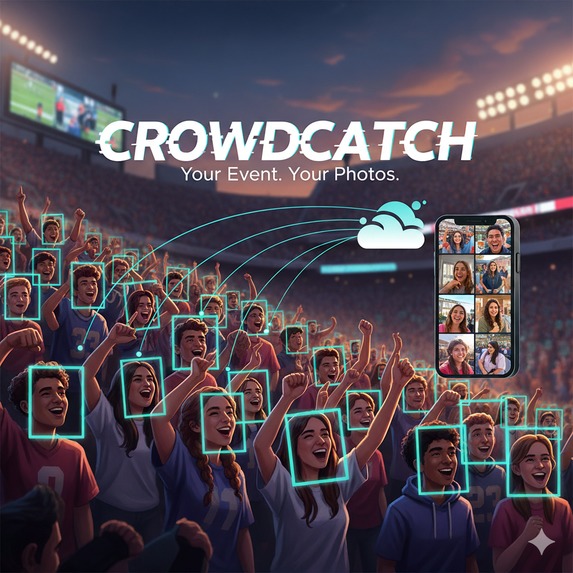
Crowd Catch Logo

Inspiration
At big events like concerts, graduations, and sports games, photographers take thousands of photos. The problem is that people rarely get to see the pictures they’re in because it’s almost impossible to find them later. We wanted to fix that. Our idea was to create a way for people to find photos of themselves automatically, without having to scroll through hundreds of random images. That’s how Crowd Catcher started. An AI powered system that helps people easily by locating photos they appear in, without them having to search for them.
What it does
Crowd catcher is a web app that helps people find photos they appear in from large events. Users can sign up, upload a few photos of themselves, and then our system scans event photos uploaded by photographers. Using facial recognition, Crowd catcher finds matches and notifies users when they've been identified in a picture. The AI system sends an email to the people matched and asks for confirmation on whether they are in that photo or not. Matched photos then appear in the Pearsons’ gallery where they can be viewed easily and downloaded.
How we built it
We built Crowd Catcher using a serverless setup on AWS. Our frontend is a simple web app where users can create an account and upload their photos. It connects to Amazon Cognito for authentication.
We used AWS S3 to store all the photos and AWS Lambda functions for the backend logic. When someone uploads a new photo, a Lambda function triggers Amazon Rekognition, which scans the image and compares faces to our database. If there’s a match, the info is saved in DynamoDB, and the user gets an email through Amazon SES letting them know they were found in an event photo. The process runs automatically from start to finish, which was one of our main goals when designing the system.
Challenges we ran into
Not enough time, lack of time and effort in frontend, especially bc so much time put into backend
API Gateway, working with localhost made it difficult for the front end photos to work with the lambda (compiler)... This made it challenging to connect with the aws s3 bucket as there were issues with encrypting keys…
By trying to learn all of these AWS systems at once, there was a steep learning curve and a lack of time to implement some ideas, like creating a gallery of photos for each individual that would be fed back into the website. This was our original plan, but we hope to improve and complete this project onwards from this hackathon.
Accomplishments that we're proud of
Having almost no experience with AWS systems, e.g. S3 Buckets, Rekognition, DynamoDB, SES, & Lambda, and studying how it can be incorporated into a project
And getting a good idea of how everything works and functions, works with AI training, creating new avenues and applications for shortcuts that we can use.
What we learned
AWS Cloud Computing, all other AWS application systems: S3 Buckets, Rekognition, DynamoDB, SES, & Lambda.
What's next for Crowd Catch
Because of issues with time and resources, could not implement into an actual accessible website… Would just need a bit of time to get that incorporated into Crowd Catch. With that accessibility, our immediate plan is to bring this service to Boston College. We can partner with BC Athletics and student photographers to scan every fan and player at football and hockey games. Imagine getting that perfect photo of you cheering at the game instantly. We also want to integrate with the Agora Portal. This means no new username/password for students; they use their BC credentials. It leverages existing university security, making it more resilient and secure. Our final horizon is building a Community Driven social platform. After you receive your private photos, you'll have the option to 'publish' your best shots to a shared event feed. This evolves Crowd Catch into a social network built on memories.
Built With
- amazon-cognito
- amazon-dynamodb
- amazon-rekognition
- amazon-s3-bucket
- amazon-simple-service
- api-gateway
- aws-lambda
- css
- html
- javascript
- react
- typescript
