
Test it out right now!
Try it out at any payphone in NSW by calling 02 9037 3879 and then typing *462 17778011609 - there's a few around a short walk away from the Computer Science Building at:
- 332 Abercrombie Street
- 296 Abercrombie Streeth
- 37 Myrtle Street
- 0 Science Road (outside the pharmacy building)
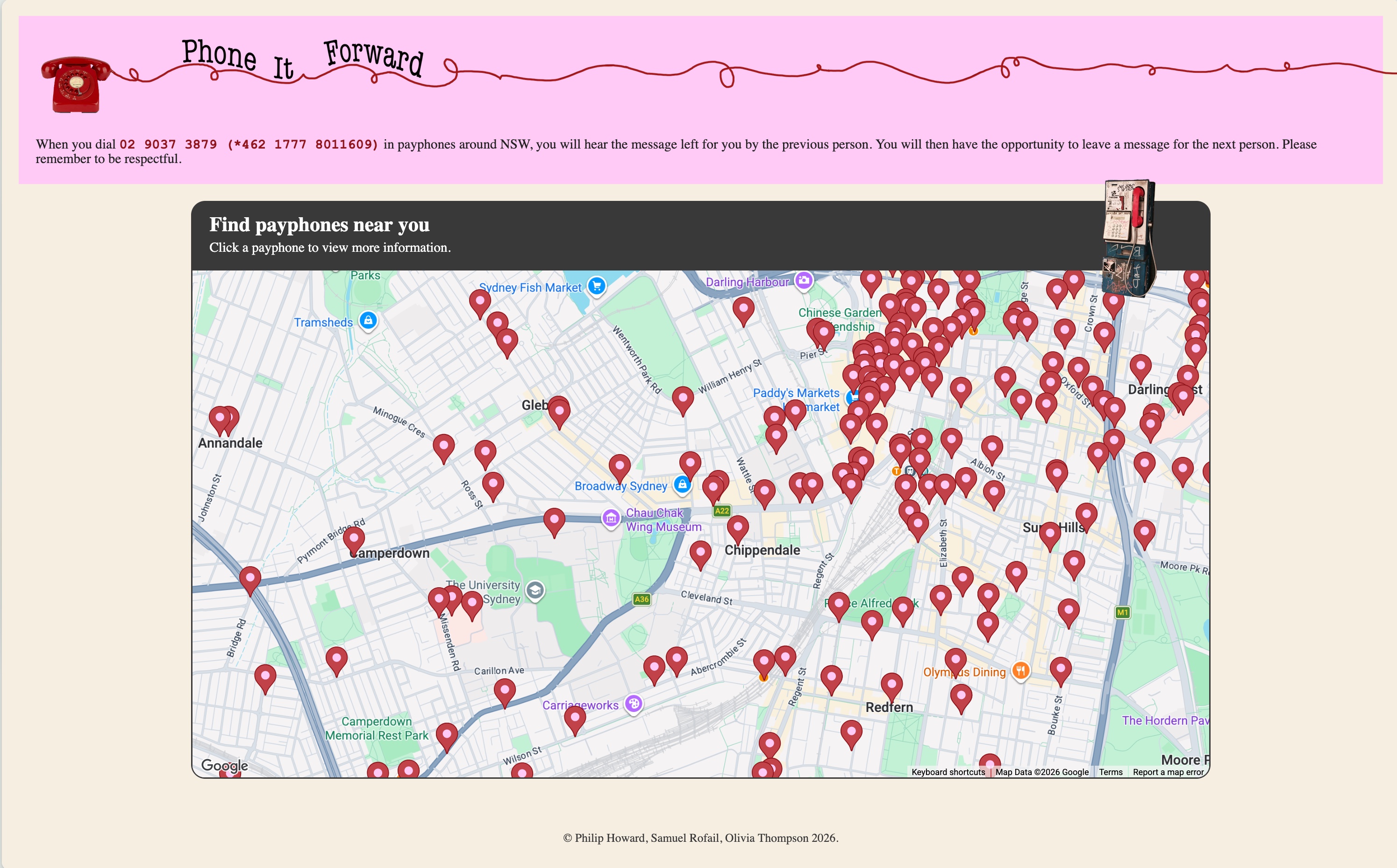
To find other payphones, try out our website https://syncs-hack-2026-three.vercel.app/!
Inspiration
In a world where everyone is stuck on their screens, every solution to bring us back outside and connect people feels like another AI app or technology that just drifts us further from our foundational blocks.
So we're going all the way back, to the payphone???
A physical place dotted all across the country where you can leave your darkest moments and greatest successes, and stories of the places we exist in together. Nothing but a payphone (free) needed, and your recording will be heard by just one stranger before being deleted forever. No algorithm, not engineered to take every last second of your attention, just authentic human connection.
Go touch some grass and try it out!
What it does
Server
Any payphone in NSW can call the SIP number deployed on the server. This then plays the most recent recording from that payphone, and then allows the user to record a message of their own following the tone. Numbers are always checked against a database to ensure the service is only used in payphones, and you have to touch grass.
Website
The Phone It Forward website displays a map containing all pay phones in New South Wales, and if permitted, can show where you are relative them too.
How we built it
Due to the time and cost constraints of the project, it was not feasible to acquire a phone number, and so instead, the user calls SIP broker (or another similar service) and then dials a VoIP number deployed for the project. On the server side, a lightweight SIP user-agent called Baresip is run in the background, which is connected to the server using a TCP socket. The server then runs in a loop, accepting calls that are received, checking if the number is in the valid set, and then sending the most recent audio recording or another message if applicable, and then waits 60 seconds or until the user hangs up to allow them to provide a message. At the end, the recording is cut down using pydub to remove audio before the beep, and then add a beep at the end and export it, overwriting the existing file.
The website was designed with react and deployed using serverless. It uses an implementation with the Google Maps API with added and customised pins for all payphone locations. The payphone locations were scraped from Telstra's websites, alongside their phone numbers for the whitelist. The website is responsive and simply resizes assets and the Google Maps window to maintain usability on different screen sizes. The website logo is hand-drawn by one of our team members.
Challenges we ran into
One major challenge of the project was an inability to use a phone number with Twilio or a similar service due to their KYC Verification taking 72 hours, beyond the time limit of this project. As such, an alternative solution was crafted using SIP Broker, which required significantly more configuration.
Furthermore, there was much difficulty with baresip's interaction with the python program and issues when restarting it, as often baresip would remain hanging following closure, meaning it would catch calls and override other baresip instances. Furthermore, there were numerous steps involved in allowing the playback function to consistently switch the audio played back to the respective audio file of the phone number.
Accomplishments that we're proud of
- Deploying the SIP setup in under 24 hours without requiring any cost or identification, and connecting numerous providers without issues
- Deploying the server to a free Oracle Cloud VM which hosts the program perpetually.
- Designing an aesthetically pleasing and nostalgic website.
- Manipulating the audio recordings in a clean manner to ensure correct playback.
- Scraping the full NSW payphone data from the Telstra website despite the lack of an available dataset.
What we learned
- How to scrape websites using Python
- React, Javascript and CSS development fundamentals
- How to interface with SIP and VoIP technologies
- Server deployment
What's next for Phone It Foward
- Posters inside phone booths for promotion.
- Concurrent callers from multiple payphones.
- Shorter phone number for ease of use.


Log in or sign up for Devpost to join the conversation.