-
-
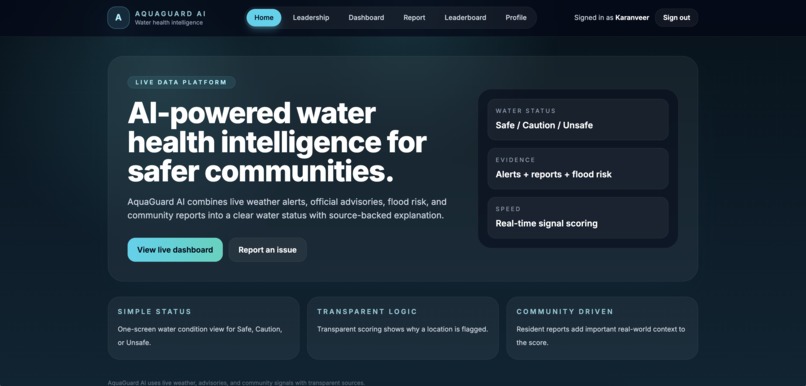
Home Page
-
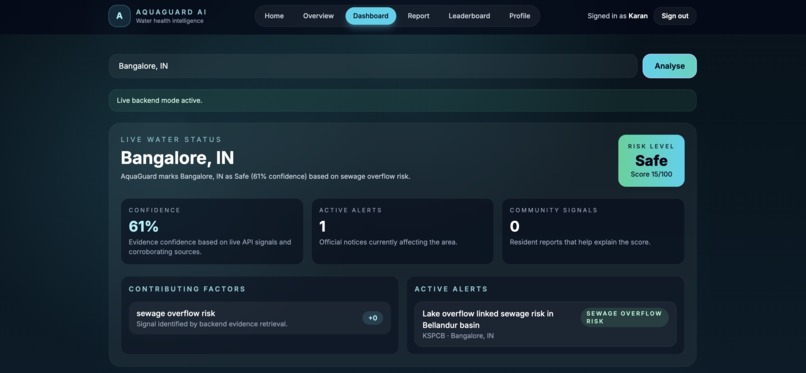
Dashboard
-
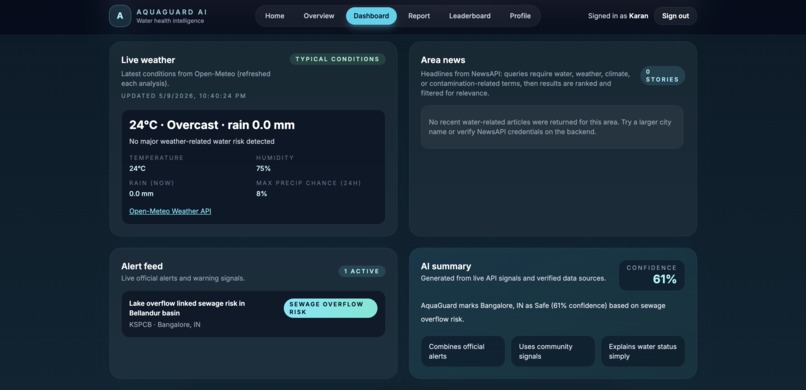
Dashboard Continued
-
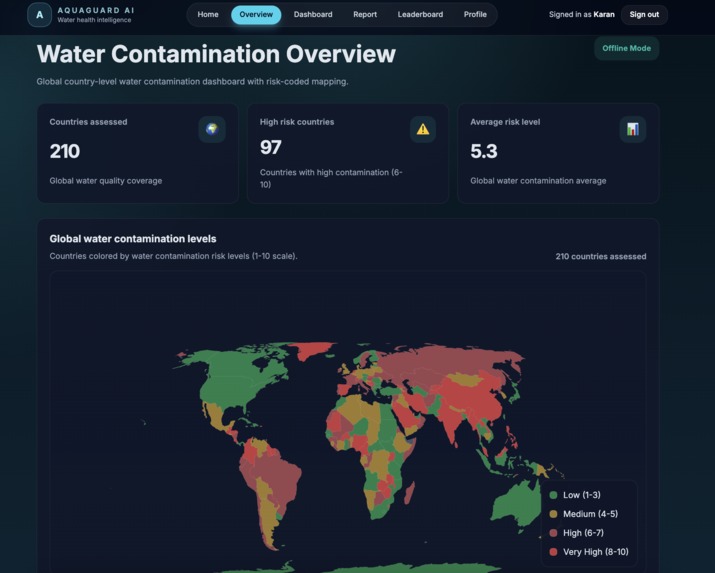
Overview
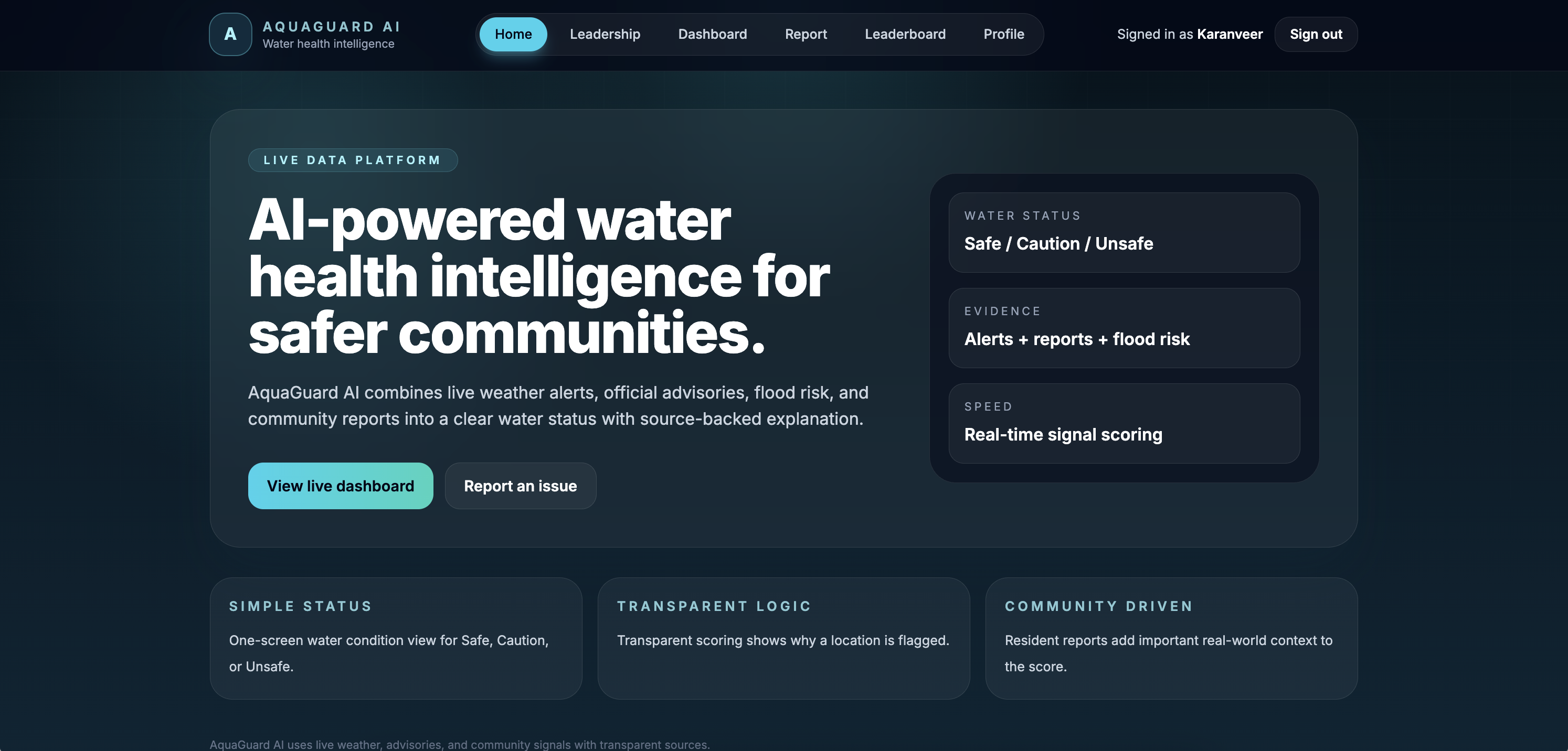
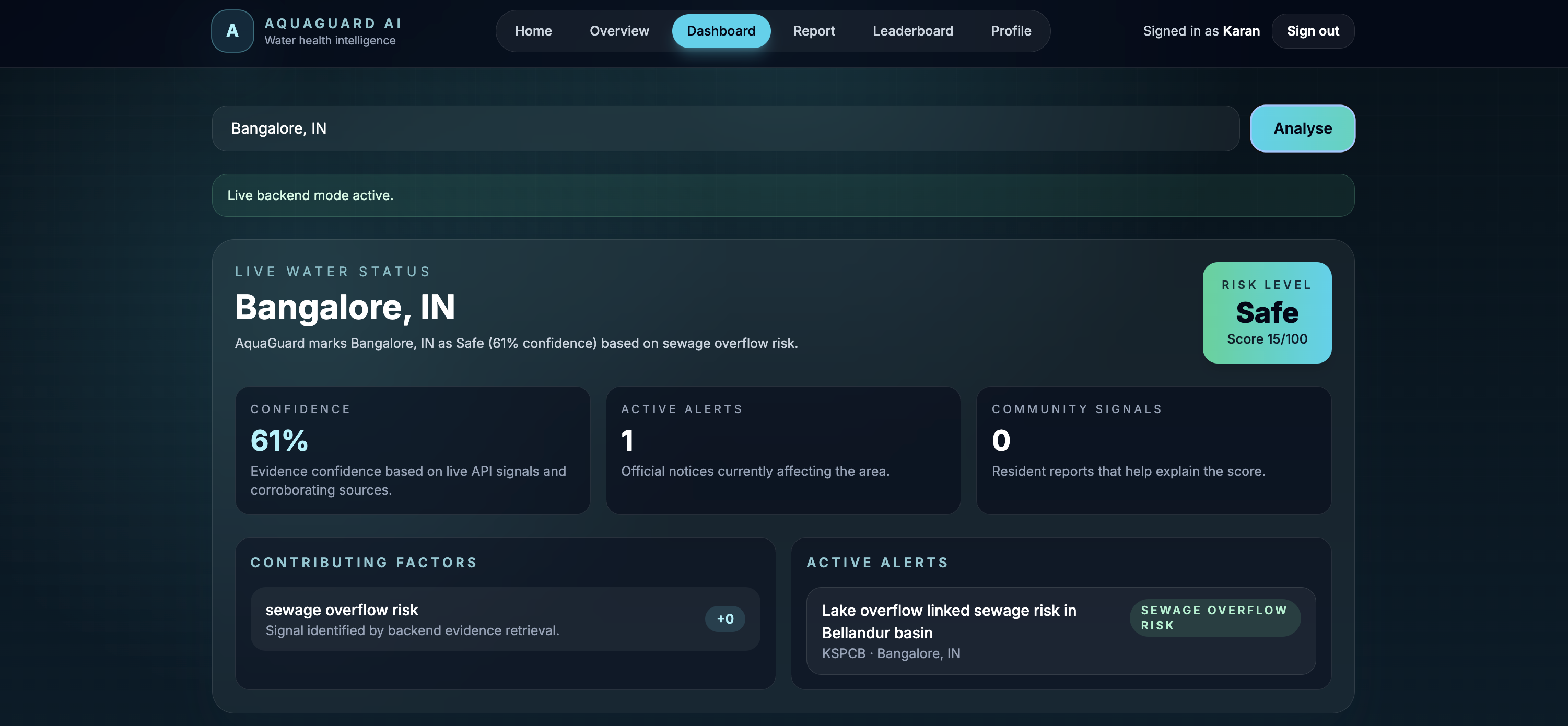
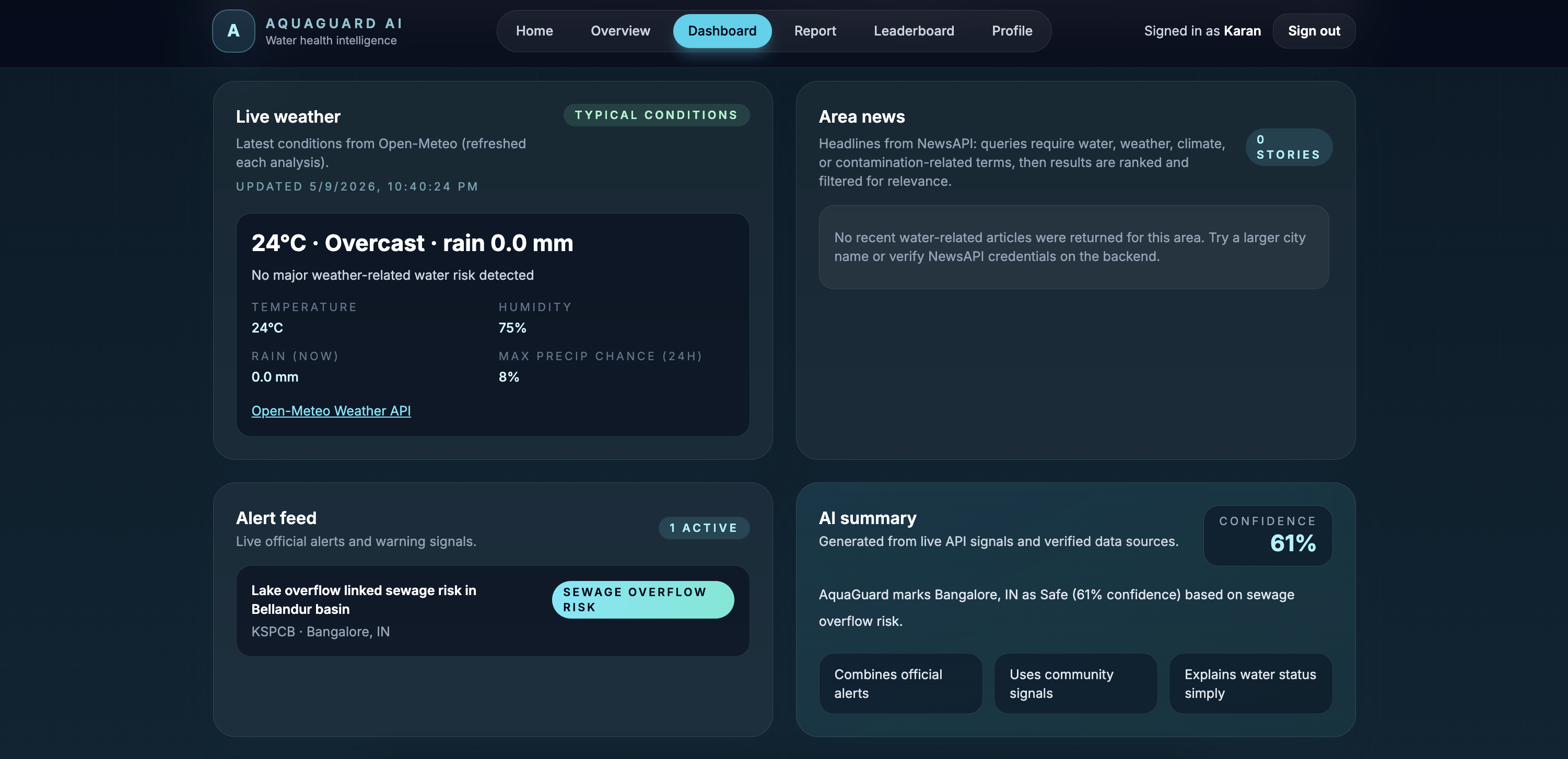
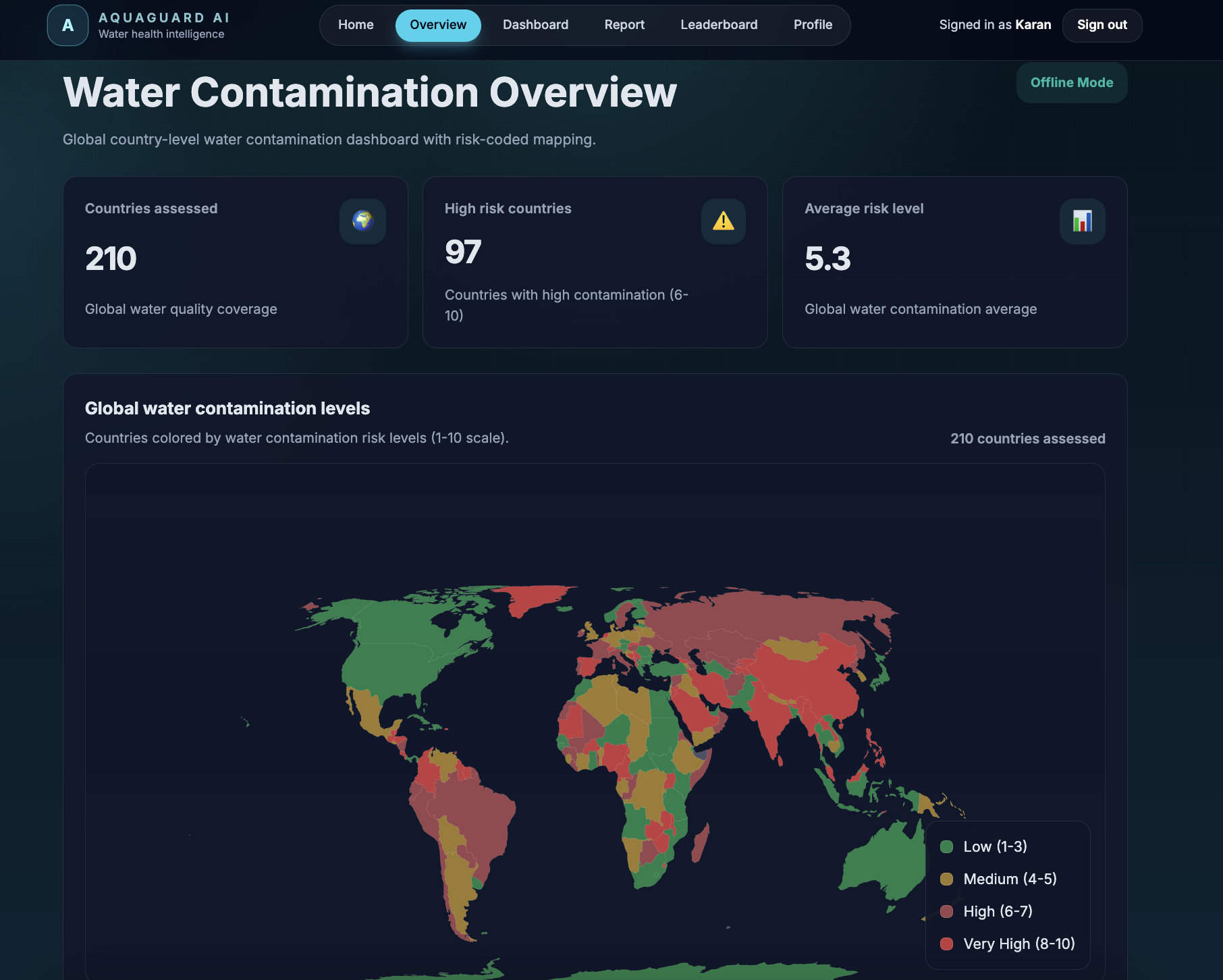
AquaGuard
Motivation
Access to safe water remains inconsistent across many urban and climate-vulnerable regions, where flooding, aging infrastructure, contamination events, and delayed advisories create significant public health risks. AquaGuard directly supports United Nations Sustainable Development Goal 6: Clean Water and Sanitation by making water-risk information more understandable, timely, and actionable for everyday communities. The innovation is not limited to AI-generated summaries. AquaGuard combines multi-source environmental signals, transparent risk scoring, and community participation into a unified environmental intelligence workflow. Instead of relying on a single advisory stream, the platform blends official alerts, environmental conditions, and citizen observations to provide practical, location-specific water-risk guidance.
Problem Statement
Water safety information is highly fragmented. Residents often need to piece together weather alerts, municipal advisories, flood warnings, and social reports across disconnected platforms. This fragmentation creates delays, confusion, and inconsistent risk awareness, potentially leading to unsafe water use, preventable illness, and slower emergency response. The problem disproportionately affects flood-prone and infrastructure-stressed communities, as well as healthcare workers, responders, and local agencies that require timely and interpretable risk information. Existing systems are often reactive, difficult to interpret, and poorly suited for rapid local-level decision-making. Most importantly, they rarely explain why a location may be at risk in clear, human-readable language.
Solution Statement
AquaGuard is an AI-assisted water-risk intelligence platform that transforms scattered environmental indicators into a clear, explainable risk assessment for a specific location.
How It Works
- Aggregates signals from:
- weather and flood conditions
- advisories and alerts
- infrastructure-related indicators
- community-submitted reports
- Computes a weighted risk score and confidence level using deterministic scoring logic.
- Uses IBM watsonx.ai to generate concise, human-readable explanations and recommendations.
- Returns transparent evidence, including contributing factors and score breakdowns.
- Allows users to submit localized reports to improve timeliness and environmental awareness.
Why It Is Different
- Multi-source by design, rather than dependent on a single data feed.
- Explainable scoring and source attribution improve trust and transparency.
- Time-weighted reporting reduces outdated or stale environmental signals.
- AI-generated summaries make complex environmental information accessible to non-technical users.
- Combines deterministic risk analysis with generative AI for both reliability and usability.
Technology Documentation
Languages
- JavaScript
- HTML/CSS
Frameworks & Runtime
- React + Vite (frontend)
- Express.js + Node.js (backend)
APIs & Data Integrations
- Open-Meteo for weather and environmental signals
- Government advisory and flood-warning integrations
- Community-submitted incident reports
- Optional municipal and regional environmental data endpoints
Data Layer
- Current implementation uses structured backend service aggregation and lightweight data stores.
- Prototype environment prioritizes rapid integration and scalability over full production persistence.
- Planned production architecture includes PostgreSQL for durable storage, analytics, and historical trend analysis.
Cloud & AI
- IBM watsonx.ai for AI-generated environmental summaries
- IBM IAM authentication flow for secure model access
- Fallback model handling for improved reliability and resiliency
IBM Technologies Used
- IBM watsonx.ai foundation models
- IBM Cloud IAM authentication services
Architecture Diagram
Frontend
React-based dashboard for:
- location search
- risk visualization
- AI-generated summaries
- community reporting
Backend
Express.js API layer responsible for:
- risk computation
- environmental signal aggregation
- weather/advisory processing
- AI orchestration
The backend risk engine combines:
- weighted environmental indicators
- confidence scoring
- evidence attribution logic
Data & Integrations
- Internal alert and report datasets
- External weather and flood data services
- IBM watsonx.ai generation endpoints for natural-language explanations
User Workflow
- User enters a location.
- Backend aggregates environmental and community signals.
- Risk engine computes:
- risk score
- confidence level
- contributing evidence
- risk classification
- IBM watsonx.ai generates concise guidance and explanations.
- Frontend displays:
- risk status
- confidence
- contributing factors
- AI-generated recommendations
- Users can submit additional reports, improving future environmental context and situational awareness.
Presentation Link
https://canva.link/81jidsimk9drdt1
What We Learned
We learned that SDG-focused technology must balance technical sophistication with accessibility. Advanced environmental modeling alone is insufficient if users cannot quickly understand and act on the results. We also learned that trust in AI-assisted systems depends heavily on transparency. Displaying contributing evidence, environmental indicators, and score reasoning significantly improves user confidence and interpretability. From a technical perspective, combining deterministic risk logic with generative AI produced the strongest outcome. Weighted scoring ensured consistency and explainability, while IBM watsonx.ai improved communication clarity for both residents and decision-makers.
What’s Next for AquaGuard
Planned Next Steps
- Deploy production-grade cloud infrastructure with managed databases and observability tooling.
- Expand integrations with municipal, NGO, and regional environmental monitoring systems.
- Add multilingual support and low-bandwidth accessibility features for underserved regions.
- Develop alert subscriptions and role-based dashboards for agencies and responders.
- Validate the platform with pilot communities and environmental-impact metrics.
- Pursue institutional partnerships and sustainability-focused funding opportunities to support long-term deployment.
Built With
- css3
- express.js
- html5
- ibm-cloud-iam
- ibm-watson
- javascript
- node.js
- open-mateo-api
- react
- rest-apis
- tailwind-css
- vite


Log in or sign up for Devpost to join the conversation.