1. Prototype link (please submit a link to a playable prototype, not alink to your design file)
2. Describe your project (max 150 words) In a world overflowing with digital clutter, people's focus often gets lost among countless files and folders.
How can we effectively address this issue? While AI often adds to the chaos of digital clutter, in this era of AI tech, it’s crucial not to resist the new and unfamiliar; we should be harnessing it to serve our needs and enhance our human intuition. Table for One's project is inspired by this idea.
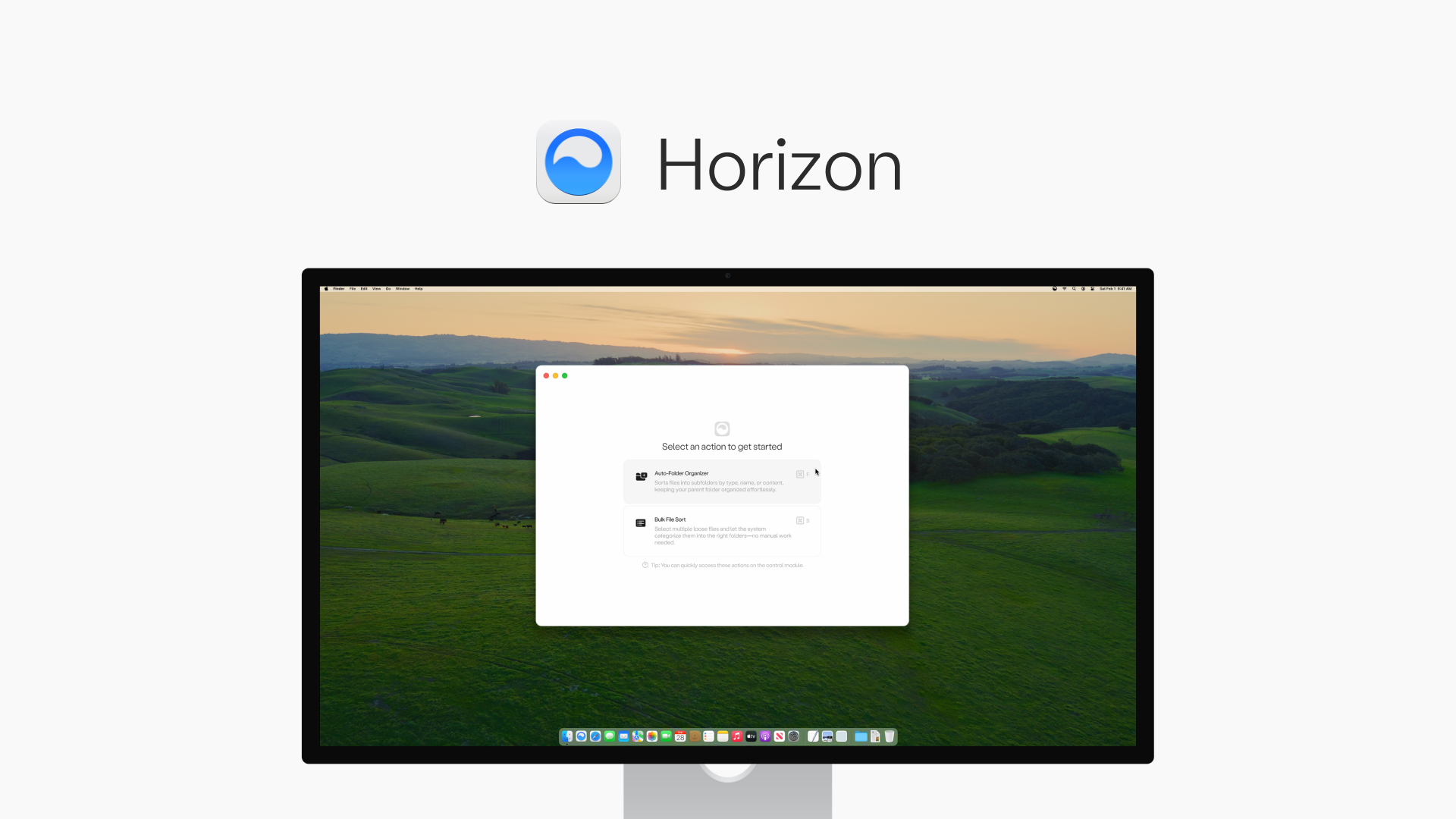
Introducing Horizon, an AI-powered file management app designed to streamline your digital files. Instead of being overwhelmed by disorganized downloads, images, and docs we accumulate everyday, Horizon intelligently sorts and categorizes your files, taking care of 90% of the tedious organization work for you. It even renames files to eliminate those endless “screenshot_02025” duplicates.
By using AI to enhance organization, Horizon can free up your mental space and allow you to concentrate on what truly matters.
3. Describe your research process and findings. If you conducted any surveys or interviews, please include the survey form and/or interview questions here. If you conducted secondary research by pulling from online sources, please include a link to your sources. (Max 500 words) Survey Research Goal: For my survey, I developed questionnaires aimed at a diverse audience to gain insights into various individuals' experiences with file organization and management. The primary insights I looked to gather were people’s challenges with file organization, its mental impact, and the strategies they employed to maintain organization. Survey form: https://forms.gle/Tq6oWFLcuZYadHhm7
Survey Findings: Duration: Feb 01, 2025 - Feb 02, 2025 Participants: 10 individuals varying from undergraduate students, working graduates, and reddit users
The surveyed individuals showed some interesting insights as many of them showed similarities in their struggles, but all employed widely different strategies to keep their files organized.
- The main entry point of newly downloaded files is “Downloads” folder, so I looked into user’s experience of organizing this folder and I found that roughly 50% (of 10) individuals rarely organized their downloads after downloading a file.
- Approximately 40% (of 10) often had troubles finding files they’ve saved and 50% have also lost files on desktop due to poor organization.
- The most widely similar struggles among interviewed users were their struggles to maintain folder naming systems, organizing subfolder levels, and renaming and large numbers of files quickly with approximately 70% (of 10) claiming this struggle.
From these findings, it’s clear that file organization and digital clutter are widespread challenges faced by many diverse people. Tackling this issue will be crucial for regaining control over our technology and managing our time effectively.
4. Describe your most important design decisions. What research findings and/or user testing results led you to make these decisions? (Max 500 words)
The key design choices I made were primarily influenced by a few core items.
1. Existing technology - What technologies exist today or are emerging that I can leverage to create a design solution that fit the needs of my problem space? I’ve found that OLlama, an AI model can be run offline can be used to create folder structures and rename files for you, after some training. Its offline capabilities also tackles the issues of privacy as personal files will be read & processed by the AI model, ensuring that the files don’t get leaked and are only stored locally.
User survey insights, specifically around surveyed user’s struggles on folder structures, renaming quickly, and bulk file organization. The flow of the app and the features I ideated on were essentially guided by these common struggles, and I felt that if I were to tackle this big trifecta, I can most likely dig deeper later to find deeper use cases that tackles more issues.
User testing - During my user testing, I interviewed a college student to gain deeper insights into how they perceived my design solutions and to evaluate their effectiveness. One of the key takeaways was the importance of not overlooking simple interactions that I might assume are intuitive. In my design, I intentionally incorporated Apple’s design system to create familiarity and reinforce those well-known interactions.
However, I’ve come to realize that not everyone grasps these interactions, highlighting the need for educational moments or affordances to address those gaps. Another insight that proved useful was the importance of copy language. Some key areas in my design that had educational moments lacked clarity due to poor copy, and doing my user testing helped resolve some of those issues.
Overall, my design decisions were guided by my user survey insights and the challenges my design solutions faced during user testing. To sum it up, my overall goal is to improve our digital clutter, reduce the time it takes for us to organize our files, and bring back the time we spend on that menial task to focus on what truly matters.
Built With
- figma

Log in or sign up for Devpost to join the conversation.