-
-
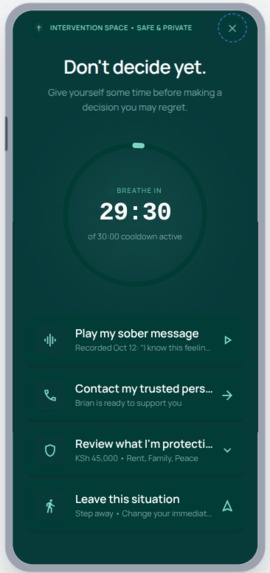
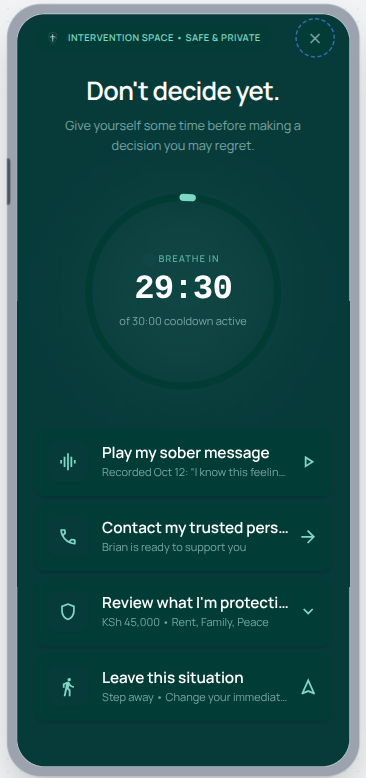
Intervention Cooldown
-
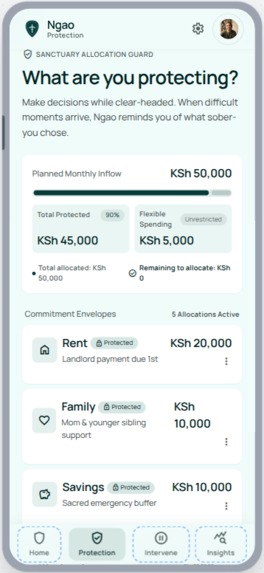
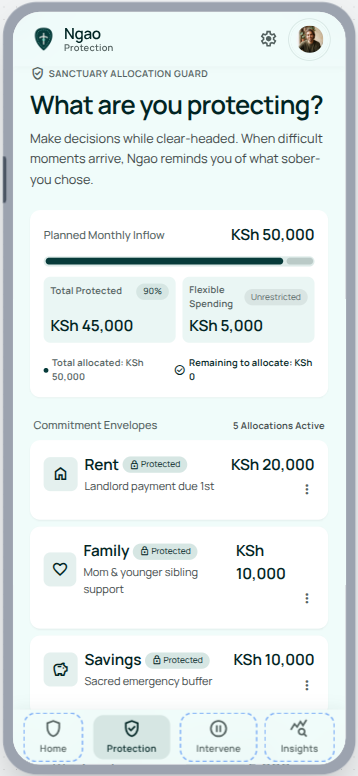
Protection Plan
-
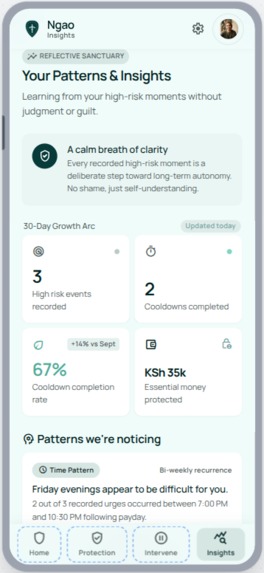
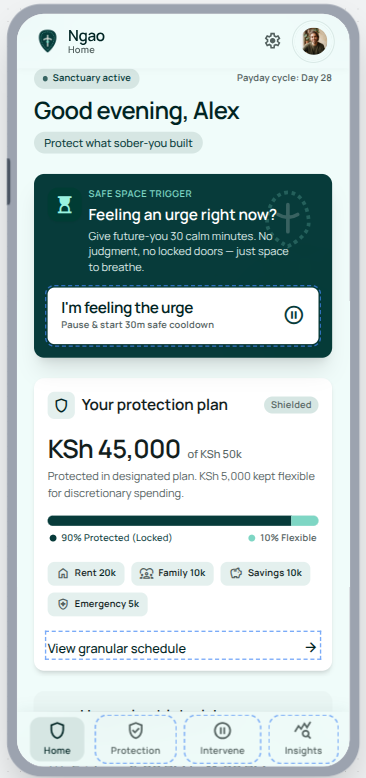
Home Dashboard
-
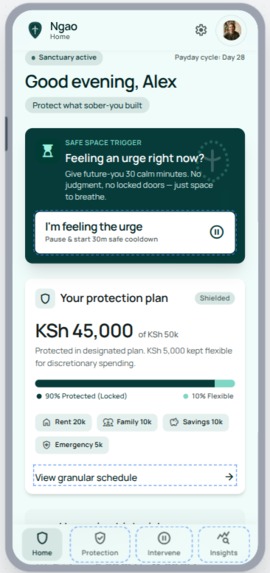
Ngao-Home Dashboard
Inspiration
Ngao started from something I observed close to home.
A close relative was struggling with alcohol use and poor financial discipline. What stood out to me was that they often understood their financial priorities while sober. They knew what their money was supposed to cover, but during periods of stress, cravings, or drinking, those decisions became much harder to maintain.
I noticed a recurring pattern:
Stress → craving → alcohol becomes accessible → money becomes accessible → impulsive spending → essential funds are depleted → financial stress → regret → another recovery attempt.
That made me realize that this was not simply a budgeting problem. The person often already knew what they should do.
The real question became:
How do we help someone protect the financial decisions they made while clear headed when they enter a high risk state?
That question became Ngao.
What it does
Ngao is a mobile financial self protection and recovery support system built around one principle:
Don't ask future-you to make a decision that sober-you could make today.
While sober, users create a protection plan for the money that matters most to them. They can define priorities such as rent, family obligations, savings, emergency funds, and discretionary spending.
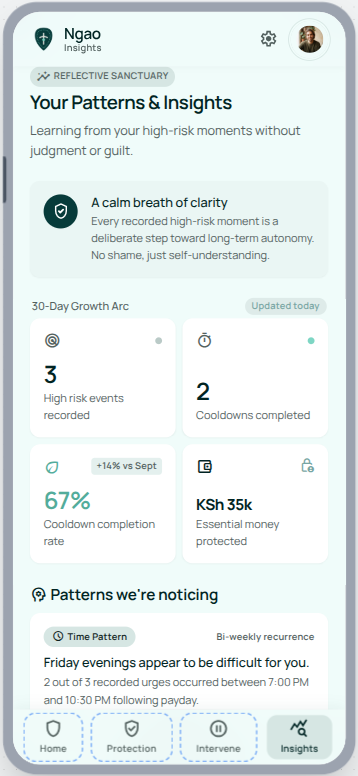
Ngao then helps users identify predictable high risk periods such as payday, weekends, evenings, stressful situations, and personal triggers.
When a high risk period arrives, Ngao changes the experience from simply tracking money to protecting decisions.
A user can activate an intervention that introduces friction before an impulsive decision is made. They can start a cooldown, listen to a personal message they recorded while sober, contact a trusted person, review what they previously decided to protect, and reflect on what happened afterward.
Ngao is not intended to shame users or claim to cure alcohol dependence. It is designed to help people prepare for moments when their decision making may be most vulnerable.
How we built it
We built Ngao as a mobile first product using Bilt.me, which allowed us to move quickly from the idea and user flows into a working application.
The core experience follows:
PLAN → PREDICT → INTERRUPT → PROTECT → LEARN
Users first create their financial protection plan and identify triggers or high risk periods. Ngao then prepares them for those periods and provides an intervention when an urge occurs.
The intervention combines practical tools such as cooldowns, sober messages, trusted person support, and reminders of previously defined financial priorities.
We also integrated RevenueCat for subscription management and premium entitlements. This allowed us to build the monetization layer into the product rather than treating it as something to add later.
Challenges we ran into
One of the biggest challenges was designing for a sensitive problem without making the product feel judgmental or reducing the user to their alcohol use.
We also had to decide what we could realistically prove with an MVP.
The initial version cannot actually control a user's bank account or physically lock away their money. Rather than pretending that it could, we focused on behavioral protection through planning, reminders, cooldowns, trusted support, and financial commitments.
Another challenge was turning a highly personal problem into a repeatable product experience that could eventually work for people with different triggers, financial situations, and patterns.
Accomplishments that we're proud of
We are proud that Ngao started from a real world observation and became a working product rather than remaining an idea.
We are particularly proud of the way the product connects financial protection, behavioral intervention, and social support instead of treating them as completely separate problems.
We are also proud of taking the project beyond functionality and thinking about it as a real business. Integrating RevenueCat gave us the opportunity to build a subscription model around recurring value and consider how Ngao could sustain itself after the hackathon.
Most importantly, we are proud of building a product around a simple but meaningful idea:
Sober-you already knows what matters. Ngao helps protect it.
What we learned
We learned that building a product is much more than building the technology.
We learned about launching a product and the importance of validating whether users actually understand the problem being solved and find the solution valuable.
We learned that marketing a product around a sensitive personal problem requires trust and careful language. People should feel supported rather than judged.
RevenueCat also gave us practical experience with subscription products. We learned that monetization is not simply adding a paywall. It requires deciding what creates recurring value, what should remain accessible, and how premium access is managed through entitlements.
We also learned to think about scaling from the beginning. A product inspired by one person's experience has to become flexible enough to serve many different users and contexts.
What's next for Ngao
The next step is to test Ngao with more users and learn which interventions are actually useful during high risk periods.
We want to improve personalization, strengthen the financial protection mechanisms, expand trusted person support, and eventually explore integrations with real financial services.
We also want to scale Ngao across different communities and regions, starting with Kenya and eventually reaching other markets where similar financial and behavioral patterns exist.
Long term, we see Ngao growing beyond its initial alcohol related use case into a broader personal resilience and financial self protection platform.
Protect what sober-you built.

Log in or sign up for Devpost to join the conversation.