Inspiration
Ledger descriptions often leave out the facts an accountant needs to decide withholding treatment. TaxTech makes those missing facts visible and keeps the accountant responsible for the final decision.
What it does
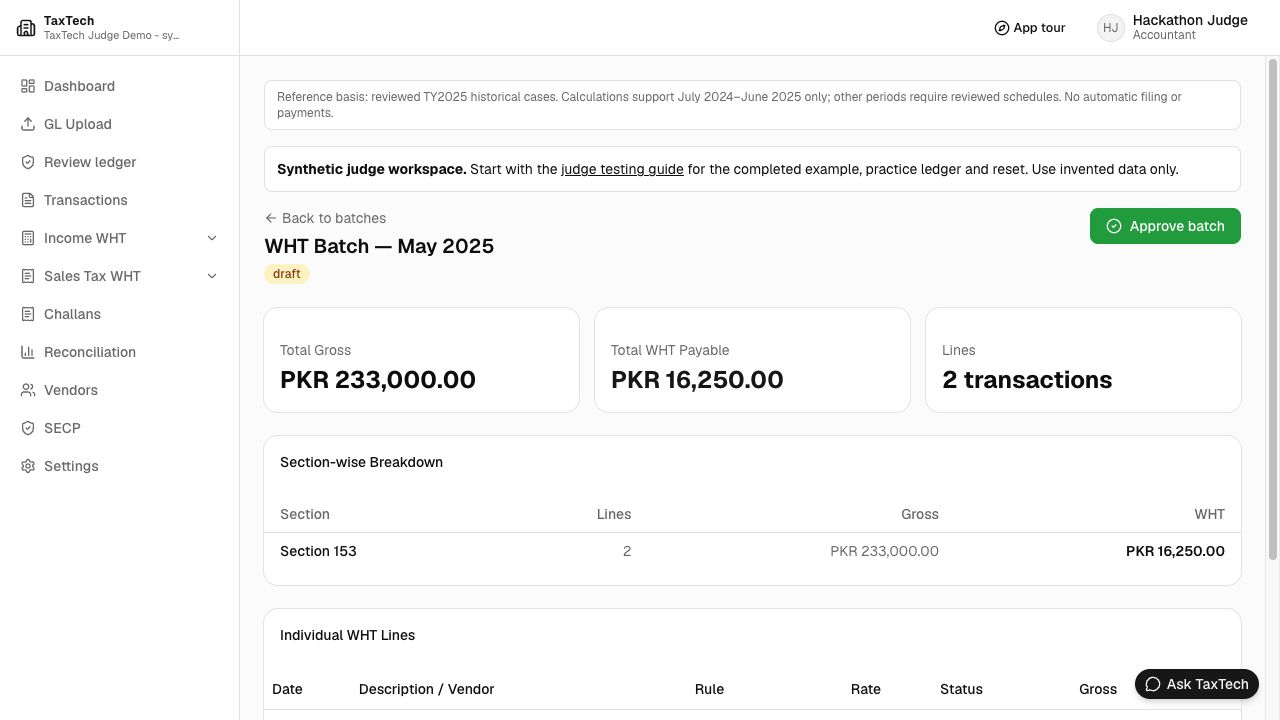
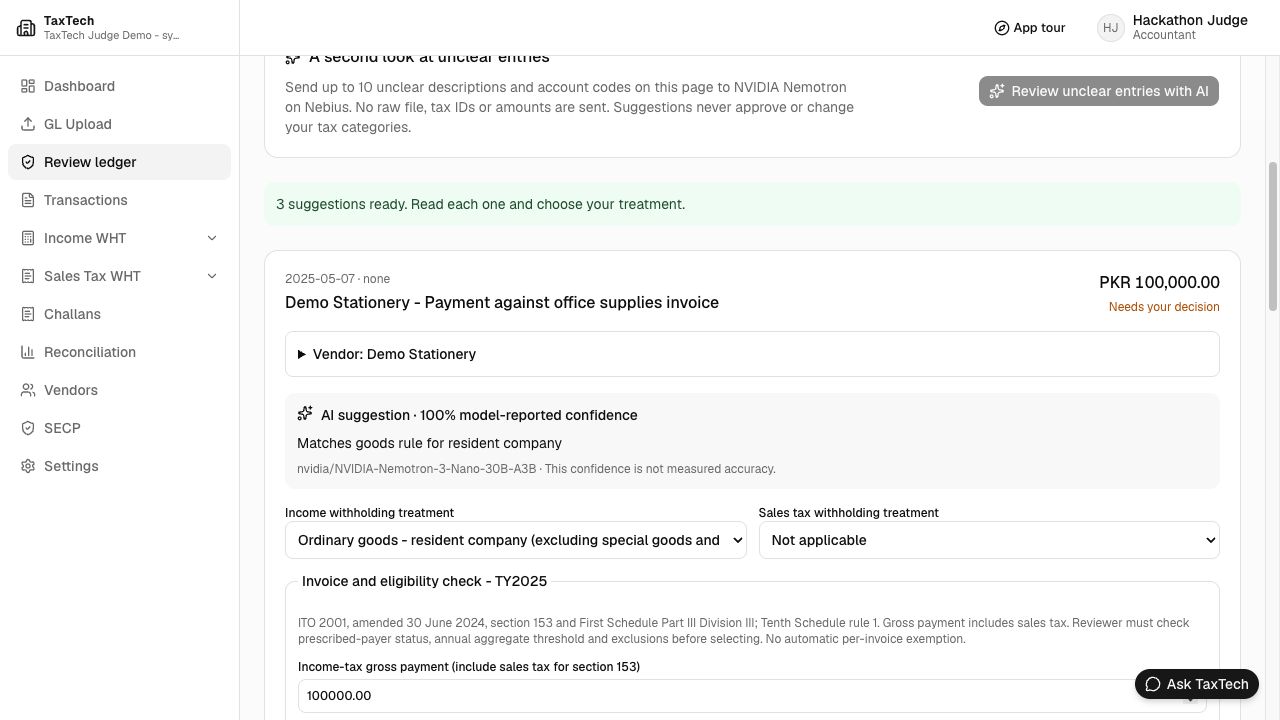
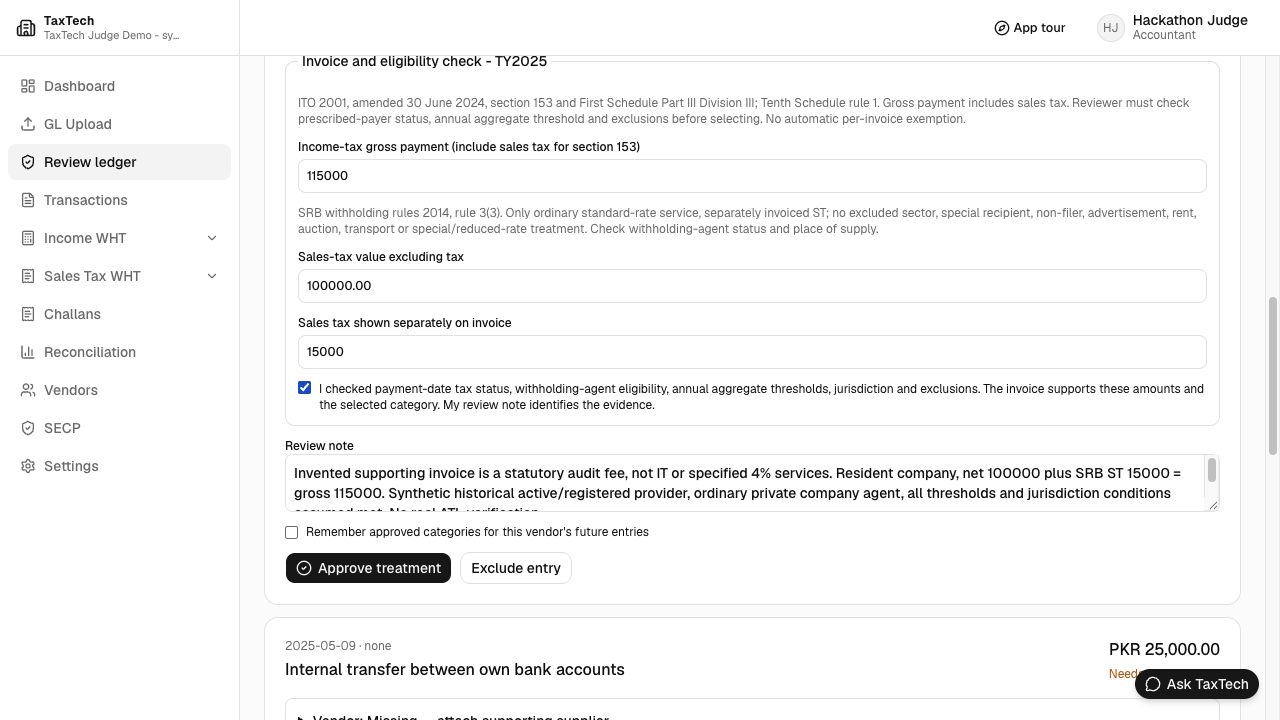
TaxTech — AI-Assisted Withholding Tax Preparation helps accountants prepare income and sales-tax withholding drafts. Ledger review is a step in this preparation workflow. TaxTech imports Excel/CSV ledgers, suggests known mappings and uses NVIDIA Nemotron to review unclear entries. The model proposes a category, explains its reasoning and asks for missing information. A person checks invoice and vendor evidence, records a decision and supplies the gross-payment and sales-tax bases. A deterministic engine then prepares tax batches and an internal PDF summary.
Ask TaxTech offers contextual guidance and navigation through the app. It cannot approve entries, file returns or make payments. Judges get an isolated workspace with a completed March 2025 example and resettable April practice, using invented data only.
How we built it
We used TypeScript, Next.js/React, NextAuth, Neon PostgreSQL and Drizzle, hosted on Vercel. Both ledger review and contextual assistance make real server-side calls to Nebius Token Factory using nvidia/NVIDIA-Nemotron-3-Nano-30B-A3B. We used Token Factory, rather than Nebius AI Cloud compute; we did not use Tavily.
Structured model responses are validated against allowed entries and rule keys. Model suggestions stay separate from approval. Tax arithmetic uses exact decimal operations, recorded invoice bases and reviewed historical configuration. Tenant access checks, stale-draft checks and approved-period locks protect the workflow. Provider keys stay on the server.
Challenges and what we learned
A plausible ledger label is not enough to decide tax. Recipient type, invoice composition, historical status, jurisdiction and eligibility must be explicit. The main challenge was separating useful AI interpretation from financial authority. Historical source workbooks also contained mismatches, so we reconciled the enabled TY2025 cases and blocked unsupported treatments.
Accomplishments
The hosted synthetic workflow was tested from sign-in and import through live AI review, separate reviewer decisions, deterministic batches and PDF output. Tests also cover duplicate imports, tenant boundaries, approval locks and failure handling. The judge account cannot access the owner's company or global administration. The codebase includes monitoring and encrypted backup tooling; scheduled jobs are currently disabled.
Significant improvements during the hackathon
TaxTech existed before the contest as a ledger/compliance application. During the submission period we added runtime NVIDIA/Nebius classification, saved explanations and missing-information questions, a recorded human-review workflow, contextual assistance, a first-run tour, stronger access and transaction protections, deployment operations, reviewed invoice-based TY2025 cases and the dedicated judge experience.
The actual change history is public:
- Review APIs and workflow
- Assistant, workspace and tour
- Verification tooling
- Operations
- TY2025 invoice assessment
- Judge experience
Nebius and NVIDIA feedback
Token Factory let us use the same NVIDIA model for review and app guidance without operating a GPU service. In two hosted tests on October 21, 2026, classification returned in 4.992 seconds and assistance in 2.421 seconds. These are individual complete application round trips, including network/database work, not a model latency benchmark. Both responses passed application validation.
Ambiguous descriptions still require missing-information questions, application validation and a human decision. A documented machine-readable credit balance and expiry interface would help maintain inference availability throughout judging. We cannot give firsthand AI Cloud feedback because we did not use it.
Scope and limitations
This demo is configured for FY2024–25 (Tax Year 2025), July 2024–June 2025, with specific reviewed cases across FBR, SRB, PRA, KPRA and BRA. Tax constants can be modified for any tax year, together with its applicable rules, thresholds, salary bands and effective dates. A developer must update and validate the configuration before enabling another year. Editing admin rates alone does not enable it; this demo has no tax-year switch or simultaneous multi-year schedules. It is not universal tax coverage or current-year certification. Unsupported cases remain pending for specialist review. Salary figures are estimates, not payroll true-ups. TaxTech does not check live ATL registries, submit returns or make payments. All judge vendors, invoices and status assumptions are invented. We have not measured an accuracy score or percentage time saving and do not claim either.
What's next
Extend reviewed policy coverage with specialist input, evaluate classification on a labeled synthetic dataset, and measure the complete accountant workflow before making accuracy or time-saving claims.
Built With
- nebius
- nvidia
- typescript
