-
-
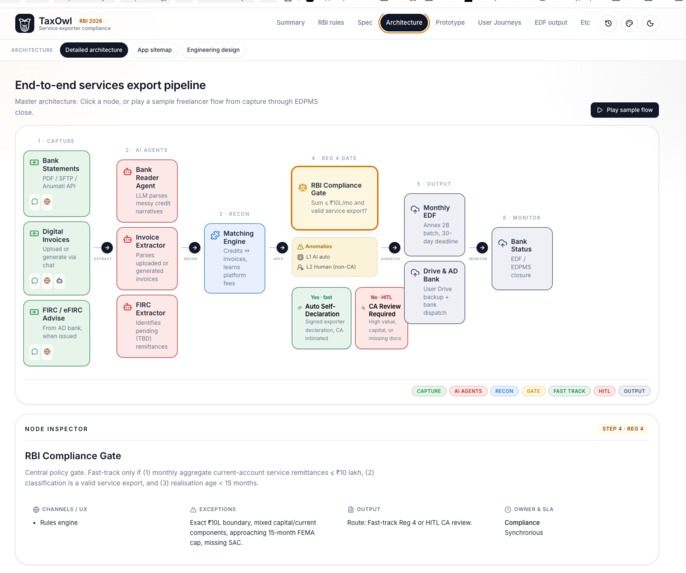
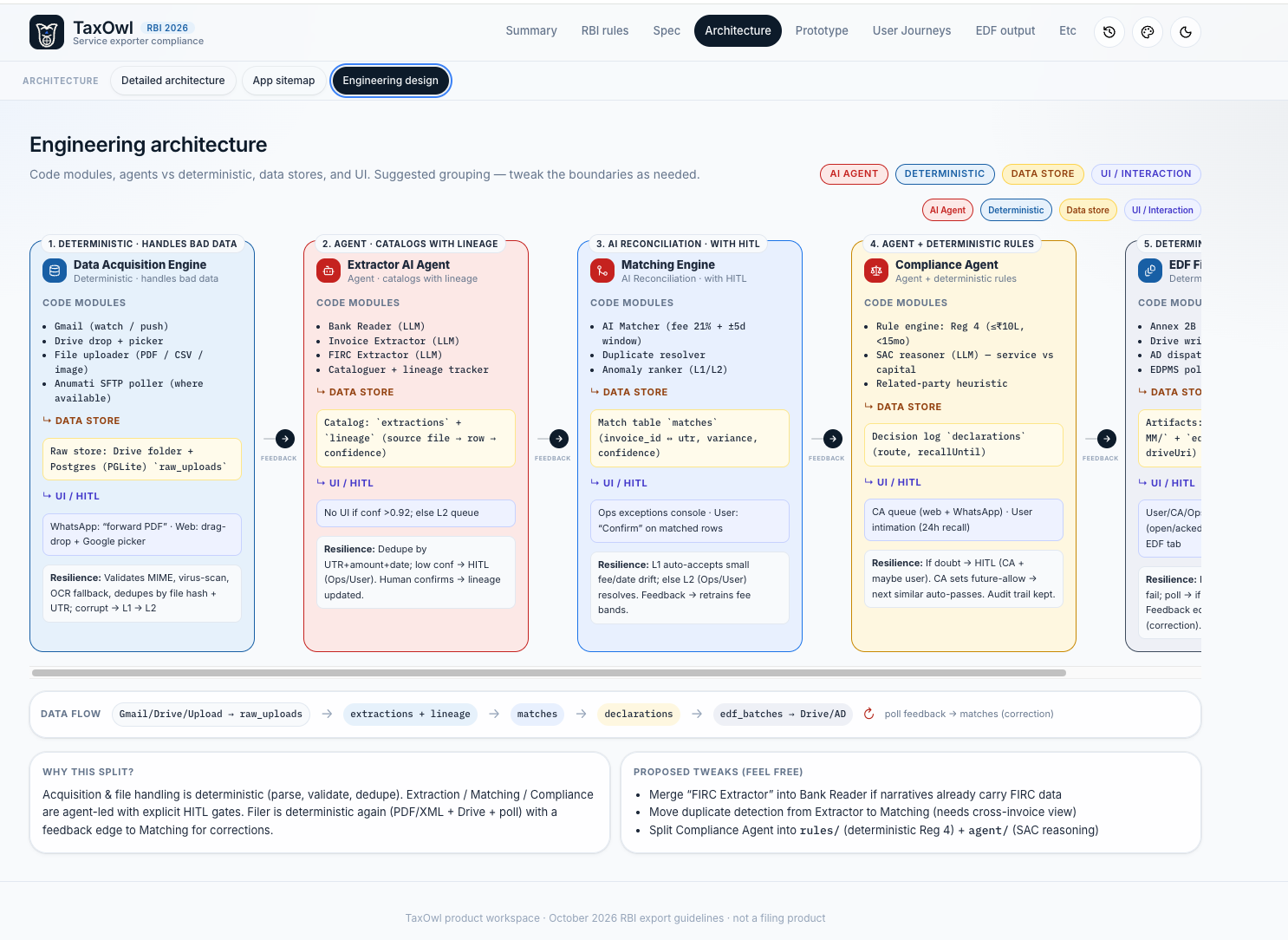
Logican architecture
-
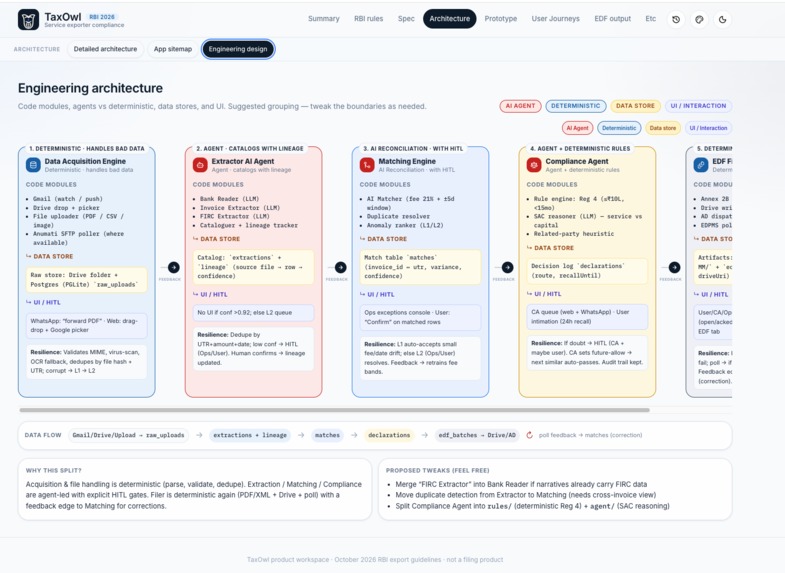
Eng architecture
-
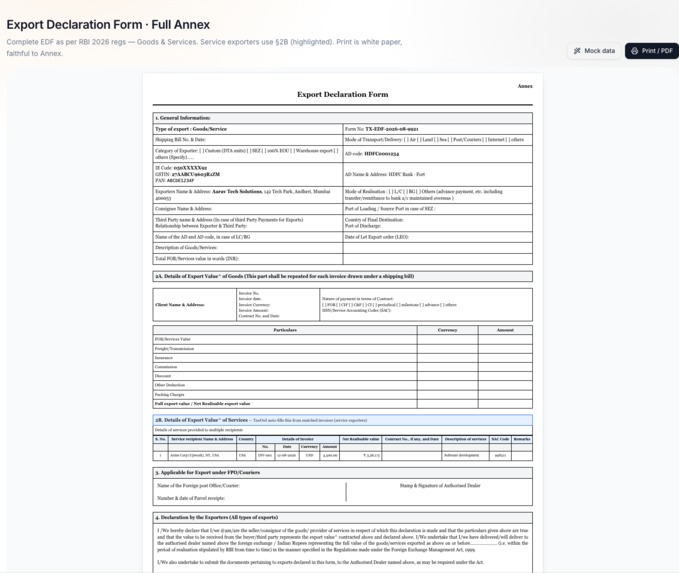
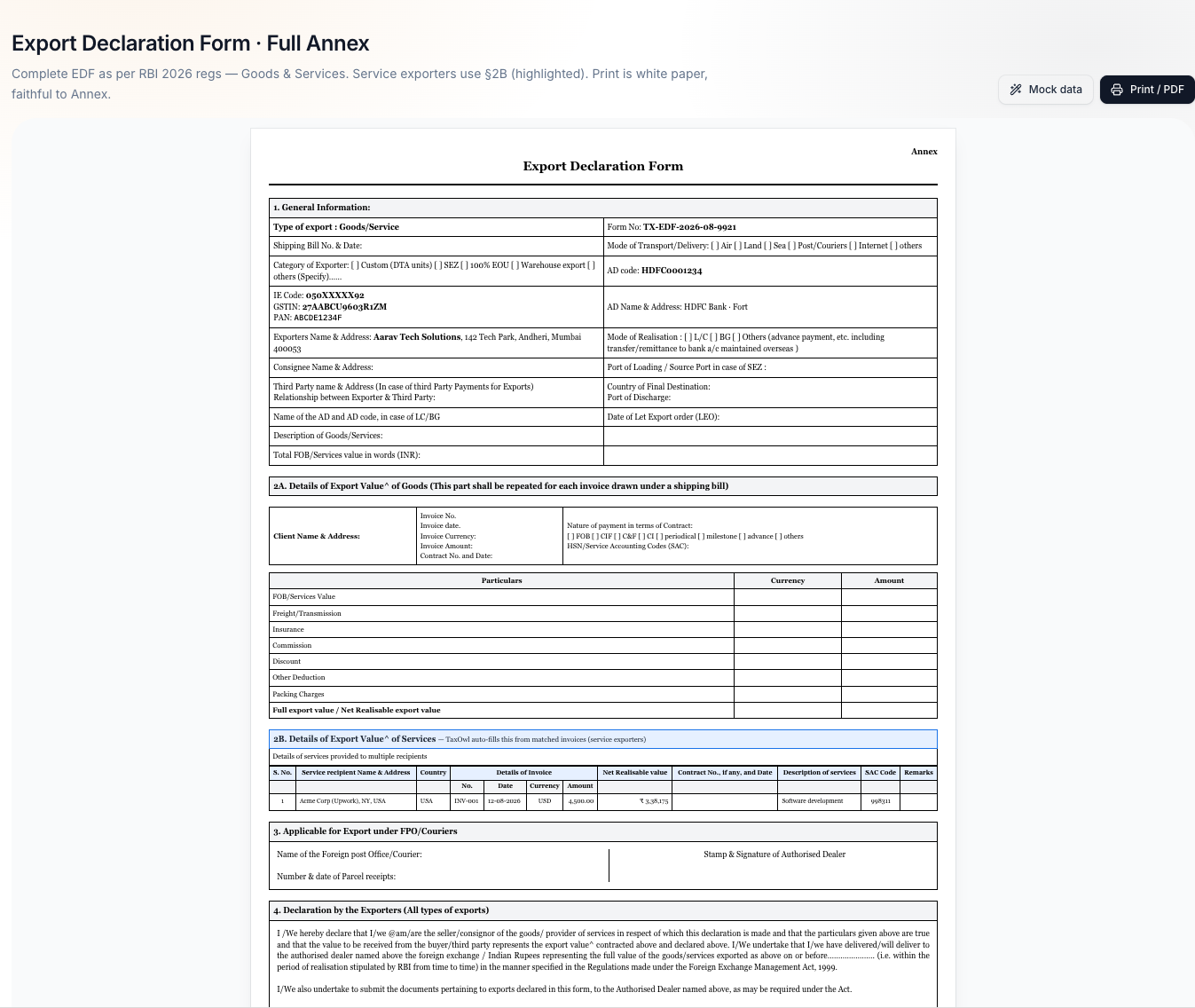
RBI compliant output
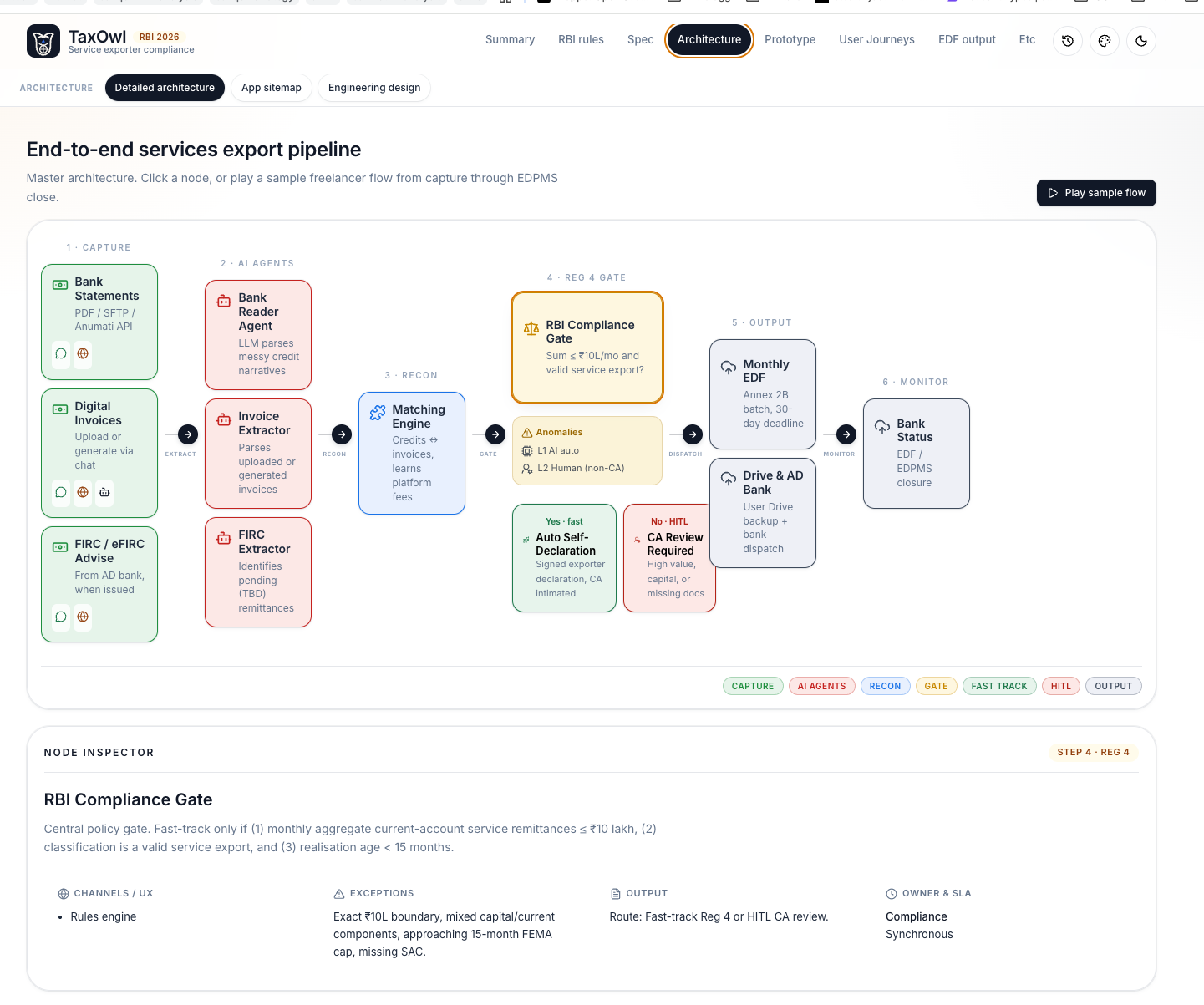
Inspiration
TaxOwl was born when an Engineer and a Banker turned AI enthusiast set out to build something deeply impactful. Recognizing the heavy administrative burden Indian service exporters and freelancers face under RBI export compliance rules (EDF/EDPMS reporting within 30 days), they interviewed dozens of Chartered Accountants to identify key friction points. They teamed up with Shrikant, a practicing CA, to design a solution that simplifies compliance for exporters while empowering regulators with transparent, audit-ready data.
Nirav and Shrikant conducted field interviews with freelancers and CAs to test affordability, usability, overall market research, and startup viability. The consensus was clear: manually reconciling international remittances across bank statements, platform payouts (Upwork, Wise), and FIRC/A advisories is expensive and error-prone. TaxOwl was created to give freelancers a seamless fast-track path while keeping CAs in the loop for complex exceptions.
What it does
TaxOwl is an AI-powered compliance desk that automates bank statement parsing, invoice matching, and RBI Export Declaration Form (EDF) generation:
- Multi-Channel Ingestion: Captures bank statements, digital invoices, and payout reports via WhatsApp, web uploads, or chat commands.
- Agentic Extraction & Validation: Employs multi-agent workflows to parse messy bank transaction strings, pulling UTRs, origin details, SAC codes, and FX conversion rates.
- FIFO Wallet Reconciliation: Uses a deterministic matching engine to reconcile platform withdrawals (Upwork, Wise) against open invoices using FIFO drawdown logic.
- RBI Compliance Gateway: Automatically routes transactions ≤ ₹10 Lakh to a self-declaration path while flagging high-value or unusual fee variances (>21%) for CA review.
- Statutory PDF Generation: Compiles standardized RBI Annex 2B compliant PDFs with totals converted to Indian numbering and realization deadlines calculated automatically.
How we built it
- Model Benchmarking & Selection: We benchmarked multiple vision and OCR models—including Gemma, ChandraOCR, and Qwen OCR. Based on our evaluation benchmark scores, we settled on Gemini 3.5 Flash OCR for its superior speed, security, and parsing reliability.
- Architecture & Roles: Nirav designed the system architecture and bank account extraction pipeline. Shrikant validated regulatory logic and FEMA compliance requirements. Bhavik and Saunak joined to complete the production build, bringing the entire solution to deployment in just 10 total man-days of development time.
- Tech Stack: Built on the Google Agent Development Kit (ADK) and deployed on Cloud Run with Cloud SQL PostgreSQL, FastAPI, and ReportLab for statutory PDF generation. Included local Gemma (
gemma4:e4b) fallbacks for zero-egress offline statement processing.
Challenges we ran into
- Platform Fee Deductions: Reconciling partial payouts (e.g., a $4,500 invoice yielding a lower net bank credit) required teaching our matching engine acceptable fee variance bands without triggering false compliance flags.
- Narrative Parsing Across Banks: Bank transaction formats vary widely in India. We paired LLM transcription with strict Python balance validation code to ensure the model never hallucinates financial figures.
Accomplishments that we're proud of
- Rapid 10-Man-Day Execution: Built and deployed a full end-to-end multi-agent statutory compliance pipeline in 10 total man-days of engineering.
- Grounded Escalation Matrix: Created a balanced two-tier model (Level 1 AI Auto-match and Level 2 CA Review) that maintains audit rigor without slowing down freelancers.
What we learned
- Model Capabilities: Testing models like Qwen OCR, ChandraOCR, and Gemini 3.5 Flash reinforced that high-stakes compliance requires pairing LLM transcription with deterministic code verification.
- Domain Dynamics: Gained deep operational insights into how RBI Regulation 4 self-declarations and EDPMS closures interact with Authorized Dealer (AD) Category-I banks.
What's next for Taxowl
Our journey has just begun. Between now and our planned public launch on October 1st, 2026 (when RBI FEMA 23(R)/2026-RB regulations take effect):
- Pilot Testing: Conducting structured testing rounds with partner CAs and contributing freelancers.
- Security & Scale: Hardening multi-tenant isolation, conducting security audits, and optimizing Cloud Run autoscaling.
- Direct Bank Integrations: Partnering with Authorized Dealer Category-I banks and Account Aggregator networks for direct API filing.


