Inspiration We wanted to create a tool that could help city planners, transport companies, and entrepreneurs forecast taxi demand based on real-world economic and population data — and present it in a visually appealing way that anyone could use. What it does
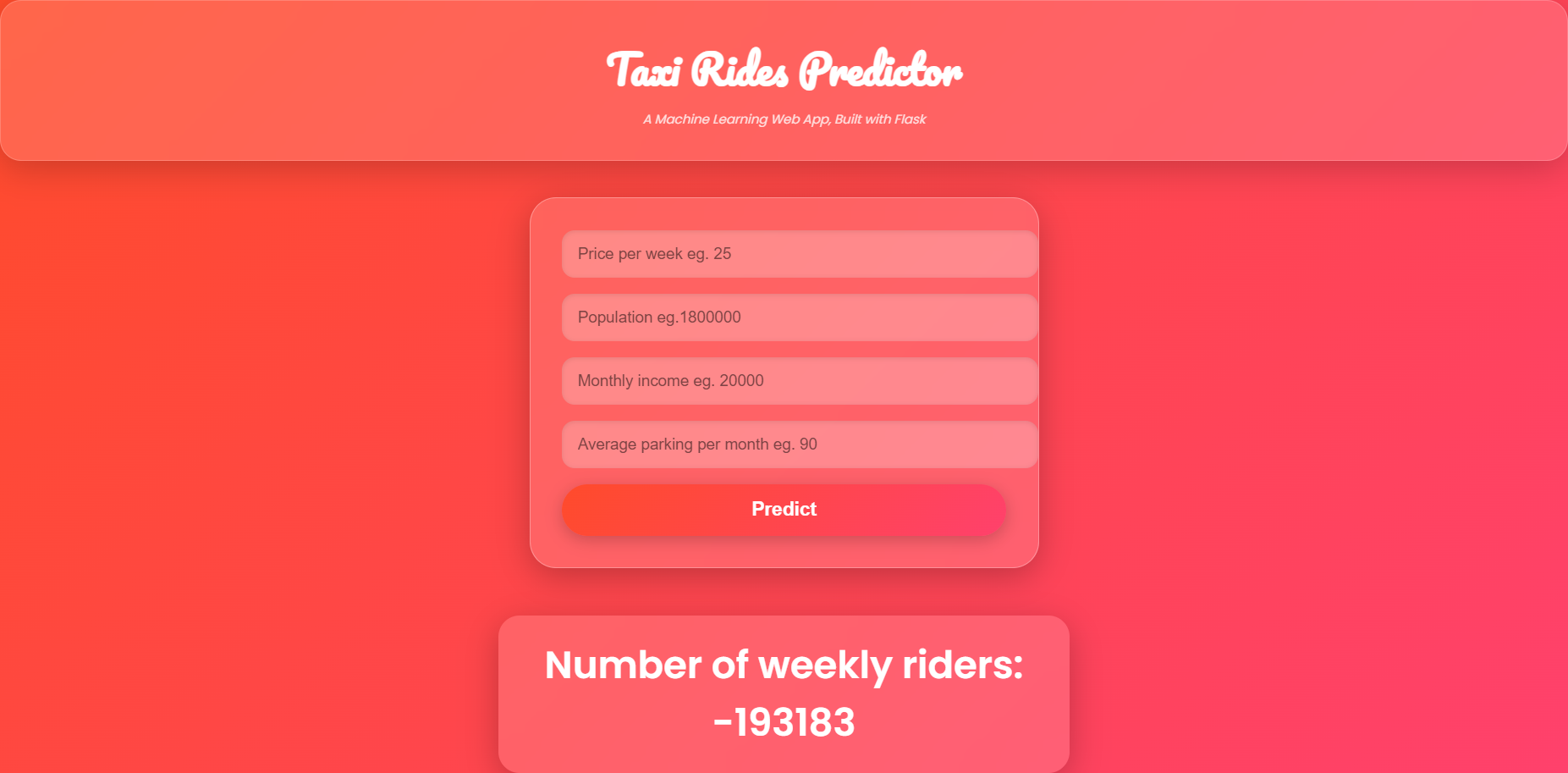
Taxi_ML predicts the number of weekly taxi riders given four inputs:
- Price per week
- Population size
- Average monthly income
- Average monthly parking cost
It displays the prediction instantly in a modern, glassmorphism-styled web interface with a dynamic disco light background.
How we built it
- Dataset Preparation: Collected and formatted CSV data containing historical pricing, population, income, parking costs, and rider counts.
- Model Training: Built and trained a regression model in Python, then exported it as model.pkl using Pickle.
- Backend: Implemented with Flask to handle form inputs, process predictions, and render the results.
- Frontend: HTML + CSS for a fluid UI/UX, with Google Fonts and Font Awesome icons.
- Styling: Applied a glassmorphism theme and an animated disco gradient background.
Challenges we ran into
- Formatting the CSV so it worked seamlessly with the ML model.
- Designing a clean and centered output section that didn’t break the background animation.
- Ensuring compatibility between local Python environments and deployment environments.
Accomplishments that we're proud of
- Creating an end-to-end ML web app that is visually engaging and functional.
- Achieving real-time predictions with minimal latency.
- Designing a UI that is both responsive and aesthetically modern.
What we learned
- How to integrate Flask with a trained ML model.
- How to center and style dynamic outputs without disturbing backend logic.
- The importance of user-friendly design in making ML tools accessible.
What's next for TAXI_ML
- Deploying on a cloud platform (Heroku, Render, or Railway) for public access.
- Adding data visualization charts for deeper insights.
- Expanding dataset coverage for multiple cities and regions.
- Enabling API access so other apps can request predictions.

Log in or sign up for Devpost to join the conversation.