Inspiration
I picture a first-time visitor in the back of a taxi from the airport. The driver asks something in a language they don't speak, then quotes a price far above a normal fare. Overcharging and detours are a common tourist-trap situation in many cities, and the traveller is stuck. They can't judge the price and can't answer, and they end up looking at a phone instead of at the driver. I wanted a tool that lets them keep their eyes up and stay polite, and still understand what's going on. Most drivers are honest, so the Lens should help you tell the difference, not treat every driver as a cheat.
What it does
The Lens starts with a choice of two modes.
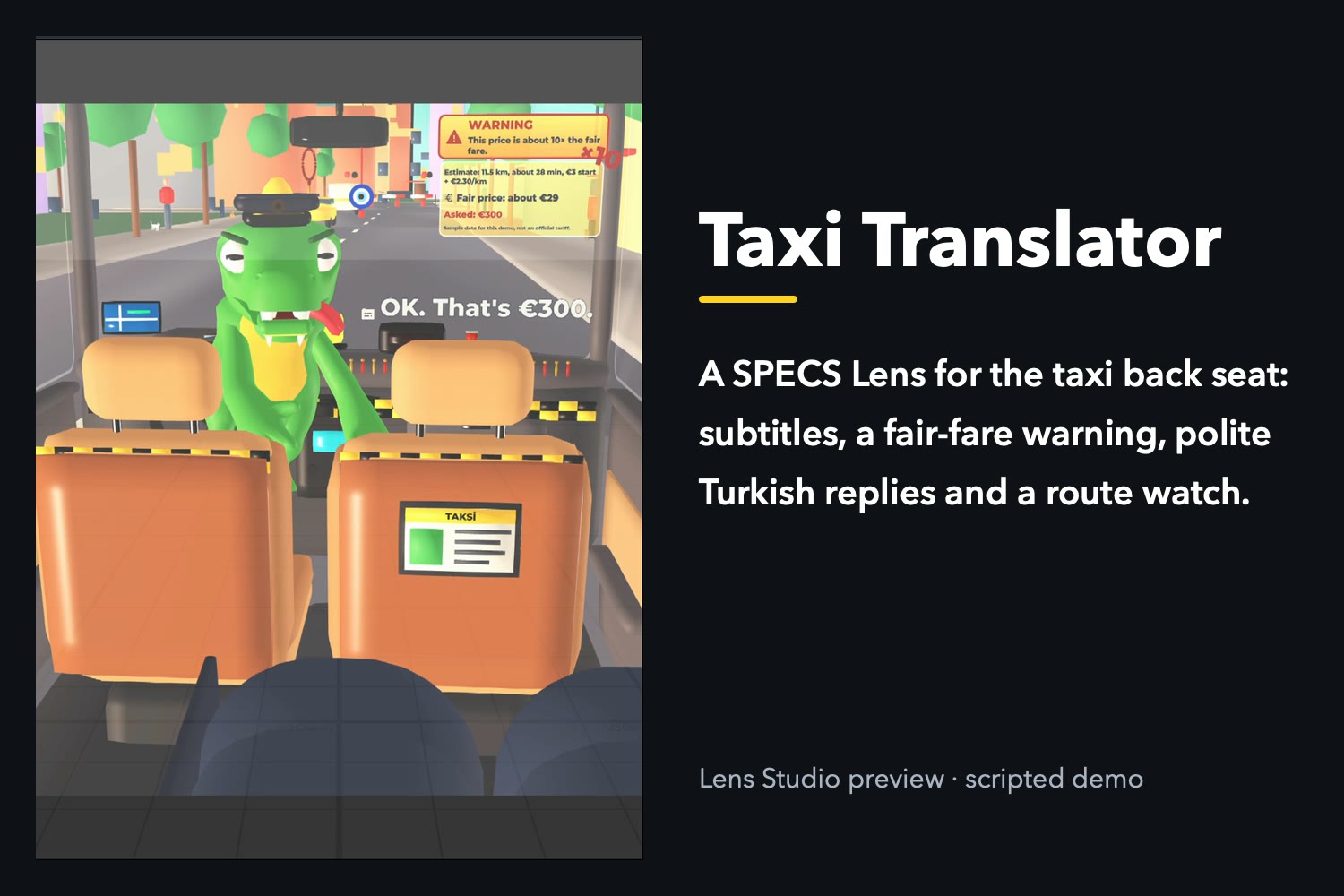
Rehearse puts you in the back-right seat of a virtual Istanbul taxi, with a cartoon lizard driver at the wheel.
- The driver asks where you're going in Turkish, then repeats it in English. Subtitles light up word by word.
- You pinch Speak on the seat back and choose:
- Read it myself: your Turkish phrase appears with an English-style phonetic spelling, and you say it out loud.
- Play it aloud: the glasses say it for you.
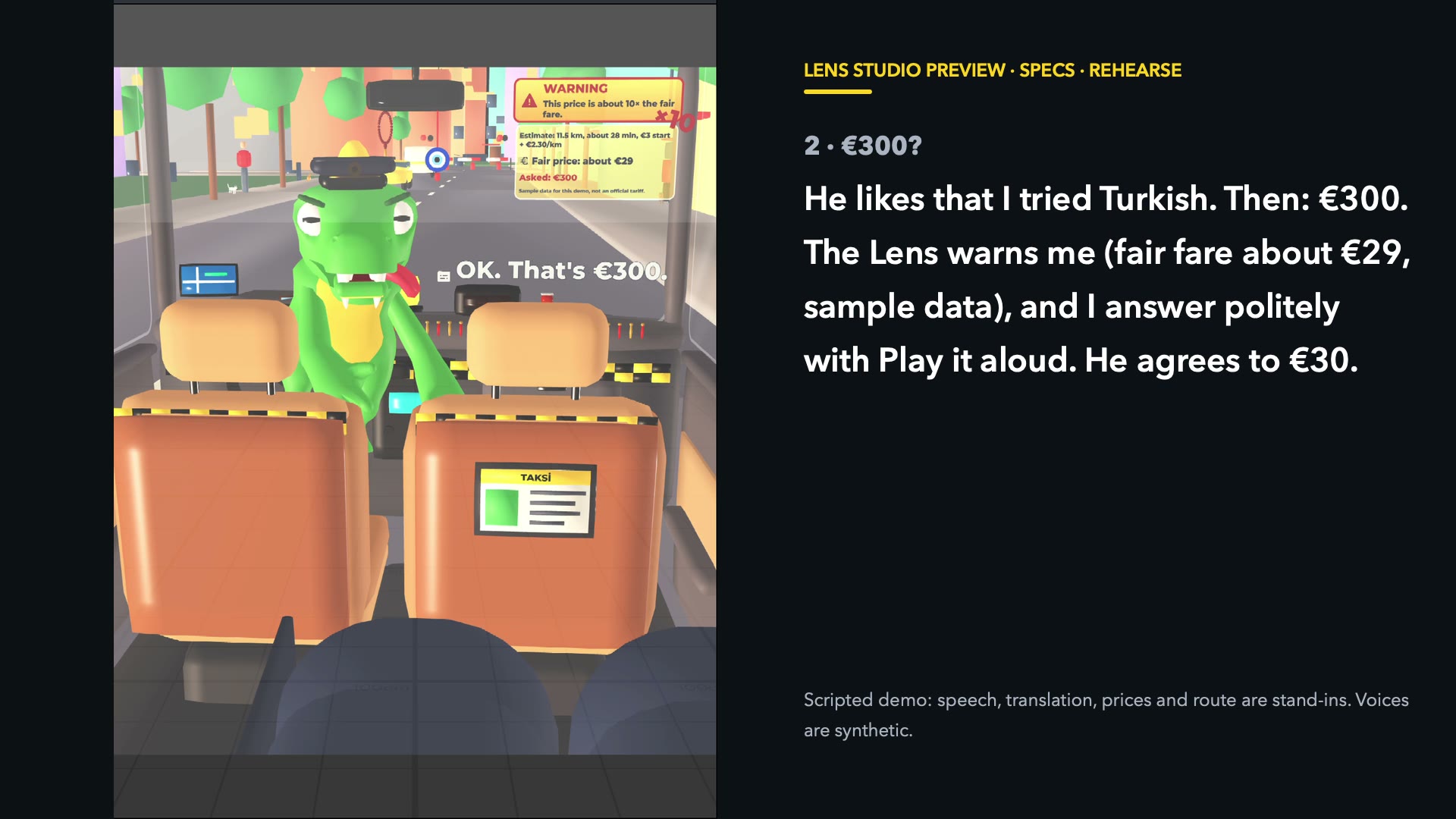
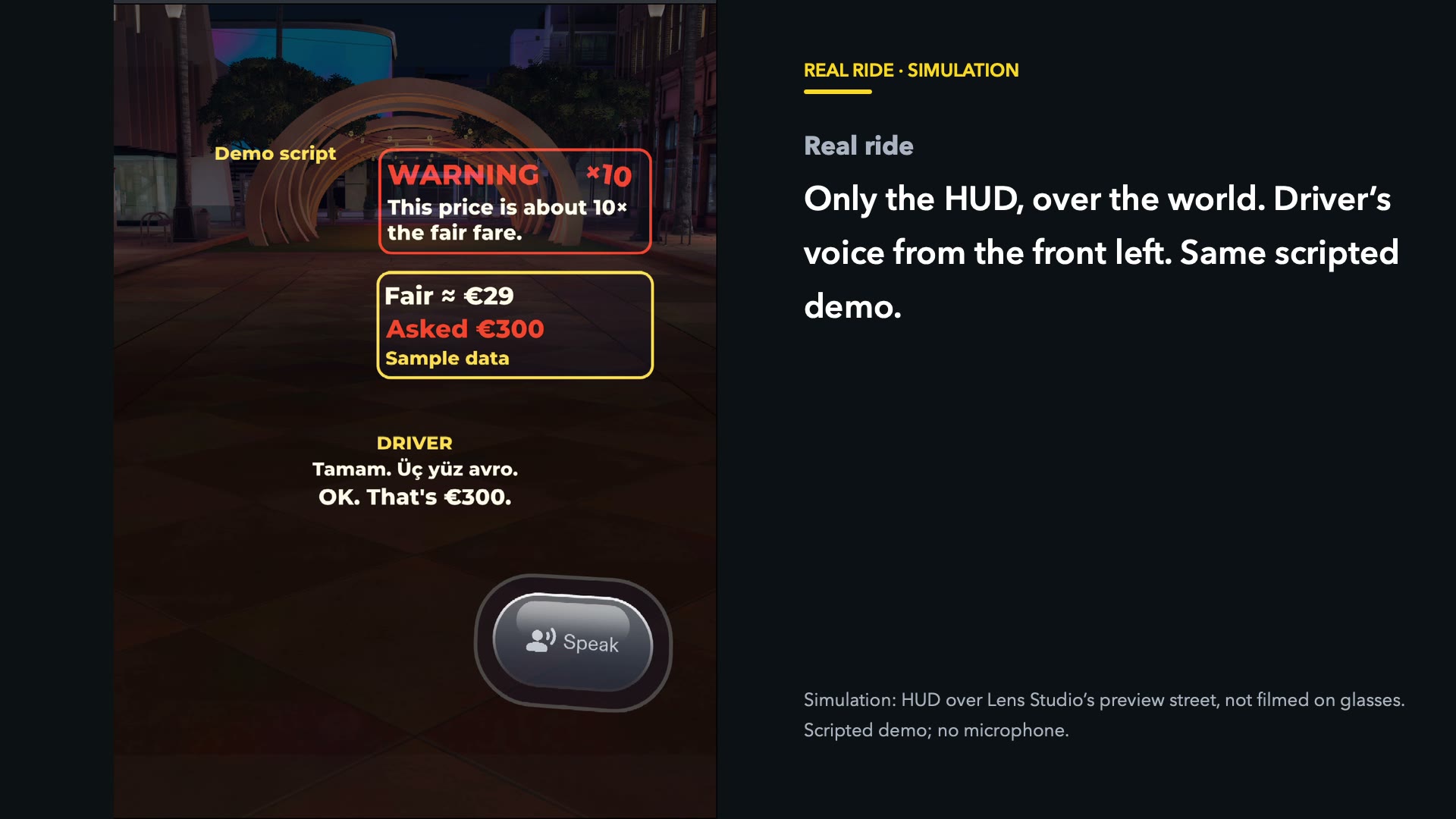
- He quotes €300. A WARNING appears ("This price is about 10× the fair fare."), with a fare card underneath: fair price about €29 for 11.5 km. The card is labelled "Sample data for this demo, not an official tariff."
- You answer politely in Turkish: "I understand, no problem. The normal price, thirty euros, please." He agrees to €30.
- A voice in your ear says: "Heads up. Check it, or ask him to switch it on." You ask him in Turkish to turn the taximeter on, and he does.
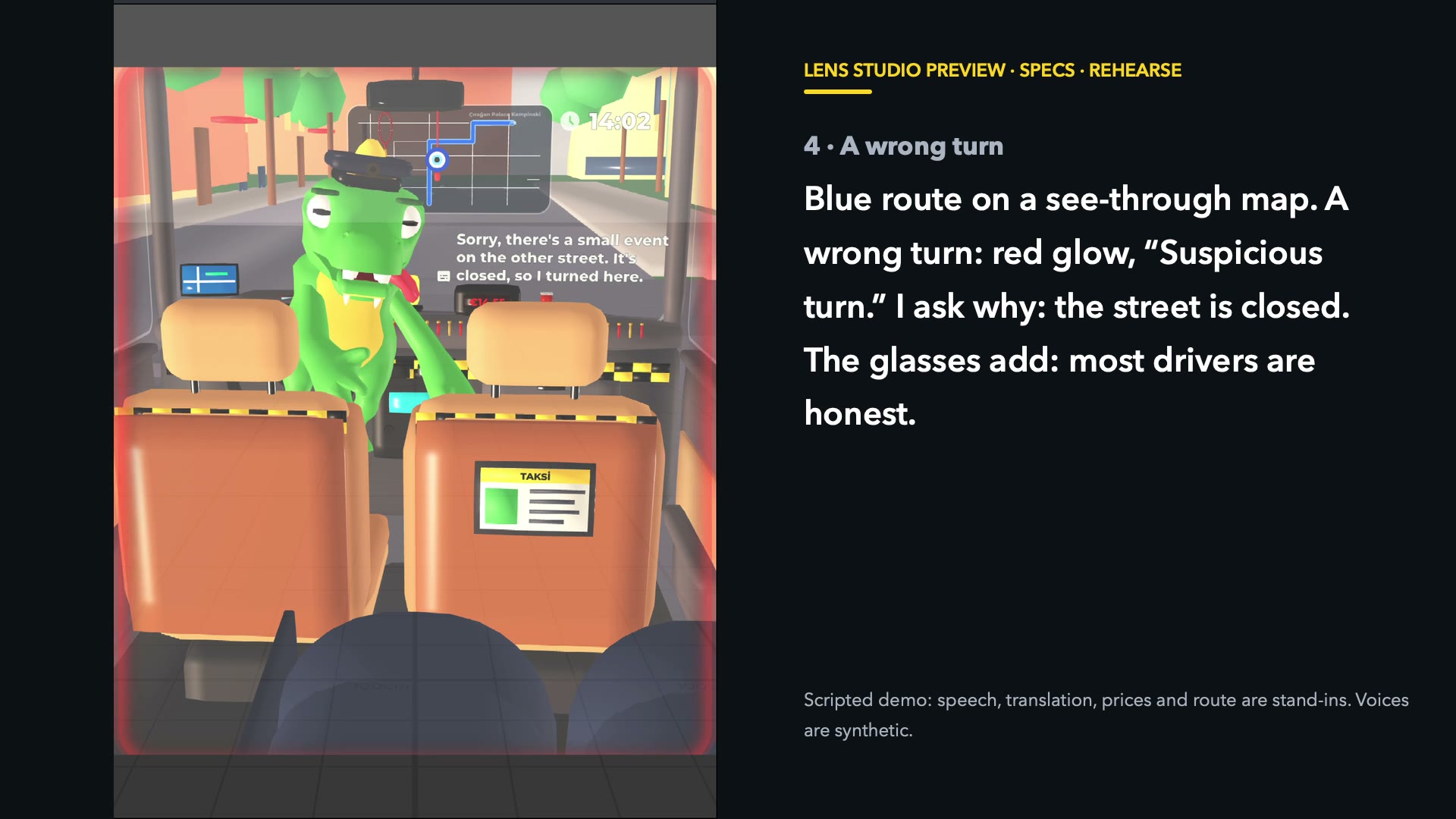
- The ride starts. A see-through map shows a blue route, along with a clock and the meter. The street moves past the windows, with city sounds.
- At a wrong turn, a red glow frames your view and an in-ear voice says "Suspicious turn." You can pinch It's fine, or Speak to ask why. He explains that the street is closed for an event. The glasses then add: "Good call: The road really was closed. Most drivers are honest; the glasses help you tell the difference."
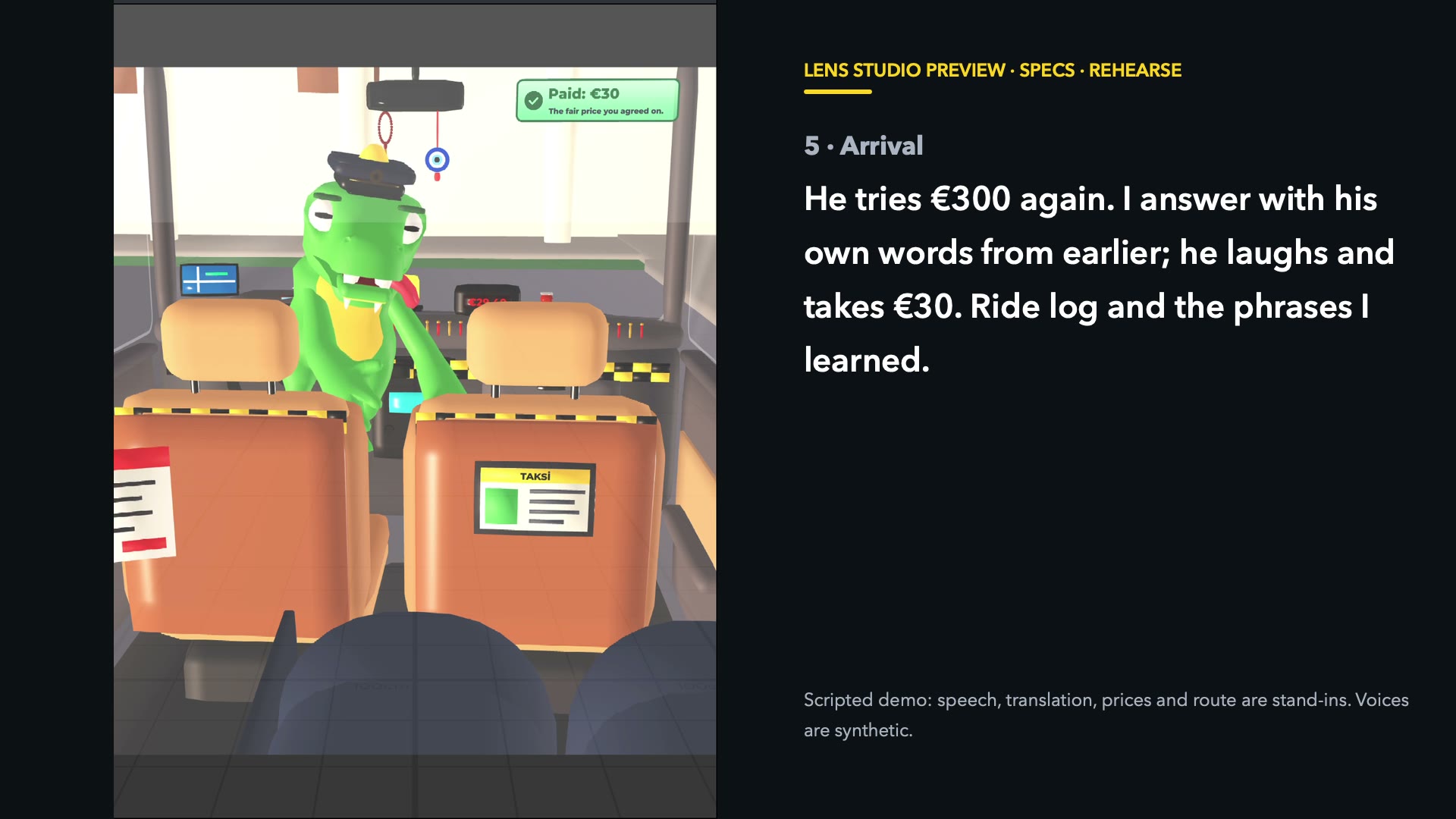
- At the hotel he tries €300 again. You answer: "No, we agreed on thirty euros. Here are your own words." The Lens plays back his earlier line, he laughs and accepts €30.
- The ride ends with a log ("Paid €30 instead of €300. Saved €270.") and a recap of the Turkish phrases you used. You can also tap objects in the cabin to learn their Turkish names.
Real ride removes the virtual taxi, driver, street and ambience. Only the heads-up display stays, over the real world:
- the driver's voice plays from the front-left, where a real driver sits;
- the display follows your head lazily and re-centres when you look away and back;
- warnings stay in the upper right, so the driver's face and the road stay visible;
- subtitles are centred with a speaker tag, and the Turkish original sits small above the English;
- the buttons stay in one fixed spot;
- text is bright and large enough for an additive display;
- a "Demo script" tag stays on screen the whole time.
What is real and what is a stand-in. This is a demo:
- Script: every line, translation, price and the route are scripted and played in order. No speech is recognised or translated live, and Real ride follows the same script.
- Prices: sample data, not a real tariff.
- Voices: synthesised with ElevenLabs voices through Higgsfield ("Andre" for the driver, "Imogen" for the glasses).
- Microphone: on real Spectacles, "Read it myself" can use the mic for an optional pronunciation score, in Rehearse only. Nothing is stored. In the Lens Studio preview it shows "Practice mode: no mic".
- Hotel: the Çırağan Palace hotel is used only as a destination, with no endorsement implied.
- Turkish: not yet checked by a native speaker.
How we built it
I planned the Lens with the Devpost Learn skill pack. The plan-lens skill interviewed me, and I answered each question myself. The result is the design brief in devpost/design-brief.md. I then directed an AI pair-programmer, Claude Code, to build the Lens in Lens Studio 5.25 through Snap's CLAD plugin (ls-clad) and the Lens Studio MCP.
- Interaction: TypeScript, Spectacles Interaction Kit and UI Kit, so every button works with a pinch, or with a mouse click in Interactive Preview.
- 3D:
- The driver is "Dino" by Quaternius (CC0), recoloured.
- The steering wheel is by Poly by Google (CC-BY 3.0).
- The cabin, seats, the passenger's hand and arm, the Istanbul street, skyline, cats, trams and ferries were all built for this project with small scripts.
ASSET_CREDITS.mdlists everything.
- Audio: the voices were generated from a line list, checked with speech recognition (faster-whisper), loudness-normalised with ffmpeg, and given word timings for the karaoke subtitles. The street ambience and taxi radio were generated with Higgsfield and looped with ffmpeg.
- Tests: LEAF scenarios check each done criterion in the preview. All 14 pass, including full rides in both modes. They check, on every frame:
- that at most two cards are visible;
- that the Real ride display stays inside the SPECS view;
- that the buttons never move;
- that text stays above a minimum angular size.
Lead developer: Khozhijon. I led the project from idea to submission and directed an AI pair-programmer (Claude Code) that helped write the code, which I reviewed and tested.
Challenges we ran into
- The narrow view. The SPECS view is only about 27 × 36°. Cards placed where I first designed them fell outside it, so I measured everything in degrees and set a hard limit of two cards at once.
- The additive display. Black renders as transparent, so dark panels vanish. Real ride uses bright, bold, larger text and outlined card borders instead.
- Real ride in a real car. The display mustn't stay fixed in the world, where it would drift behind you, and it mustn't sit over the driver's face. It now follows lazily, ignores quick glances out of the window, and clamps its pitch so that looking down doesn't drag it into your lap.
- Tone. Early versions had the traveller accuse the driver. I softened both the Turkish reply and the WARNING text, and added the honest-driver tip, so the Lens stays polite.
- Sound. My first street ambience was synthesised noise, and I could hear it. I replaced it with generated city sound.
Accomplishments that we're proud of
- A complete ride from pickup to payment, with a warning, a polite answer, a meter check, a wrong turn and a fair ending, in two modes.
- A design where the glasses really matter: your eyes stay on the driver and the road.
- Honest by design:
- sample data is labelled;
- a "Demo script" tag stays up in Real ride;
- there's a tip that most drivers are honest;
- every stand-in is listed in the README.
- 14 automated LEAF tests, including per-frame layout checks against the SPECS view.
What we learned
- Design in degrees, not pixels. The SPECS view is narrow, and measuring every element at real scale showed problems a sketch would not.
- A design brief with checkable done criteria lets an AI agent test its own work.
- Separate what the preview can prove from what only real glasses can. Daylight readability, tracking in a moving car and spatial audio on the device are still open questions.
What's next
These are plans, not built yet. Today both modes follow the same scripted conversation. A live mode is the next step. I have not built or tested it, and it would use these Spectacles APIs:
- Speech recognition: the Spectacles ASR Module, to transcribe the real driver. It runs only on the glasses, not in the Lens Studio preview. Snap lists 40+ languages, but I have not confirmed Turkish.
- Translation and speech: the Remote Service Gateway (OpenAI / Gemini) to translate his words, and its text-to-speech for "Play it aloud". This needs a Snap API token.
- Price check: the same WARNING logic, run on the live transcript (numbers plus "avro"/"euro").
- Real fare estimate: GPS through RawLocationModule, for the real distance.
- Privacy: a real version would keep only text, never audio, and would ask for the driver's consent where the law requires it.
Other next steps:
- Have a native Turkish speaker check the lines and the phonetic spellings.
- Try it on real Spectacles: daylight readability, tracking in a moving car, and the spatial voice direction.
- Add more cities and languages.
Built With
- clad
- claude-code
- elevenlabs
- faster-whisper
- ffmpeg
- higgsfield
- leaf
- lens-studio
- lens-studio-mcp
- plan-lens
- snap-spectacles
- spectacles-interaction-kit
- typescript
- ui-kit
