Inspiration
Most tax simulators answer one question: “How much tax do I owe?” They usually answer it after the tax year has ended, when it is already too late to make a decision.
TaxForward answers an earlier and more useful question: “What can I still decide before December 31, and what will that decision really cost me?”
The product insight comes from 26 years of accounting, financial analysis and tax experience. Individuals can access tax-return simulators, but useful year-end decision support often requires a professional. TaxForward makes that reasoning more understandable without hiding uncertainty, financial risk or the limits of the calculation.
What it does
TaxForward is a decision-support application for individual households.
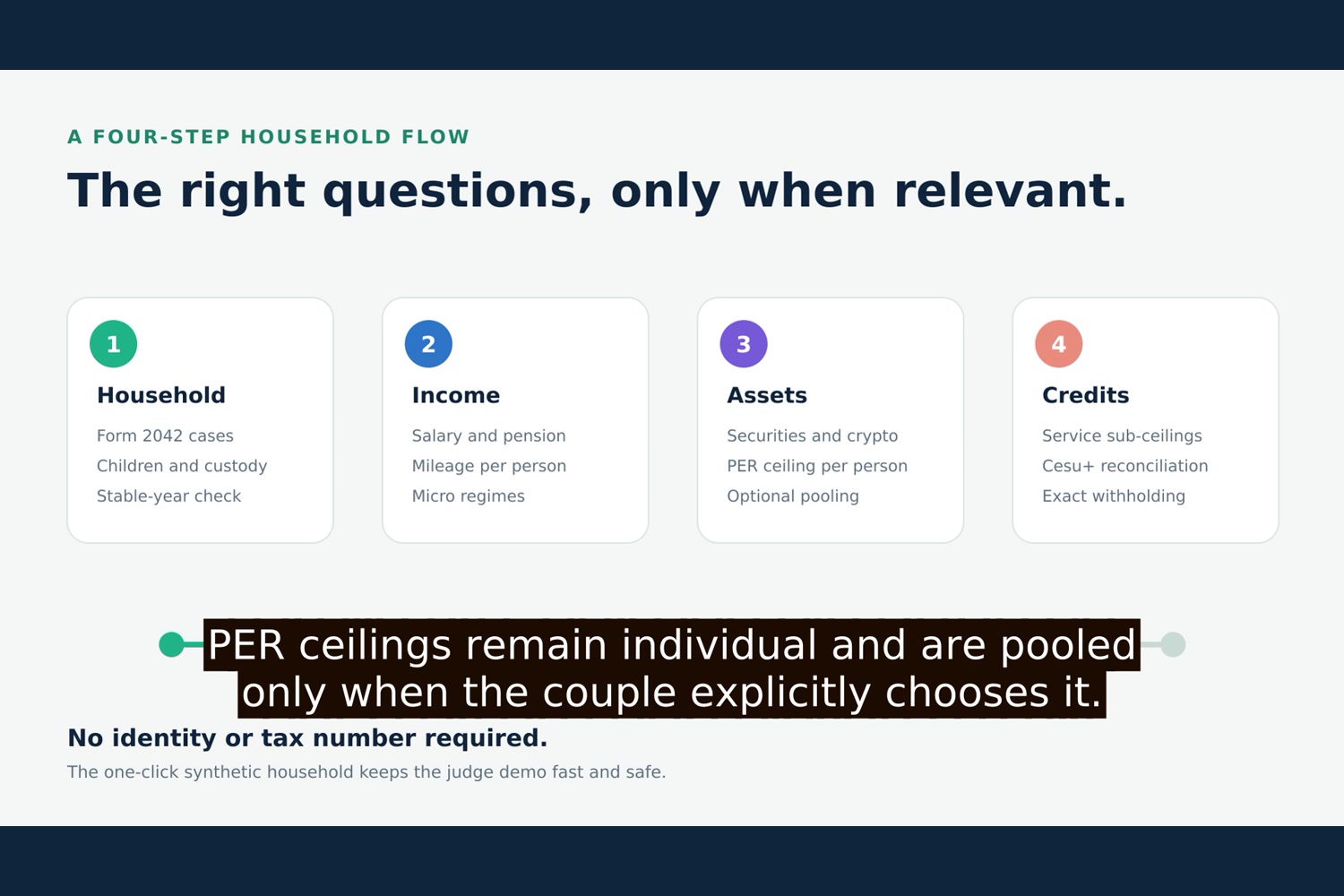
Its first rule pack covers standard households in metropolitan France. It collects household composition, salaries, unemployment benefits, pensions, investment income, securities and crypto gains, simplified property and non-professional business income, deductions, tax credits and withholding.
The application calculates employment expenses separately for each person, compares them with the standard 10% deduction and respects individual PER retirement-savings ceilings. For couples, it can test an explicit pooling of unused PER ceilings.
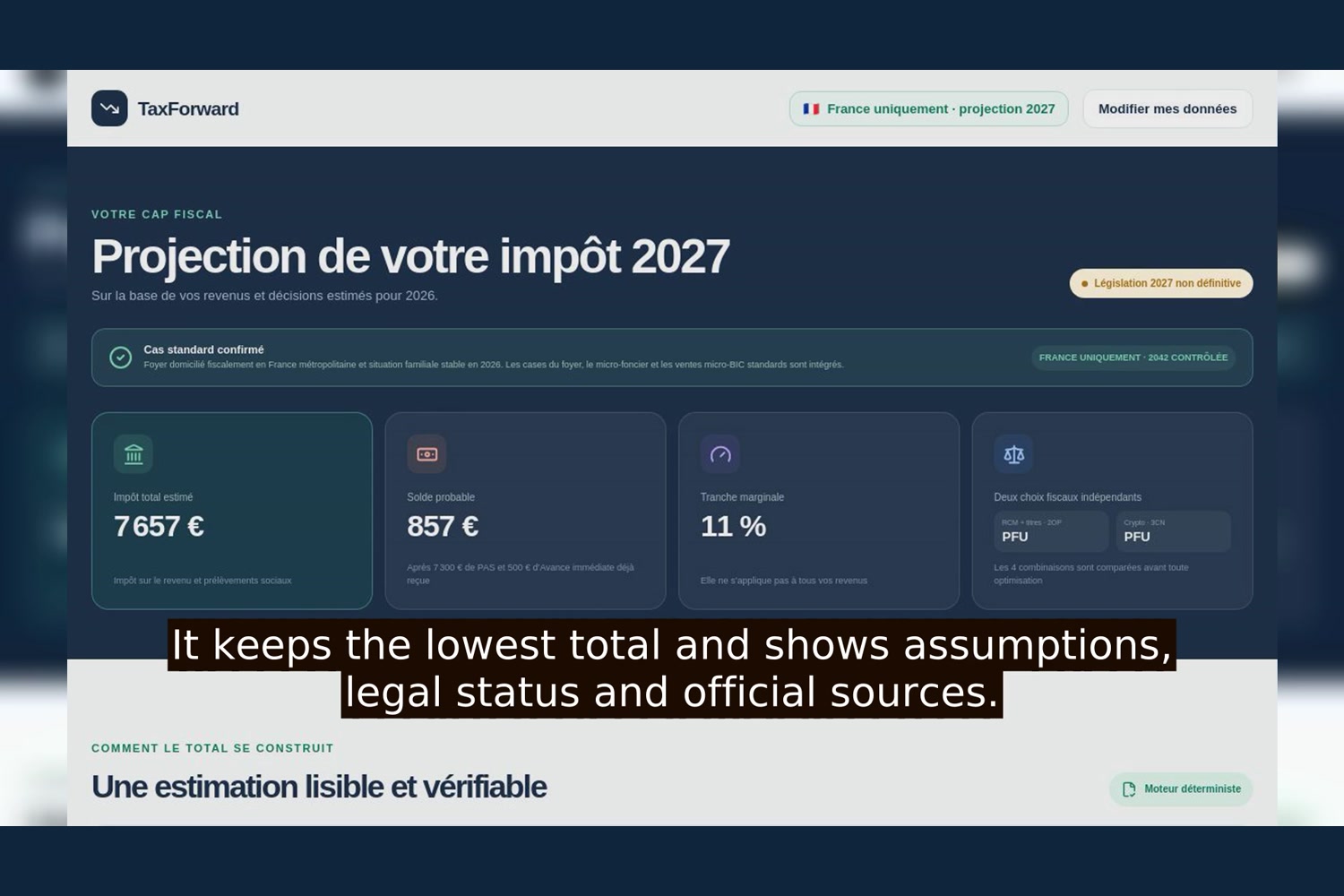
Before optimization, the deterministic engine automatically compares the available flat-tax and progressive-scale combinations and keeps the least costly result.
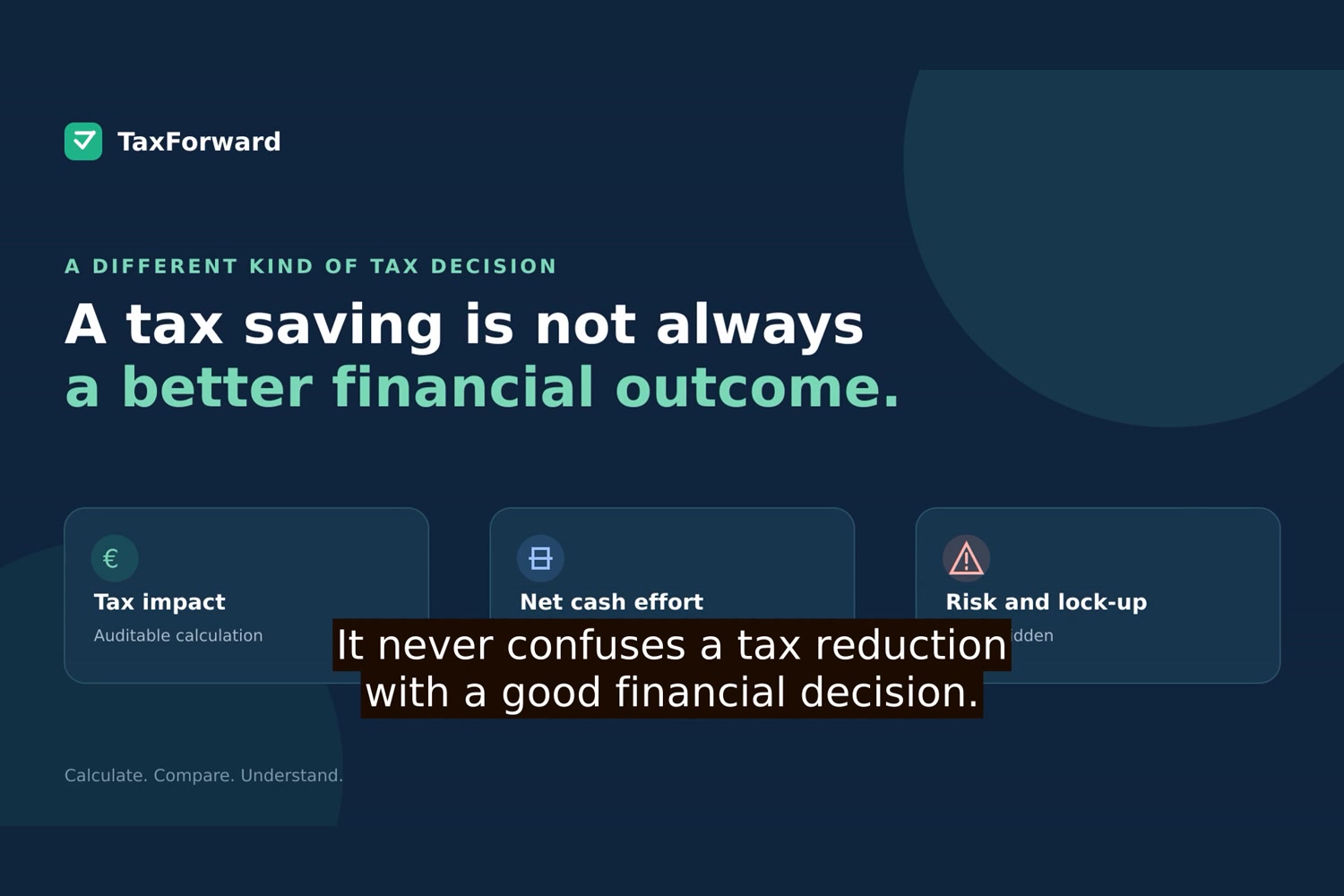
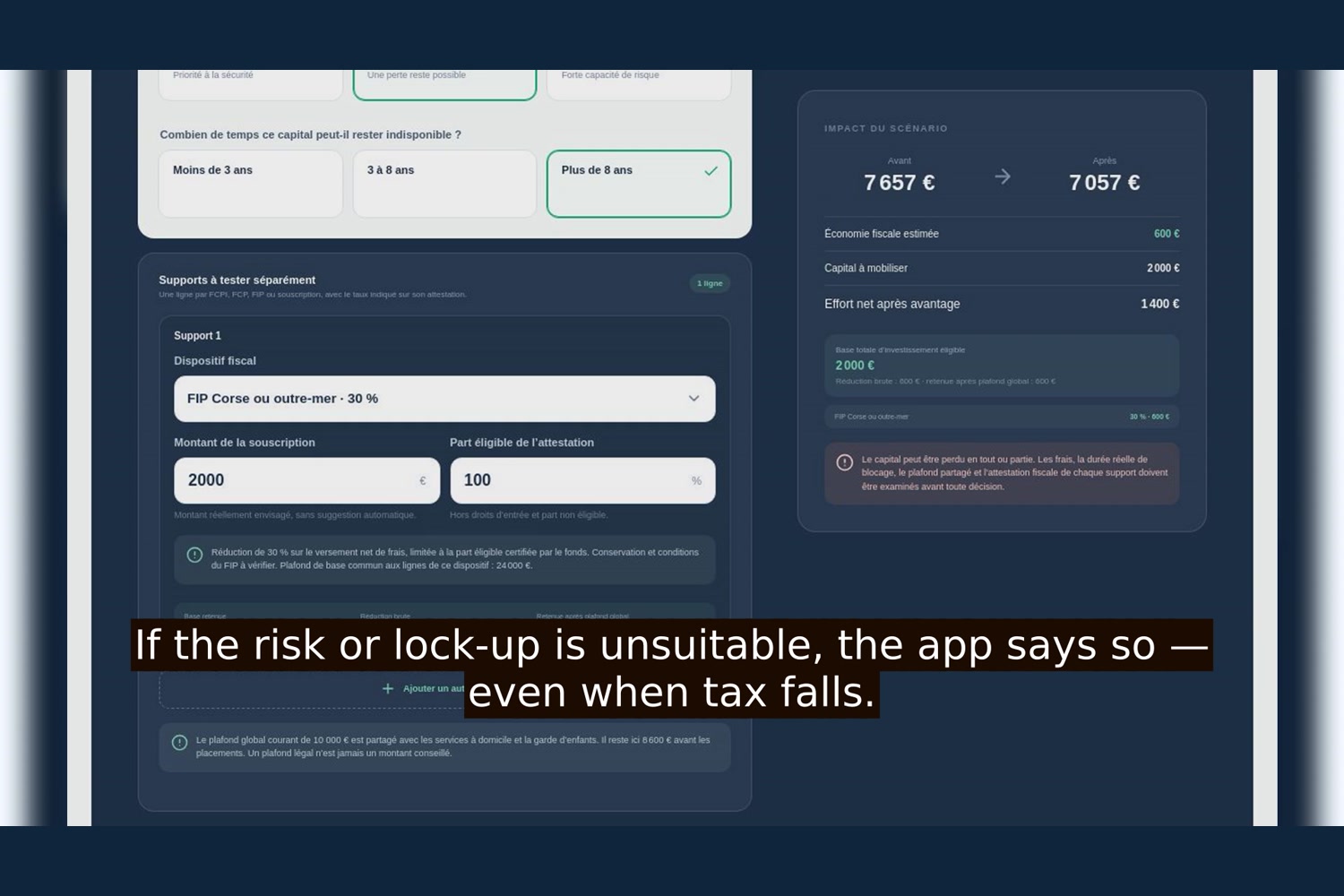
TaxForward then presents possible decisions without showing the tax saving alone. Every scenario also displays:
- cash committed;
- net financial effort;
- liquidity and holding period;
- fees and eligibility conditions;
- possible capital loss;
- the applicable legal ceiling;
- official sources and the status of the rule.
A tax-advantaged investment can therefore be marked unsuitable when it conflicts with the household’s risk tolerance or liquidity needs.
The application also includes a radar covering additional tax regimes. Straightforward cases are calculated, while complex regimes such as Girardin, Malraux, historic monuments, Denormandie and earlier rental-investment commitments are identified without inventing a gain before all conditions are known.
Honest scope
TaxForward clearly states what it cannot yet calculate.
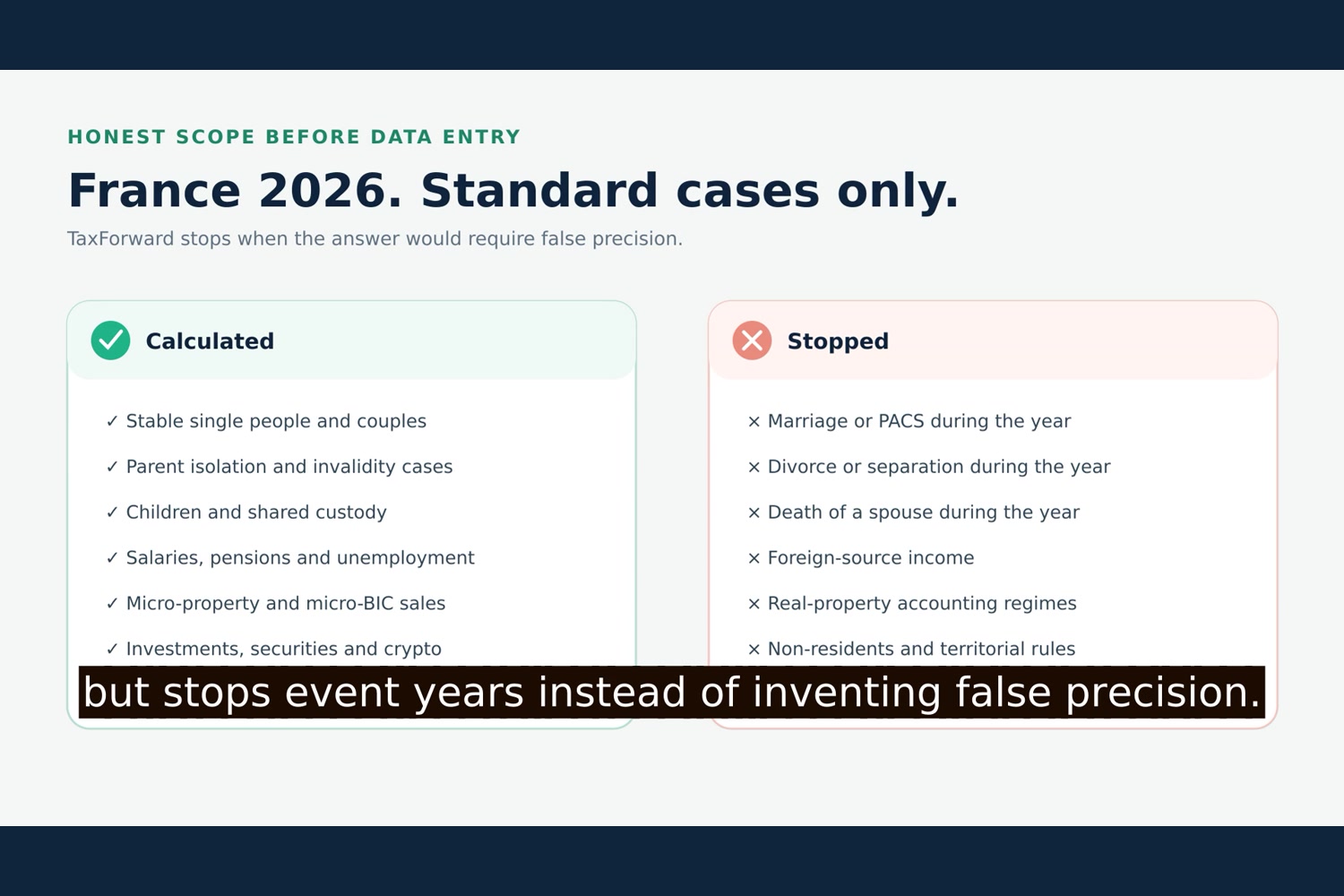
The current version is France-only and limited to standard cases. It blocks event years such as marriage, PACS, divorce, separation or the death of a spouse. Foreign income, detailed real-property regimes and other complex situations are reserved for later versions.
The projected 2027 tax is calculated from estimated 2026 income using the latest available rules at constant legislation. The interface clearly warns that the 2027 Finance Act is not final.
How we built it
The project was created from scratch during OpenAI Build Week using Codex and GPT-5.6.
The technical architecture separates:
- a versioned country-and-year tax rule pack;
- a deterministic and auditable calculation engine;
- a scenario and decision-card engine;
- official legal sources and update controls;
- a constrained GPT-5.6 explanation layer.
The application uses React, TypeScript, a Next.js-compatible App Router and Vitest. Its tax engine currently passes 27 regression tests, including synthetic household cases checked against the official French complete income-tax simulator.
GPT-5.6 Sol receives only figures already calculated by the deterministic engine. It turns them into a short and cautious explanation, identifies missing checks and explains the consequences of possible decisions. Its instructions explicitly prohibit recalculating tax, inventing an amount or promoting a financial product.
If the model is unavailable, the deterministic calculation continues to work.
How Codex helped
Codex transformed domain expertise and product decisions into a working application during the Build Week period.
It helped research primary official sources, challenge the initial product framing, design the country-year architecture, implement the calculation engine and interface, create regression tests, review edge cases and refine the full user experience.
The human product decisions remained central: serve individual households, forecast before year-end, keep AI away from the tax calculation, and never present a tax reduction without its financial counterpart.
Challenges
The hardest product challenge was preventing “lower tax” from being mistaken for “better financial outcome”.
The hardest technical challenge was keeping probabilistic AI explanation completely separate from the auditable calculation. TaxForward solves this through a deterministic engine, typed outputs, constrained prompts and a transparent fallback.
French taxation also contains many special cases. Instead of hiding this complexity, the product blocks unsupported situations and distinguishes calculated rules from devices that still require qualification or professional review.
Accomplishments
We are proud to have created:
- a complete consumer journey rather than a calculation-only prototype;
- a one-click synthetic household for judges;
- person-by-person employment-expense and PER calculations;
- automatic comparison of flat-tax and progressive-scale options;
- transparent multi-investment scenarios with shared ceilings;
- an explicit “not suitable” result for mismatched risky investments;
- a source-grounded legal-rule radar;
- a tested separation between deterministic tax calculation and GPT-5.6 explanation.
What comes next
Future versions will expand the French rule pack, calculate a dedicated reference tax income, import tax-notice data with user consent, monitor legal changes automatically and add independently reviewed country packs.
TaxForward’s long-term goal is to make cautious, source-grounded year-end tax decision support accessible across countries without mixing their laws or hiding their risks.
Built With
- api
- cloudflare
- codex
- gtp-5.6
- next.js
- openai
- react
- sites
- typescript
- vinext
- vitest


Log in or sign up for Devpost to join the conversation.