-
-
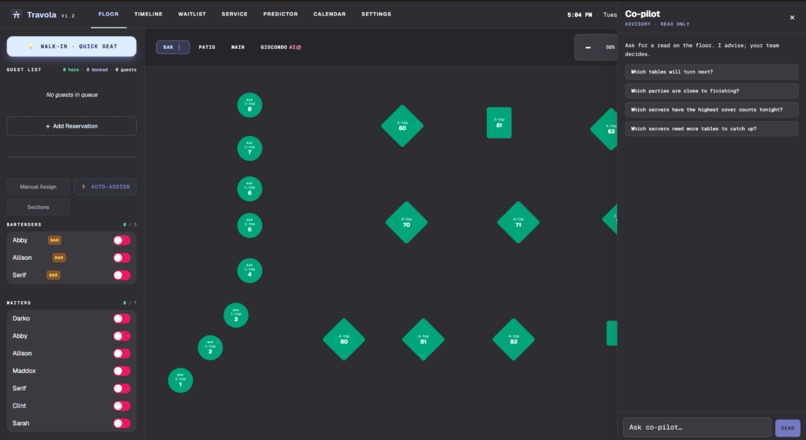
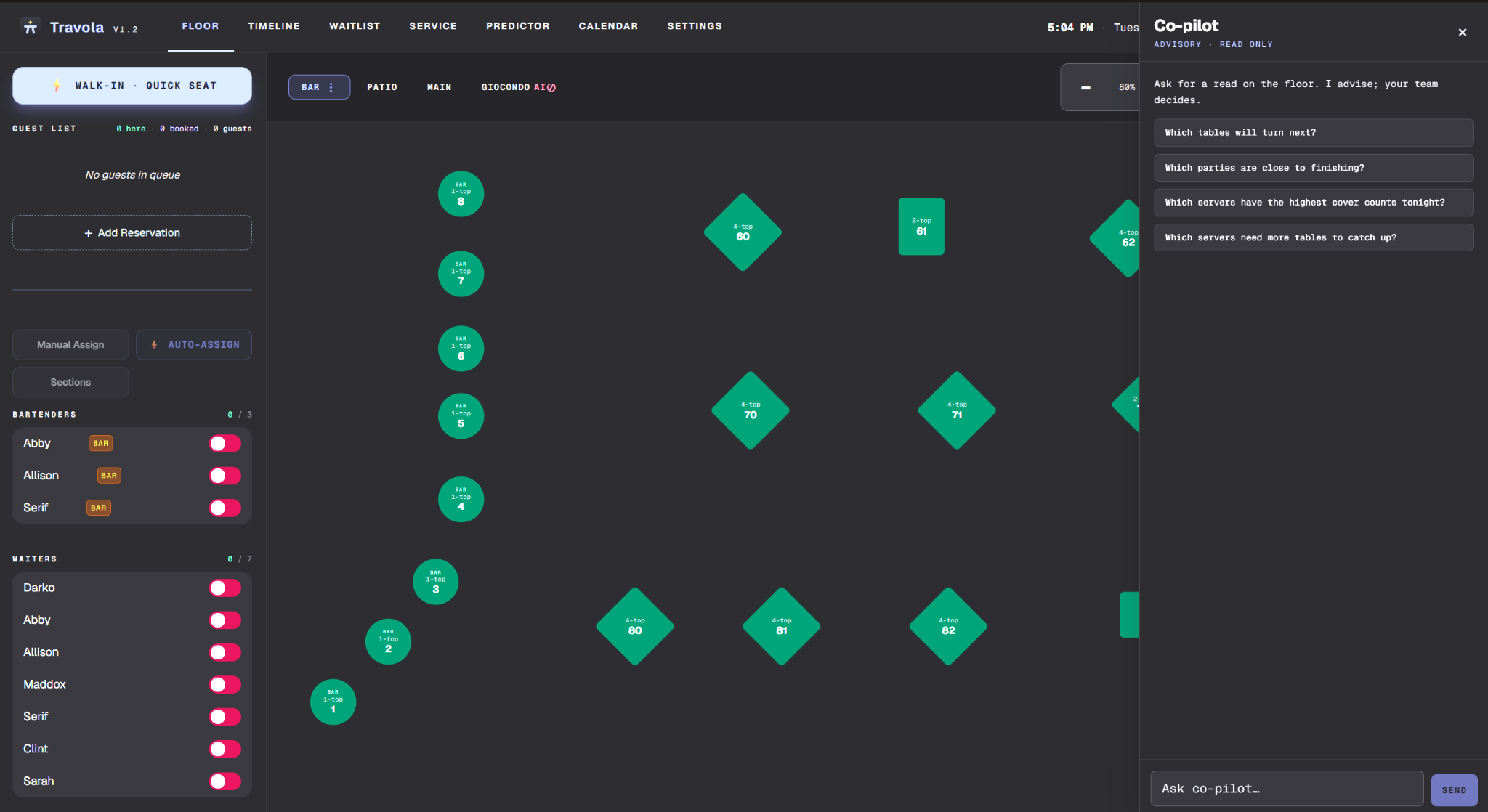
Co-pilot
-
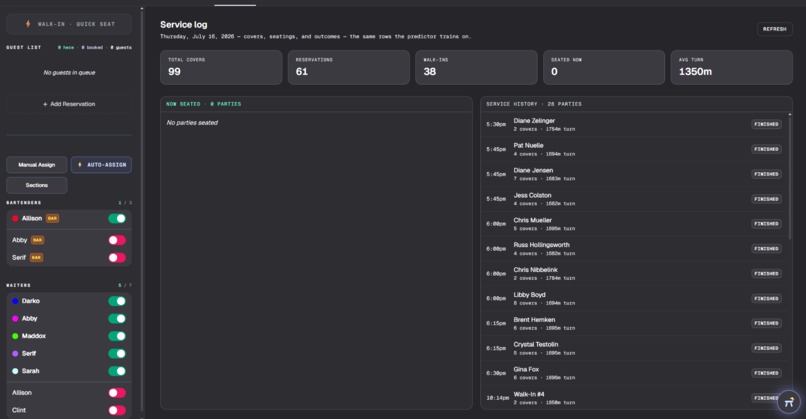
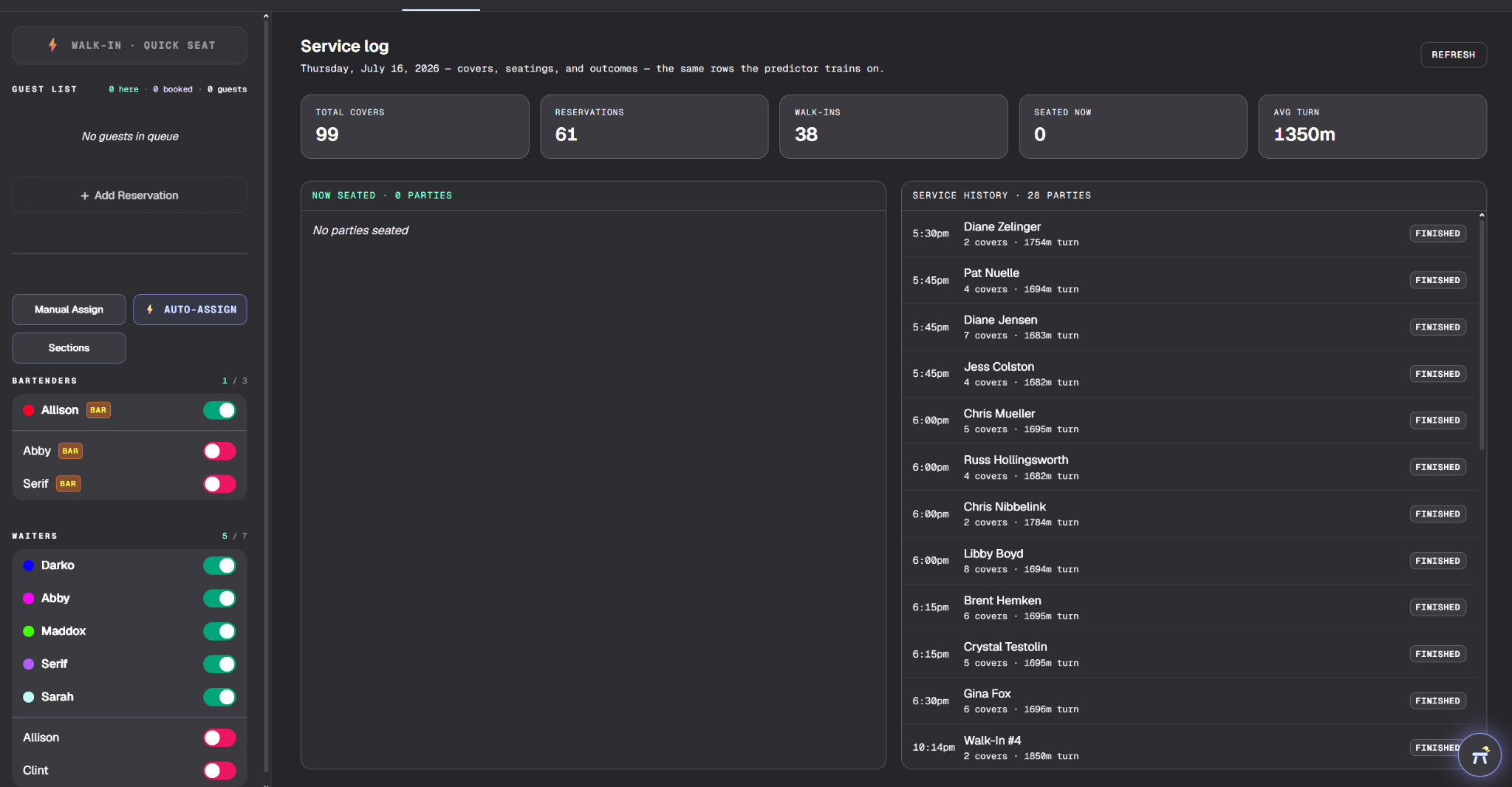
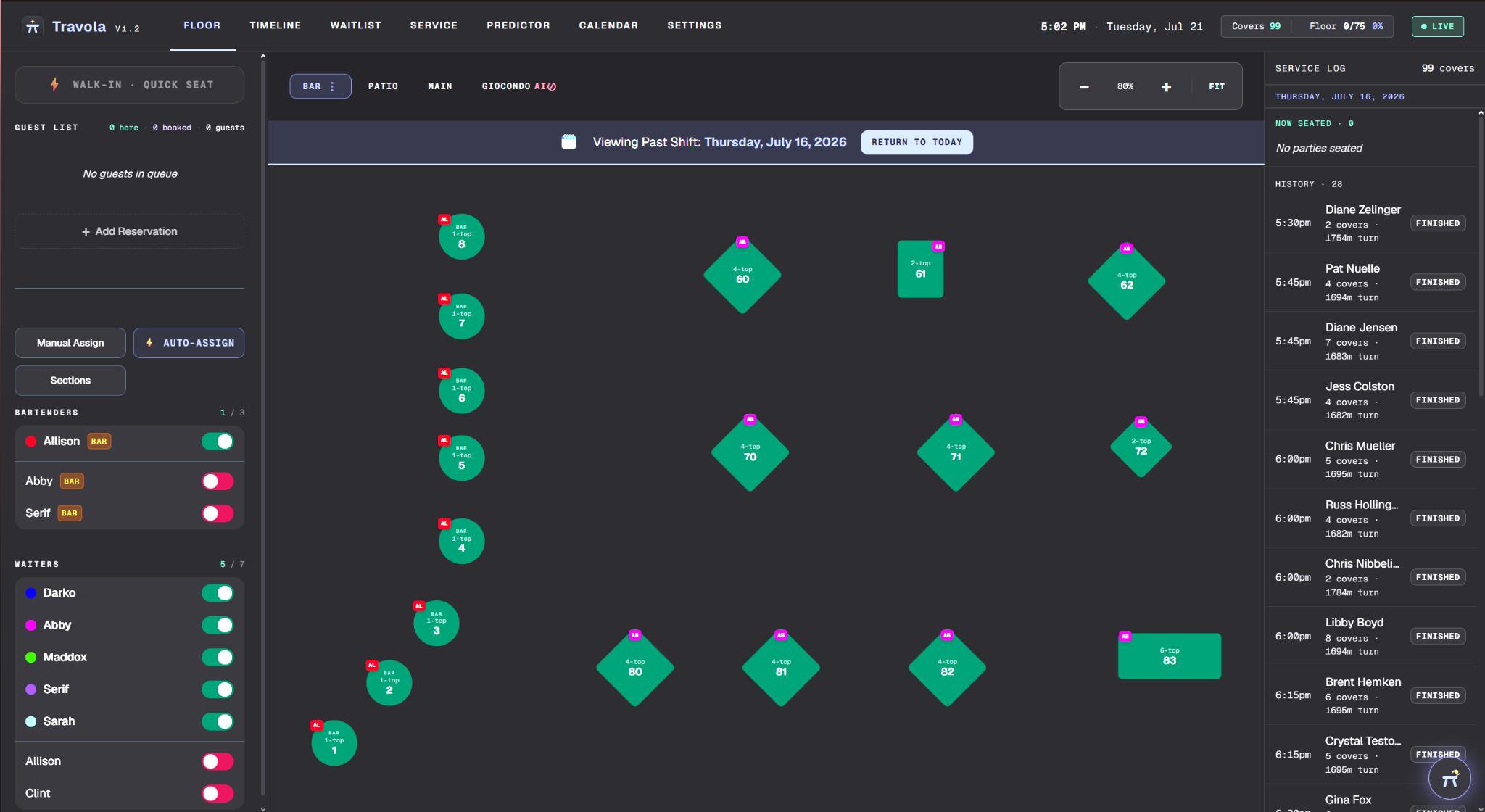
Service log
-
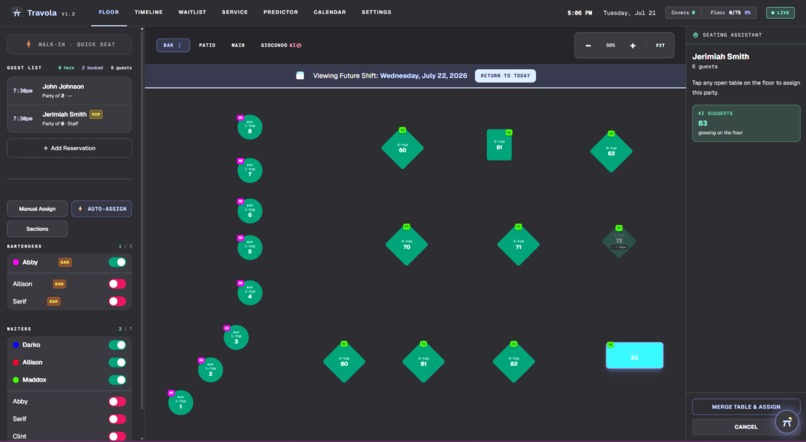
AI assigner (glowing teal table)
-
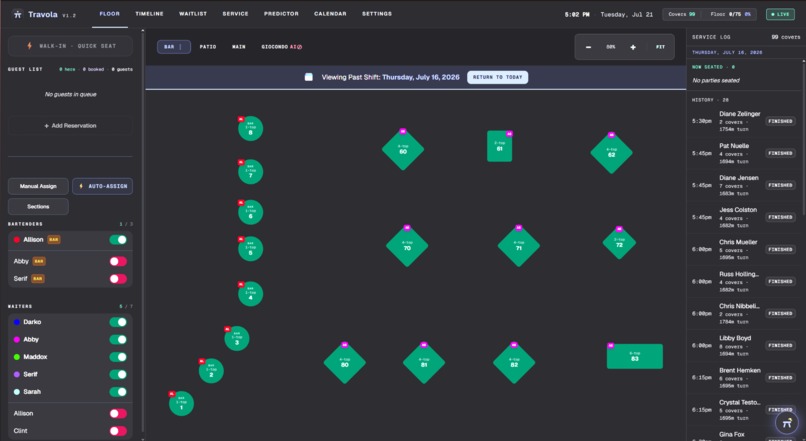
Past shift viewer
-
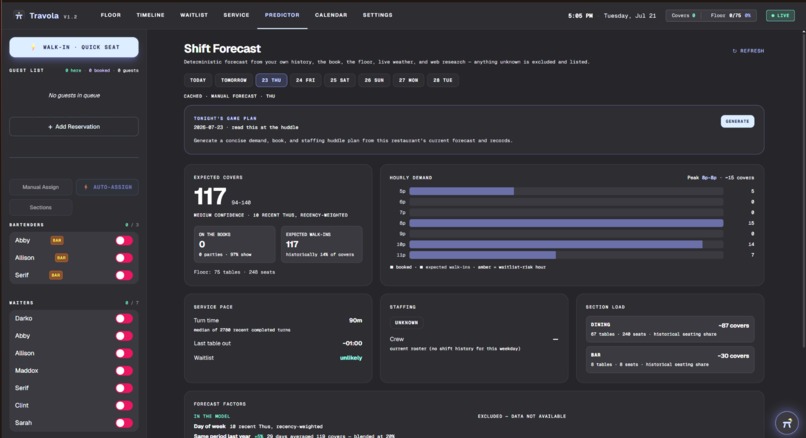
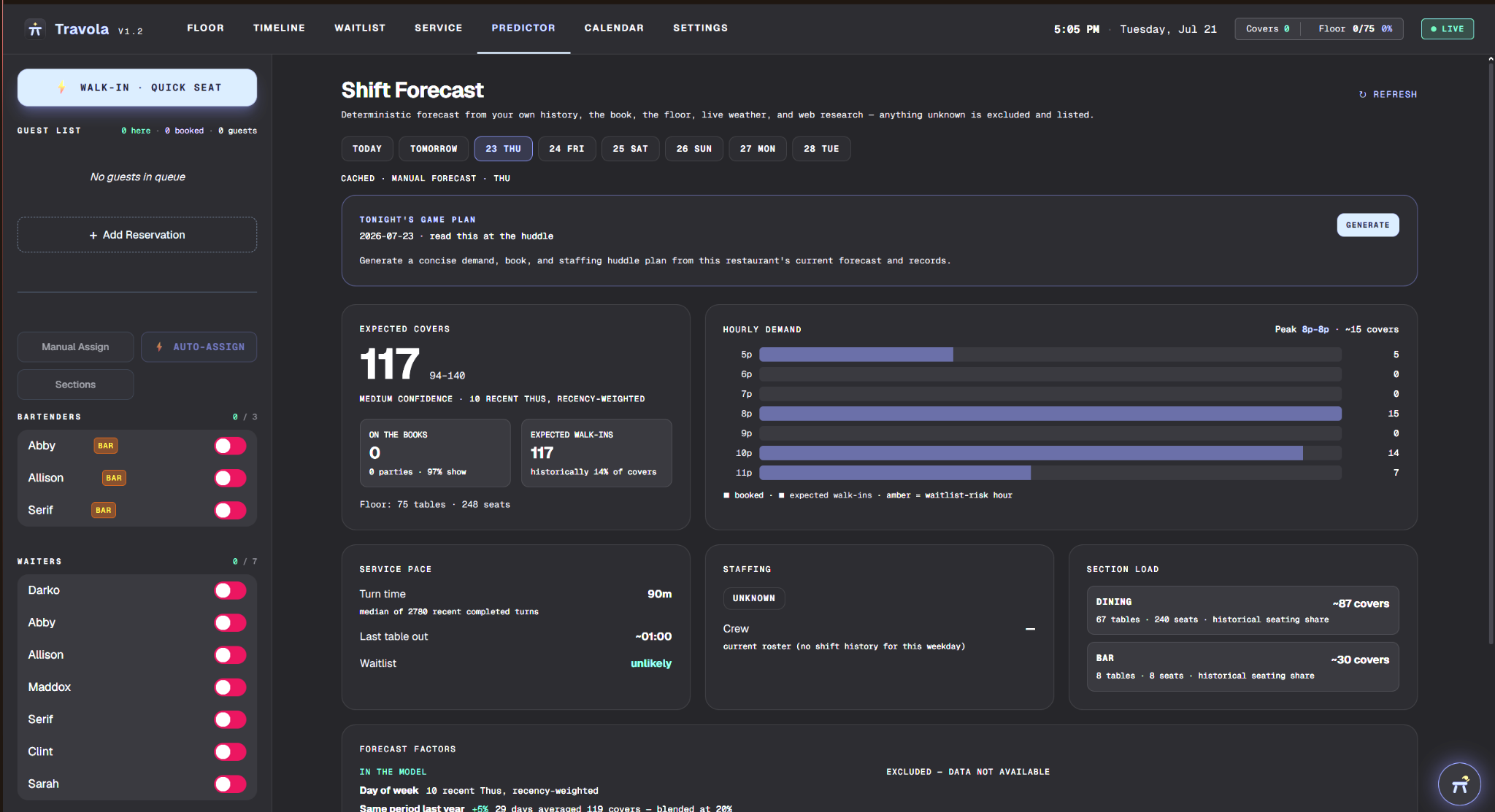
AI predictor
-
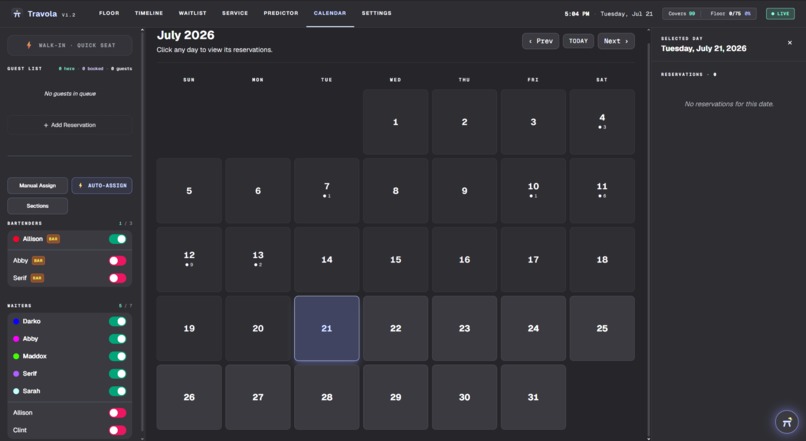
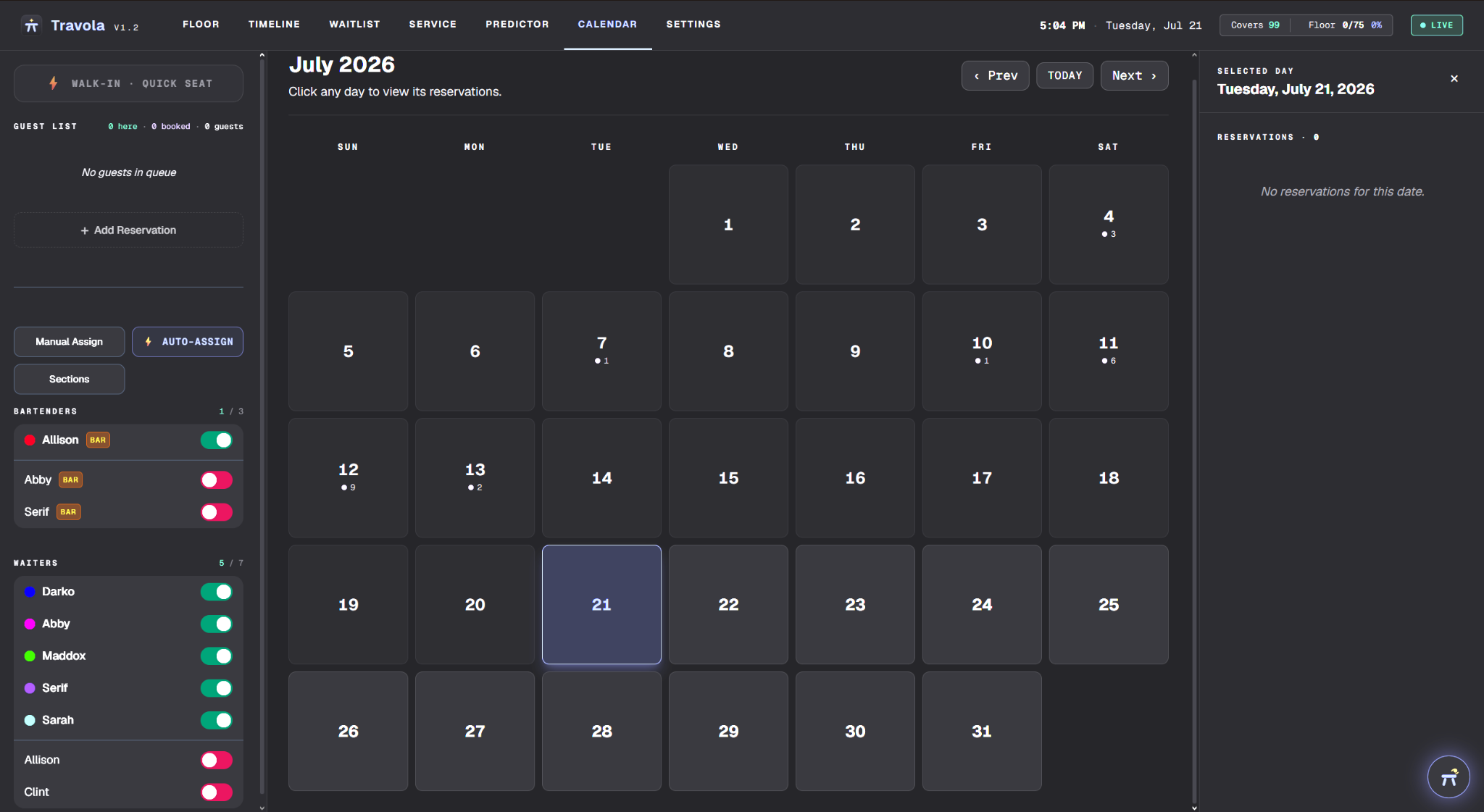
Calendar
Inspiration
Working in multiple restaurants for the past three years has shown me the same scene over and over every single busy night. A server, already overwhelmed, gets double, or triple sat on an understaffed night and drowns, while another server two sections over gets half the tables and barely makes any money for the night. It's never the host's fault either, they were just as overwhelmed as everyone else, line out the door, odd accommodation requests, people calling the phone constantly, take out orders being rushed to the front by the kitchen, and the expectation to balance every section on the fly. Nobody in those restaurants had a chance at having a good shift. That's where Travola began. What if the floor managing software that most restaurants used actually worked for the staff itself? What if the software used the insane power of emerging AI models to help the whole front of house run smoothly? If human error, understaffing, and the unreasonable demand that one person schedule an entire floor on the fly was eliminated, or even just softened? Staff could focus on the floor, taking care of their guests, making sure they get good tips by providing genuinely good service, instead of being buried all night. Not only that, but what if the small mom and pop restaurants being killed by steep big platform fees, could afford a software that works for them. That's what Travola will fix.
What it does
Travola is an AI-native floor management platform, an OpenTable class floor manager with a forecasting brain wired right in.
- Floor & host mode -- drag and drop floorplan editor, touch first host view that installs as an iPad PWA, drag to seat, sections, and auto assign.
- Shift Forecast -- a predictor that blend the restaurants own history with live GPT-5.6 web research: local events, weather, promotions, competitor activity, and seasonality, per date.
- Co-pilot -- a GPT-5.6 chat assistant on every screen that answers from the restaurant's real data ("Which section gets slammed Friday?", "Can I fit a 6-top at 7:30?"), proactively pops alerts when a table's about to turn or a section is about to get buried, and pushes back with data when you're wrong.
- Tonight's Game Plan -- a one tap pre-shift briefing built by parallel GPT 5.6 workstreams, written to be read aloud at the huddle each shift.
- Shift Intelligence -- a shared deterministic layer every AI surface pulls from, plus a weekly auto-forecast and a nightly accuracy watchdog that re-runs the predictor when reality diverges from the forecast.
- Multi-Restaurant -- passcode login, guided setup walkthrough, AI floor-plan migration from past layout photos, and history import that feeds and fine tunes forecasts from day one. ## How we built it Next.js 16 + React 19 on Vercel, Prisma 7 on Neon Postgres. Every runtime AI feature runs on the GPT-5.6 family, tiered by job: Terra for chat and research, Luna for high-volume sentry checks and briefing workstreams. The co-pilot uses GPT-5.6's programmatic tool calling over read only, tenant scoped data tools; the briefing uses the Responses API's multi-agent workstreams. Every added feature during build week was written as a detailed engineering directive, spec, root cause diagnosis, gate checklist, and OpenAI Codex implemented, tested, and merged each one. Dozens of directives took the project from single tenant demo, to production multi tenant SaaS in under a week, with product verification after every merge. ## Challenges we ran into
- Silent data loss from tenant ID collisions -- global primary keys met per-restaurant ID minting; fixing it meant creating collision proof identity and turning every silent drop into a loud 409.
- Serverless reality -- an in memory cache that vanished between invocations, UTC vs local date keys that forecast Wednesdays from Thursdays, and payload shapes that differed by writer. Everything now flows through one canonical layer.
- Making AI surfaces agree -- chat, briefing, and predicttor once gave three different numbers for the same night. The fix was architectural: LLMs never talk to each other, they all read one deterministic Shift Intelligence dossier.
- Making it sound human -- style adjectives in prompts produced memos; few shot example exchanges finally gave the co-pilot a floor manager's voice. ## Accomplishments that we're proud of A forecast pipeline that audits itself nightly and corrects its own bad predictions. A co-pilot that operates on shift layer intelligence. A guided walkthrough that takes brand new users from nothing, to AI ready in minutes. And it all runs live, in production, on real restaurant data. ## What we learned Put the math in code and the words in the model. State is the authority and events are accelerants. One source of truth beats any clever synchronization. And an AI pair -- one writing rigorous specs, and one implementing relentlessly -- ships faster than either could alone. ## What's next for Travola Onboarding local restaurants, a public facing online reservation page that respects floor and table blocking rules, POS integration to deepen forecasts, and continued tuning of the accuracy watchdog as real service data accumulates.
Built With
- gpt-5.6
- neon
- next.js
- node.js
- openai-codex
- playwright
- postgresql
- prisma
- pwa
- react
- tailwindcss
- typescript
- vercel
- vercel.cron

Log in or sign up for Devpost to join the conversation.