-
-
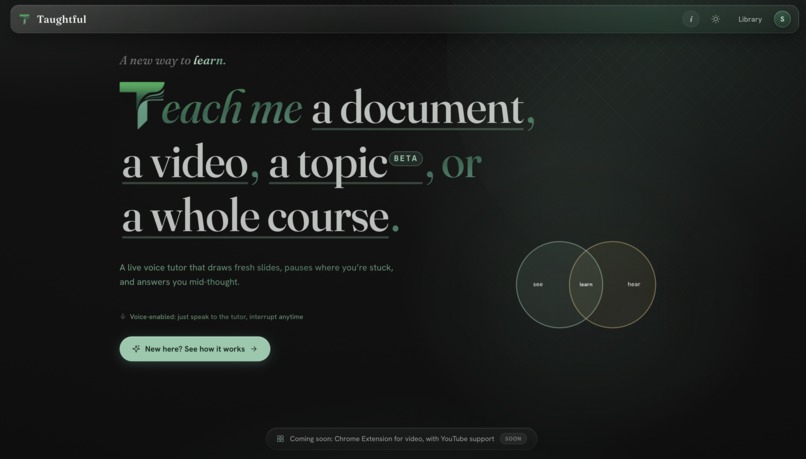
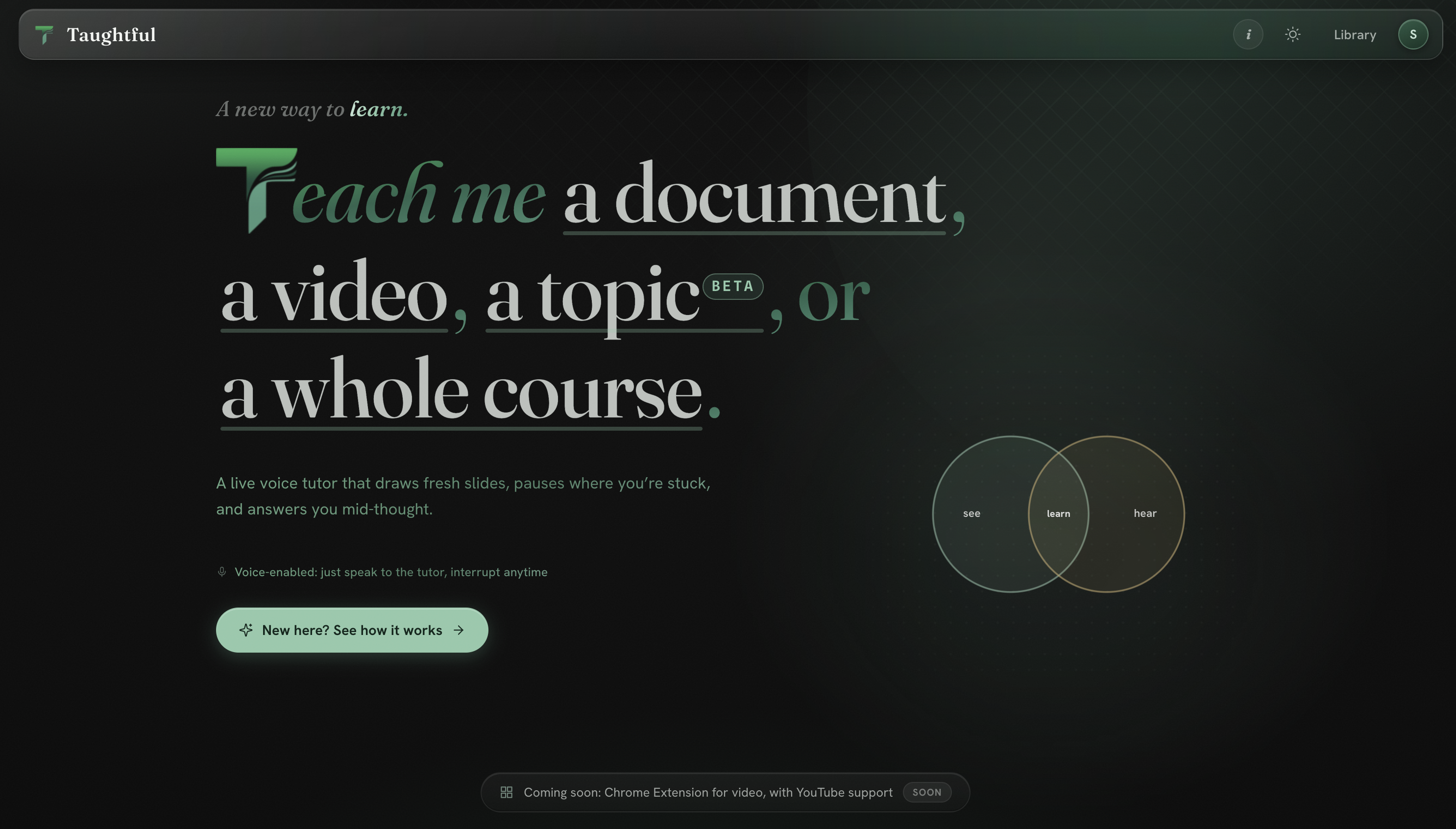
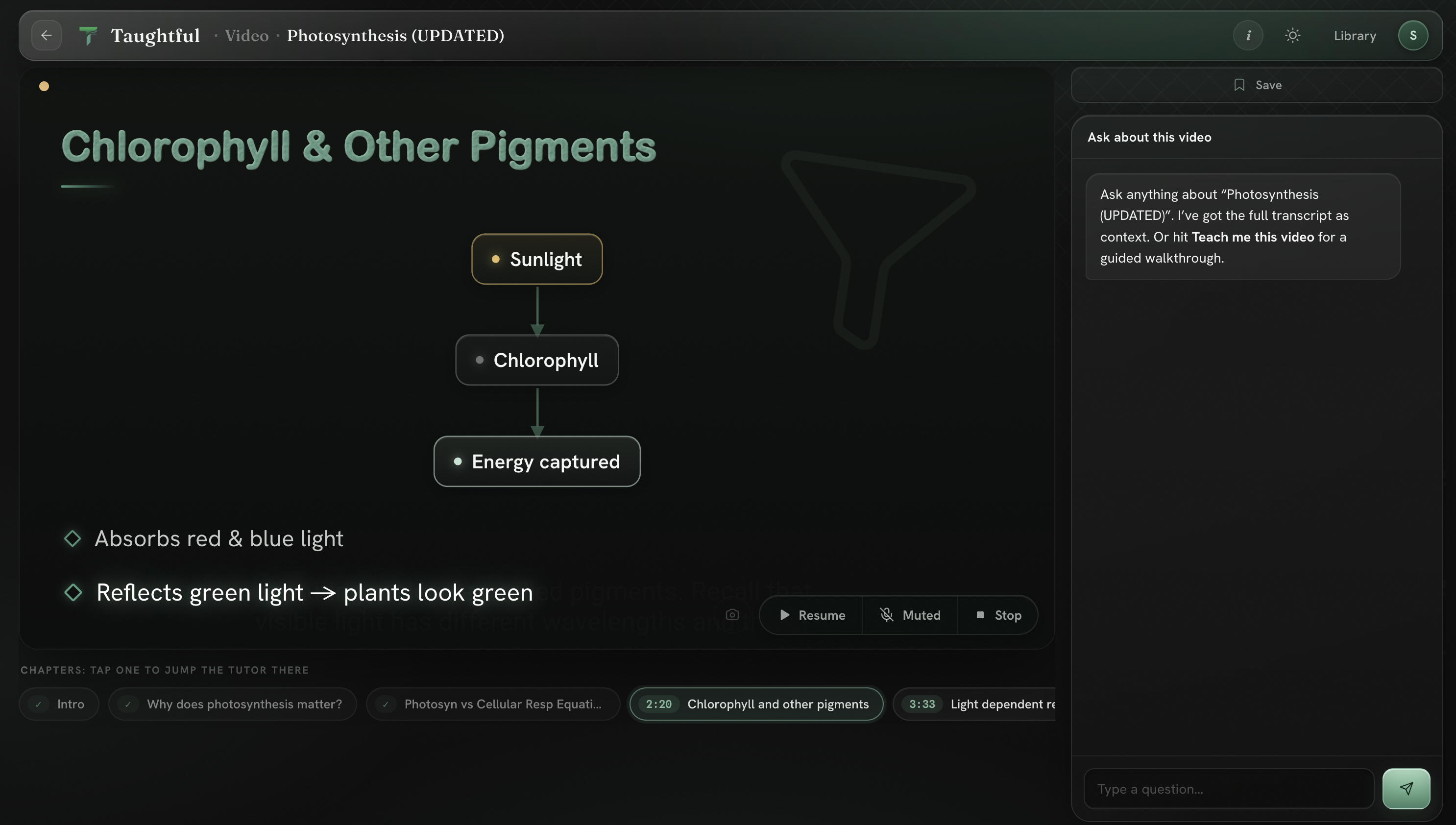
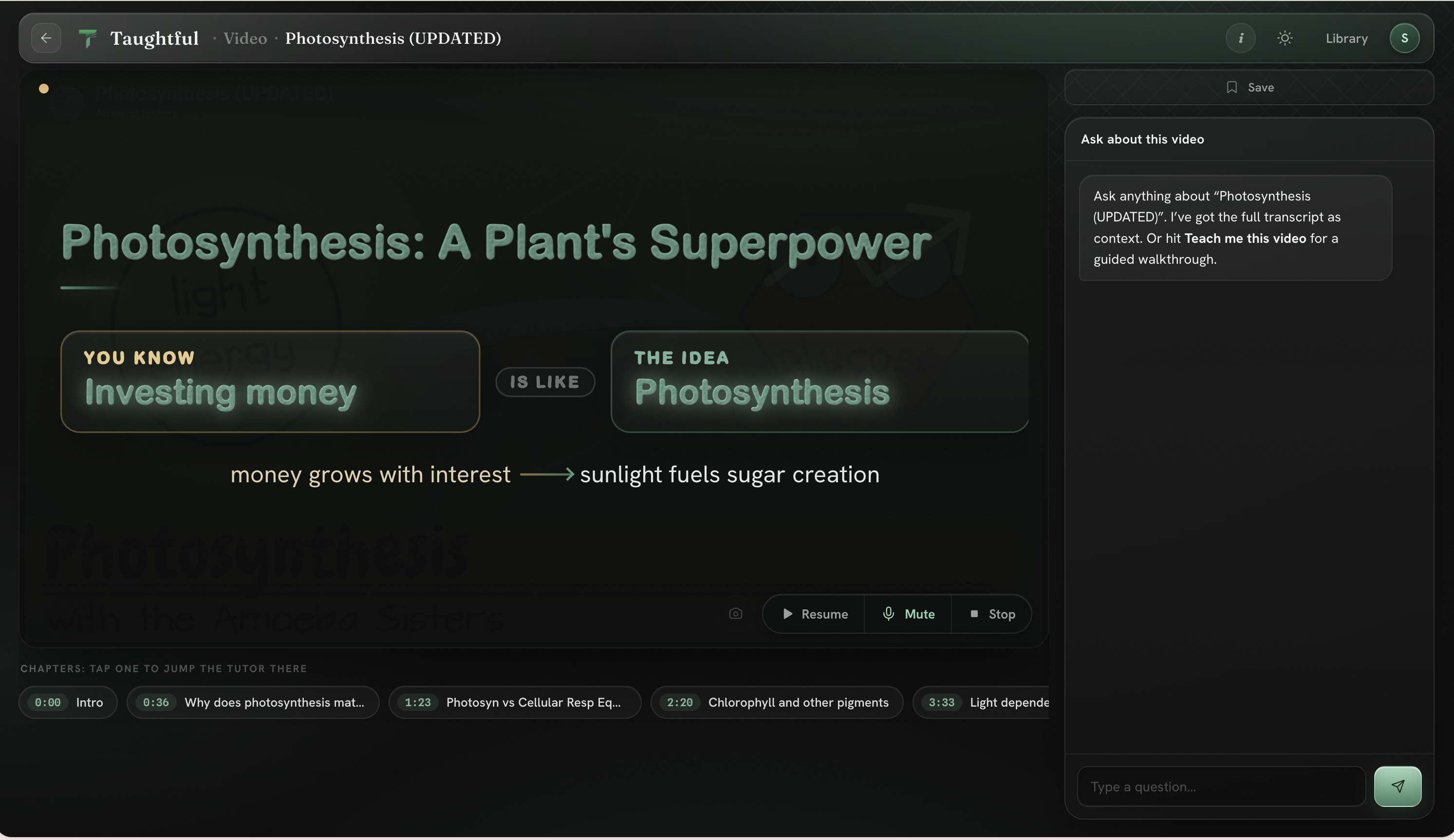
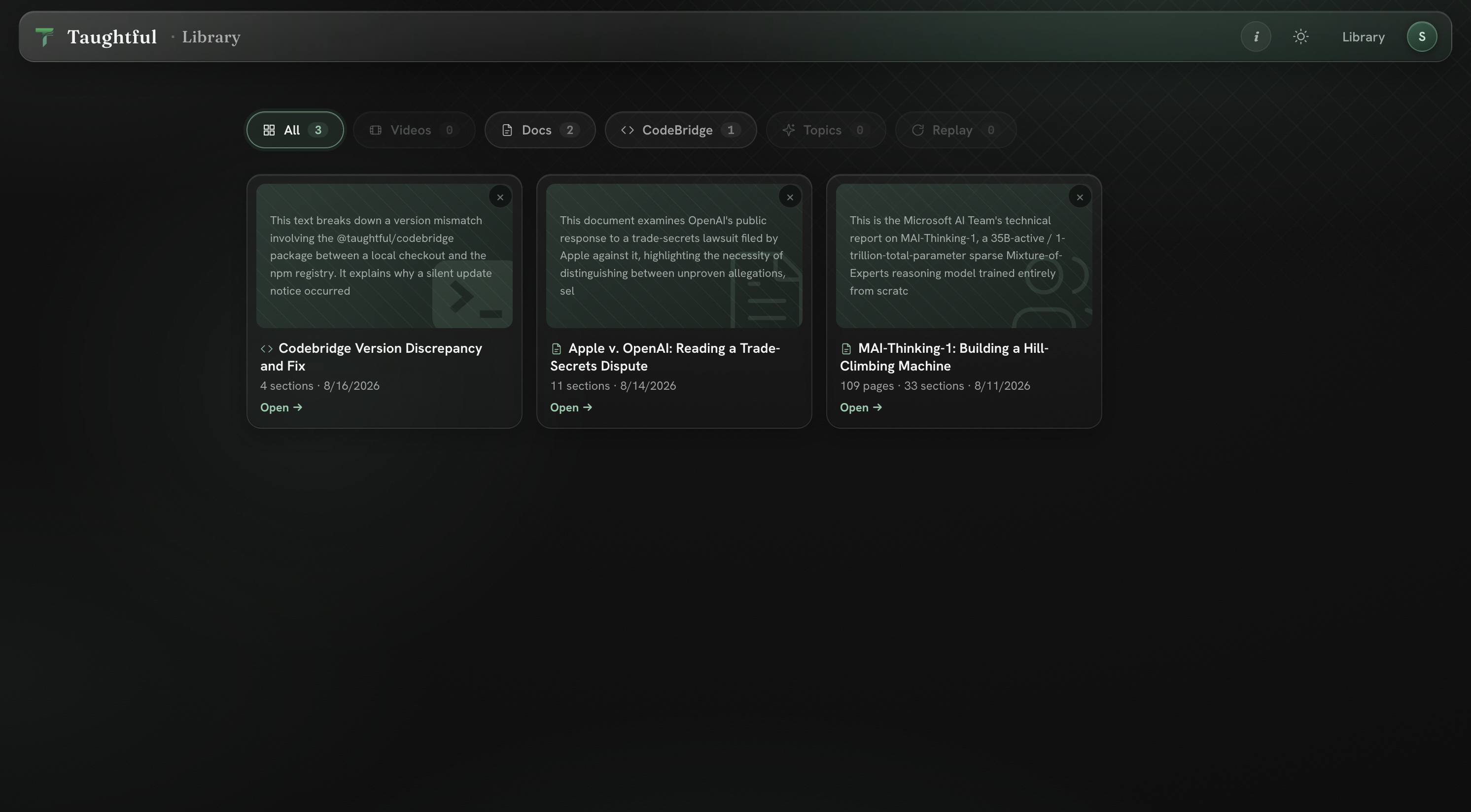
Taughtful.ai can teach docs, videos, topic or a course.
-
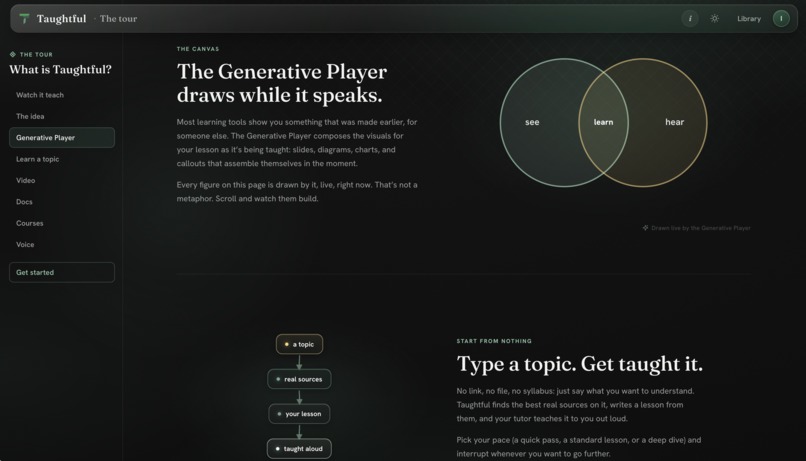
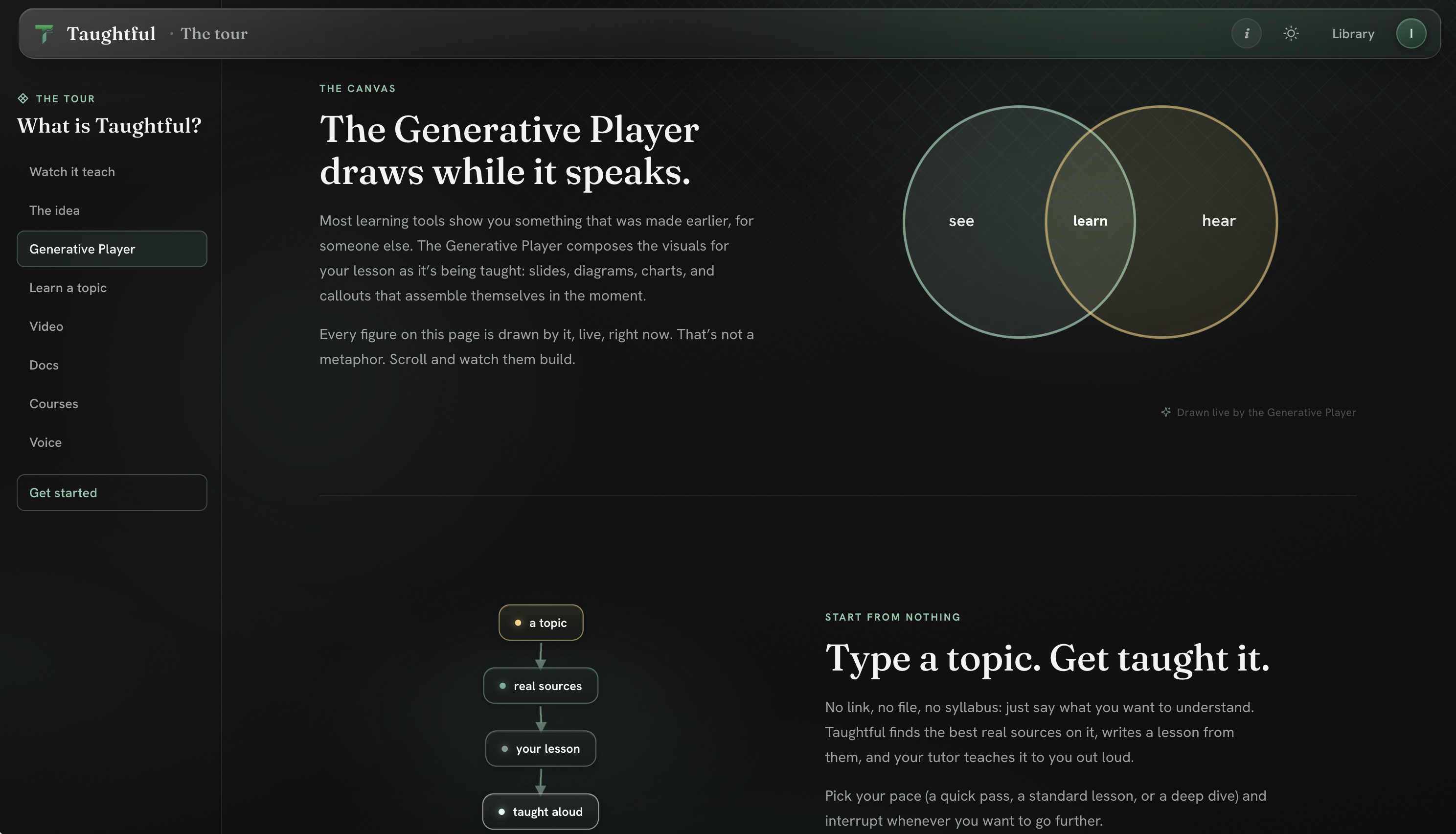
GenerativePlayer draws while it teaches
-
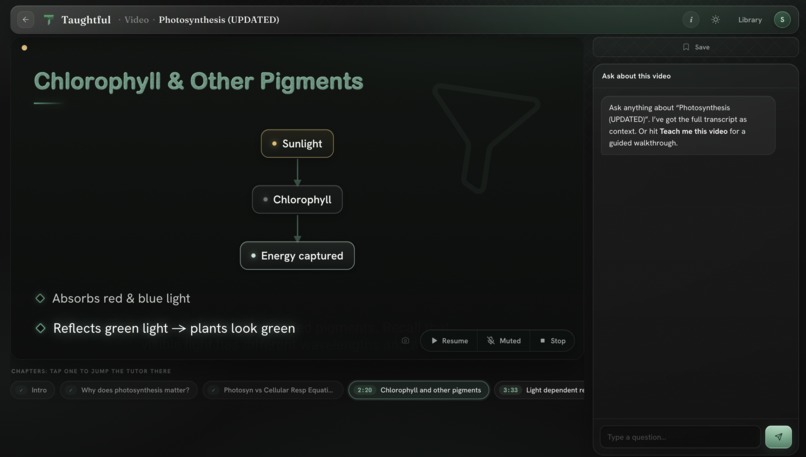
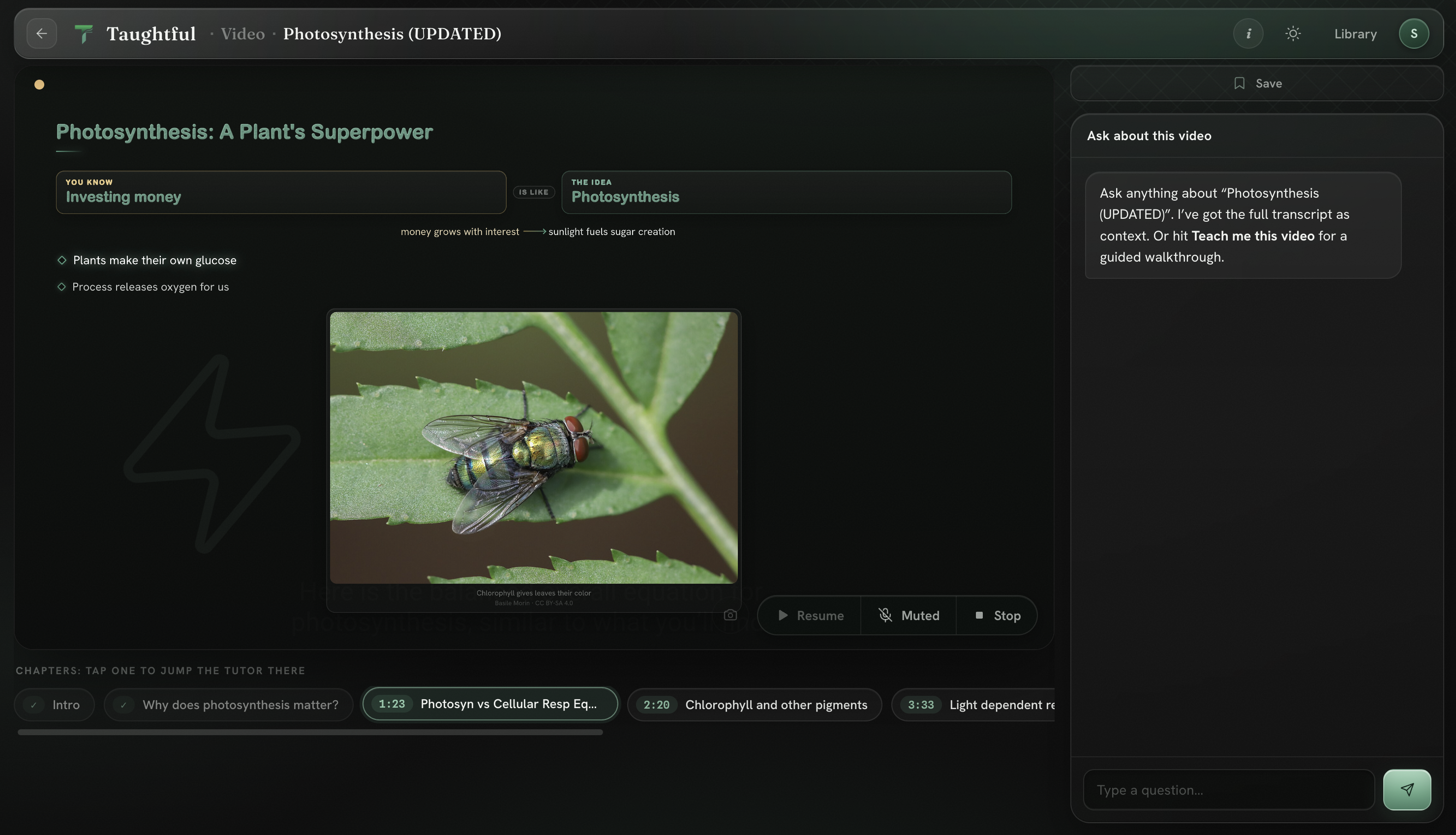
GenerativePlayer can visualise content on the go in realtime
-
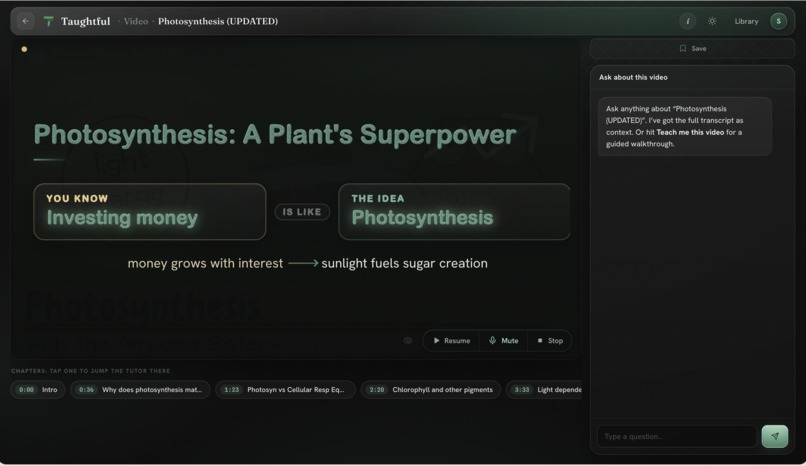
GenerativePlayer can visualise content with 30+ infographic combo
-
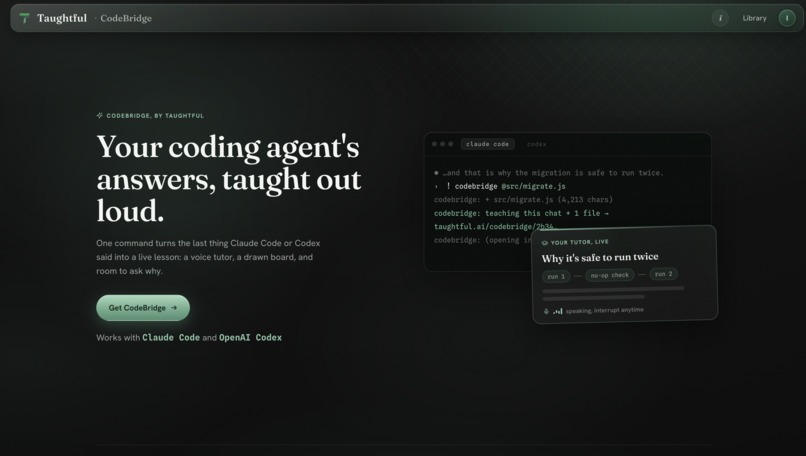
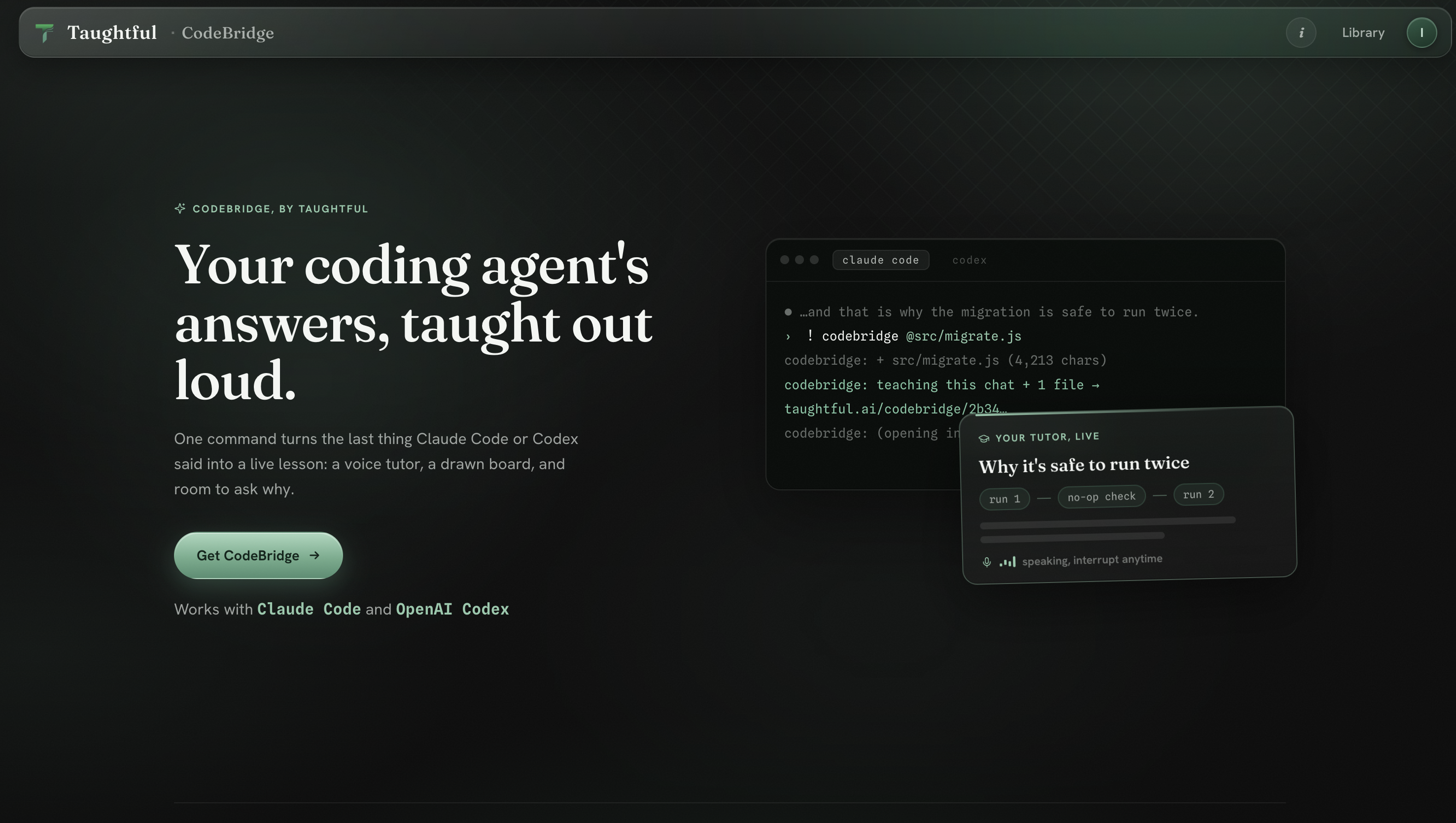
Codebridge by Taughtful teaches you your coding agents responses
-
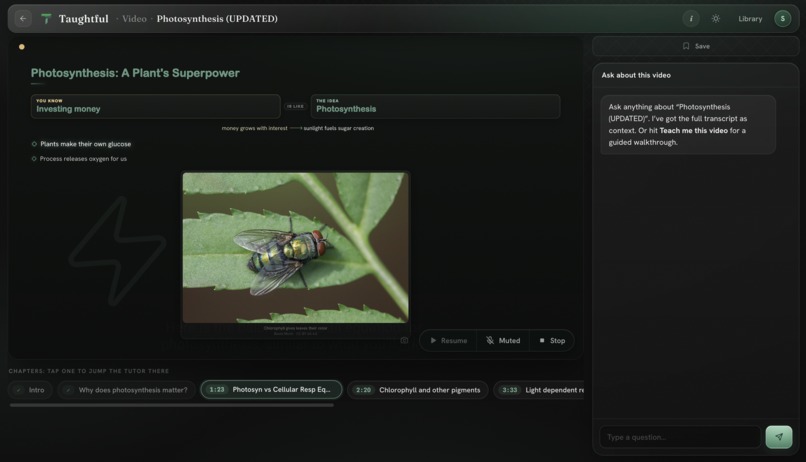
Taughtful.ai pulls images from web if needed
-
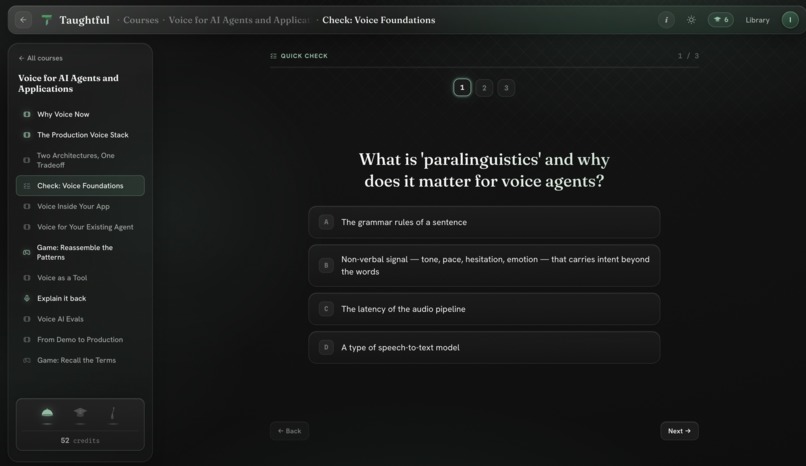
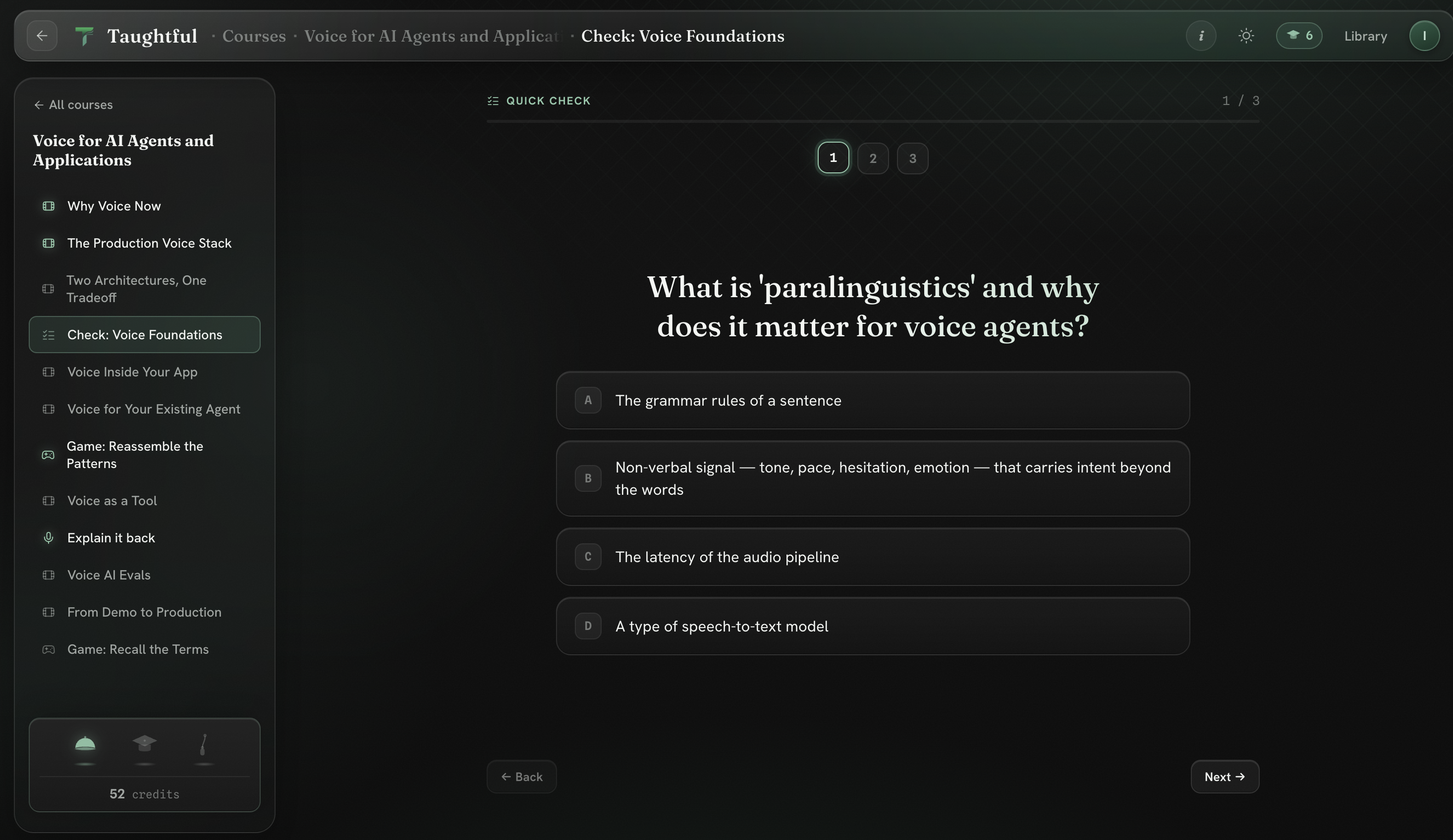
Taughtful.ai has quizzes inside the lesson; to gauge if learner is absorbing
-
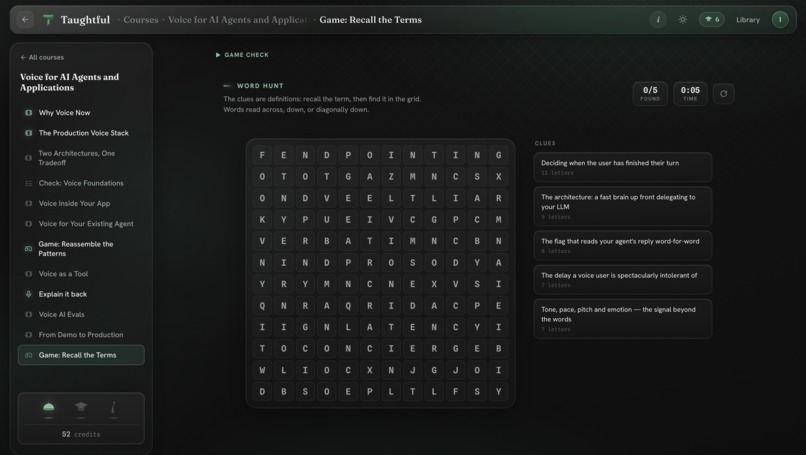
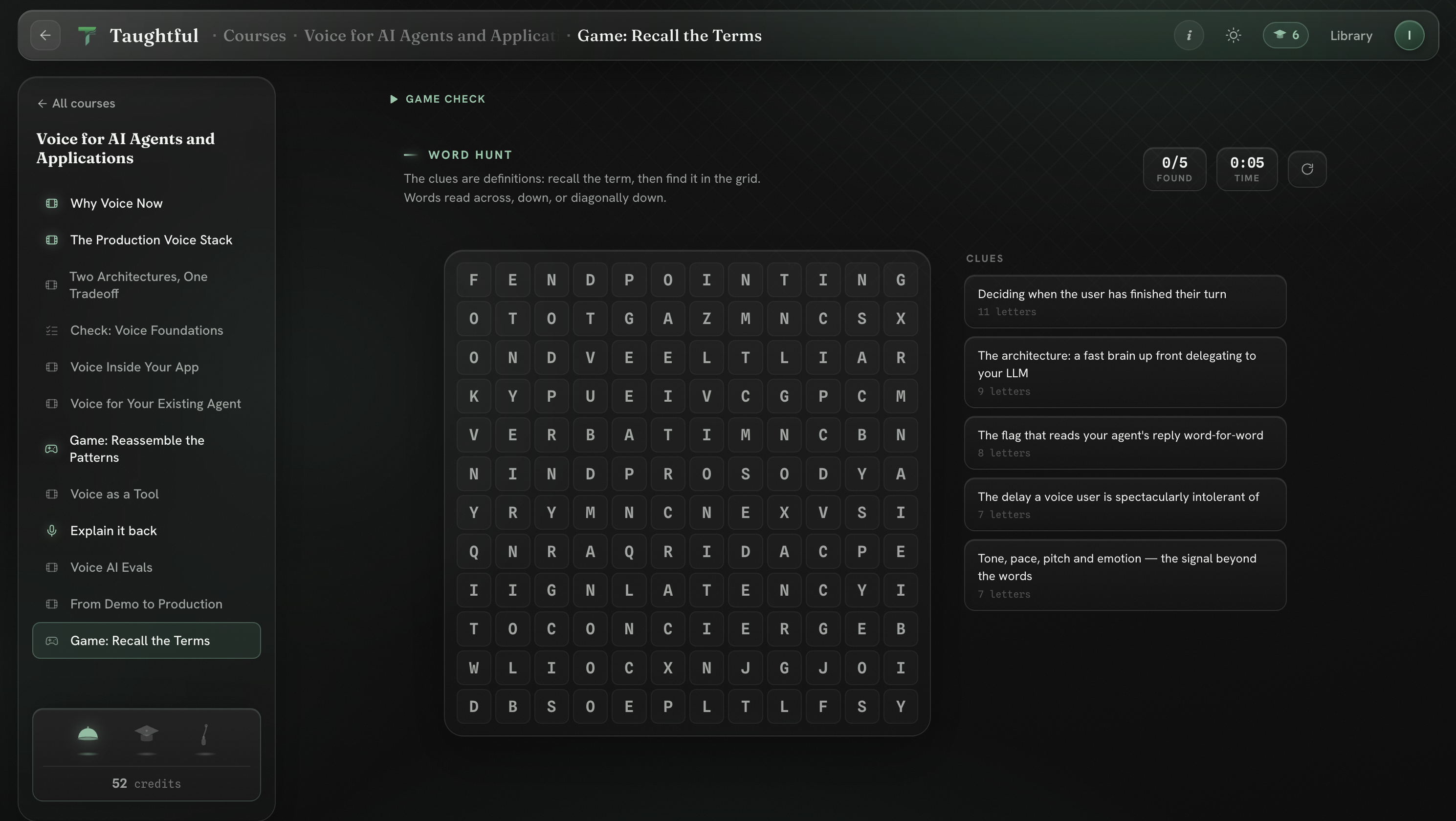
Courses on taughtful.ai have fun games too
-
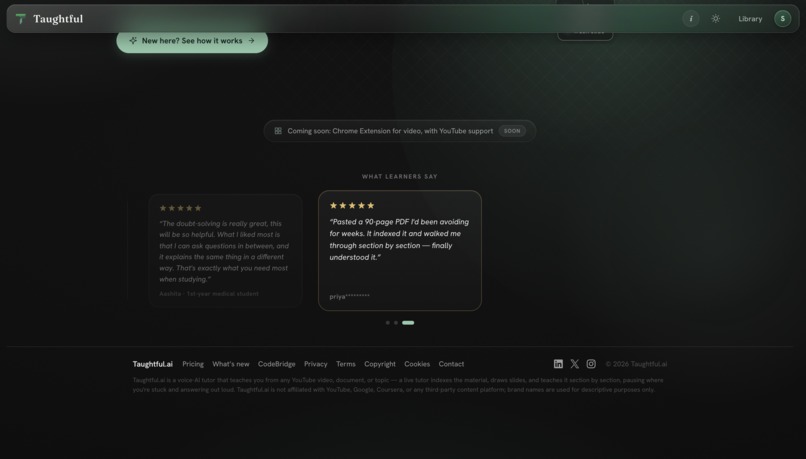
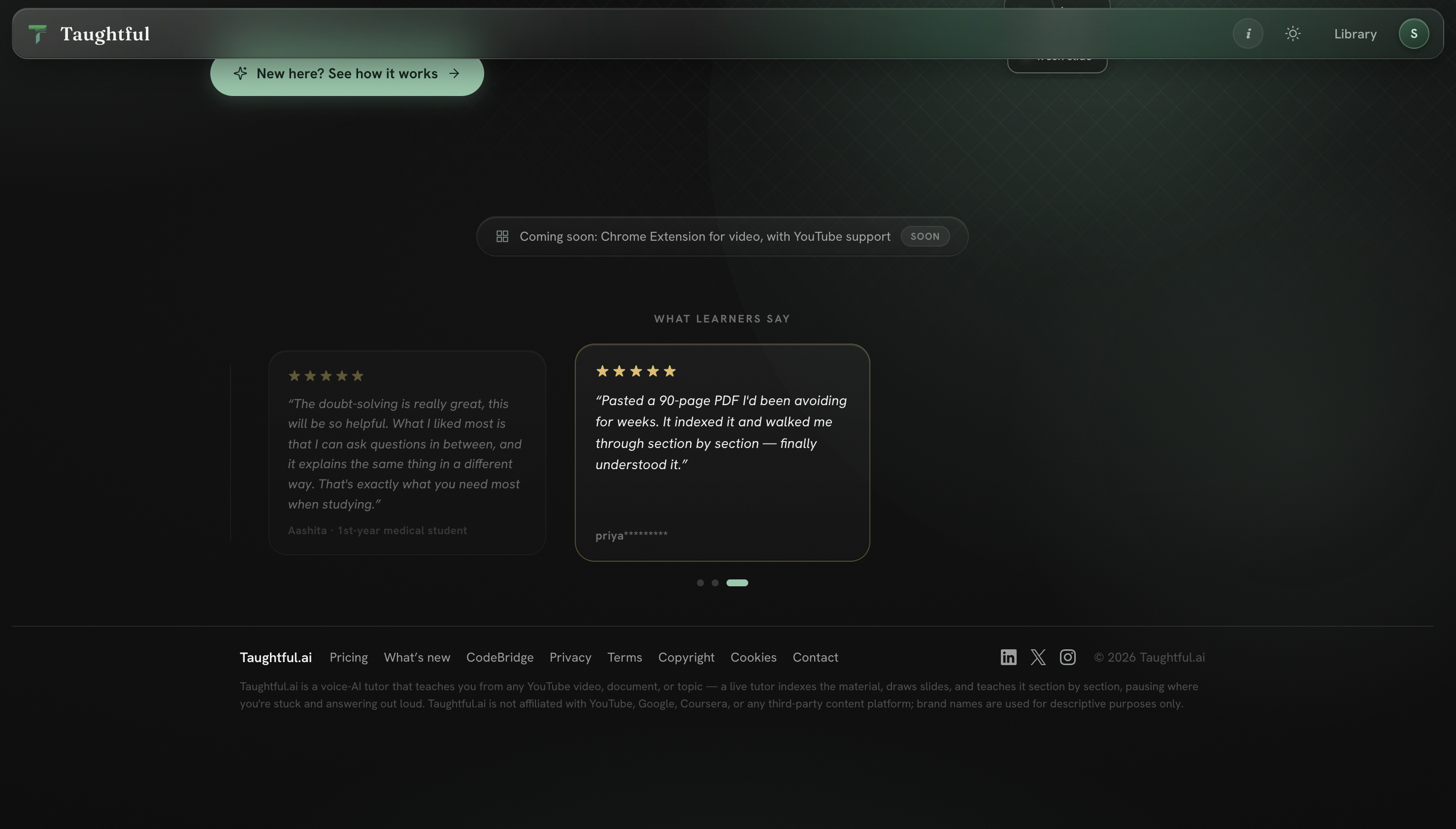
Taughtful.ai has strong customer feedback
-
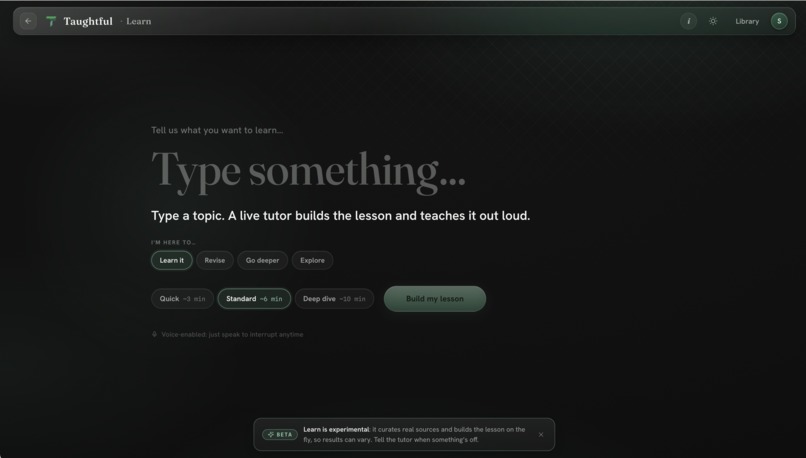
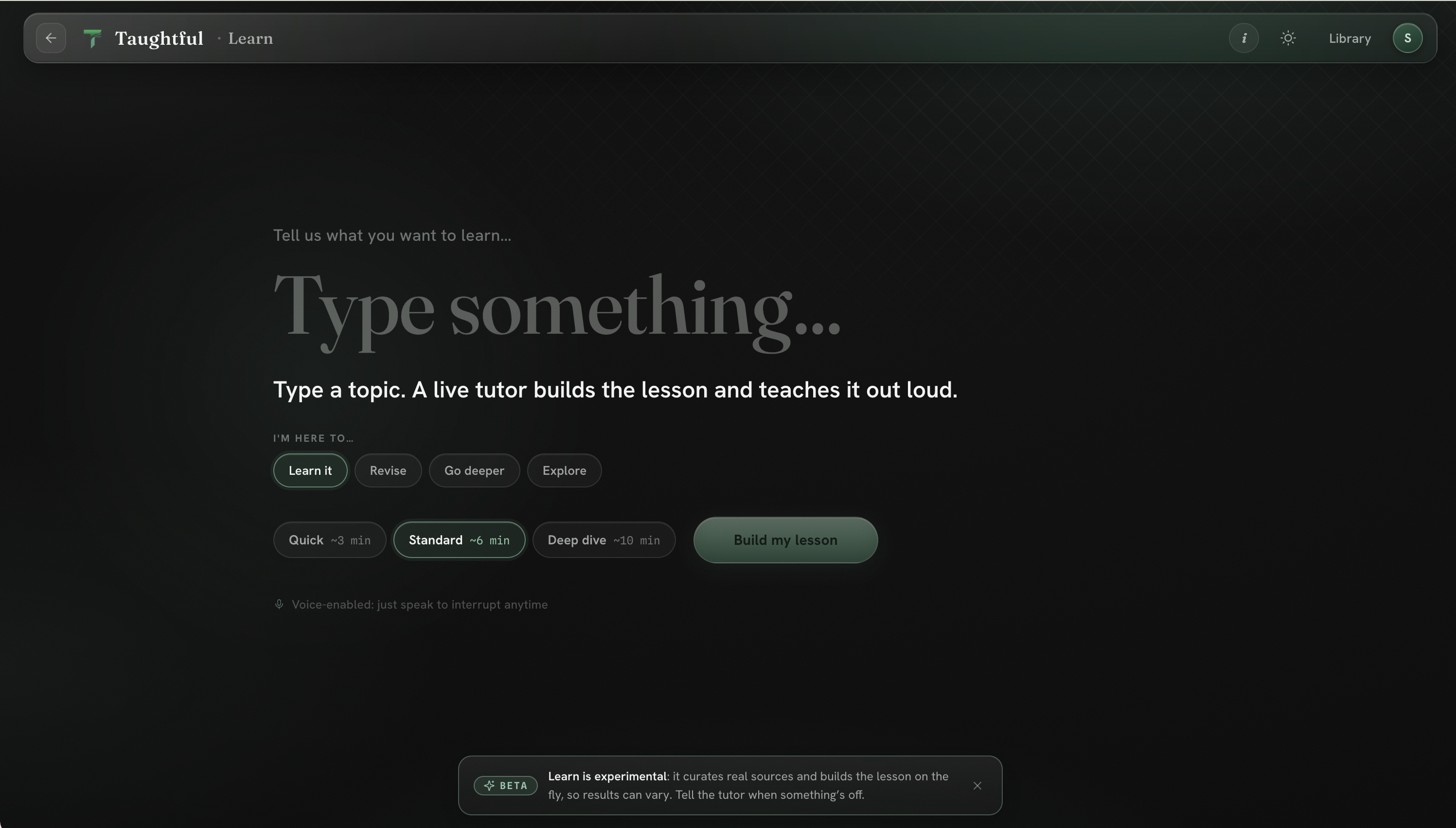
In learn mode, you can type something and it starts to teach it under 20 seconds
-
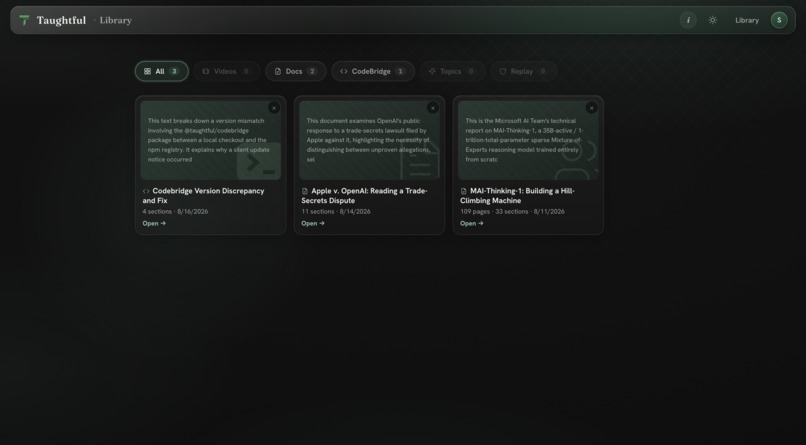
Yes, we have courses library which will keep growing
Inspiration
As a teaching assistant at San Jose State, I made course videos by hand and watched them fail students. A video cannot answer the question a student has at minute six, and that is the only moment instruction matters. The format that actually works is one on one tutoring, a person talking while drawing on a board, changing tack the moment your face goes blank. It costs $40 to $80 an hour, so almost nobody gets it.
The mechanism arrived in January 2026, when a realtime AI co-presenter that managed a screen live while you spoke won its first hackathon. Watching people use it made the bigger use obvious. A voice that controls a live screen at conversation speed is not most valuable helping you present. It is most valuable teaching you.
What it does
Taughtful is a live voice tutor for anything you want to learn. Bring a YouTube video, a PDF, a photo of handwritten notes, a topic, or take a full course with quizzes and spoken checks. A voice starts teaching out loud and the screen draws itself in sync with the speech: diagrams, slides, motion, generated in the browser in real time, nothing played back.
Interrupt it by speaking and the lesson rebuilds around you. Struggle with something and it changes approach on its own, a different analogy, a simpler frame, even your other language, then remembers how you learn for the next session.
Teaching is a dual channel act, a tutor talks while drawing. Every product in this space shipped one channel. ChatGPT has the voice with no board. Khanmigo has a board with no live voice, locked to its own curriculum. We generate the board live, synchronized to speech, interruptible mid sentence, over anything you bring.
Live at taughtful.ai with billing on. Pro is $15 a month for the 1:1 mechanic that private tutoring rations at $40 to $80 an hour.
How we built it
React and Vite on Vercel, a Python backend on Fly.io, Supabase for auth and data, Stripe for billing. The voice loop is realtime speech transport with barge-in and turn detection. Doc indexing and the anchor pass run Gemini first through Vertex AI on Google Cloud, with other providers as silent fallthrough, so the ingestion that turns a video or document into teachable structure runs on Gemini in production.
Above that layer everything is ours: the teaching brain, GenPlayer (the render engine that draws the screen in sync with the voice), ingestion that turns videos, documents and topics into teachable structure in about 5 to 15 seconds, and a personalization layer that merges what each session revealed about how you learn into the next session's context.
The company itself runs on AI, not just the product. Development is agent first, built and maintained with Claude Code under my direction. Marketing is a factory rather than a task: a topic scout agent picks subjects, a scriptwriter agent turns one into beats, and the product's own GenPlayer renders the frames, so our explainer videos are manufactured by the same engine that teaches our customers. That factory doubles as our proving ground for the render engine. New visual elements are trialled on marketing footage first, where the cost of a bad one is a discarded video rather than a confused learner, and an audit agent reports which elements are over and under used across the library. The ones that earn their place graduate into GenPlayer and start appearing in real lessons, so the marketing line item is also how the product's visual vocabulary grows. Operations run on persistent agent maintained state stores, one per function, for marketing, SEO, the reel factory, and fundraising, each with its own write back discipline. Our work board ranks open intents by how often they resurface on their own, and that ranking is what decides what gets built next. Every push to production passes an AI judge that blocks anything that is not product code.
Challenges we ran into
Holding generated visuals in sync with speech a learner can interrupt at any moment. Generating visuals is easy now. Keeping them synchronized at conversation speed, when the human can cut in mid sentence, is the engineering nobody wanted to do, and it is the whole product.
The tutor also used to talk over people. We assumed voice quality needed polish, but the real complaint was that it would not let anyone finish a thought. Rebuilding turn detection to wait longer before responding made sessions immediately calmer.
People do not say when they are lost. They go quiet, or ask the same question again in different words. We expected them to just tell the tutor. So we now read the transcript for repeated questions and frustration instead of waiting for someone to admit confusion.
Accomplishments that we're proud of
One person shipped five teaching surfaces, a live render engine, payments, and personalization in a few months, working agent first.
The business is real, not a demo, and it was built inside this window. First commit June 2, 2026, incorporated as Taughtful, Inc. on July 20, billing live July 24. We now have 71 accounts with 34 from the past week, people running voice sessions, and paying subscribers on Pro, five of whom converted in the last five days. We have spent nothing on customer acquisition. Every user is organic or invited.
Outside validation came in the same window. On July 18, Andrew Ng presented the build medal to Taughtful at a realtime voice showcase in front of around 400 builders. We are also part of the Google for Startups Cloud Program.
The part we are most proud of is the loop where the product pays for its own distribution. The same render engine that draws a live lesson generates our explainer videos, so content costs compute instead of a content team, and every video doubles as a test bed for visuals that later ship into lessons.
What we learned
A great first session does not bring people back on its own. Our first invited group ran 119 sessions in week one and 11 in week two. That number, not a strategy document, set the roadmap: courses, spoken checks, and memory of how each person learns, before spending a dollar on acquisition.
We also learned how far AI native operations can go for a company of one. Agents do not just write the code. They author the courses, manufacture the marketing, gate what reaches production, and maintain the state that decides what gets worked on. Throughput stopped being the constraint. Judgment about what to point them at became the constraint.
What's next for Taughtful.ai
Retention before spend. The next 60 days are about week 4 retention holding, because buying users into a product that does not yet pull them back is how early money disappears.
Then depth and reach: a richer generative player with more of the visual vocabulary a real tutor uses, mobile, and letting learners pull source material from where it already lives instead of uploading it. CodeBridge, which turns a coding agent's last answer into a spoken lesson, is our second zero cost acquisition door, where the lesson itself is the ad.
The long version is the mission: give every person a tutor that teaches out loud, draws what it explains, and learns how your mind works, in whatever language you think in.
Built With
- anthropic
- claude-code
- fly.io
- gemini
- gemini-vision
- google-cloud
- javascript
- lucide
- openai
- paddleocr
- postgresql
- pymupdf
- python
- react
- stripe
- supabase
- three.js
- vercel
- vertex-ai
- vite
- vocalbridge
- webrtc
- yt-dlp


Log in or sign up for Devpost to join the conversation.