The short version
People love their star signs. But a sign comes from your birthday, and you didn't choose that.
You did choose your taste. The films you rewatch, the album you can't stop playing, the café you keep going back to. That's you.
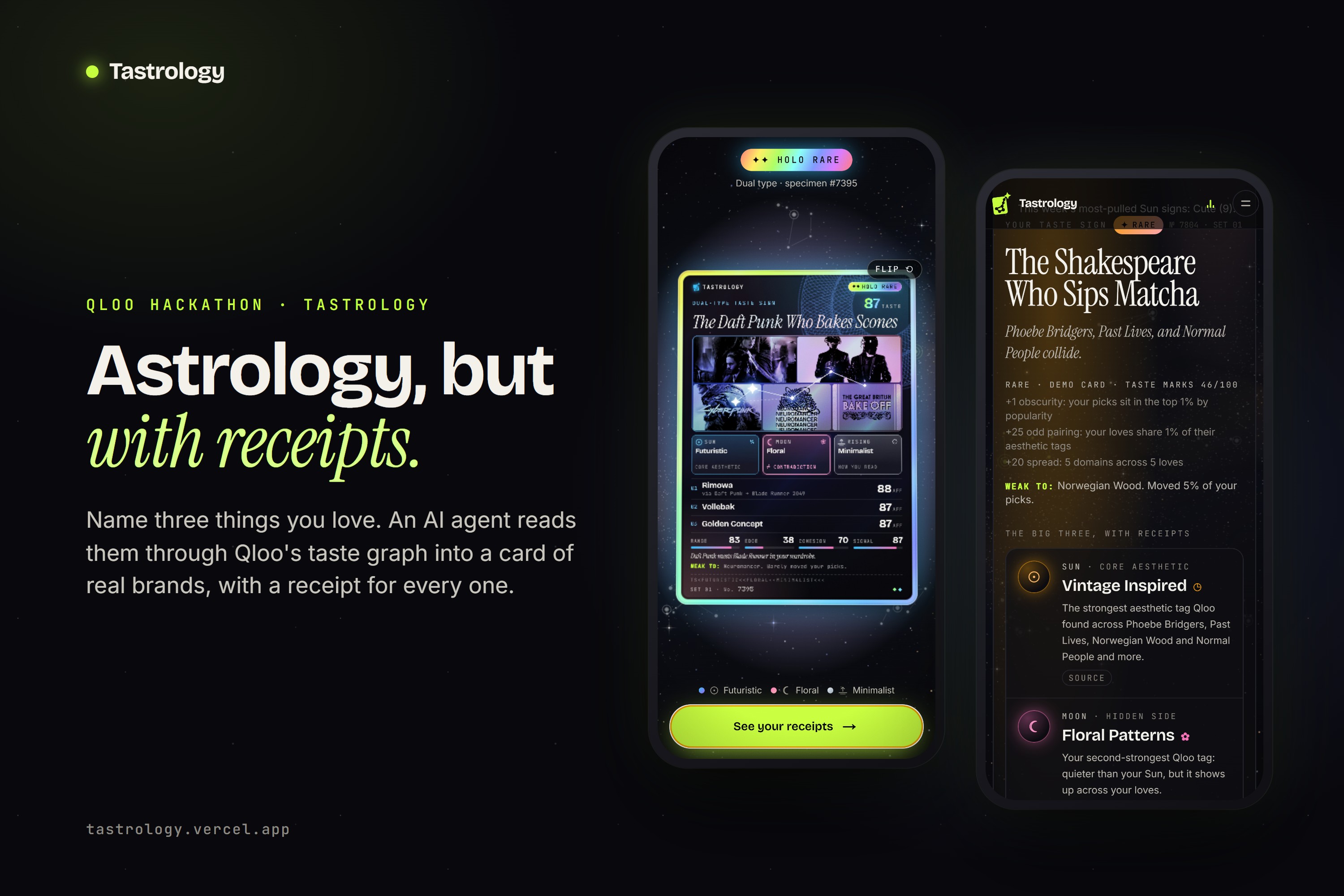
Qloo knows how taste connects. So I made a thing that turns yours into a star sign: name three loves, and an AI agent maps them through Qloo into a constellation of real brands on a card you can keep.
AI loves to make stuff up. This one can't. Every star is checked against Qloo, and the app shows you the receipt.
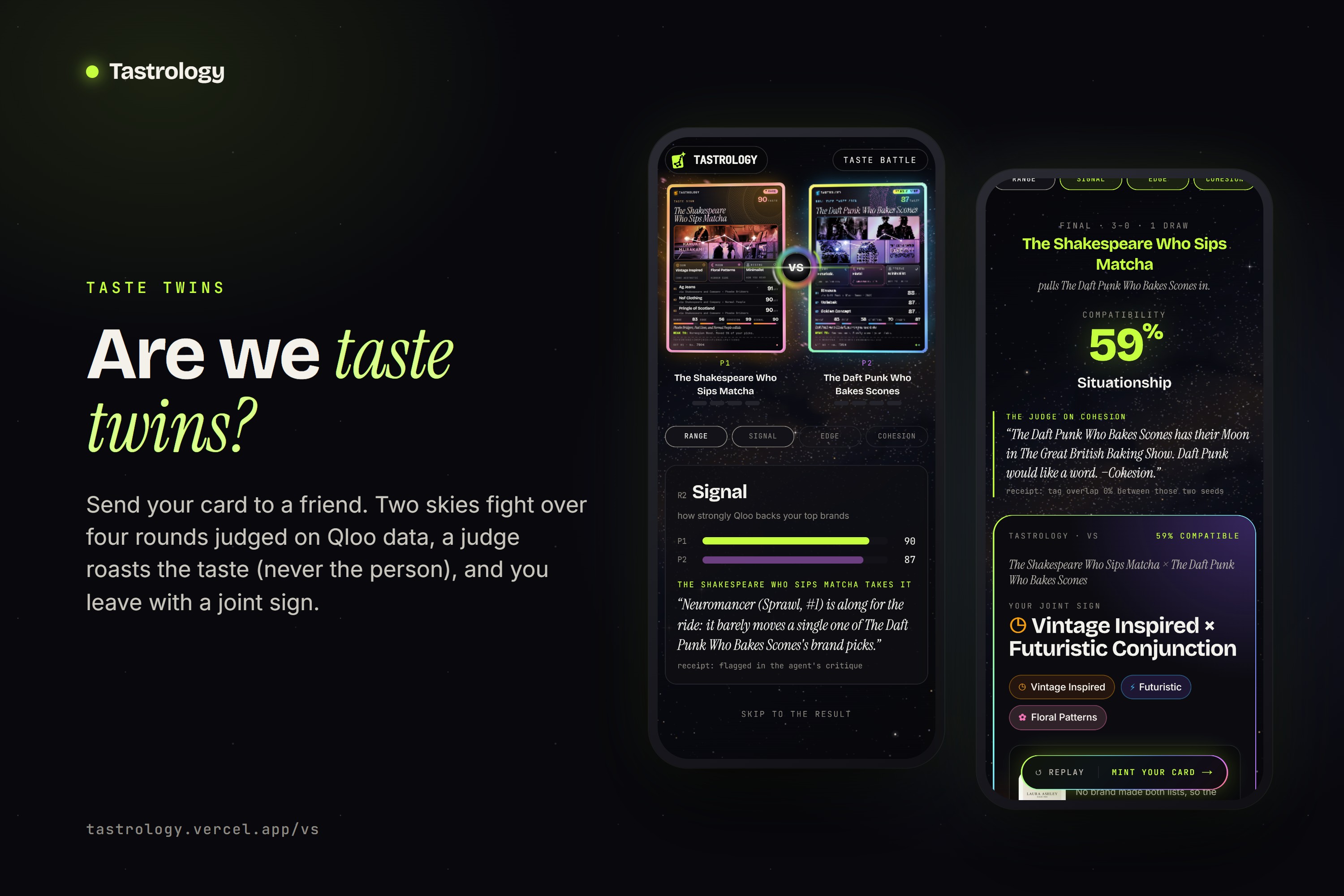
Then you send it to a friend with one question: are we taste twins? They mint theirs, you both get a score, and then you fight.
Astrology, but with receipts.
Try it in 2 minutes (judges, start here)
Open tastrology.vercel.app on a phone or a laptop. Everything is free while it's in beta, and nothing asks for money.
- No account: tap a sample persona on the home page to see a finished reading, or type three things you love for one fresh reading of your own. Open Under the hood to watch the agent call Qloo live.
- See a fight: open tastrology.vercel.app/vs, pick two personas and let them battle over four rounds of Qloo data.
- Keep your card: sign up with Google or your email to save your card to a deck. New accounts get 3 free readings, enough to see the deck, Stardust and packs open up.
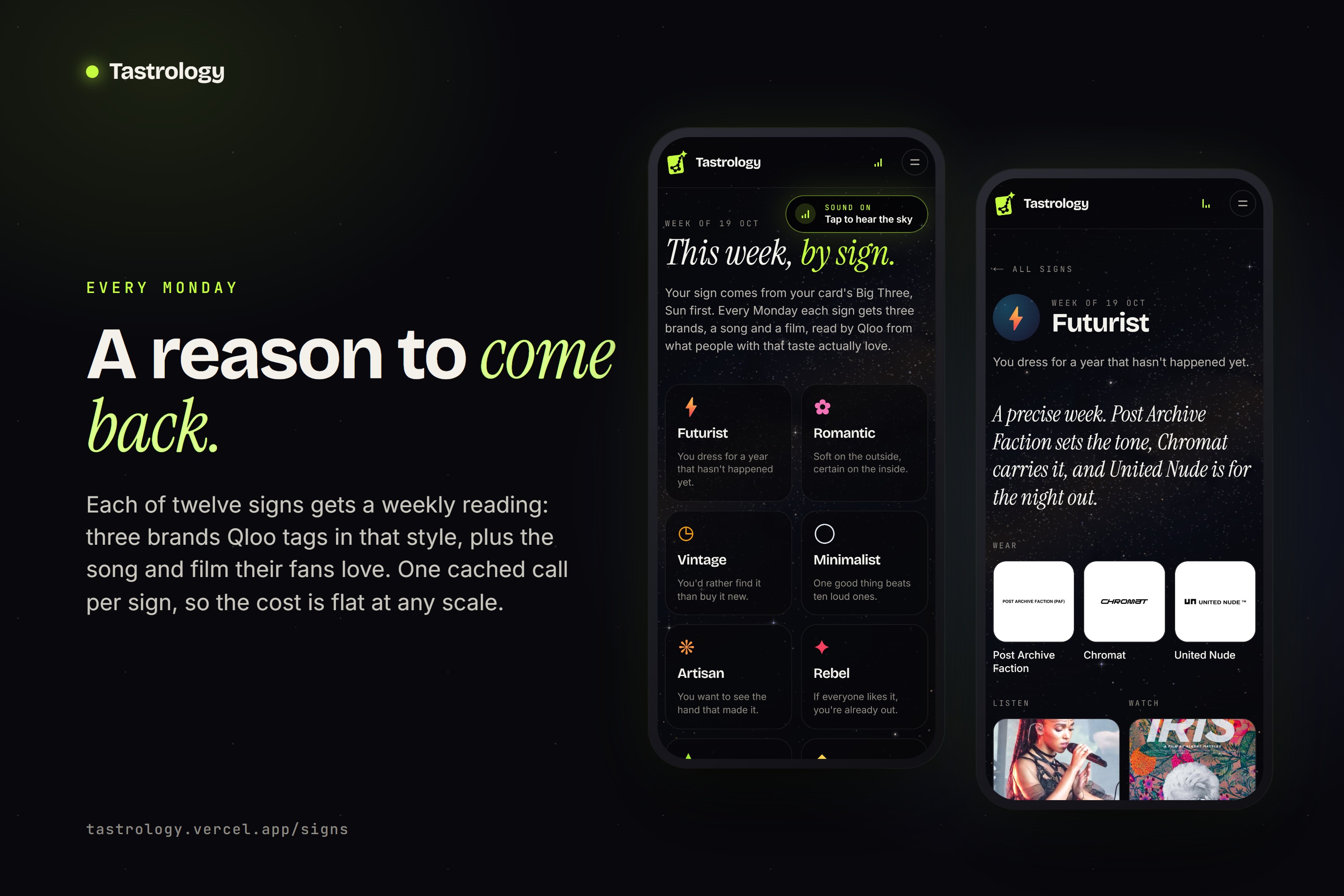
- This week: tastrology.vercel.app/signs has a new reading for each of the twelve signs every Monday.
Taste twins and friend fights need two people: send your card's link to a friend, or open it in a second browser with a second email.
Inspiration
My friends will argue about their star signs for an hour. Nobody believes the planets picked their personality, but everyone wants a sign that feels like theirs. It's never really about the stars. It's about being seen, and having something to compare with the people you like.
Here's what bugged me. Your sign comes from your birthday, something you had no say in. Your taste is different. You built it, one rewatched film and one looped song at a time. It's the most personal thing most of us share without thinking. Your taste deserves a constellation.
Qloo made that buildable. Its graph knows that the people who love one thing tend to love a dozen others, across music, film, food, fashion and places. So I wrote one rule on a sticky note before writing any code:
Every star in your sky comes from Qloo, in that run, and the app has to prove it.
That rule matters because of who's on the other end. If an app tells you something about yourself, it owes you the truth, not a confident guess. The rest of this page is what it took to keep that promise.
What it does
You type three things you love. Say: Daft Punk, scones, Spirited Away.
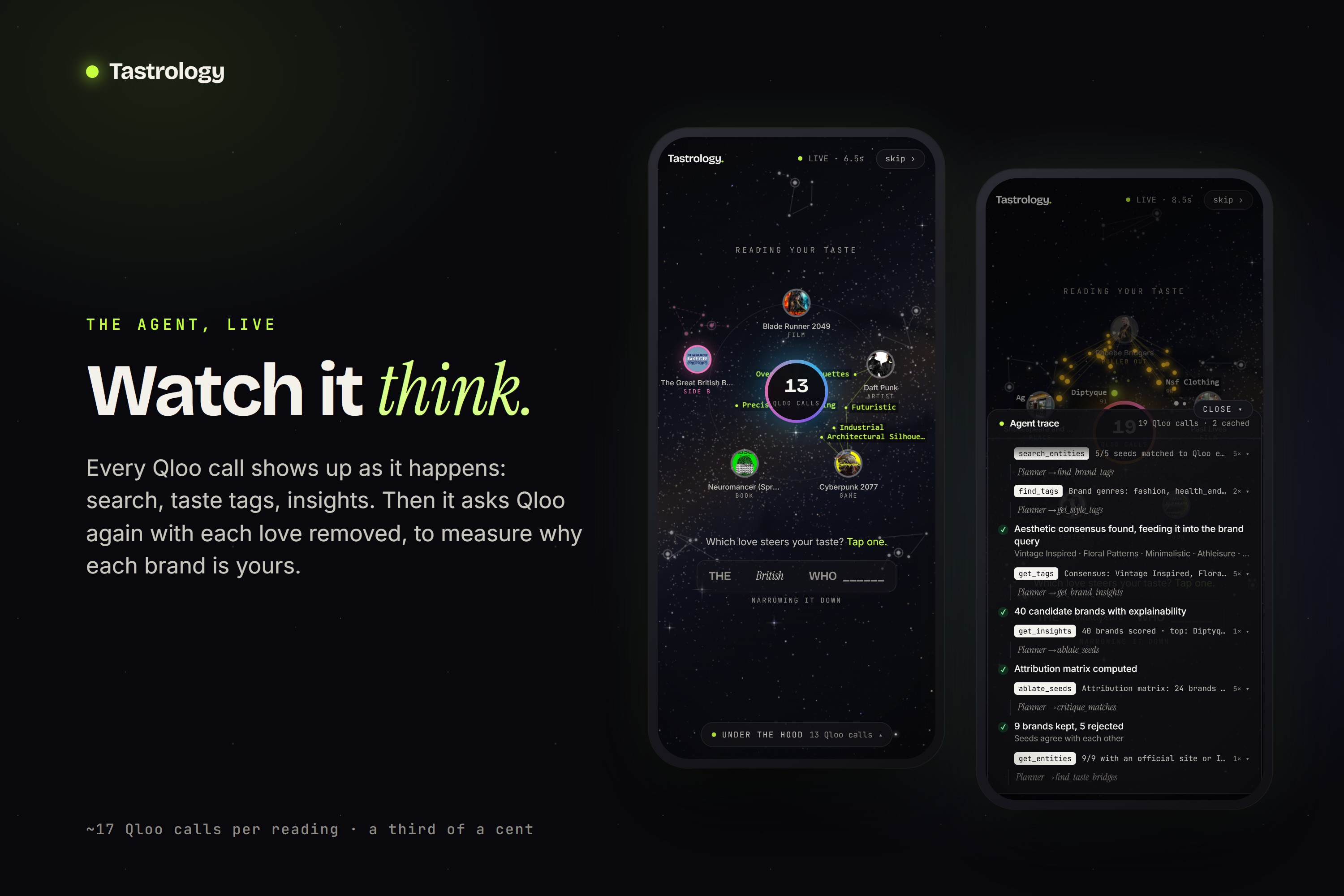
Then you watch an AI agent work. It doesn't hide behind a spinner. Each step shows up on screen as it happens: it looks your loves up in Qloo, reads their taste tags, and pulls brands from across the graph. Then it pokes holes in its own answer.
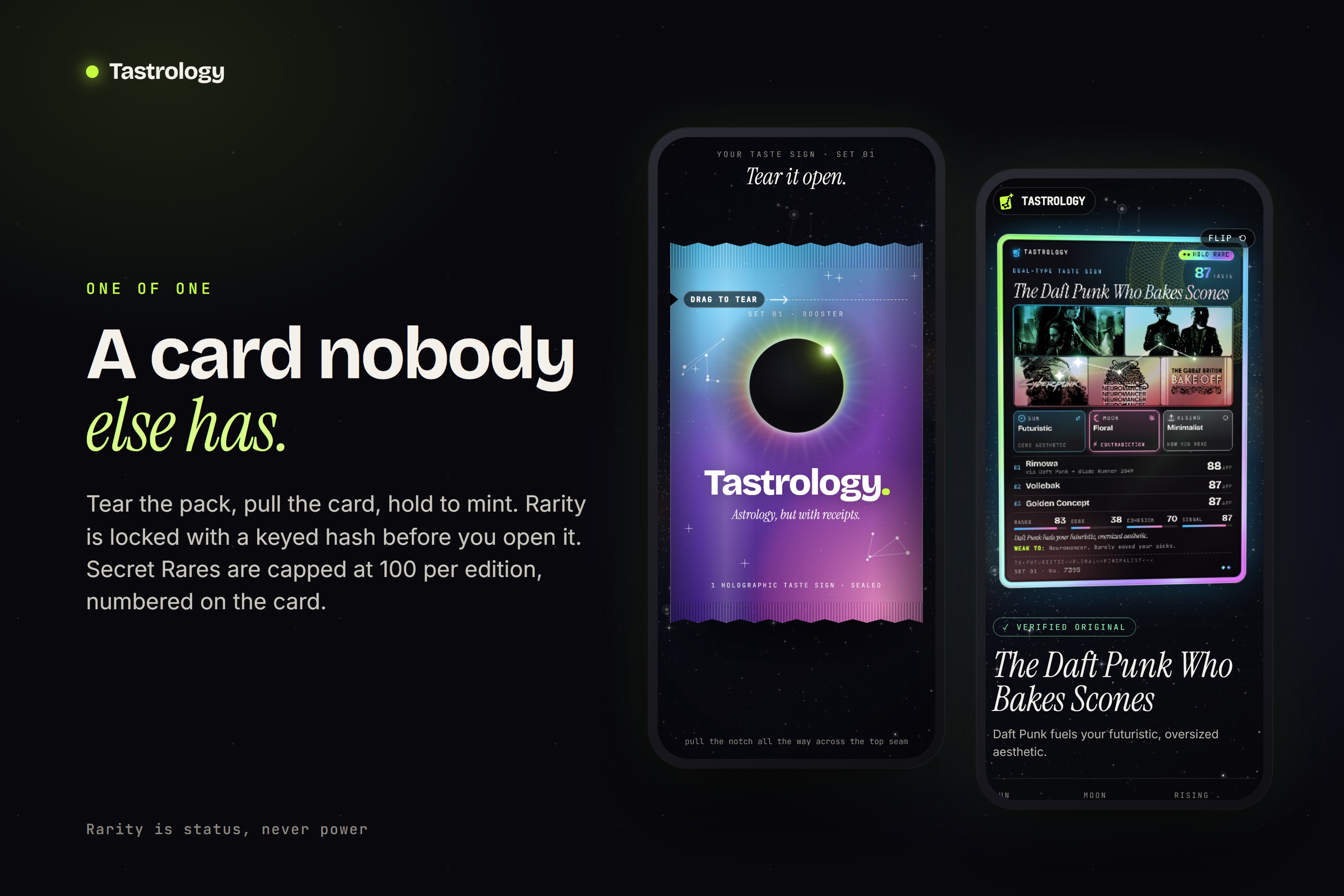
A few seconds later you're tearing open a pack (you actually drag it open), and your card slides out. On it is your sign, The Daft Punk Who Bakes Scones. Under that is a constellation of real brands. Tap any star and it tells you which of your loves put it there.
The last line of every reading:
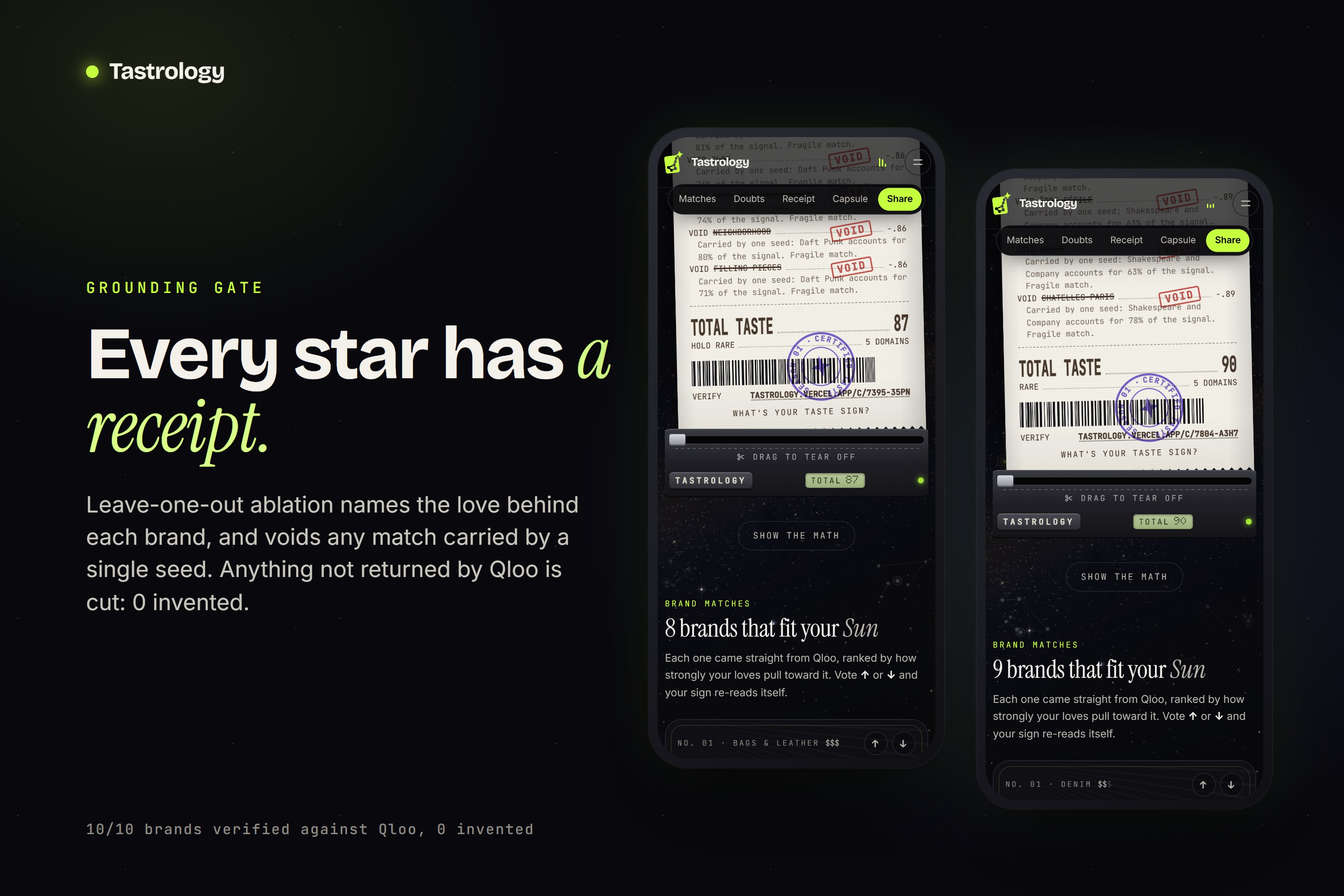
Grounding gate: 10/10 brands verified against Qloo, 0 invented.
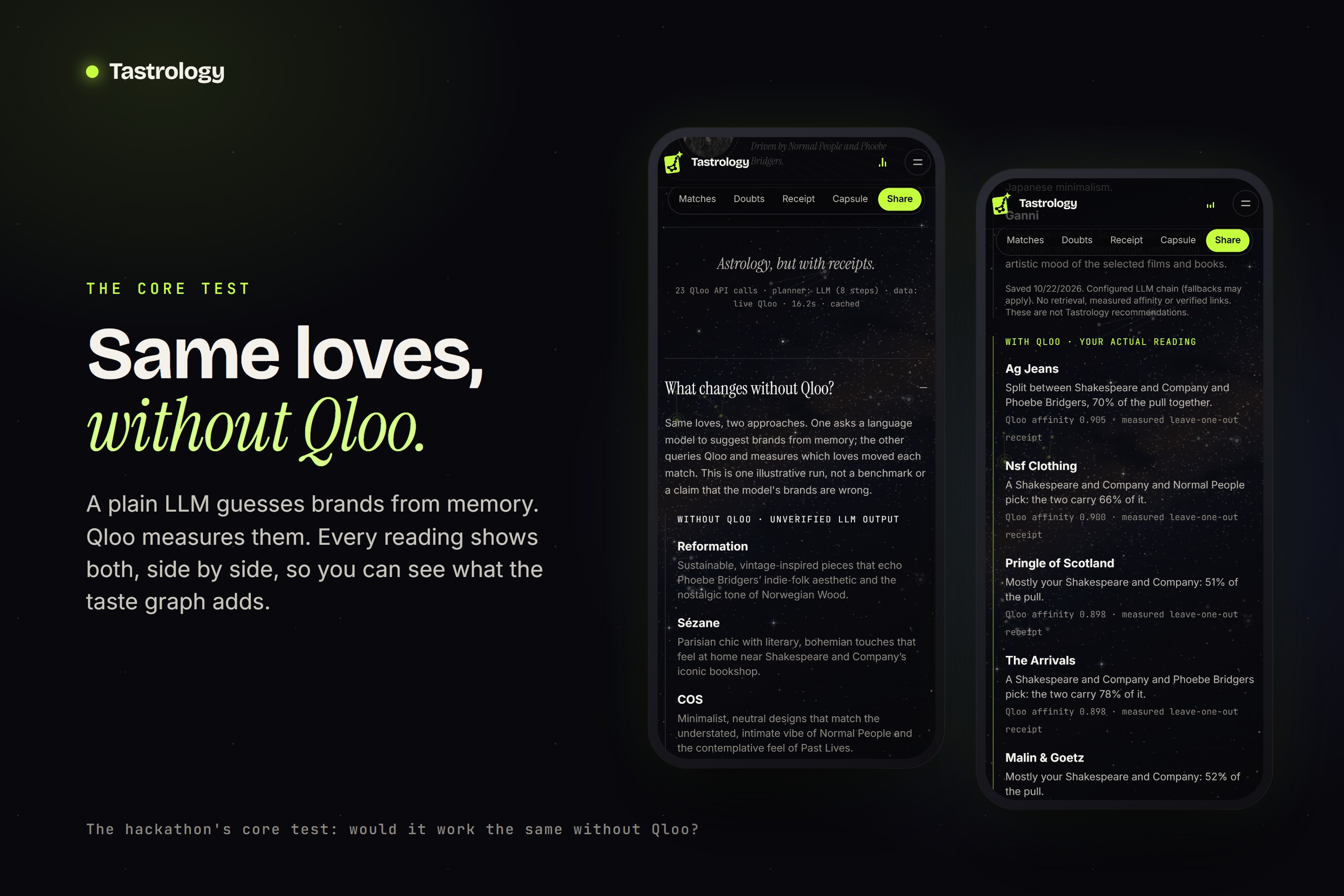
Next to it is a panel I'm a little smug about. It asks a plain LLM the same question with no Qloo, and puts the two answers side by side. That's the best argument I have for the taste graph.
After that, it's a game you play with your friends. Send your card and the link asks one thing: are we taste twins? Your friend makes theirs in a minute, you both see how close your taste is, and then your skies fight. Cards have rarities, and nobody can fake them, me included.
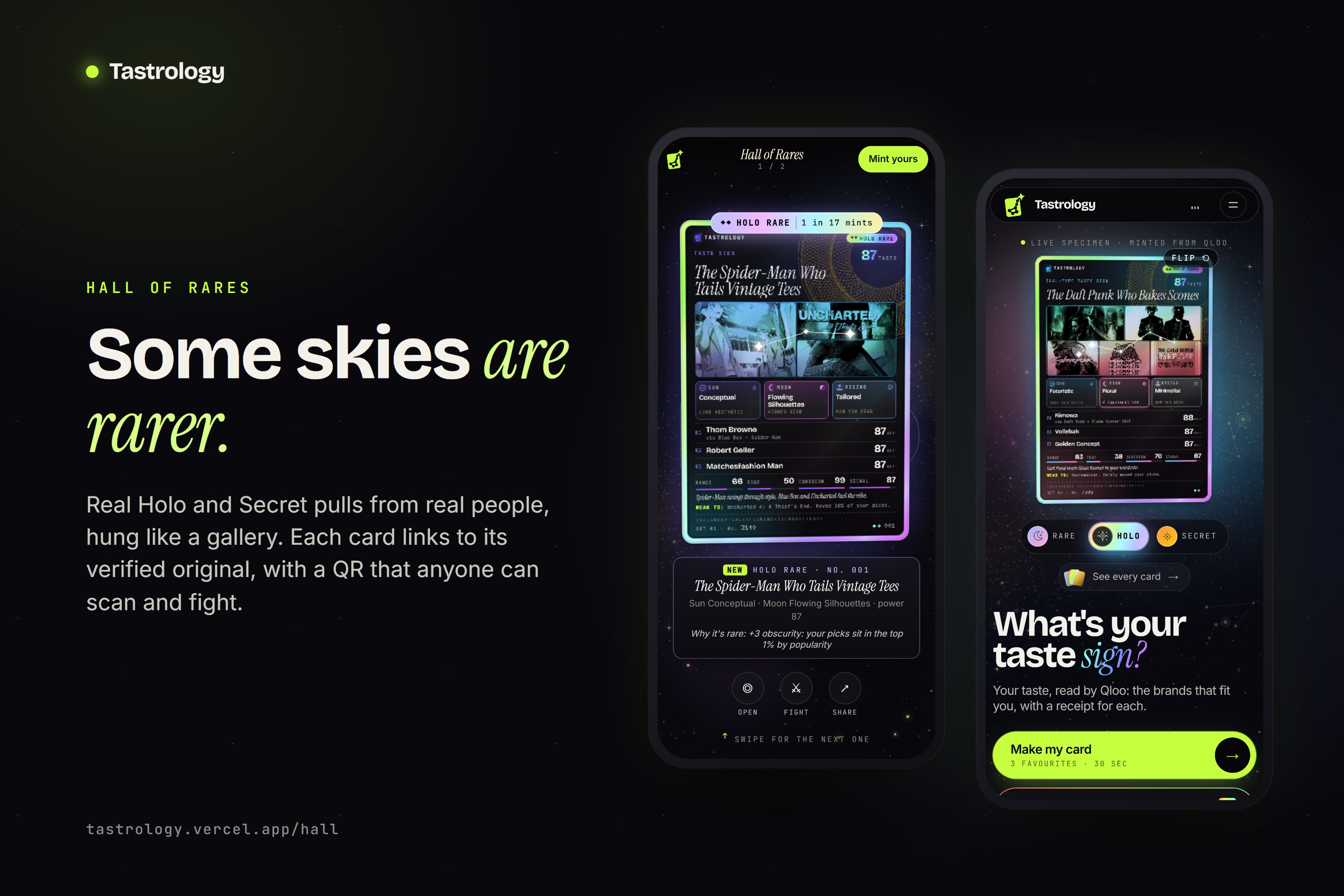
Every card is one of a kind. Two people with the same three loves get the same reading, but never the same card: each mint is its own print with its own number, edition and look. The rarest tier, Secret Rare, is capped at 100 per edition and numbered on the card ("037 / 100"), so it means the same thing at 50 users or 100,000.
And there's a reason to come back every week. Your sign is your Sun, the style your card reads first. Every Monday each of the twelve signs gets its own reading: three brands Qloo describes in that style, plus the artist and the film that people who love those brands love too.
Made with care
A taste card gets shared in group chats and school chats, so I built it to be safe to share.
- Nothing adult or hateful reaches a card. Qloo's catalogue is the whole world, including adult studios and worse. A guard checks every search, every pick and everything Qloo sends back, and a model reads the names and bios people write about themselves.
- A blocked word still leads somewhere. Instead of a cold "no", the picker offers the nearest clean neighbours (search hentai, get Anime, Manga, Seinen).
- If someone types something that sounds like they're struggling, it doesn't block them. It shows a helpline. That one line of code is the one I care about most.
- Real brands keep their place, even the rude ones. If Qloo says a streetwear label called F*CKTHEPOPULATION fits you, it stays on your card, because your taste is real. Only the word gets softened.
- Your data is yours. No ads and no trackers. The usage counters respect Do Not Track. Deleting your account deletes everything: deck, friends and cards.
How I built it
Solo. Fifteen days. Almost 300 commits, about 41,000 lines of TypeScript, and zero dollars. Everything runs on free tiers, which turned out to matter more than anything else on this page.
The agent (lib/agent.ts) runs a fixed set of steps. Each step knows what it needs from the steps before it: resolve, tags, insights, ablate, critique, bridges. An LLM decides the order. If the LLM dies halfway, a plain deterministic planner picks up the same tools and finishes. You never get a blank screen.
Ablation is my favourite part. To find out why a brand is in your sky, the agent asks Qloo again with one of your loves removed, then again with a different one removed, and measures what drops. Take away Daft Punk and a sneaker brand falls off a cliff? That sneaker brand is yours because of Daft Punk. It costs an extra Qloo call per love. I stream each one as it lands, so the waiting is the fun part.
The grounding ledger (lib/grounding.ts) is basically a bouncer with a guest list. Anything Qloo returns goes on the list. Anything the LLM writes that isn't on the list gets cut before you see it. Tests check this against every demo persona, every time.
The rest, briefly:
- Rarity is locked in with a keyed hash before you open the pack. Reloading can't reroll it, and I can't rig it either.
- Packs, fight stakes and refunds are single DynamoDB transactions, so tapping twice can't charge you twice.
- I talk to AWS through a 31-line signer I wrote myself, with no SDK.
- The constellation shape is real geometry: farthest-point sampling picks the stars, and a minimum spanning tree draws the lines.
- Every sound in the app is synthesized live. There isn't one audio file in the repo. On iPhone, buttons tick under your finger.
Stack: Next.js on Vercel, Qloo, Amazon Bedrock and OpenRouter, DynamoDB, S3, Upstash Redis, Clerk, Cloudflare Turnstile. 271 tests.
Every Qloo endpoint, and why:
/search: turns the three things you typed into real Qloo entities. If Qloo can't find it, it isn't in your reading./entities: one batched lookup for the brands you keep, for their official site and Instagram (insights leaves those out), so every brand on your card links somewhere real./v2/tags: finds the taste tags (personal style, aesthetics) your loves share. Your Sun, Moon and Rising come from these./v2/insights, brands: the core call. Your loves in, ranked brands out, with Qloo's explainability saying how much each love pulled./v2/insights, again with one love left out: the ablation. What drops tells you which love put each brand there./v2/insights, artists, films and places: the "bridges", the culture next to your brands, and the weekly reading's song and film./v2/insightswithfilter.tags: the weekly reading's brands for a sign, picked from what Qloo tags with that sign's style.
What a card costs to make. A real reading on the live site (22 Oct, three loves) made 17 Qloo calls and used 15,719 LLM tokens in and 1,902 out on gpt-oss-120b (Bedrock, about $0.15 per million tokens in and $0.60 out). That's about a third of a cent per card, so a thousand new cards cost about $3.50. The token count is printed at the bottom of every reading. Repeat readings of the same loves are cached, and the weekly readings are shared by everyone with the sign: twelve signs, three calls each, a few times a day, whether ten people read them or ten thousand.
Real people, real cards
The site has been live since 19 Oct. In its first five days, every reading that someone started ended in a card. The friend link works the way I hoped: 19 times someone opened a friend's card, and 4 of those visits turned into a brand-new card of their own: someone who came for a friend and stayed for their own sky.
The numbers are small and honest (they include my own testing). They also showed me two problems: most visitors never started a reading, and almost nobody shared. So I put the promise on the very first screen, explained what happens when you send your card to a friend, and added counters that show exactly where people stop. Then I started sending my own card to the people I know, one message at a time.
Challenges I ran into
I kept a diary the whole way through. Some highlights.
The free LLM ran out on day two. OpenRouter's free tier gives you 50 requests a day, and one reading eats several. The live site was quietly falling back to autopilot after a handful of people. I moved the planner to Bedrock and chained four providers, each with a circuit breaker. When one gets rate-limited, it sits out and the next one steps in.
"The Daft Who Bakes Scones." That was a real output. The model chopped "Daft Punk" in half. Other models were leaking their inner monologue into the answer, wrapped in <thinking> tags. So now the reasoning gets stripped, and the sign name gets repaired against the real seed. Even the title on your card is grounded.
A demo persona lost three of its five loves. Qloo was rate-limiting a burst of searches, and the seeds just vanished without an error. I only noticed because the card felt boring. That one got backoff with jitter, a concurrency limit, and a log line every time a seed drops.
I found a way to forge cards. In my own app. The server was saving whatever card the browser sent it. Bad. Registration moved server-side, codes are tied to a hash of the reading, and S3 refuses to overwrite a card. That last one is enforced in IAM, so even my own code can't do it.
Sharing took about ten rounds. I'd fix it on my laptop, then my phone would find something new:
- Snapchat showed a blank white preview.
- The exported constellation turned into a solid black triangle.
- iPhone Safari dropped the card art entirely.
Each card now draws its own preview image, and the server warms it up before X's crawler gives up waiting.
The fight that never showed up. First test with two phones: I challenged myself from the laptop and accepted on the phone. The laptop never found out. I couldn't afford a real-time server, so pages now check one tiny counter, fast right after something happens and slower as things go quiet. It feels instant and costs about two reads a minute. That same test also found that one fight in five was failing because of a dash in an ID.
Then, before launch, I spent an evening throwing garbage at my own API: null bytes, path tricks, emoji. Nothing crashed. One rename race turned up, and it's fixed.
Accomplishments that I'm proud of
The "0 invented" line. Every reading, every stranger. I didn't get there by asking the model nicely. I made it so the model can't be wrong about what's real. I'll take that over any feature.
The first time someone tapped a star, saw which love it came from and said "wait, that's actually me." That's the moment I was building for, and it works.
The helpline. Nobody will ever notice it unless they need it, and that's exactly right.
It's a whole product. Guest readings with no sign-up wall, accounts, decks, friends, live fights, an in-app currency with escrow, privacy pages, and an account delete that really deletes. One person, fifteen days.
And it cost nothing. I'm a bit proud of that one too.
What I learned
I learned the most when I asked the LLM nicely not to invent brands, and it invented them anyway. Prompts are suggestions. If something has to be true, enforce it in code.
I also learned that people will happily wait if they can watch. I spent a day worrying the reading was too slow. Then I put every step on screen, and the slow part became the part people screenshot.
My laptop lies. My phone found more bugs in ten minutes than I'd found in a day at my desk.
Building it was the easy half. Getting a stranger to tap "start" is harder than any bug I fixed, and the only thing that works is a real person sending it to a friend.
And having no budget forced me to actually understand things. I can't pay for a push server, so I built polling that feels like push. There was no room for the AWS SDK, so I learned how request signing works. I'm a better engineer for being broke this month.
What's next for Tastrology
Short version: Tastrology is a taste identity people actually want to show off, and a reason to talk to the people they like. Here's how it grows.
Sponsored stars, without selling out. A brand can never buy a spot in your sky; that would break the one rule. What it can do is sponsor a star that's already there. If Qloo puts that brand in your constellation on its own, the sponsor gets to light it up with a special frame, a limited drop, or a glow in fights. If it doesn't fit your taste, it simply doesn't show. The grounding gate enforces that, not a policy doc.
This also gives brands something ad networks can't. Ablation shows exactly which loves pull people toward a brand. Not "women 18–24", but "people whose sky has Tame Impala and Ghibli in it." Anonymous and aggregated, with nothing personal leaving the system.
A weekly census of taste. Every card already feeds anonymous counters ("rarer than 91% of signs", this week's top signs). At scale, that becomes a live read on how culture moves: which pairings are rising, and which scenes are blending.
Taste twins, with strangers. "Are we taste twins?" already works between friends: one link, a score, a fight. Next it finds strangers who share your sky. Moving to a new city, starting at a new school: the first conversation is easier when you already know you both love the same weird band.
Seasons and real cards. Your sky re-reads each season and your card evolves. The card backs are already designed for print, with a QR code that opens the verified original. So you'd have a physical card a stranger can scan and fight.
Boring but necessary: end-to-end tests in CI, load testing, a fallback for when Qloo is down, and real push notifications.
I built all of this in fifteen days with no money. I'd love to see what it becomes with a little.
Built With
- amazon-bedrock
- amazon-dynamodb
- amazon-web-services
- canvas
- clerk
- next.js
- node.js
- qloo
- react
- redis
- typescript
- upstash
- vercel
- vitest
- web-audio-api
- webgl
