TasteTrip: Your Taste. Your Next Adventure.
Inspiration
You finally have a few days off. A budget, a suitcase, and twenty browser tabs open. Every destination looks incredible. Every itinerary promises the perfect trip. But which one actually feels like you? We wanted to explore a different starting point for travel planning: the things people already love. Their favorite films, the artists on their playlists, the books they return to, and the places they remember long after coming home. Those interests can reveal connections that a destination checklist misses. Someone might know exactly what moves them culturally without knowing where they want to travel next.
TasteTrip began with that question: what if your next adventure started with your taste?
What it does
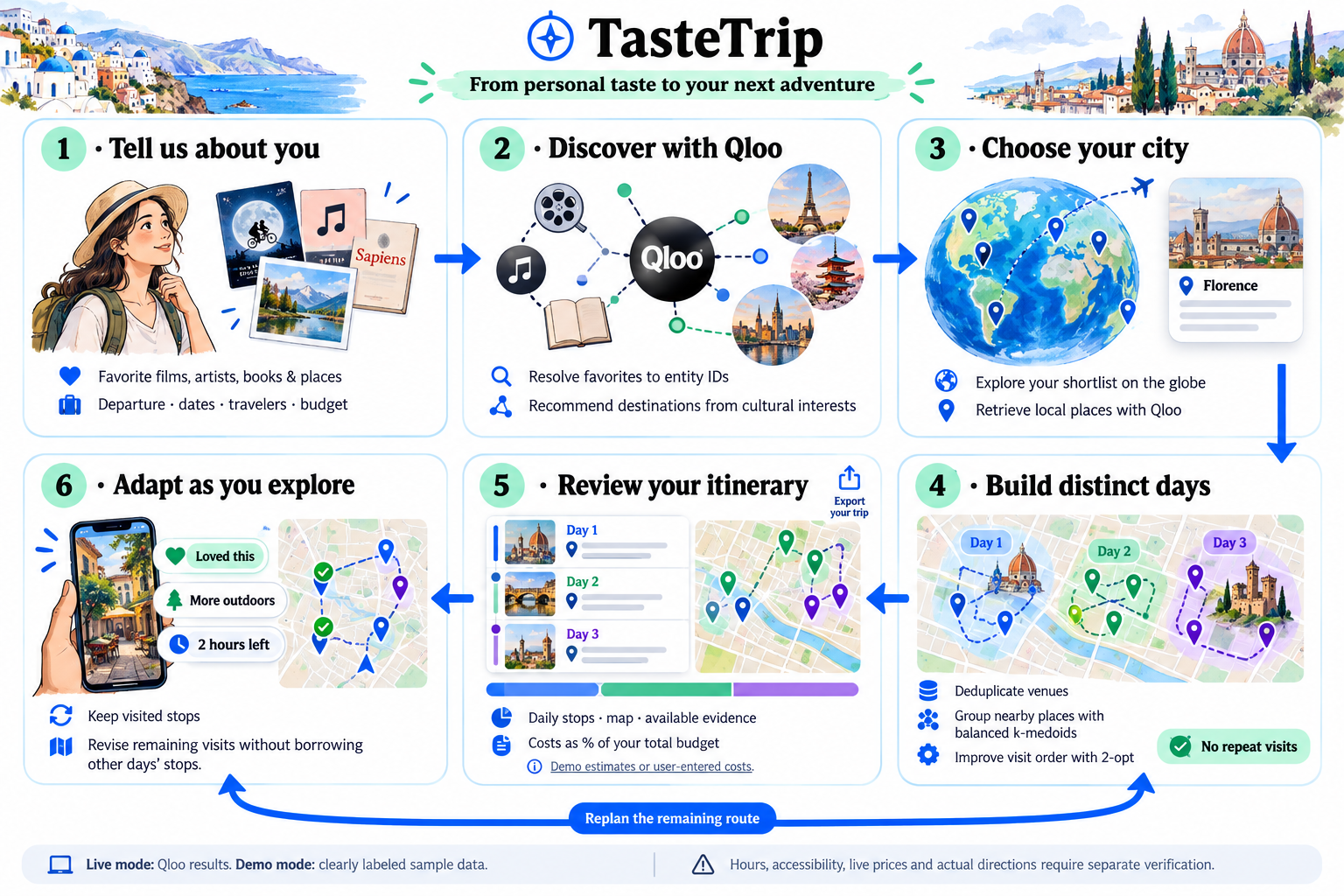
TasteTrip is a travel discovery and itinerary-planning website that helps users explore destinations through their cultural interests. Travelers enter their departure city, dates, trip length, traveler count and budget. They can search for favorite movies, artists, books and places, share previous travel memories, and choose their preferred pace.
The discovery interface brings destinations onto an animated globe. In live mode, the app requests cultural recommendations from Qloo using confirmed entity IDs. Users can explore the results and select a destination to discover relevant local places.
The itinerary planner then turns a collection of places into distinct days. It groups nearby venues geographically, improves their visit order, and prevents the same venue from appearing on multiple days. An “All clusters” map makes those geographic groups visible in different colors.
Users can inspect recommendation evidence when Qloo supplies it, swap a stop, mark places as visited, request more outdoor activities, or shorten the remaining plan to two hours. Adaptation preserves completed visits and avoids taking venues already assigned to another day. The itinerary can also be exported.
The budget panel shows flights, hotels, food, local travel and reserve as percentages of the traveler’s total budget. The demo uses clearly labeled illustrative costs. In live mode, users can enter their own costs; missing prices remain unknown.
Qloo guides cultural discovery. TasteTrip’s planning engine organizes the experience. Live flight and hotel shopping, booking, verified opening hours and navigable directions are outside the current prototype.
How we built it
We built the application with Next.js, React and TypeScript, with server-side API routes and a project structure ready for Vercel deployment. Zod validates recommendation inputs, and API credentials stay on the server.
The Qloo integration follows two stages:
- Resolve interests: use
GET /searchto find entities matching the traveler’s favorites. Users select exact results rather than passing arbitrary text as an entity ID. - Discover destinations and places: use
GET /v2/insightswithsignal.interests.entities. Destination discovery usesfilter.type=urn:entity:destination; local discovery usesfilter.type=urn:entity:placewith geographic filtering. Requests enablefeature.explainability=true, and the app preserves returned affinity and explanation evidence when available.
For hackathon access, the server adapter targets the hackathon API environment and authenticates with X-Api-Key. We implemented the integration against the documented contracts; credential-backed validation remains necessary for a particular account.
The data science contribution is the multi-day planner. It deduplicates venues, constructs a haversine distance matrix, and uses balanced k-medoids to assign places to geographic groups. Each group becomes a separate day. Within each day, nearest-neighbor ordering followed by bounded 2-opt improves the geographic visit sequence.
The scheduler applies the chosen pace, assumed visit durations and a daily time allowance. Transfer estimates use geodesic distances and an assumed walking speed, so they are explicitly approximate. Sparse results produce lighter days instead of recycled attractions.
We used Three.js for the globe, with a software-rendered fallback when WebGL is unavailable. Leaflet displays the itinerary and geographic clusters. The visual experience includes floating motion, page and day transitions, responsive layouts and reduced-motion support.
Challenges we ran into
The biggest challenge was moving from attractive recommendations to a coherent trip.
Our first planner could recycle places across days. We replaced that approach with a single trip-wide assignment, making venue ownership explicit before generating daily schedules. Swaps and feedback also needed to respect that assignment; otherwise, adaptation could reintroduce duplicates.
Another challenge was separating cultural relevance from practical certainty. Qloo affinity does not establish that a venue is open, accessible, affordable or available at a particular time. We kept those distinctions visible instead of turning missing information into confident claims.
We also had to maintain a strict boundary between demo and live behavior. Switching to live mode clears sample destinations, favorites and itinerary state. Missing images use neutral placeholders, missing evidence stays missing, and illustrative costs are never presented as live quotes.
Finally, browser rendering and external map layers required resilience. We added globe and map fallbacks so a graphics limitation or failed basemap would not erase the core experience.
Accomplishments that we're proud of
- Built a connected experience from taste collection and globe discovery to daily itineraries, feedback and export.
- Made the data science visible through geographic clusters, distinct days and an inspectable planning explanation.
- Eliminated cross-day venue repetition instead of hiding a small candidate pool behind repeated recommendations.
- Added transparent budget percentages with clear distinctions between sample, user-entered and unknown costs.
- Preserved visited stops across day changes and kept adaptation from borrowing venues assigned elsewhere.
- Passed the production build and 14 automated tests, including geographic separation, cross-day uniqueness, sparse candidate pools, budget calculations and response normalization. We also exercised the demo and mode-switching flows in the browser.
What we learned
Personalization has several layers. Cultural discovery helps identify interesting possibilities; geographic planning determines whether those possibilities form a sensible day. Both matter.
We learned that a strong itinerary is a constrained selection problem, not simply a long list of relevant places. Coverage, visit duration, proximity and changing preferences all affect the result.
We also learned that adaptation requires memory of the plan: what has been visited, what belongs to another day, and what remains available. Rebuilding everything from scratch can undo decisions the traveler already made.
Most of all, we learned that uncertainty belongs in the product. Clearly distinguishing an affinity score, a planning assumption and a verified fact makes the experience more useful and trustworthy.
What's next for TasteTrip: Your Taste. Your Next Adventure.
Our next priority is connecting practical travel providers for flight and hotel quotes, opening hours, admission prices, reservations and actual travel-time matrices. That would let destination ranking account for verified costs and daily planning respect real operating windows.
We also want to add individual companion profiles and group-fairness objectives, so shared itineraries accommodate different interests rather than collapsing everyone into one average traveler.
Further work includes weather-aware replanning, better treatment of arrival and departure days, and explicit accessibility requirements backed by appropriate sources.
For evaluation, we plan to compare cultural recommendations with a popularity-only baseline, measure planning distance and constraint violations, and gather traveler feedback on relevance, variety and usefulness. We will validate improvements before presenting them as measured outcomes.
The longer-term opportunity includes personal travel planning and cultural discovery tools for boutique hotels and destination operators.
TasteTrip: Your taste. Your next adventure.
Built With
- css
- geographic-clustering
- k-mediods
- leaflet.js
- next.js
- node.js
- qloo
- react
- recommendation-systems
- route
- route-optimisation
- three.js
- typescript
- vercel
- zod


Log in or sign up for Devpost to join the conversation.