
Inspiration# 🧠 Inspiration
Exploring new places should feel personal — not generic. We often rely on popular lists or random suggestions that don’t truly reflect who we are.
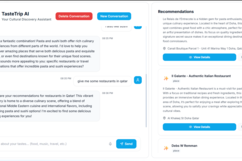
TasteTrip AI was created to recommend locations that align with your unique cultural preferences — from the food you enjoy to the music you vibe with — and seamlessly guide you there using intelligent, contextual map-based visuals.
💡 What it does
TasteTrip AI recommends restaurants and destinations tailored to your individual cultural taste — and enhances the discovery experience with:
- A taste-based prompt system (e.g., “fantasy novels, lofi music, sushi”)
- Qloo’s Taste AI translates your preferences into cultural categories
- A smart agent selects and explains fitting nearby venues
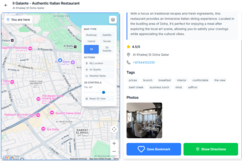
- Google Maps provides:
- Directions
- Local weather overlay
- 3D view mode
- Rich insights (e.g., terrain, satellite view, neighborhood dynamics)
- The system remembers your likes using RAG (Retrieval-Augmented Generation)
🛠 How we built it
- Frontend: React + TailwindCSS
- Backend: Node.js + Express
- Qloo Taste AI: Maps user inputs to multidomain cultural data
- Google Maps JavaScript API:
- Interactive maps with 3D view and data layers
- Directions rendering and routing logic
- Dynamic weather and terrain visualizations
- Interactive maps with 3D view and data layers
- OpenAI: GPT for prompt interpretation, explanations, and RAG memory
- Supabase: Handles user embeddings, session persistence, and vector search
- RAG architecture: Supports personalized memory and evolution over time
🚧 Challenges we ran into
- Mapping cultural tastes to geospatially relevant data
- Integrating multiple APIs smoothly
- Making AI explain why a place matches a user’s unique profile
- Managing real-time UX for geolocation and dynamic overlays
🏆 Accomplishments that we're proud of
- Created a pipeline that links abstract taste to real-world locations
- Integrated AI explanations into map-based suggestions
- Delivered weather-aware, 3D-enabled discovery
- Engineered persistent user memory and preference learning
📚 What we learned
- Taste can be a strong filter for real-world discovery
- LLMs paired with cultural embeddings enable deeper personalization
- Enhancing maps with live weather, terrain, and interactivity increases decision confidence
- RAG architecture brings continuity to user experience
🚀 What’s next for TasteTrip AI
- Real-time taste graphs between users
- Smarter bookings and reservation systems
- Integrating local event data
- “Offline Trip Mode” with downloadable visual routes
- Feedback loops for taste refinement and gamification
What it does
How we built it
Challenges we ran into
Accomplishments that we're proud of
What we learned
What's next for Untitled
Built With
- express.js
- google-maps
- gpt-4
- next.js
- openai
- qlootasteai
- supabase
- supabaseauth
- tailwind

Log in or sign up for Devpost to join the conversation.