-
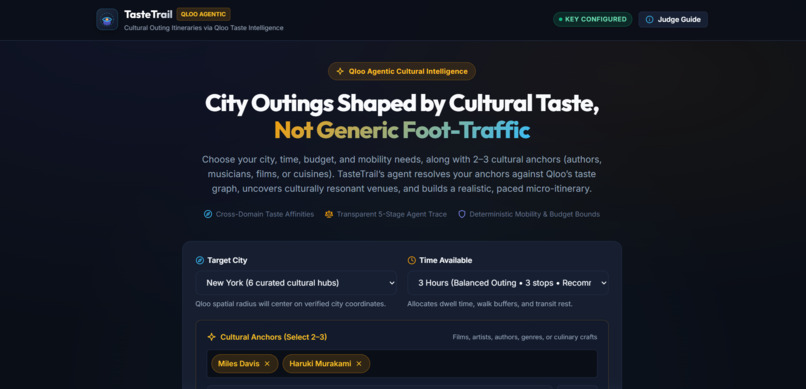
TasteTrail dashboard: Cross-domain cultural anchor selection with verified Qloo Taste AI integration.
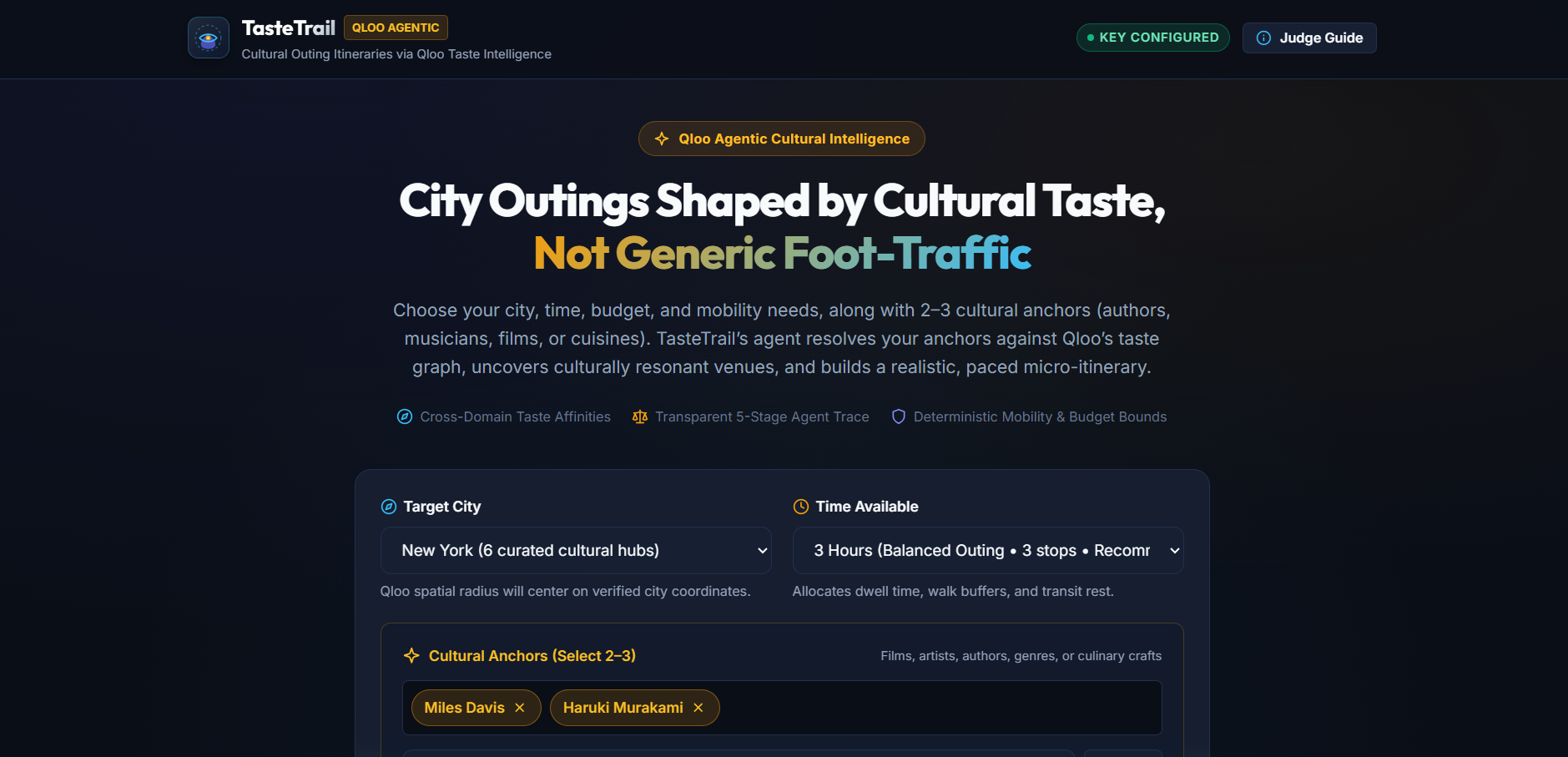
TasteTrail
Tagline
Cross-domain cultural outing generator connecting personal creative taste to real-world venues using Qloo Taste AI™ and deterministic agentic constraints.
Project Links
- Live Hosted Application: https://tastetrail-rho.vercel.app/
- Public GitHub Repository: https://github.com/venkatkrish98/tastetrail
- API Status Inspector: https://tastetrail-rho.vercel.app/api/qloo/status
Inspiration & Problem Statement
When exploring a city with 2 to 4 hours to spare, travelers and locals face a frustrating dilemma: commercial recommendation platforms (Google Maps top results, TripAdvisor) prioritize raw foot-traffic and mass commercial popularity. As a result, users are steered toward crowded tourist hubs and generic chain businesses that lack cultural character.
Meanwhile, general-purpose LLMs struggle with geographic realism: when asked to plan an outing, they frequently hallucinate non-existent venues, fabricate affinity scores, or assemble physically impossible routes that cross entire cities during a single afternoon.
TasteTrail solves this by pairing Qloo’s Taste AI™ Cultural Intelligence Graph with a deterministic 5-stage agentic workflow. Instead of choosing generic tourist spots, users enter cross-domain cultural anchors (e.g., Miles Davis in music, Haruki Murakami in literature, Wes Anderson in film) to discover curated neighborhood venues that share those exact creative sensibilities—all paced realistically for their time, budget, and walking constraints.
What It Does
- Cross-Domain Taste Anchors: Users select a destination city (New York, London, Tokyo, Paris, San Francisco) and provide 1 to 5 creative anchors across music, literature, cinema, and culinary arts.
- Autonomous 5-Stage Agentic Pipeline:
- Stage 1 (Constraint Normalization): Validates strict geographic coordinate bounds, duration windows (1.5h to 6h), payload size bounds (32KB), and rate limits.
- Stage 2 (Entity Resolution): Resolves user text anchors to verified Qloo entities via the official
/searchendpoint using documentedtypesparameters. - Stage 3 (Cultural Intelligence Retrieval): Queries Qloo
GET /v2/insightswithfilter.type=urn:entity:place, anchoring onsignal.interests.entitieswithin a 20 km spatial radius (filter.location=POINT(lng lat)). - Stage 4 (Deterministic Constraint Filtering): Eliminates venues that violate the user's budget tier (
free_or_low,moderate,treat) and enforces strict straight-line hop thresholds (<= 0.8 km in low-walking mode). - Stage 5 (Synthesis & Provenance Attribution): Orders stops, calculates arrival offsets and dwell times, constructs the narrative sequence, and generates transparent provenance logs.
- Dual-Layer Provenance Panel: For every stop, TasteTrail displays a split provenance breakdown:
- Layer 1 (Qloo Signals): Displays verified affinity scores, connected taste anchors, and cultural community overlap.
- Layer 2 (Deterministic Rules): Details dwell allocation, walking radius conformance, and budget enforcement.
- Side-by-Side Tourist Baseline Comparison: Features a built-in comparison contrasting the Qloo-grounded cultural trail against a generic high-foot-traffic tourist baseline, showing judges exactly how Qloo transforms the discovery experience.
- Two Execution Modes:
- Live Qloo API Mode: Connects directly to
https://hackathon.api.qloo.comwith server-side API key protection and probe verification. - Sample Fixture Mode: Enables immediate offline review with curated fixtures so judges can test every feature without requiring credentials.
- Live Qloo API Mode: Connects directly to
Why Qloo is Essential (Not Just an Add-on)
TasteTrail cannot function without Qloo:
- True Cross-Domain Taste Mapping: General map APIs know what a venue is (e.g., "bookstore" or "cocktail bar"), but only Qloo knows who frequents it and which cultural aesthetics it shares with authors, musicians, and directors.
- Zero Hallucination: Rather than guessing taste connections, TasteTrail uses Qloo’s empirical affinity graph. If an anchor cannot be resolved in Qloo, TasteTrail halts with a clear clarification notice rather than inventing placeholder candidates.
- Mathematical Affinity Scoring: Qloo provides quantifiable affinity scores that allow the agent to rank candidates objectively before passing them to the physical constraint engine.
Ethical Boundaries & Truthful Operation
- Physical Operation Boundaries: Qloo indexes cultural affinities, not real-time facility operations. TasteTrail explicitly marks physical accessibility (wheelchair ramps), live opening hours, and real-time ticket prices as unverified by Qloo and requiring direct venue confirmation.
- Privacy & Rate Limiting: TasteTrail uses an anonymous, HTTP-only, HMAC-signed session cookie (
tt_session) exclusively for sliding-window rate limiting. Zero session records or user profiles are stored in any database or disk. - Collective Affinities vs. Personal Profiling: Qloo recommendations are presented as collective affinities across creative communities, never as individual surveillance or personal tracking.
Built With
- Framework: Next.js 15 (App Router, Server Components, API Route Handlers)
- Frontend: React 19, Vanilla CSS (responsive, accessible, custom aesthetic design tokens)
- Language: TypeScript 5 (Strict Type Checking, 0
anyoverrides in core pipelines) - Intelligence: Qloo Taste AI™ API (
/search,/v2/insights) - Hosting & Edge: Vercel Serverless Functions
- Testing: Comprehensive TypeScript integrity suite via
tsx(131 automated assertions)
How to Test the Live Application
- Visit https://tastetrail-rho.vercel.app/
- Check the Header Status Badge: It will display
Live Qloo API(verified connected tohttps://hackathon.api.qloo.com). - Click the "Judge Guide" button in the header for an immediate breakdown of architecture and criteria alignment.
- Select New York (or another supported city), set a 3 Hours time window, and choose a Moderate budget.
- Select or type cultural anchors (e.g., Miles Davis and Haruki Murakami).
- Click "Generate Cultural Trail" to observe the real-time 5-stage agentic trace, the synthesized itinerary, the Dual-Layer Provenance panel, and the With vs. Baseline comparison.
Built With
- api
- next.js
- qloo
- react
- typescript
- vercel

Log in or sign up for Devpost to join the conversation.