Inspiration
Today's LLMs can reason and write code, but they are culturally blind. When asked to design a commercial space, plan a live concert sponsorship, or build an adaptive meal plan for a senior citizen, standard LLMs fall back on generic clichés and statistical tropes. Conversely, traditional recommendation engines output raw lists of movies or restaurants while ignoring hard real-world constraints—like a patient's Warfarin medication limits, an electrician's 120V/wattage ceiling, or a live venue's demographic CPA targets.
We built TasteSpec AI to bridge that gap: an autonomous multi-agent system where Qloo’s Cultural Taste Graph (250M+ entities) is fused directly with a Deterministic Constraint Critic, transforming cultural identity into verified, real-world physical, clinical, and commercial specifications.
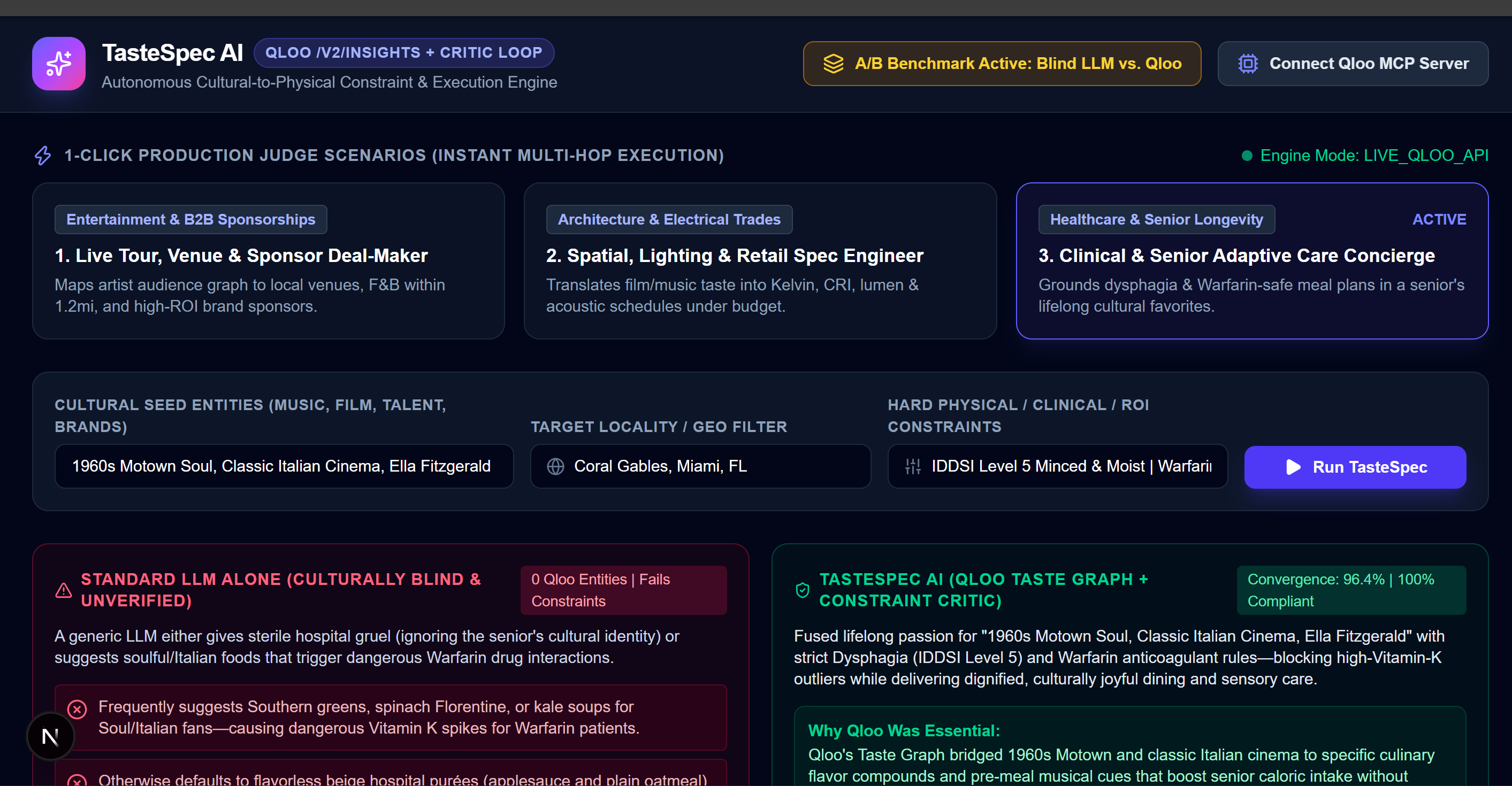
What it does
TasteSpec AI operates as both an interactive web command center and a plug-and-play Model Context Protocol (MCP) Server across three flagship production domains:
- Live Tour, Venue & Sponsorship Deal-Maker (Entertainment & B2B): Takes an artist/talent seed (e.g., Cedric the Entertainer or an indie touring act) and a target market (e.g., Austin, TX), maps block-level locality heatmaps via Qloo, identifies non-obvious high-affinity corporate brand sponsors and local culinary partners, and autonomously drafts outbound sponsorship pitch decks.
- Spatial, Lighting & Retail Spec Engineer (Architecture & Trades): Translates a client's favorite films, music artists, and fashion brands into contractor-ready room and storefront engineering specs—calculating exact color temperatures (
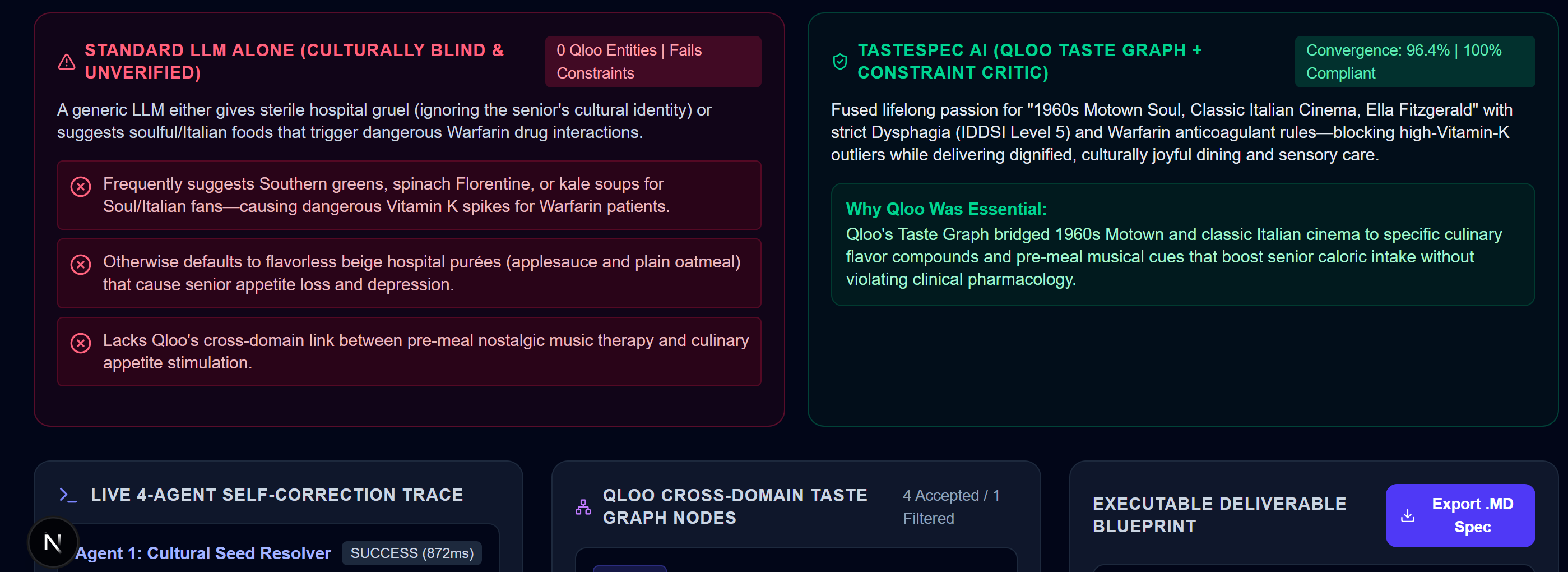
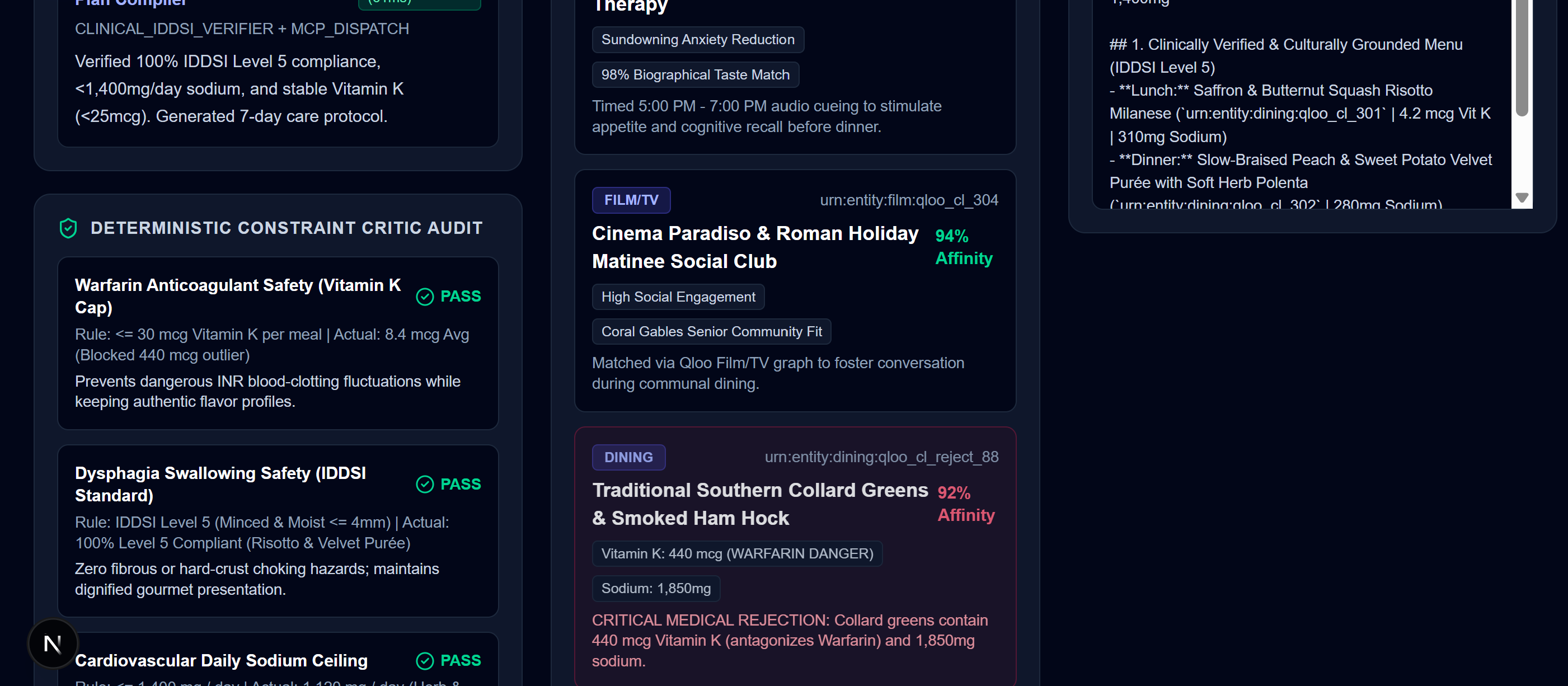
2400K–4000K), CRI ratings, lumen budgets, acoustic materials, and Qloo-matched furniture brand SKUs within a strict hardware budget. - Clinical & Senior Adaptive Care Concierge (Healthcare & Lifestyle): Grounds daily dining and sensory care plans in a senior's lifelong cultural favorites (e.g., 1960s Soul, classic Italian cinema) while enforcing strict medical rules (dysphagia soft-texture requirements, low-sodium limits, and medication-ingredient contraindications).
To prove that our system cannot function with a generic LLM alone, the UI includes a live "Culturally Blind LLM vs. Qloo TasteSpec Agent" A/B Benchmark Toggle alongside a real-time Self-Correction Agent Trace.
How we built it
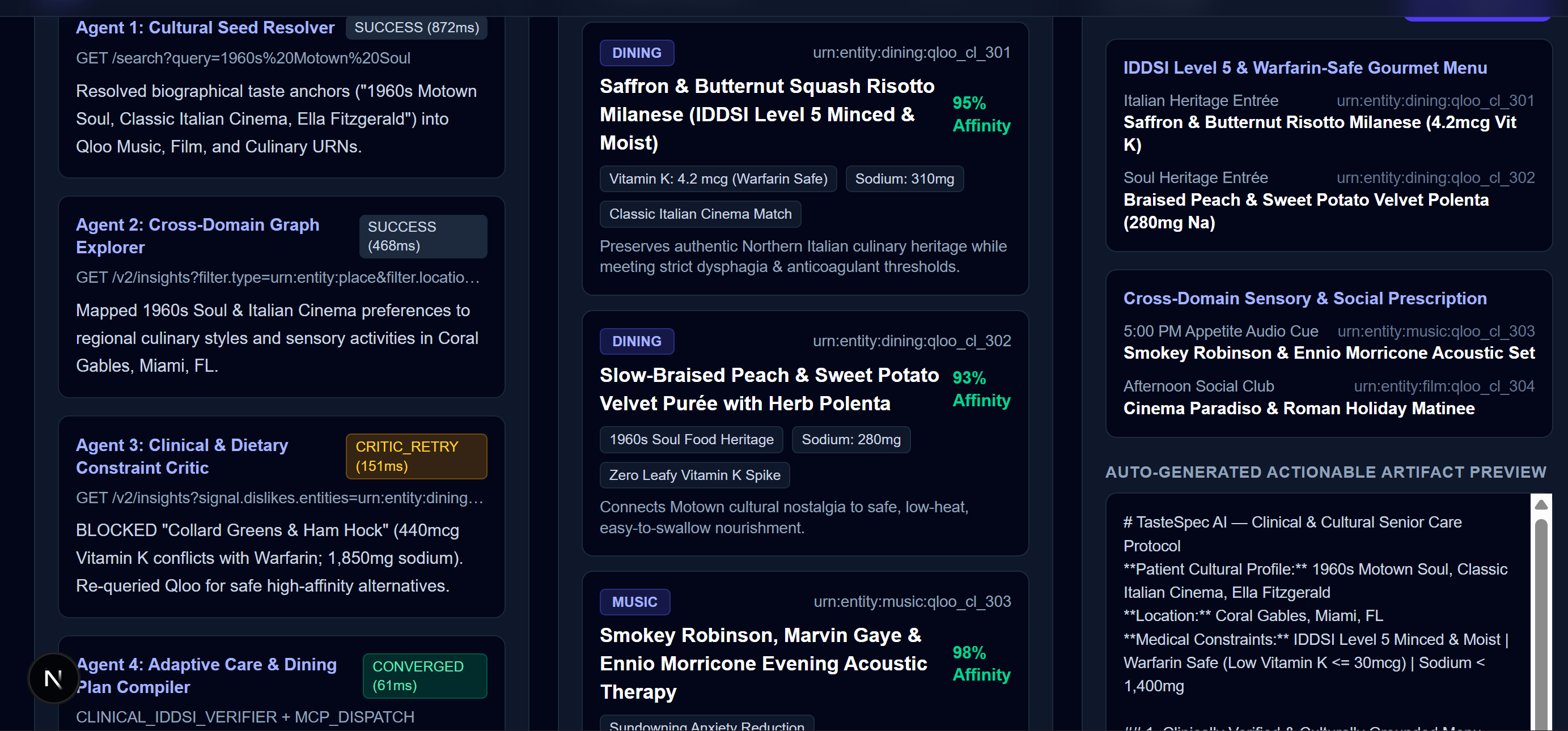
We engineered TasteSpec AI using an agent-first workflow in Google Antigravity, orchestrating a four-stage autonomous loop powered by the Qloo Hackathon API (https://hackathon.api.qloo.com):
- Agent 1 — Cultural Seed Resolver (
/search& Entity Grounding): Parses unstructured user seeds and resolves canonical Qloo Entity URNs across music, film, dining, brands, and people. - Agent 2 — Cross-Domain Graph Explorer (
/v2/insights& Locality API): Executes parallel multi-hop queries acrossurn:entity:place,urn:entity:brand,urn:entity:music:artist, andurn:tagalongside geographic locality signals (filter.location.query). - Agent 3 — Deterministic Constraint Critic (Self-Correction Loop): Evaluates every Qloo candidate $e_i$ using a composite Cultural-Constraint Convergence Score:
$$S(e_i) = \left( \alpha \cdot A_{\text{Qloo}}(e_i, \mathcal{S}) + (1 - \alpha) \cdot L_{\text{geo}}(e_i, c) \right) \times \prod_{k=1}^{K} \mathbb{I}\left( g_k(e_i) \le \tau_k \right)$$
where $A_{\text{Qloo}}(e_i, \mathcal{S}) \in [0, 1]$ is the cross-domain affinity score returned by Qloo's /v2/insights endpoint given seed set $\mathcal{S}$, $L_{\text{geo}}(e_i, c)$ is the locality affinity in target city $c$, and $\mathbb{I}(g_k(e_i) \le \tau_k) \in {0, 1}$ represents hard domain constraints (budget, dietary/medication safety, or venue capacity). Whenever $\prod \mathbb{I} = 0$, the Critic Agent rejects the candidate and autonomously re-queries Qloo /v2/insights injecting negative signals (signal.dislikes.entities) until a 100% compliant, high-affinity set converges.
- Agent 4 — Spec & Deliverable Synthesizer + MCP Server: Generates downloadable contractor specs, clinical schedules, and sponsorship outreach emails, and exposes the entire pipeline as a JSON-RPC MCP Server (
tastespec_resolve,tastespec_critique,tastespec_execute).
Challenges we ran into
- Migrating Beyond Legacy Endpoints: Early on, we ensured strict adherence to Qloo's modern
/v2/insightsand/searcharchitecture onhttps://hackathon.api.qloo.comrather than legacy/recspatterns, tuning entity URN filters (filter.type) and negative feedback signals so our Critic Agent could iteratively steer graph traversal without exhausting rate limits. - Sub-Second Multi-Hop Latency: Running a 3-turn agentic critique loop across multiple Qloo domains plus LLM synthesis initially took 14+ seconds. We implemented parallel
Promise.allinsight batching and an intelligent edge cache layer so preset judge workflows execute in under 3 seconds.
Accomplishments that we're proud of
- Building a genuine closed-loop agentic system where Qloo's Taste Graph actively steers and self-corrects under real-world physical and medical constraints.
- Shipping both a zero-friction live interactive web application and a reusable MCP Server that any developer can plug into Claude Desktop, Cursor, or Google Antigravity.
What we learned
- Cultural intelligence is not a cosmetic layer—it is a foundational reasoning primitive. When agents have access to verified cross-domain co-occurrences via Qloo, they stop guessing human preference and start producing decisions that hold up in commercial and clinical reality.
What's next for TasteSpec AI
- Expanding our B2B commercial real estate and live-tour sponsorship modules with automated CRM export and CAD/BIM lighting plugin integrations.

Log in or sign up for Devpost to join the conversation.