-
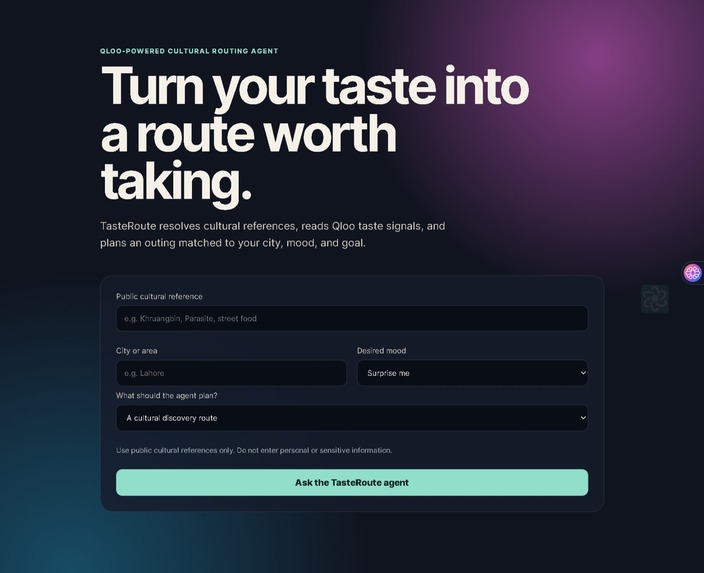
http://16.176.31.89:3000/
Inspiration
Finding somewhere to go is easy. Finding an outing that fits your interests takes more thought. You may know the artists, films, or music you enjoy, yet still struggle to decide where to spend an evening in a particular city.
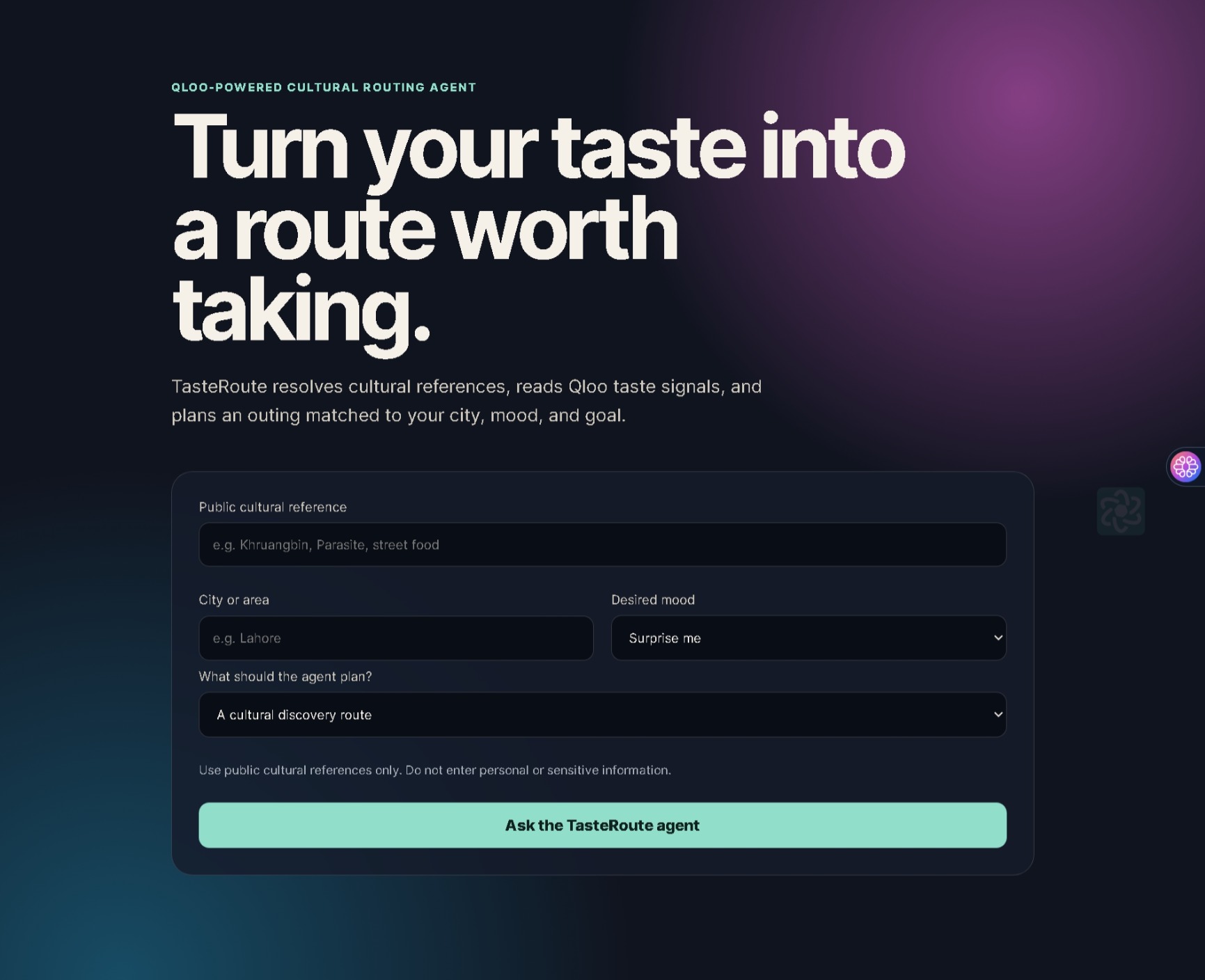
We built TasteRoute to help make that decision easier. It takes a cultural reference, your city, your mood, and what you want from an outing, then uses those details to recommend a cultural route.
What it does
TasteRoute is a cultural routing agent powered by Qloo. Users enter a public cultural reference, such as an artist, select their location and mood, and choose a goal: cultural discovery, dining, live music, or film.
The agent interprets the reference, retrieves related taste signals from Qloo, and ranks local experiences according to the user’s preferences. It then presents a route recommendation alongside a trace of the steps that led to it.
This helps users understand how their interests and choices influenced the recommendation.
How we built it
We built TasteRoute with Node.js and a straightforward, accessible form interface. The application connects to the Qloo API for cultural taste signals and processes those signals through an agent workflow to produce ranked recommendations.
The application runs on Amazon EC2. We assigned an Elastic IP to give it a stable public address.
Live application: http://52.64.143.122:3000/
Challenges we faced
A key challenge was explaining how the recommendations were produced. We wanted users to be able to follow the process and assess whether a suggestion made sense for them.
To support this, we added an agent trace showing the progression from the user’s input to Qloo’s taste signals and the final recommendations.
Deployment brought another challenge. An automatically assigned EC2 public IP can change when an instance is stopped and started. We addressed this by allocating and associating an Elastic IP.
What we learned
We learned that personalization is most useful when it helps someone make a practical decision. Connecting cultural interests with a location, mood, and outing goal gave the taste signals a clear purpose.
We also learned how valuable it is to make the recommendation process visible. A trace gives users something concrete to review and helps us identify where the application needs improvement.
What's next
We would like to add multi-stop routes, saved taste profiles, and a map view to make outings easier to plan.
We also want to explore feedback based on the places users choose or skip, so future recommendations can better reflect their preferences.

Log in or sign up for Devpost to join the conversation.