Inspiration
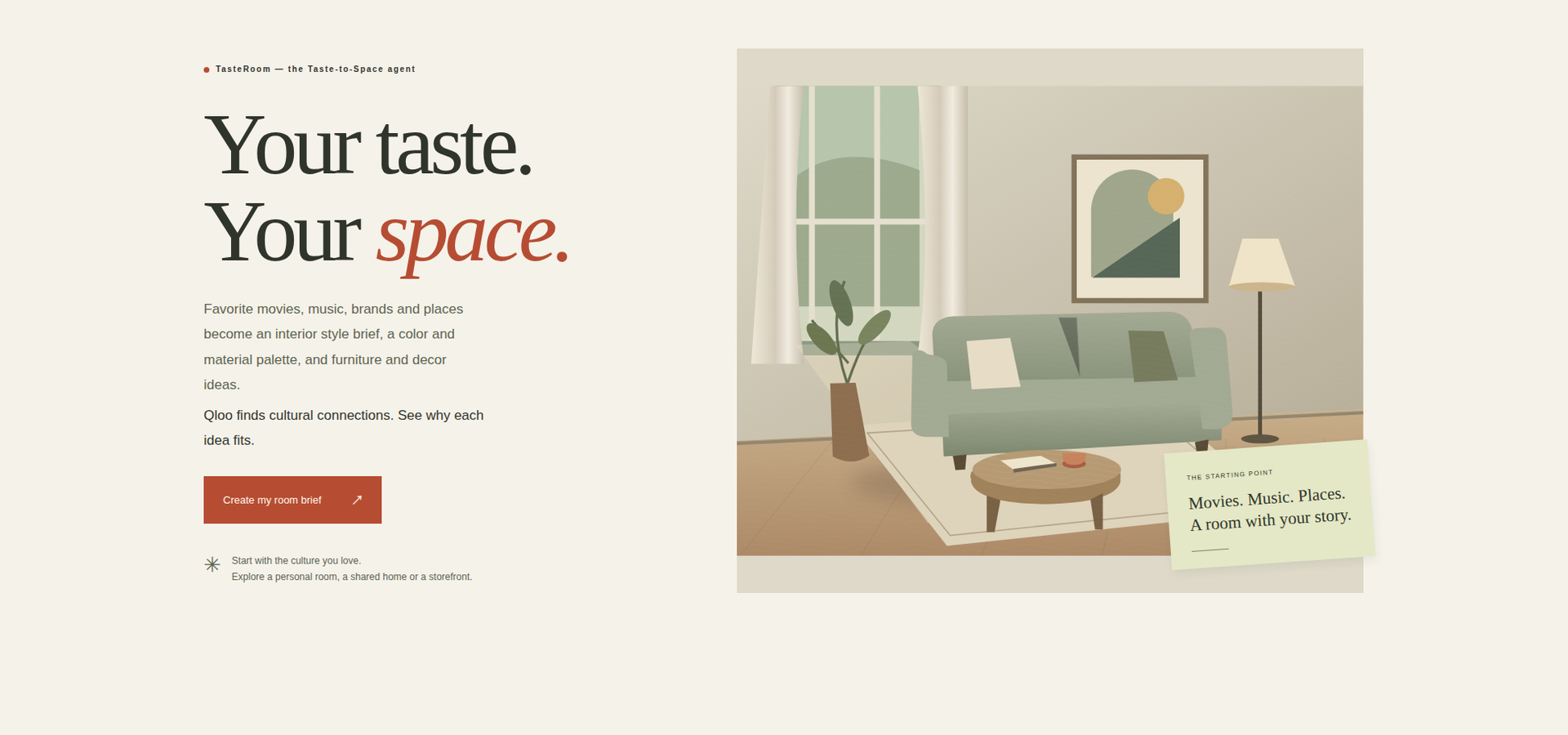
TasteRoom explores a simple question: how can personal cultural tastes become an interior brief with reasons someone can inspect? Its verified examples start with combinations such as Amélie, Radiohead and MUJI, then develop a direction for a specific room.
What it does
The My Room flow turns real taste inputs into a style brief, a color and material palette, furniture and lighting directions, and a conceptual moodboard. Explanations connect suggestions to returned cultural evidence. The evidence dialog lets people inspect that evidence.
Colors, materials, furniture and lighting are design interpretations, rather than Qloo measurements. The concepts use bounded authored schemes, so different inputs do not guarantee different palettes.
How we built it with Qloo and Nebius Nemotron
The production path uses live Qloo evidence and a Nebius agent running nvidia/Nemotron-3_5-Lightning. Qloo resolves actual entities and returns cultural affinities; the agent interprets supplied evidence into an interior brief. In verification, cited names, IDs, tags and source relationships were checked against actual Qloo responses.
Provider credentials are configured as sensitive production secrets. Browser verification found no Qloo or Nebius credentials and no direct provider calls. Raw provider and application samples remain private, outside the public application repository.
Challenges
A central challenge is separating cultural evidence from creative design choices. The briefs label that distinction, and verification checked for invented Qloo facts and exaggerated claims. Entity types also matter: the IKEA input resolved to a real Qloo place, which the app displayed as a place; Insights then returned brand affinities.
Verification has clear boundaries. Shared Space and Storefront were tested offline, but their live paths were outside the required My Room gate. Mobile checks used automated Chromium; the 390px result replayed one real desktop response and was not another live generation or a physical-device test.
Accomplishments
On October 16, 2026, all six production runs passed on commit d574a4daf2703c8cf925965221af8e9afa8e2055: three real profiles, two runs each, with live Qloo and Nebius active. The profiles covered a living room, a home office and a bedroom. Requests returned HTTP 200 with zero warnings in 8.0–10.2 seconds.
All six final briefs were read, and 182 evidence entries matched actual Qloo entity, tag and source relationships. The recorded checks include 41 passing unit tests, a pilot production build, 11 offline browser checks, 12 production browser checks, production 400/405 error handling, clean pre-push secret scans and passing GitHub CI.
What's next
The next validation priorities are live coverage for Shared Space and Storefront and physical-device mobile testing. Another development direction is broadening the bounded authored concept schemes; the current version does not promise a unique palette for every taste profile.
Try it out
Live demo: https://tasteroom-rho.vercel.app
Source: https://github.com/kks0488/tasteroom
Open My Room, enter a few things you love (for example a film, an artist and a brand) and a room type, then generate. Open the evidence dialog to inspect the Qloo entities, tags and affinities behind each suggestion.
License
MIT. Copyright (c) 2026 Kyoungsoo Kim.

Log in or sign up for Devpost to join the conversation.