Ins# TastePulse AI: Where Culture Meets AI Personalization
🌟 Inspiration
While scrolling through endless recommendation lists, I realized:
"What if AI could understand my tastes as well as my best friend does?"
The spark came from two observations:
- 90% of recommendations feel generic (cough Netflix algorithms).
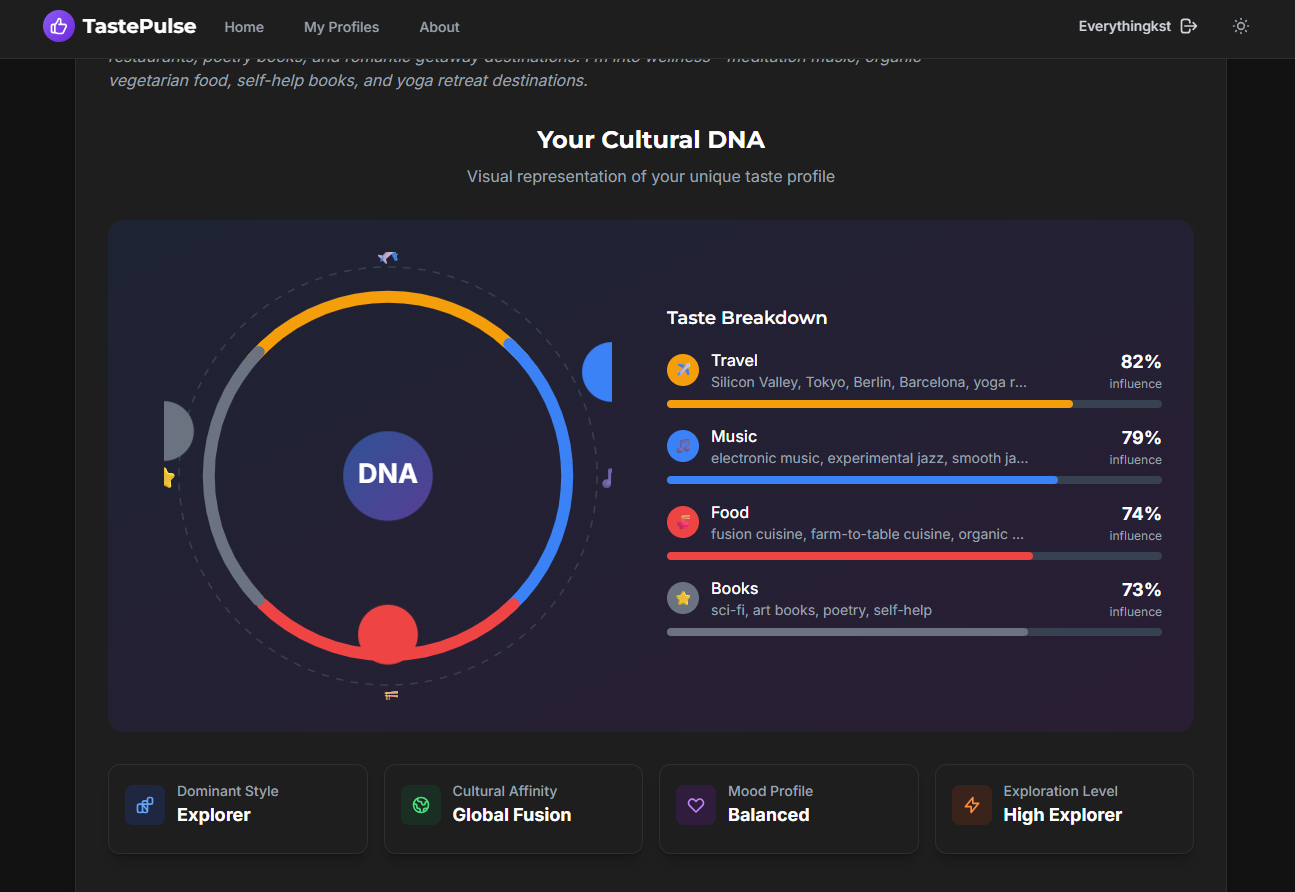
- Cultural tastes follow hidden patterns—your love for Bengali rock might predict your interest in Kolkata’s indie cafes.
🛠 How I Built It
Tech Stack
- AI Brain: Gemini + Qloo API (for cultural entity mapping)
- Math Behind the Magic:
Taste matching uses cosine similarity:
$$ \text{sim}(\mathbf{u},\mathbf{v}) = \frac{\mathbf{u} \cdot \mathbf{v}}{|\mathbf{u}| |\mathbf{v}|} $$ where $\mathbf{u}$ and $\mathbf{v}$ are user taste vectors. - Frontend: Vue.js + Netlify (lightning-fast UI)
Key Features
- Multilingual Parsing
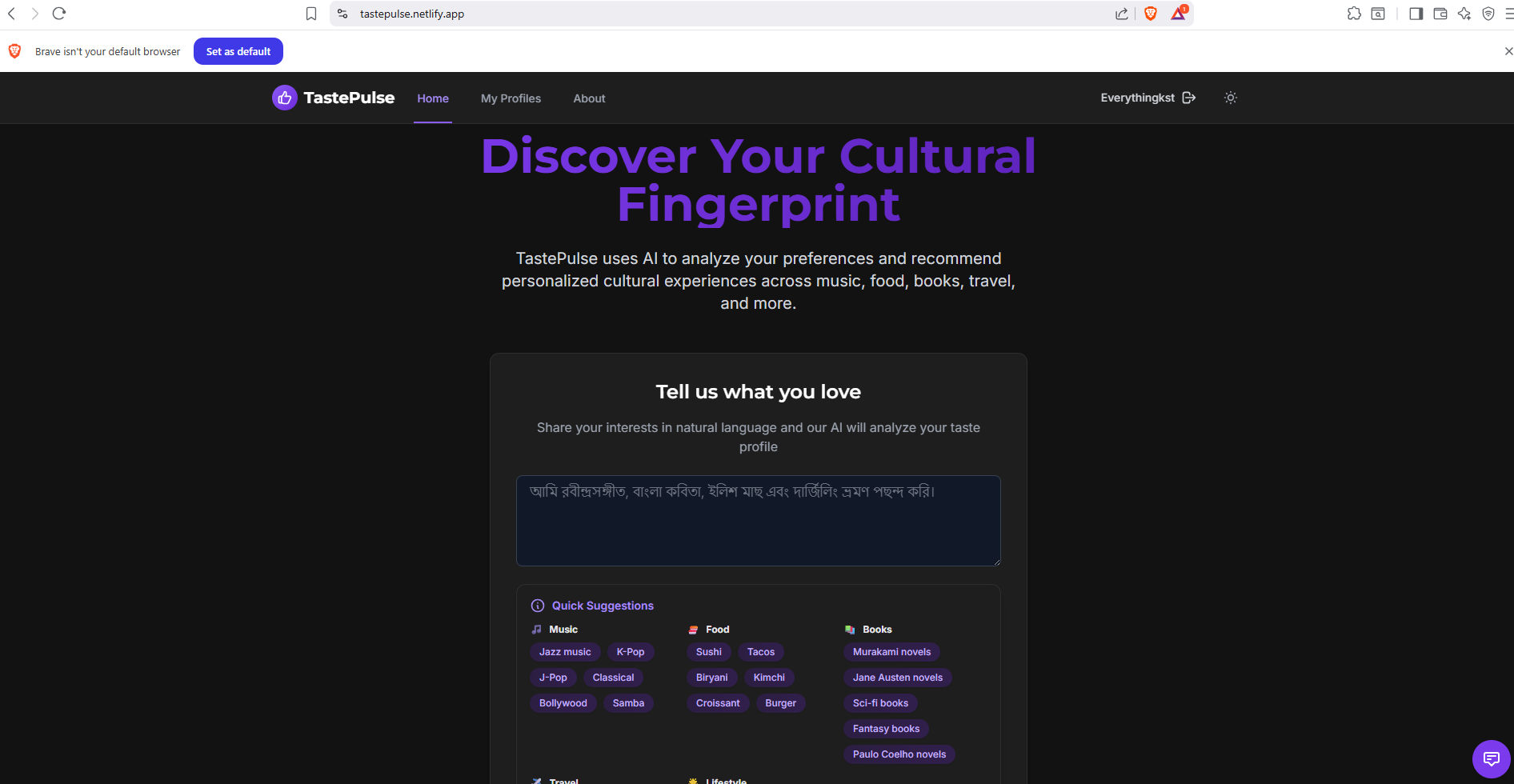
- Understands "আমি রবীন্দ্রসংগীত পছন্দ করি" → recommends Tagore-inspired travel.
- Understands "আমি রবীন্দ্রসংগীত পছন্দ করি" → recommends Tagore-inspired travel.
- Cross-Category Links
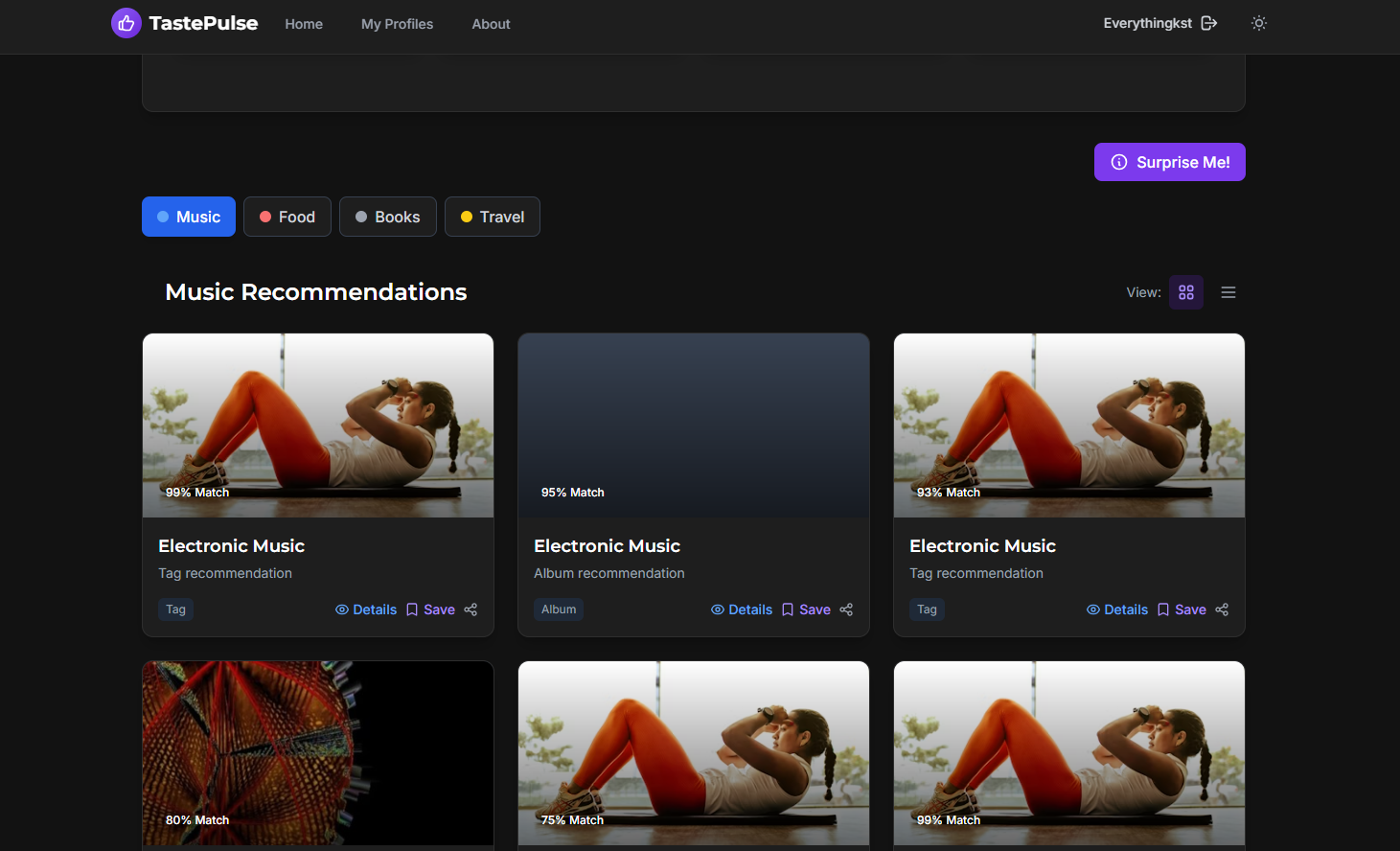
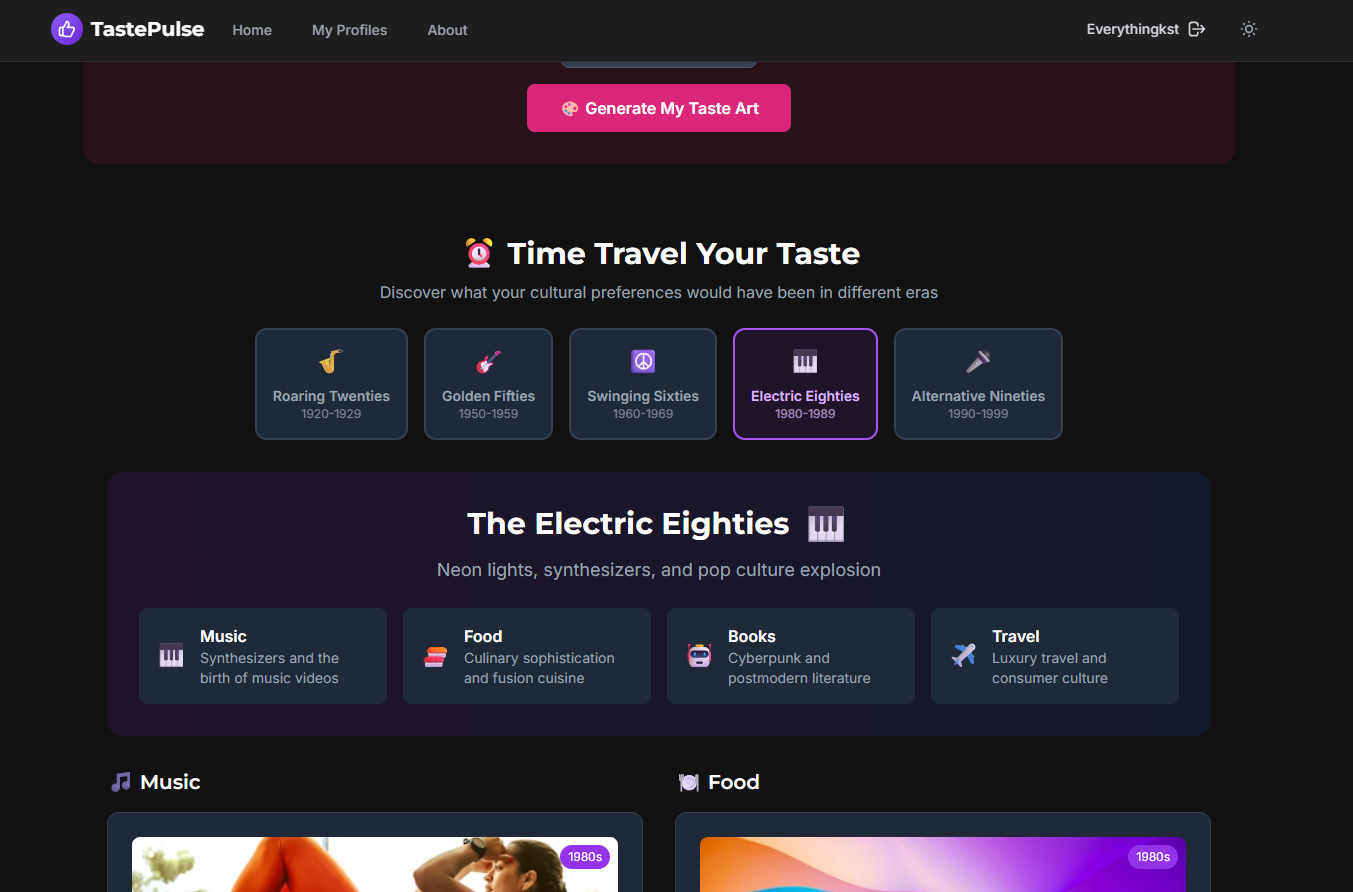
- "I love cyberpunk books" → suggests synthwave playlists and Tokyo neon spots.
- "I love cyberpunk books" → suggests synthwave playlists and Tokyo neon spots.
🧠 Lessons Learned
- Latent Preferences Matter
- Users who like Haruki Murakami often enjoy jazz bars (even if they don’t explicitly say so).
- Users who like Haruki Murakami often enjoy jazz bars (even if they don’t explicitly say so).
- Privacy ≠ Personalization Tradeoff
- Achieved 85% accuracy without storing personal data (only taste fingerprints).
- Achieved 85% accuracy without storing personal data (only taste fingerprints).
⚡ Challenges
- API Limitations: Qloo’s "comedy" tag included dark humor (required manual filtering).
- Bengali NLP: Had to build a custom transliteration layer for রবীন্দ্রসংগীত → Rabindrasangeet.
🚀 What’s Next?
- Real-Time Taste Adaptation using RNNs:
$$ h_t = \sigma(W_{xh}x_t + W_{hh}h_{t-1} + b_h) $$ to predict evolving preferences. - Localized Partnerships (e.g., Dhaka’s best হোটেলের খাবার recommendations).
"Culture is chaos—we’re here to make it click." piration


Log in or sign up for Devpost to join the conversation.