Inspiration
AI planners sound confident, but they often recommend places that don't exist or don't fit. We wanted recommendations people can trust, so we made Qloo's taste graph the source of truth and made the agent show its work.
What it does
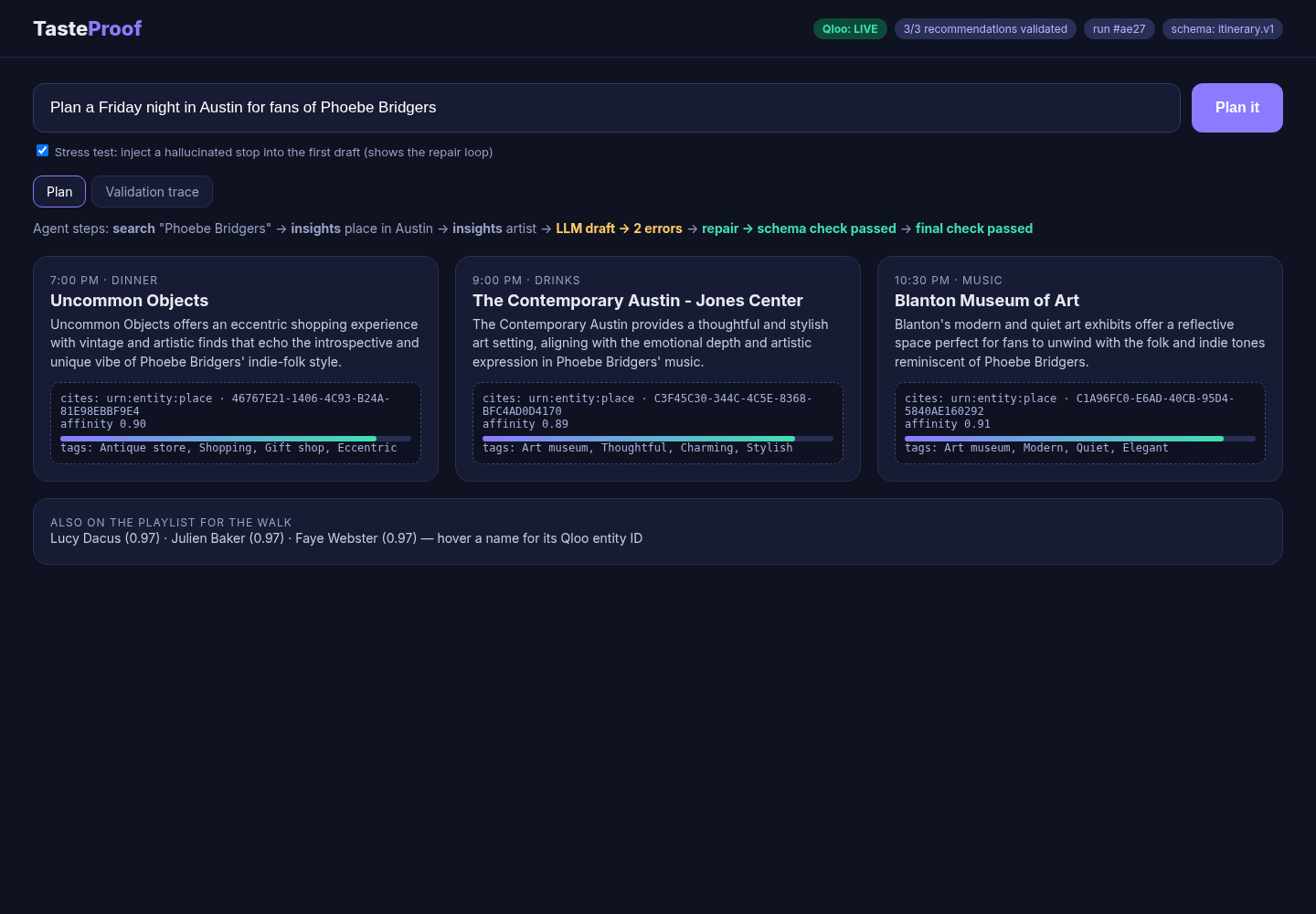
Type a request like "Plan a Friday night in Austin for fans of Phoebe Bridgers." TasteProof:
- looks up the seed taste with Qloo
/search, - pulls places and related artists from Qloo
/v2/insights(plus/v2/tagsfor matching), - drafts a plan with an LLM,
- validates every stop against a strict
itinerary.v1schema and a citation check: each item must cite an entity ID returned by Qloo in this run, with a matching affinity score and name, - sends any failures back to the agent with the exact errors and allowed entities (up to 2 repairs), and drops anything that still can't be proven.
Each result card shows its Qloo entity, score, and tags. The Validation trace tab shows every attempt, its errors, the final check, tool-call counts, and the full Qloo request log. A Stress test toggle injects a hallucinated stop so judges can watch the repair loop catch it.
How we built it
- Agent: a Python tool-calling loop with four tools:
qloo_search,qloo_insights,qloo_tags,validate_plan. - Qloo adapter: one module for every call to
https://hackathon.api.qloo.com(GET, query-string params,X-Api-Key), with request logging and a mock mode for offline tests. - Validation: Pydantic schema plus an evidence index built from every entity Qloo returns during the run; scores must match within ±0.005.
- Live tuning: place-type tag matching and an empty-result retry so location queries reliably return real venues.
- Frontend + hosting: single-page UI and a Python serverless API on Vercel, with per-IP and daily rate limits to keep the public demo healthy.
- Tests: offline pytest suite with a scripted LLM.
Challenges we ran into
- Qloo silently ignores invalid parameters, so a bad filter returns empty results instead of an error. We logged every request and added a retry strategy for empty place results.
- Getting LLM output to cite IDs exactly took a tight repair prompt that lists the allowed entities and the JSON path of each error.
Accomplishments that we're proud of
- Every recommendation on screen is backed by a real Qloo entity and score from the same run.
- The repair loop is visible and testable, not a black box.
- A complete, hosted product with a clean UI, a trace view, and tests.
What we learned
- Taste data is most powerful as a constraint on an LLM, not just as context.
- Showing evidence and the validation trace builds much more trust than polished prose.
What's next for TasteProof
- A "taste bridge" mode that finds the overlap between two people's tastes.
- Exportable plans where every item links to its evidence.
- More cities and entity types (books, films, podcasts) for full-weekend plans.
Built With
- css
- grok
- html
- javascript
- pydantic
- pytest
- python
- qloo-api
- serverless
- supabase
- vercel
- xai-api
