TasteProbe
Your agent recommends. TasteProbe verifies.
What if AI recommendations didn't just sound intelligent — but came with evidence?
AI can recommend almost anything. Movies, music, experiences, products.
But there is a fundamental problem:
A convincing recommendation is not necessarily a verifiable recommendation.
We built TasteProbe to change that.
Powered by Qloo's cultural intelligence, TasteProbe helps people discover movies, evaluate existing AI-generated recommendations, and understand the evidence behind the results.
Not another chatbot. Not another generic recommendation engine.
An evidence layer for AI-powered discovery.
🚀 TRY THE LIVE DEMO | 💻 EXPLORE THE SOURCE CODE | 🔍 VIEW OUR EVIDENCE
01 — Inspiration: The AI Trust Problem
Imagine asking an AI:
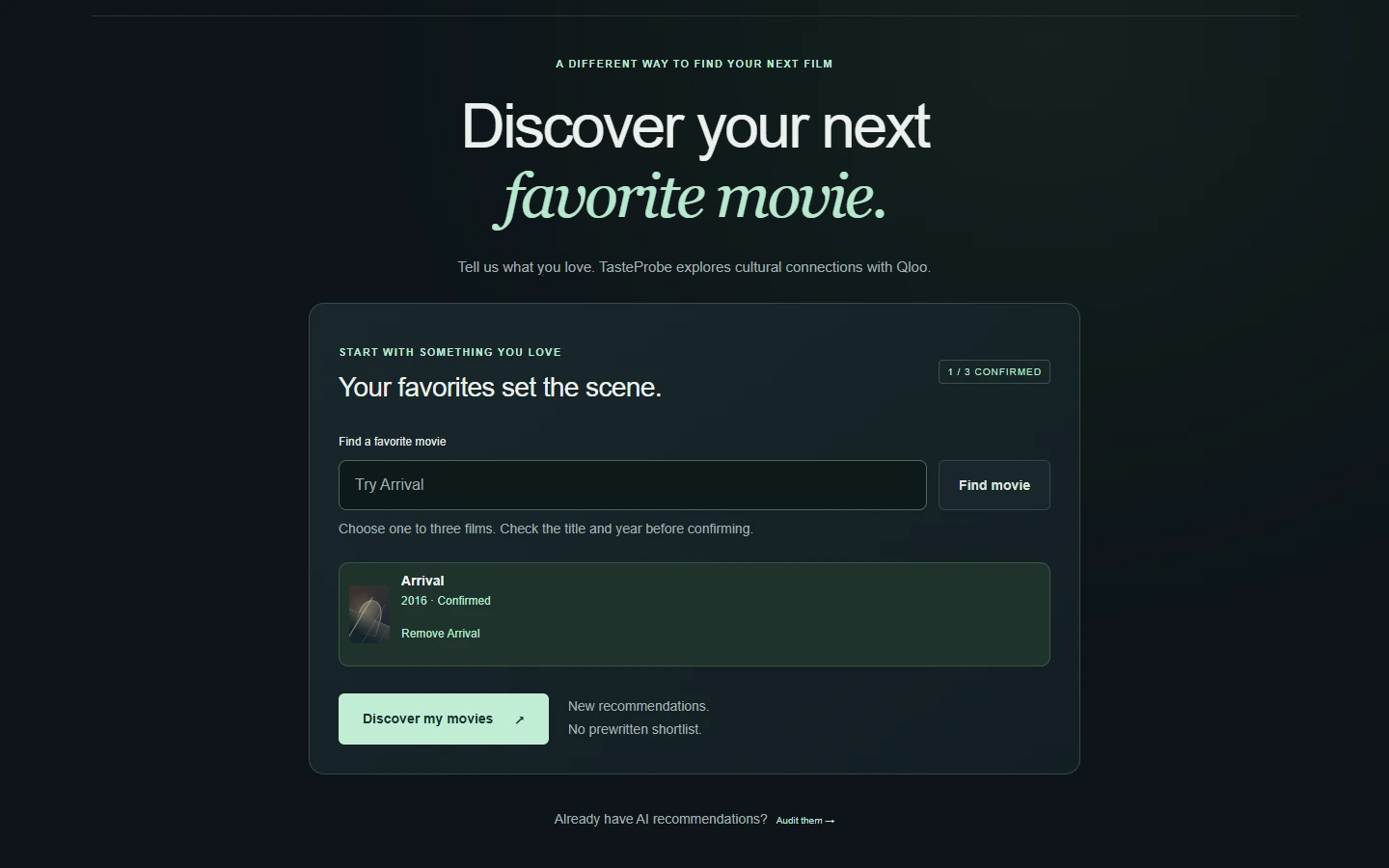
"I love Arrival. What should I watch next?"
Within seconds, you receive a perfectly written list.
But why those movies?
Are they culturally connected to your interests? Is the AI relying on evidence, or merely generating a plausible answer?
We realized the bigger opportunity wasn't creating another recommendation engine.
It was creating a way to inspect, challenge, and improve AI recommendations using an independent cultural intelligence source.
That insight became TasteProbe.
Our vision is simple:
AI should not only recommend. It should help people understand what supports a recommendation — and where the evidence stops.
02 — What We Built
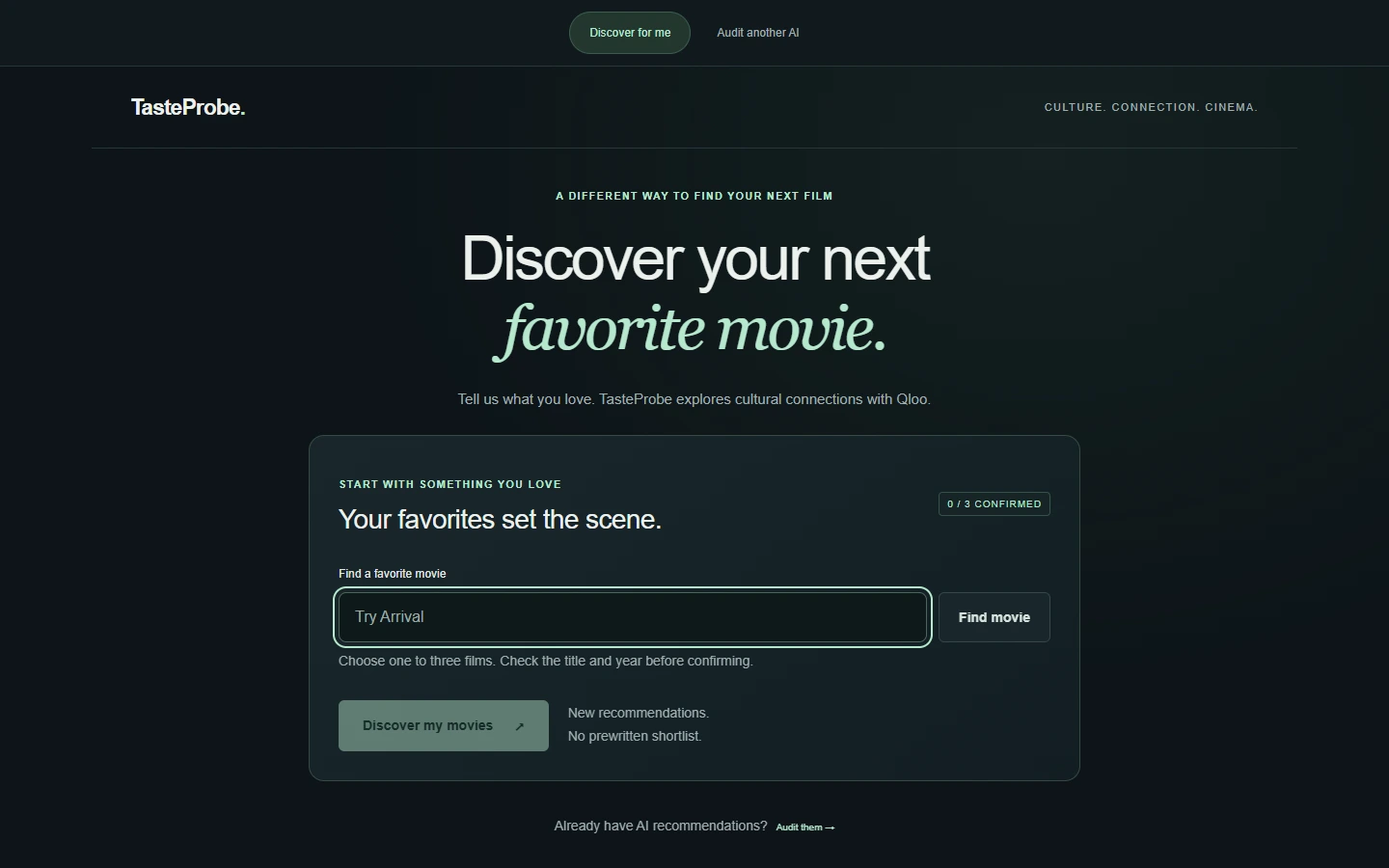
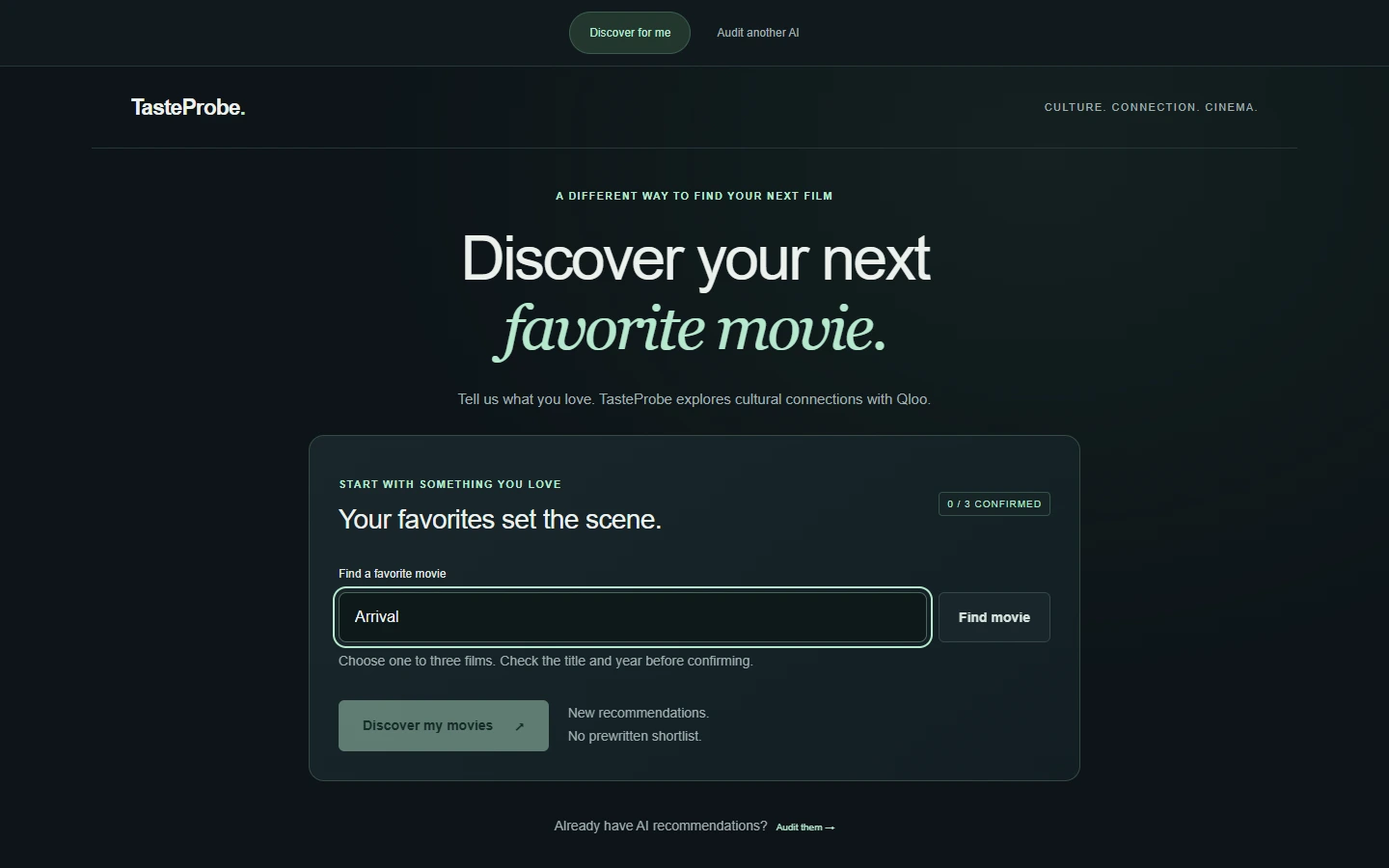
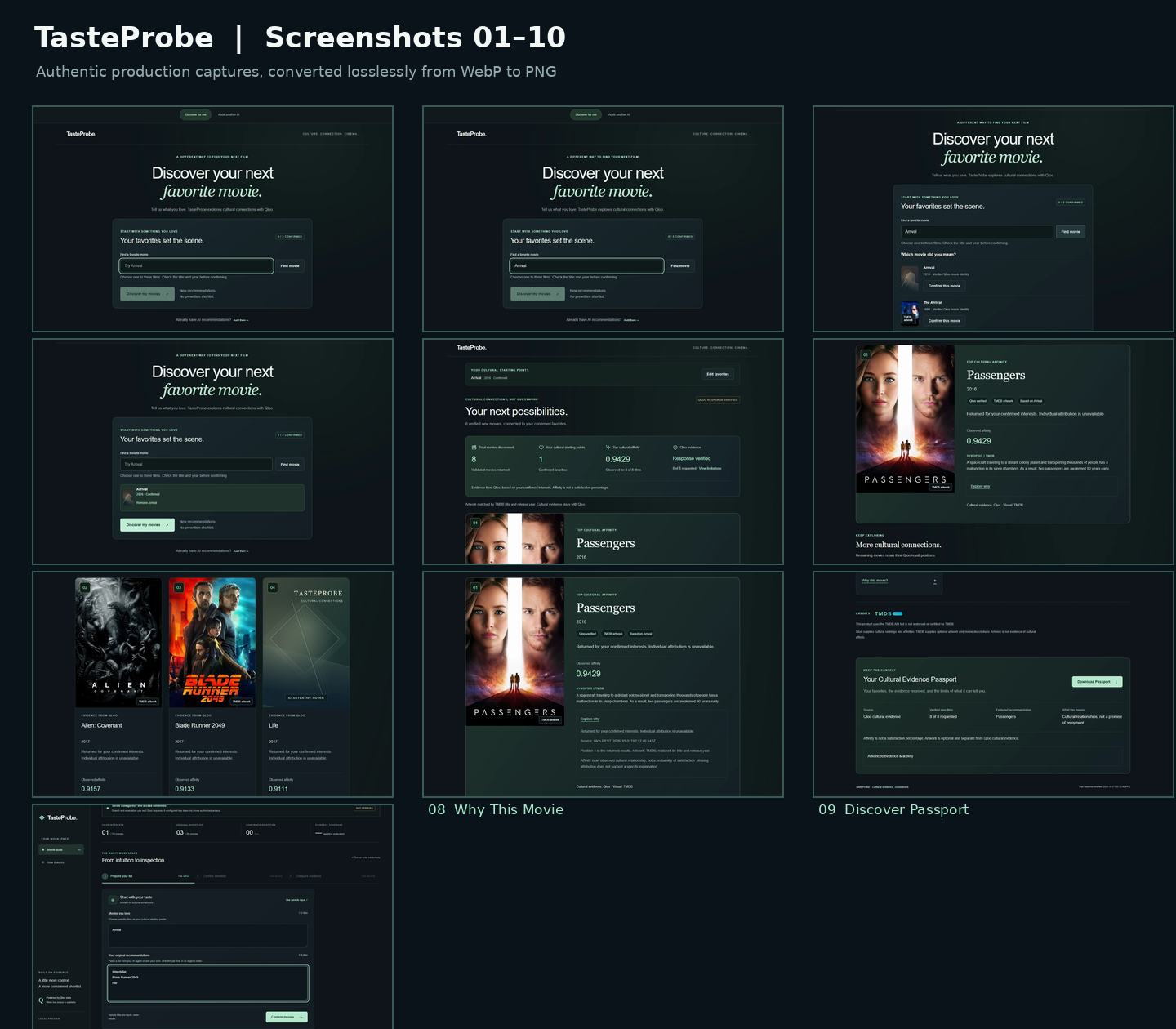
TasteProbe is a live, open-source web application with two complementary experiences.
| DISCOVER FOR ME | AUDIT ANOTHER AI |
|---|---|
| Find new movies using cultural signals from your favorites. | Evaluate an existing AI-generated movie shortlist. |
| Confirm identities and inspect observed affinity. | Compare the original order against Qloo's actual results. |
| Explore cinematic recommendations with TMDB artwork. | Review a proposed revision and retain human control. |
Two experiences. One principle: evidence before confidence.
Experience A — Discover for Me
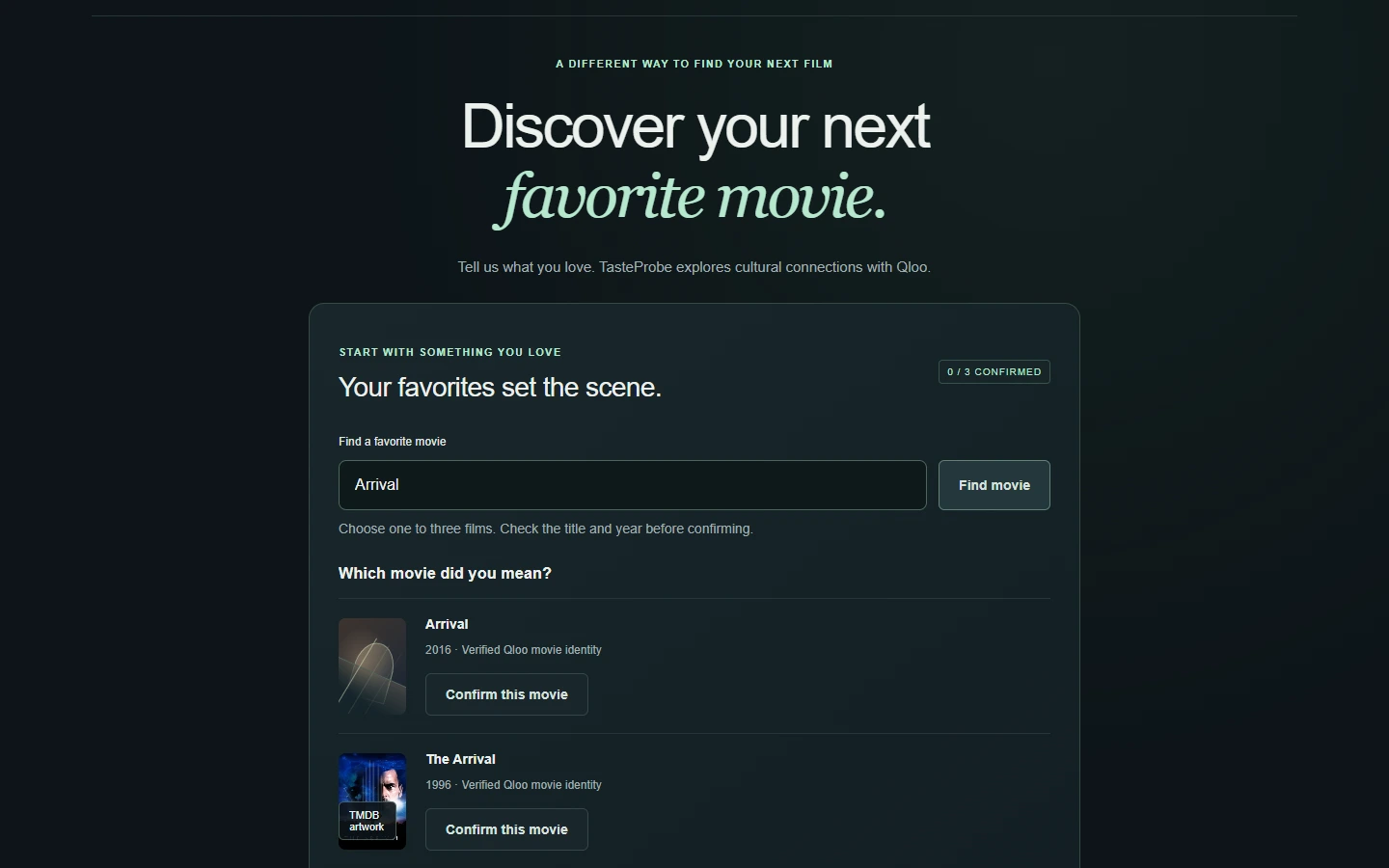
The journey begins with something personal: a movie you love.
TasteProbe asks you to verify its identity before making recommendations.
That matters. Arrival (2016) and The Arrival (1996) are different films — and cultural analysis should never confuse them.
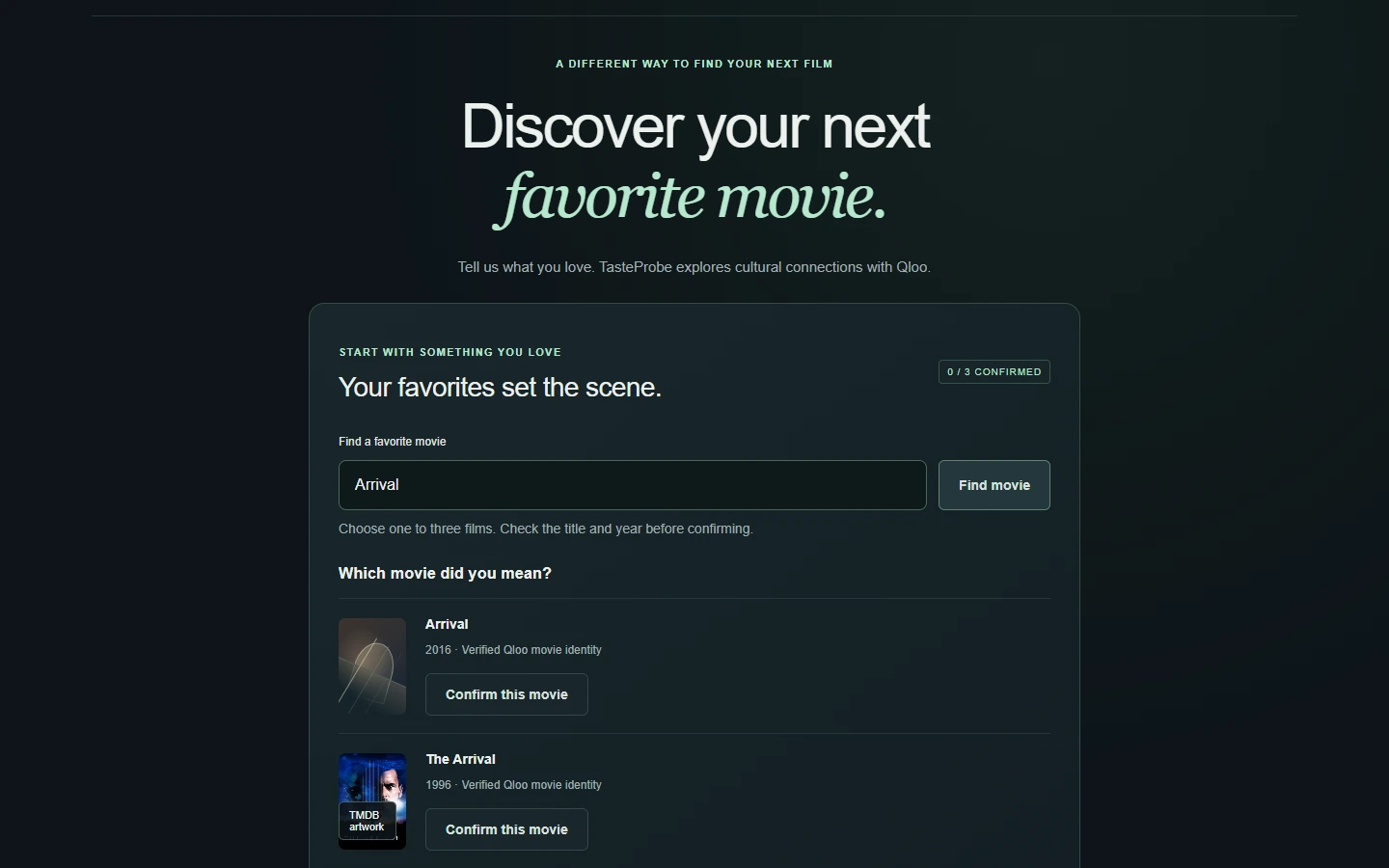
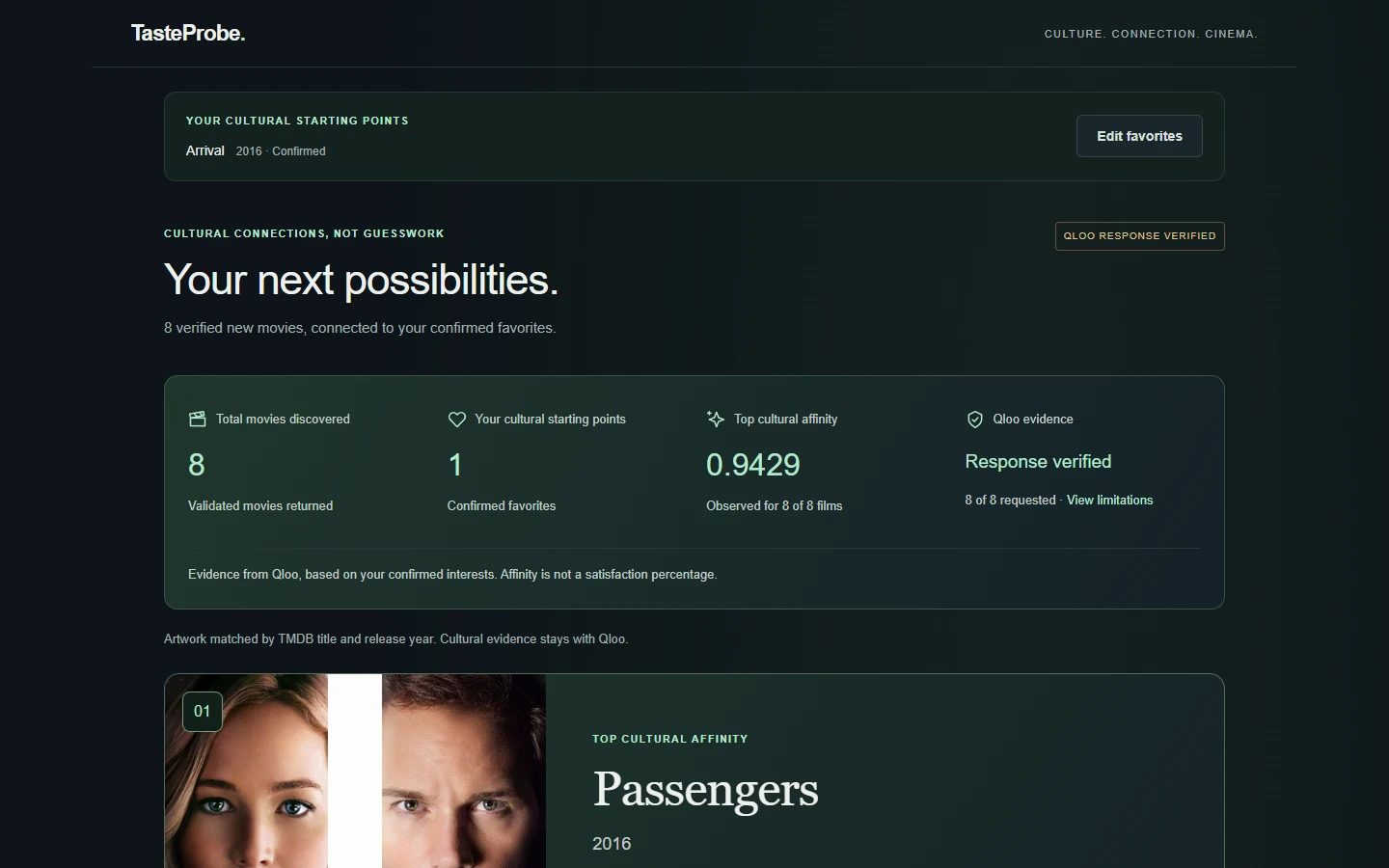
After confirmation, TasteProbe uses Qloo to discover new movies based on cultural connections.
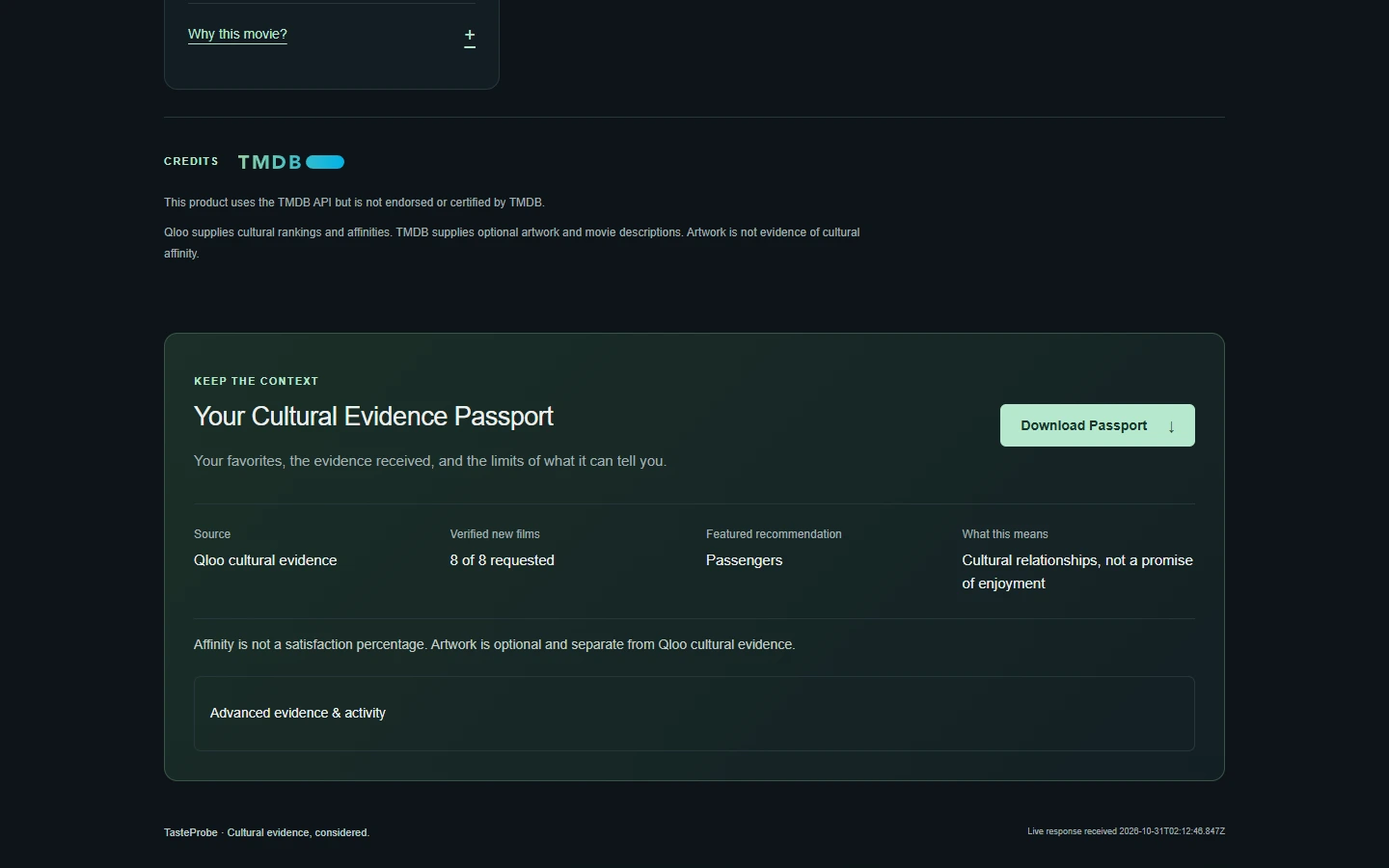
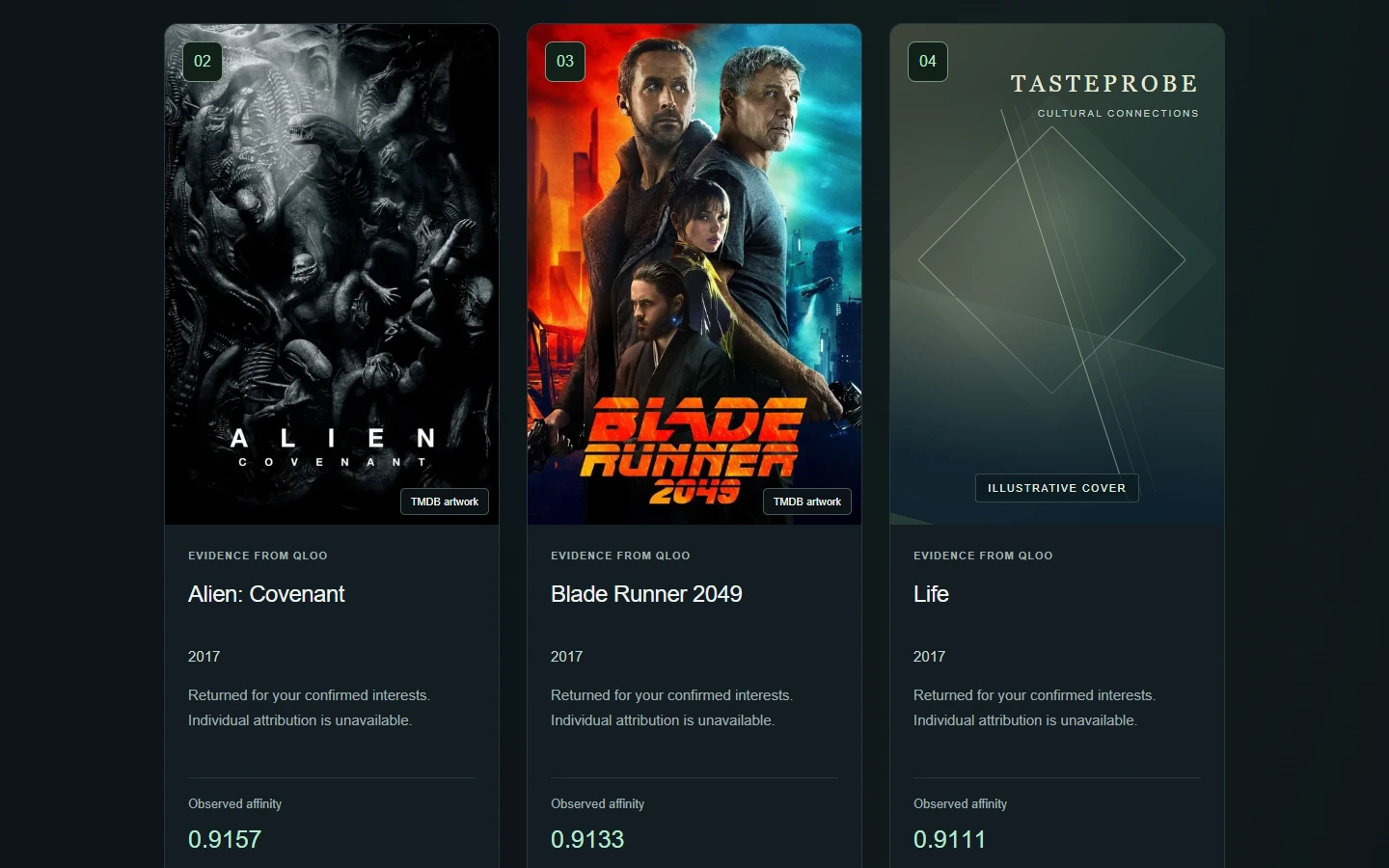
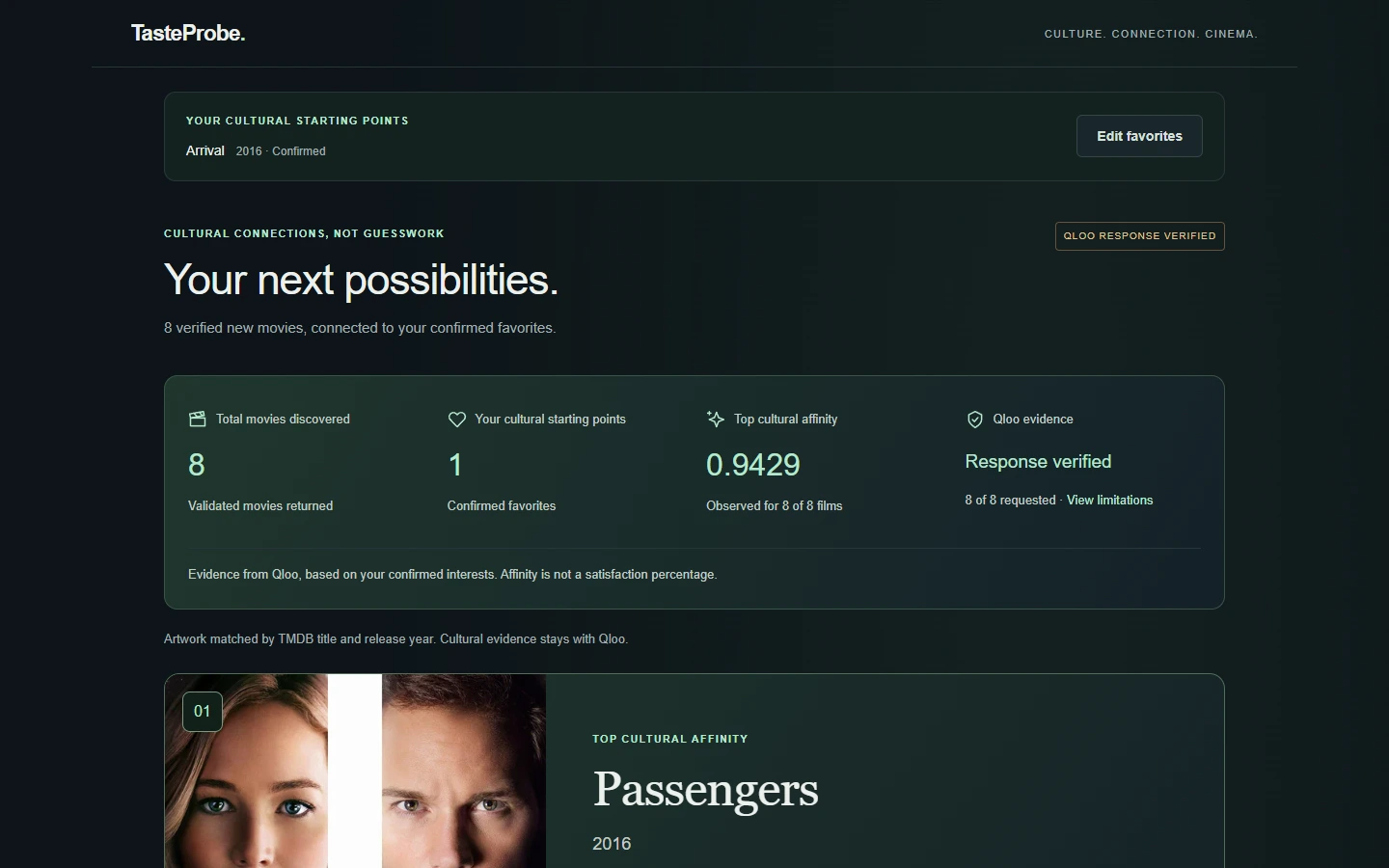
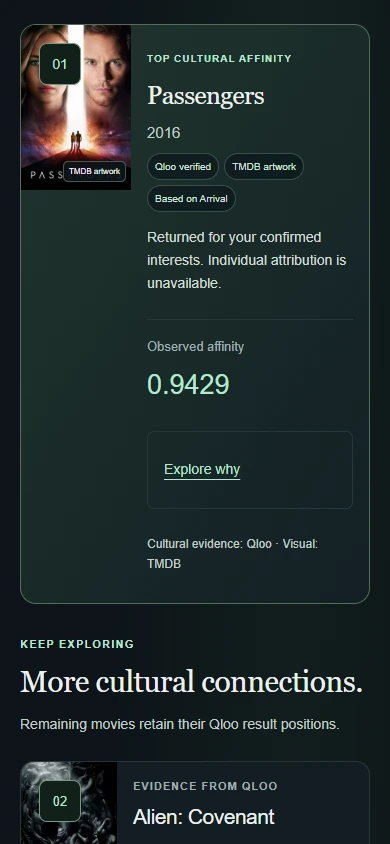
In our verified production demonstration, Qloo returned eight distinct movie recommendations, excluding the original favorite.
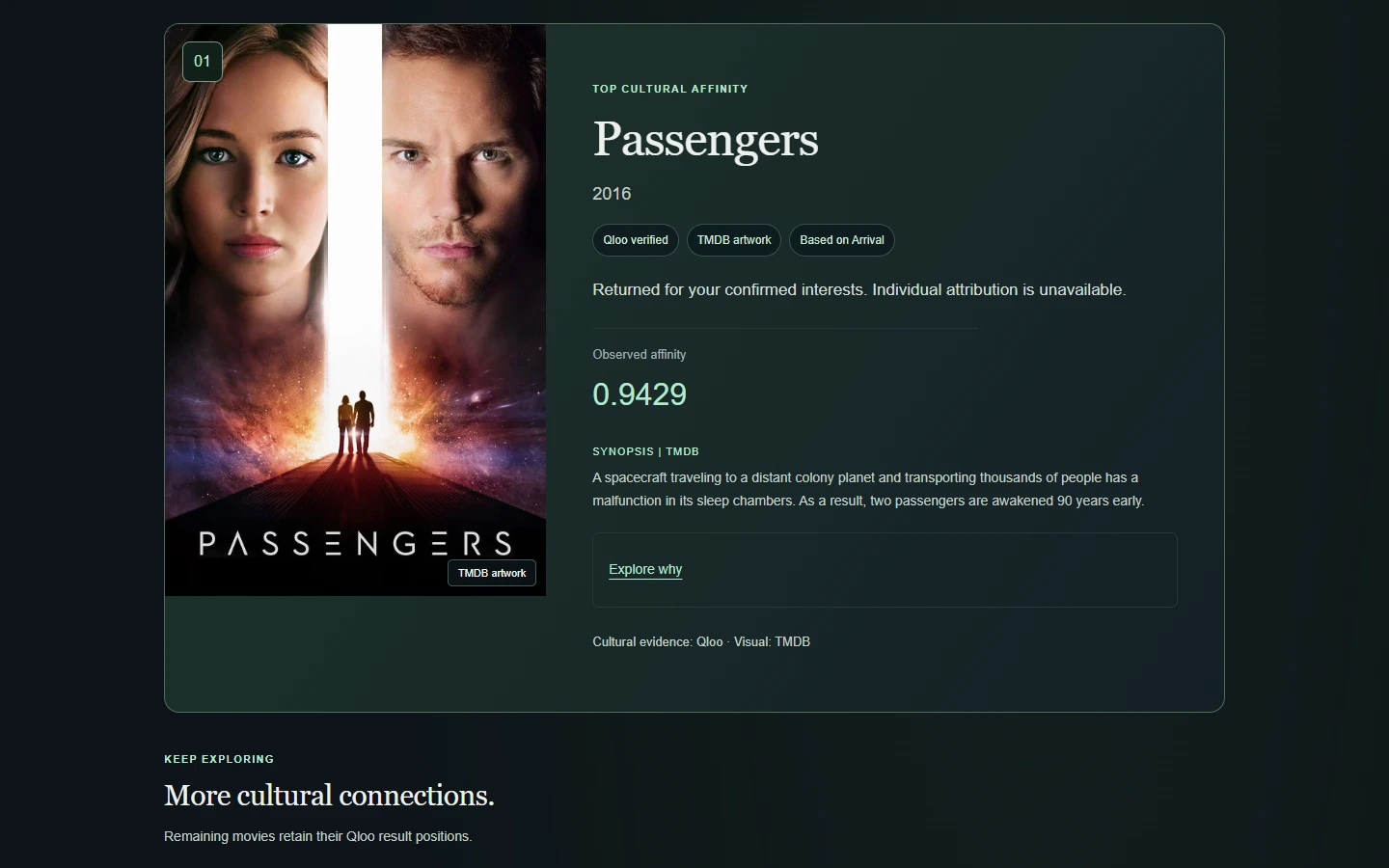
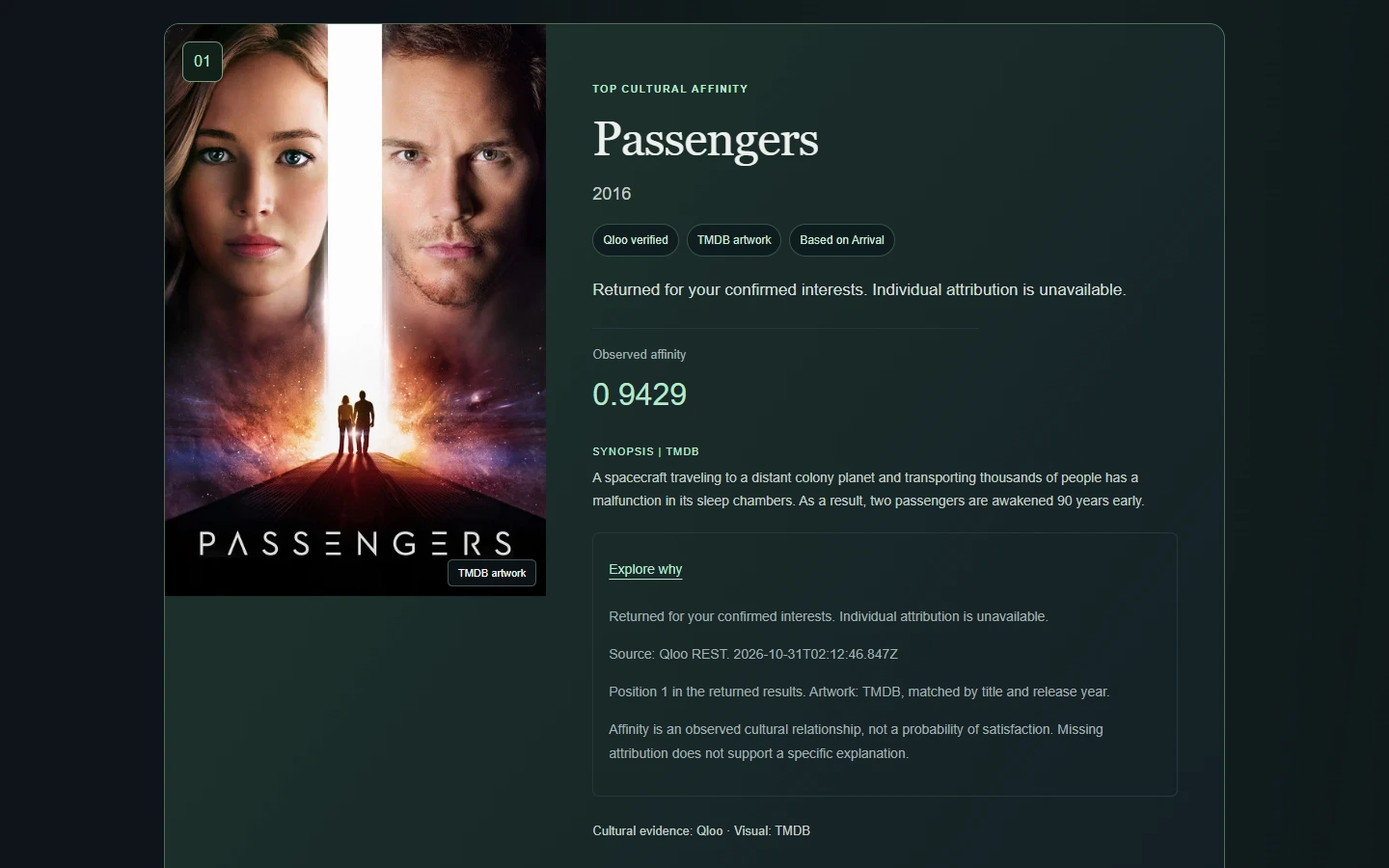
Users can explore the returned rankings, observed affinities, and available evidence in a visual dashboard.
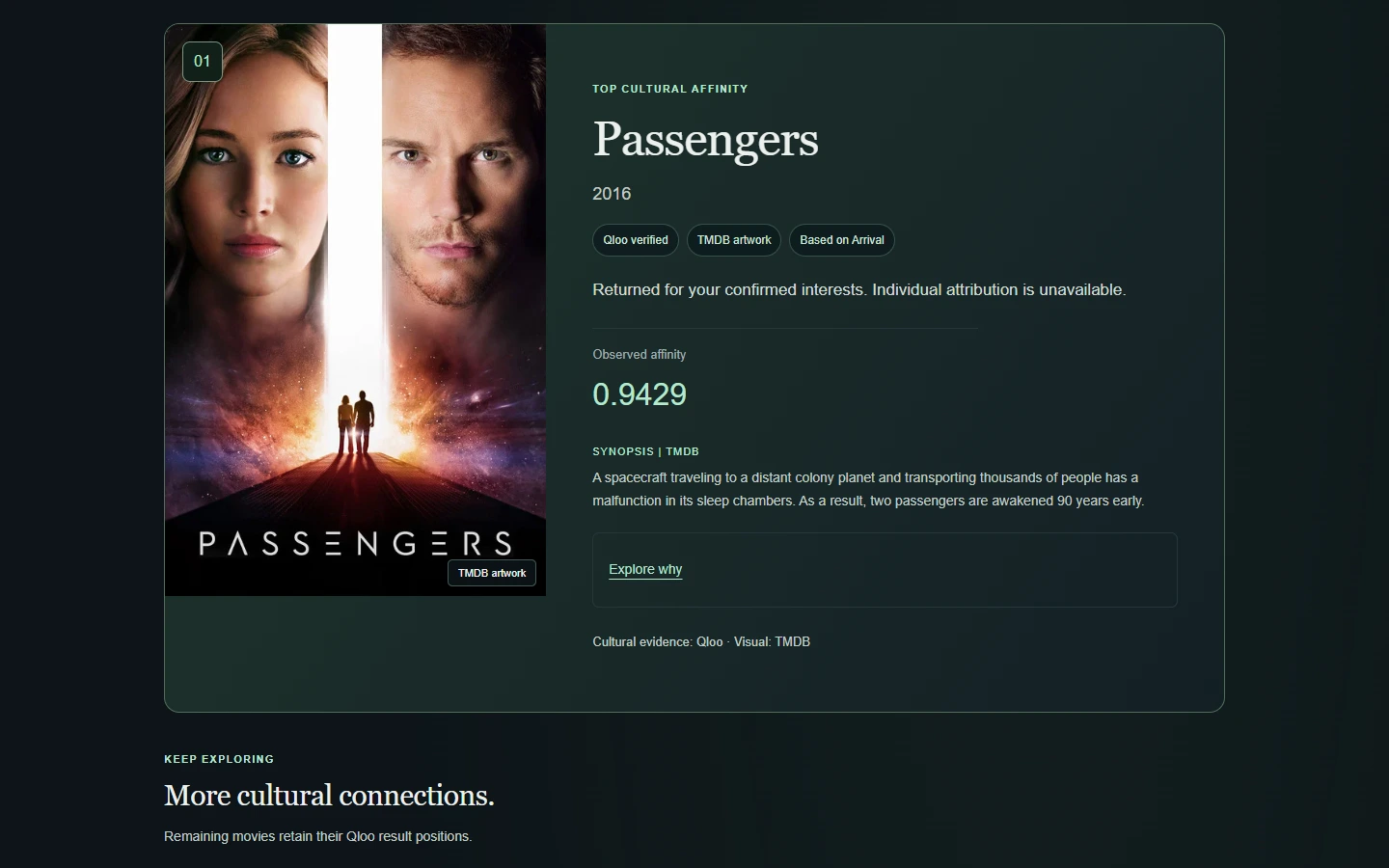
TMDB supplies optional movie artwork and descriptions, while Qloo remains the source of cultural ranking and affinity.
This separation is intentional. A beautiful image should never influence the evidence.
03 — The Breakthrough: Audit Another AI
This is where TasteProbe becomes more than a discovery experience.
What if you could challenge a recommendation list produced by another AI?
We tested exactly that.
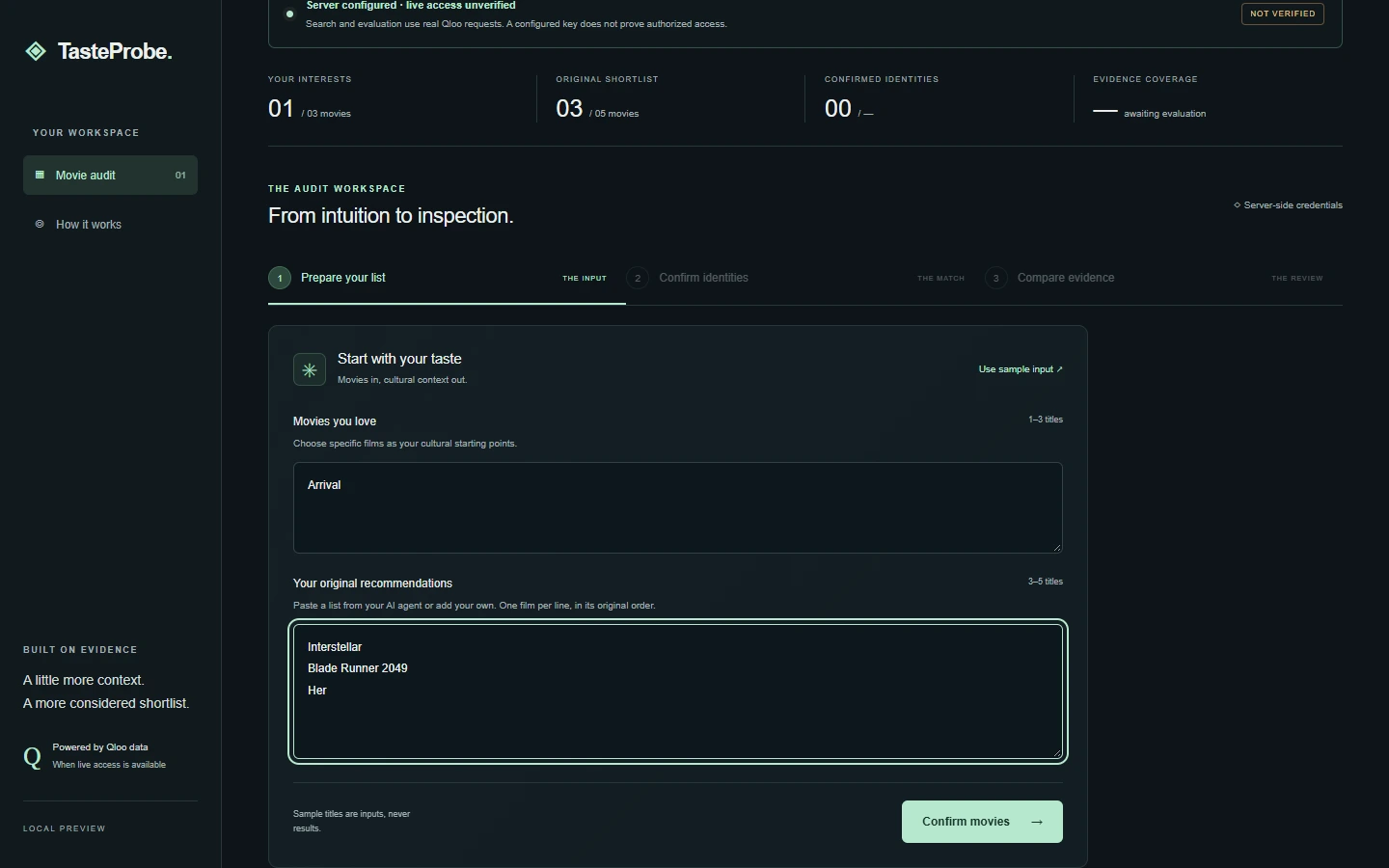
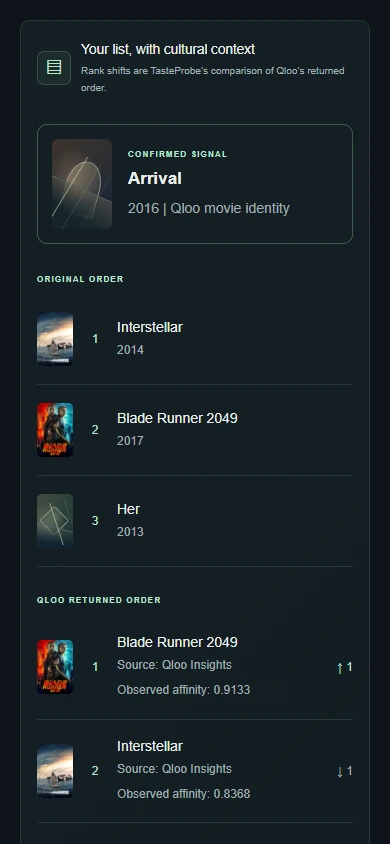
Cultural signal: Arrival (2016)
Original shortlist:
- Interstellar (2014)
- Blade Runner 2049 (2017)
- Her (2013)
TasteProbe confirmed all four movie identities and evaluated the shortlist using Qloo.
The verified Before vs. After
| Movie | Original rank | Qloo rank | Observed affinity |
|---|---|---|---|
| Blade Runner 2049 | #2 | #1 ↑ | 0.913275 |
| Interstellar | #1 | #2 ↓ | 0.836813 |
| Her | #3 | #3 — | 0.801382 |
Coverage: 3/3 verified candidates.
Blade Runner 2049 moved from second place to first in this actual Qloo response.
We didn't hardcode that result. We didn't ask another LLM to invent a better ranking.
We inspected a real cultural intelligence response.
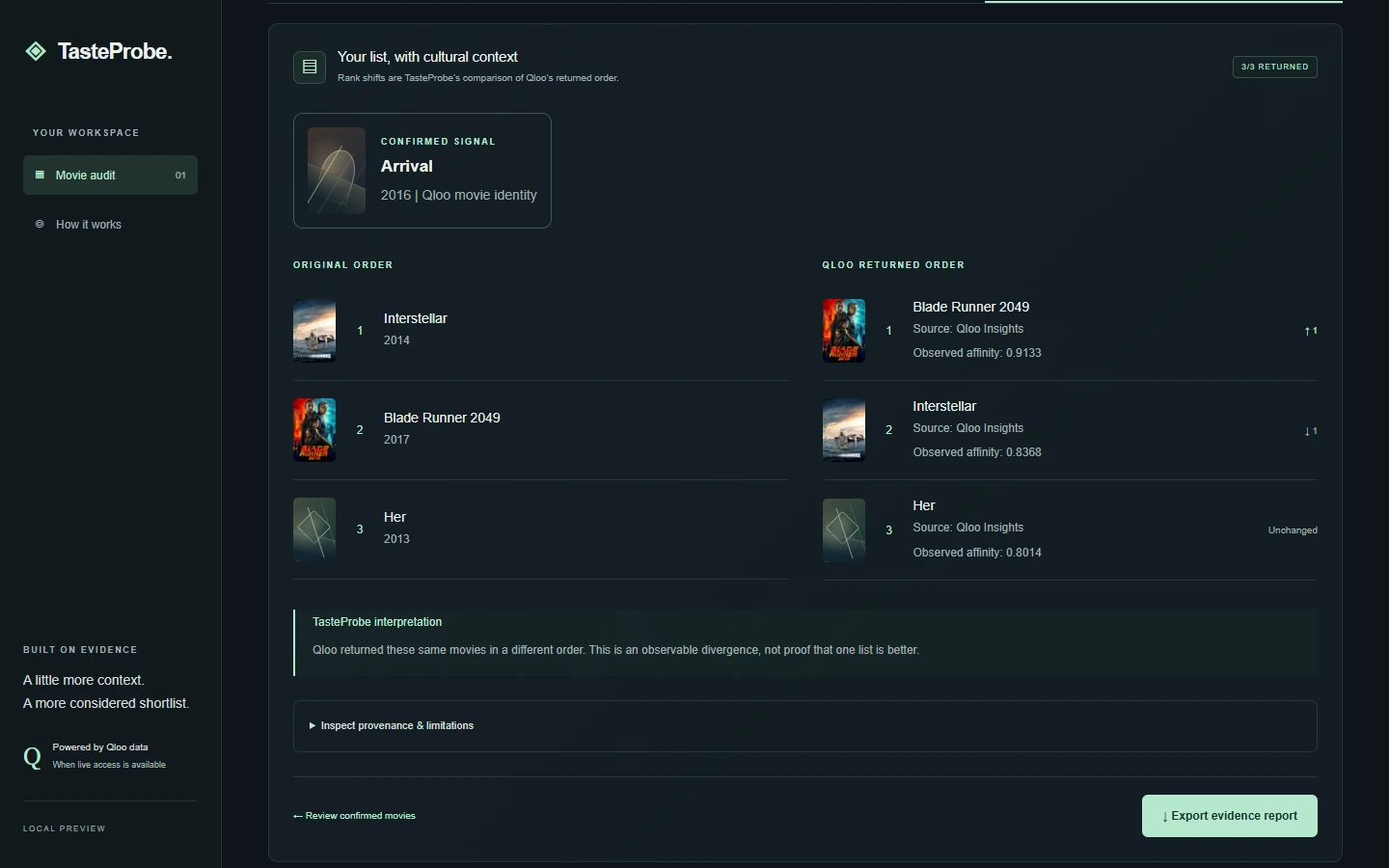
An important distinction: these affinity values are observed cultural relationships, not probabilities of personal satisfaction. Results are specific to the query and may change.
04 — Rescue My Recommendations: Humans Stay in Control
Finding a different order is only half the solution.
TasteProbe introduces Rescue My Recommendations, a workflow that proposes a revision based on verified evidence.
The user can:
- Review the original and suggested rankings.
- Inspect the evidence and its limitations.
- Approve the proposal or keep the original list.
- Export the decision without modifying the underlying Qloo results.
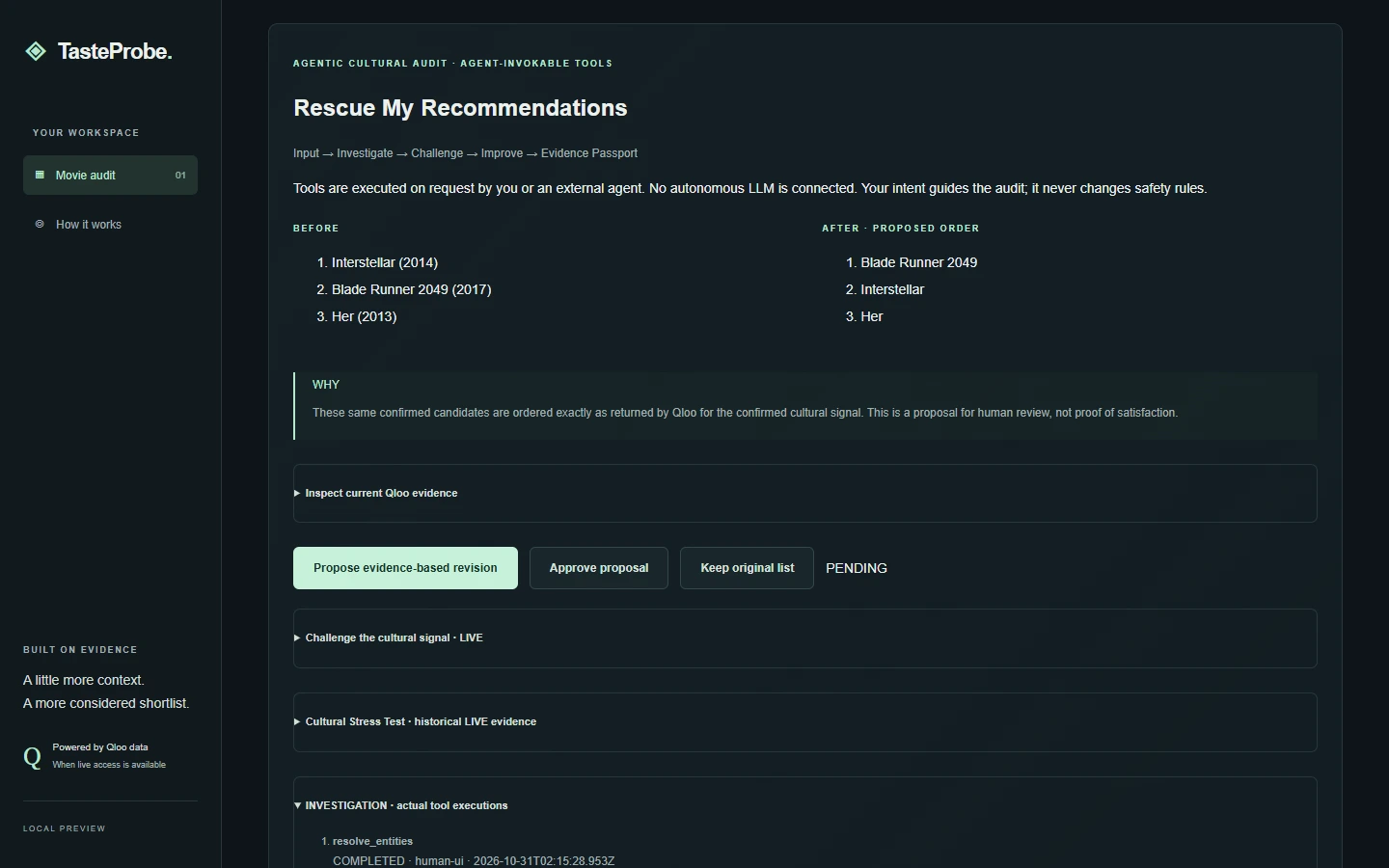
Human judgment remains the final authority.
In production testing, both APPROVED and REJECTED exports preserved the same original analysis and evidence.
05 — Evidence Passport: Give Recommendations a Receipt
Every recommendation workflow should leave behind something more useful than an answer.
TasteProbe generates a downloadable Evidence Passport, preserving the information needed to inspect the result.
It includes confirmed movie identities, observed source data, candidate coverage, returned affinities, limitations, and recorded decisions.
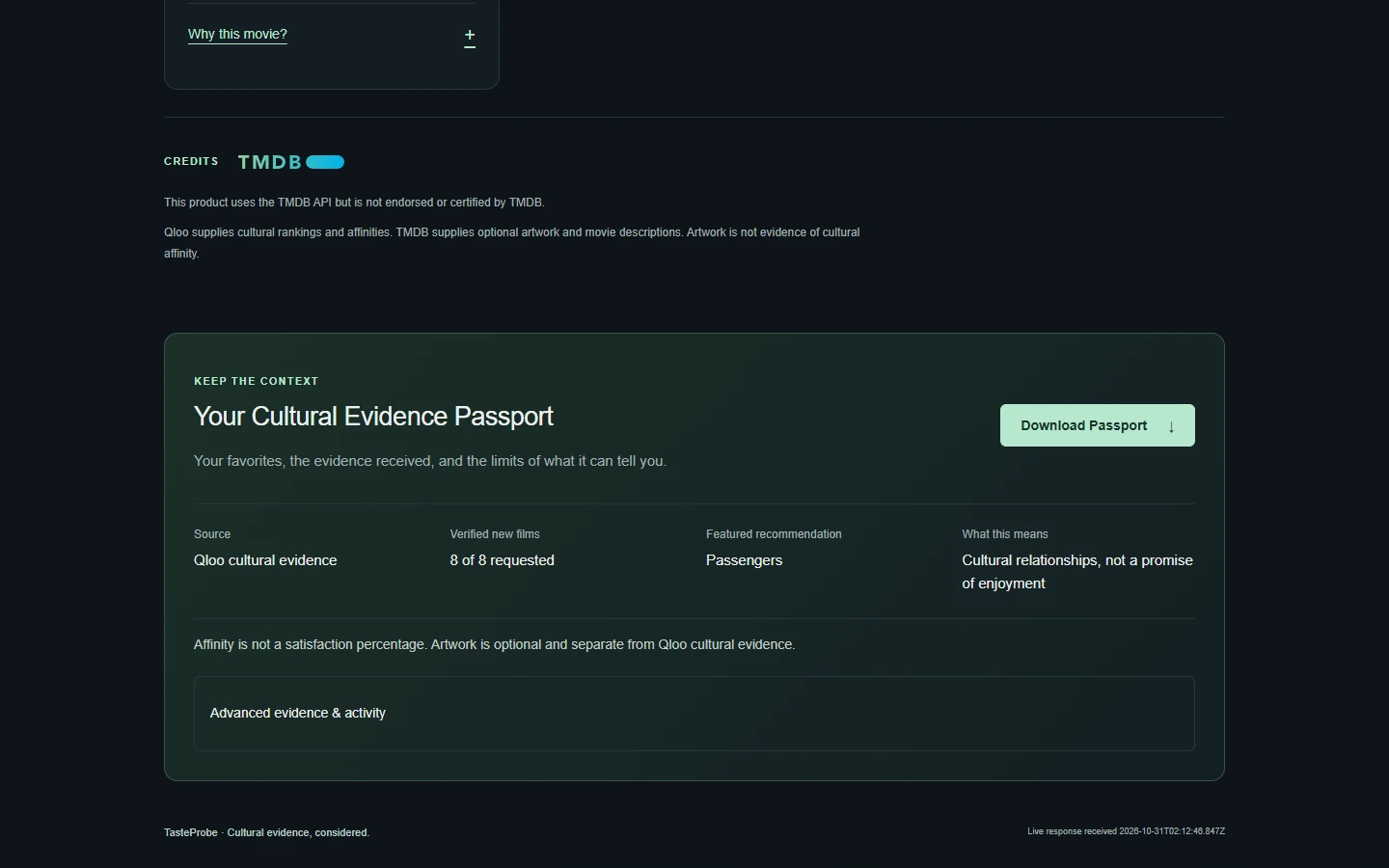
We believe verifiability should be a product feature, not an afterthought.
No fabricated confidence. No hidden substitutions. No invented explanations when the evidence is missing.
06 — Built for Agentic AI, Not Just Human Users
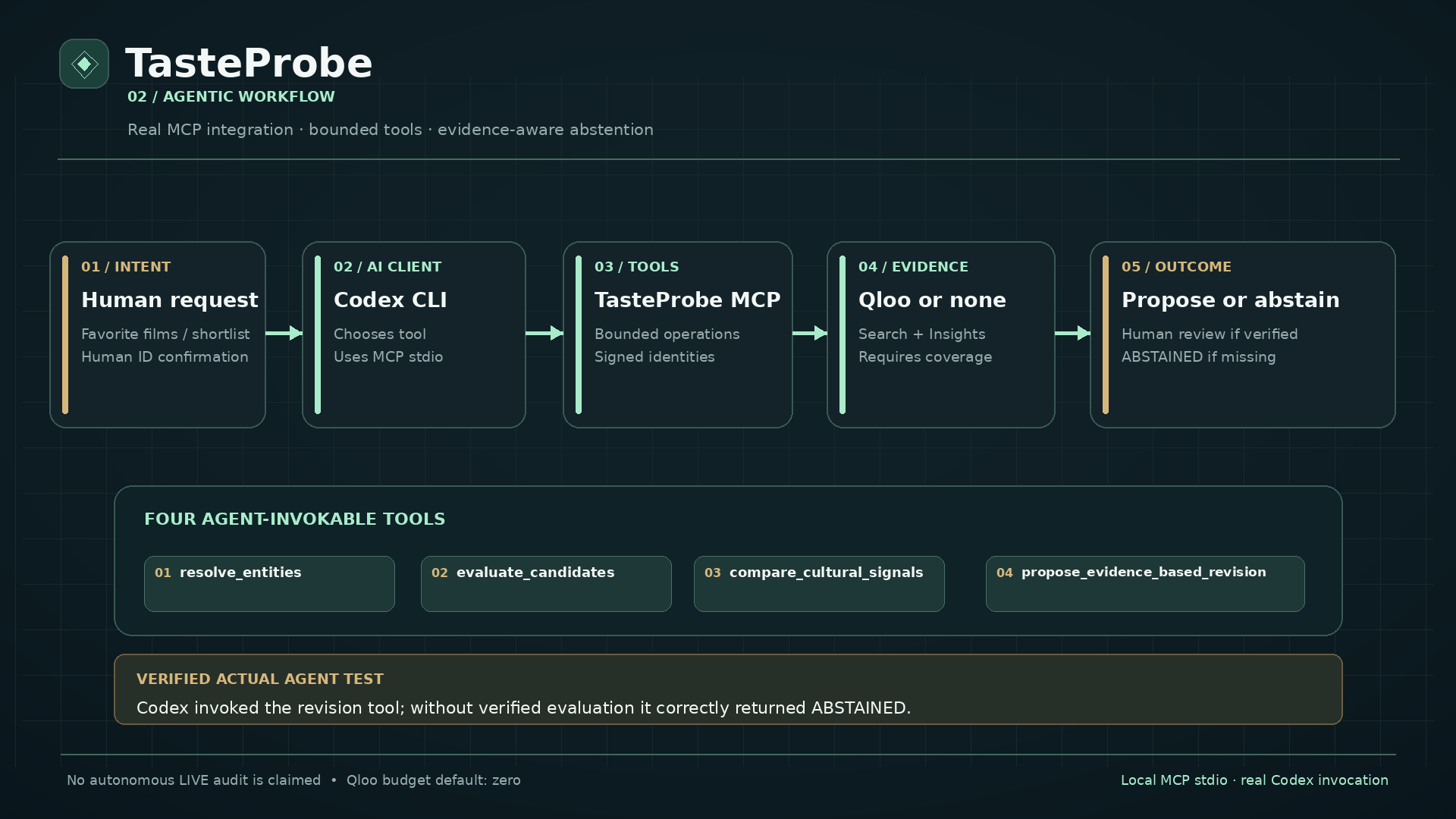
TasteProbe also exposes a local Model Context Protocol (MCP) integration for compatible AI agents.
Its four bounded tools support entity resolution, candidate evaluation, cultural signal comparison, and evidence-based revision.
In an actual integration test, an authenticated Codex agent discovered TasteProbe's tools, selected a revision tool, and invoked it.
Because no verified evaluation had been supplied, the tool returned:
ABSTAINED — insufficient verified evidence to propose a revised ranking.
The agent respected that limitation instead of fabricating a recommendation.
This demonstrated real agent-to-tool connectivity and evidence-aware abstention. It was not represented as a complete autonomous live audit.
Our principle: a trustworthy AI agent must know when not to answer.
Explore the verified MCP integration
07 — How We Built It
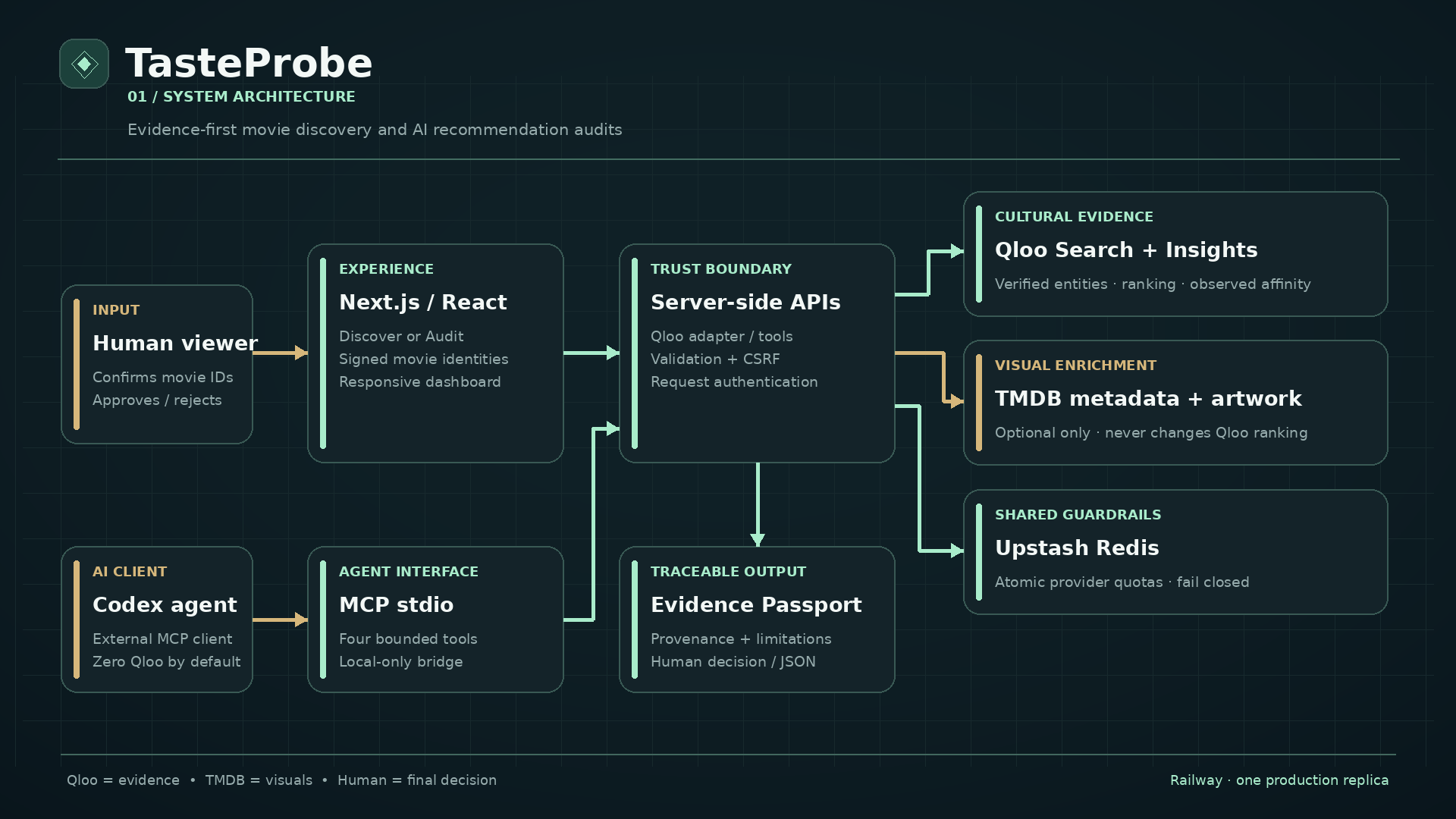
TasteProbe combines modern web engineering, specialized cultural intelligence, and controlled agent integration.
Our technology architecture
| Layer | Technology | Responsibility |
|---|---|---|
| Experience | Next.js, React, TypeScript | Responsive Discover and Audit interfaces |
| Cultural intelligence | Qloo Search + Insights | Entity resolution, movie discovery, rankings, and observed affinity |
| Visual enrichment | TMDB API | Optional movie posters and metadata |
| Agent integration | MCP stdio + Codex | Structured tool invocation and grounded abstention |
| Security | Signed identities, HTTPS, CSRF validation | Request and identity integrity |
| Shared controls | Upstash Redis | Atomic request budgeting and provider limits |
| Deployment | Railway | Public production hosting |
| Transparency | JSON Evidence Passport | Portable source evidence and decisions |
The architecture deliberately separates cultural evidence from visual metadata and agent decisions.
Our Next.js server handles Qloo requests securely. Users confirm movie identities before evaluation. Redis enforces shared request budgets, and signed identity proofs prevent silent substitutions.
The published application runs on Railway with a single server replica to support the existing session model.
Explore the system architecture and diagrams
08 — Our Biggest Challenges
Challenge 1: Identity is more important than a successful API call
A movie title may refer to multiple films.
We learned this directly with Arrival and Her. Selecting the wrong identity could produce a successful HTTP response while compromising the meaning of the analysis.
Solution: explicit identity confirmation, validated coverage, and safe abstention.
Challenge 2: Cultural affinity must not be mistaken for certainty
An affinity score is not a calibrated probability that someone will enjoy a movie.
Solution: preserve Qloo's observed values and communicate their limitations rather than inventing confidence.
Challenge 3: Making an agent trustworthy
Connecting an LLM to a tool is relatively straightforward. Ensuring that it respects missing evidence is harder.
Solution: bounded MCP tools, explicit request budgets, verified state, and structured abstention.
Challenge 4: Going from a local prototype to public production
Production required stable identity signatures, strict HTTPS origin validation, shared Redis quotas, protected API credentials, and a deployment model compatible with in-memory sessions.
Solution: a hardened single-replica Railway deployment with shared atomic quota controls.
09 — What We Accomplished
TasteProbe is not just a concept or slide deck. It is a working public product.
Our verified milestones include:
| Milestone | Verified result |
|---|---|
| Live movie discovery | 8 distinct Qloo recommendations |
| Live recommendation audit | 3/3 candidate coverage |
| Evidence-based revision | Rescue demonstrated |
| Human decisions | APPROVED and REJECTED exports verified |
| Agent integration | Real Codex → MCP tool invocation |
| Production deployment | Railway HTTPS demo accessible |
| Open source | Public GitHub repository with MIT license |
| Visual documentation | 15 authentic production screenshots |
| Automated quality | 121 tests and 7 isolated HTTP integration tests passed in the release verification |
We also performed a controlled cultural-signal comparison using Arrival and Paddington 2, keeping the candidate set constant. The observed Qloo results changed, demonstrating how the selected cultural signal affected the returned evidence in that experiment.
Inspect the recorded experiment
Designed for desktop and mobile
10 — What We Learned
Building TasteProbe changed how we think about AI products.
Transparency is not simply displaying a score. It requires knowing which identities were evaluated, where data originated, how much evidence was available, and when a system should abstain.
We also learned that human approval and auditability matter just as much as automation.
And perhaps most importantly:
The future of useful AI isn't only about generating better answers. It's about building systems that make those answers more inspectable and accountable.
11 — What's Next?
Movies are our first use case.
The broader vision is to explore an extensible cultural evidence layer for AI-powered discovery and recommendation workflows.
Future directions include deeper agent integration, additional supported cultural domains, stronger independent evaluation, and more flexible review experiences.
Those are future opportunities, not features we claim are already implemented.
Our ambition is to make TasteProbe a foundation for AI recommendations that can be examined before they are trusted.
12 — Try TasteProbe Yourself
The product is live. No account is required to explore the demo.
Discover: Choose a favorite movie, confirm its identity, and inspect the new recommendations returned by Qloo.
Audit: Enter an existing shortlist, confirm the movies, compare the evidence, and review a proposed revision.
Export: Download an Evidence Passport to inspect the actual result and its limitations.
The public demo has conservative shared API budgets to protect availability. Please avoid unnecessary repeated evaluations.
Explore the project
🚀 LIVE PRODUCT — OPEN TASTEPROBE
🧠 AGENT INTEGRATION DOCUMENTATION
Final Thought
AI recommendations are becoming easier to generate every day.
Making them trustworthy is the harder problem.
TasteProbe is our attempt to close that gap — one verified identity, one cultural insight, and one transparent decision at a time.
Your agent recommends.
TasteProbe verifies.
Built for the Qloo Agentic Hackathon.
Powered by Qloo cultural intelligence. This product uses the TMDB API but is not endorsed or certified by TMDB. Source code is MIT licensed; third-party artwork, data, and trademarks remain subject to their respective rights and terms.
Built With
- codex
- github
- javascript
- model-context-protocol
- next.js
- node.js
- playwright
- qloo-api
- railway
- react
- redis
- rest-api
- tmdb-api
- typescript
- upstash-redis

Log in or sign up for Devpost to join the conversation.