-

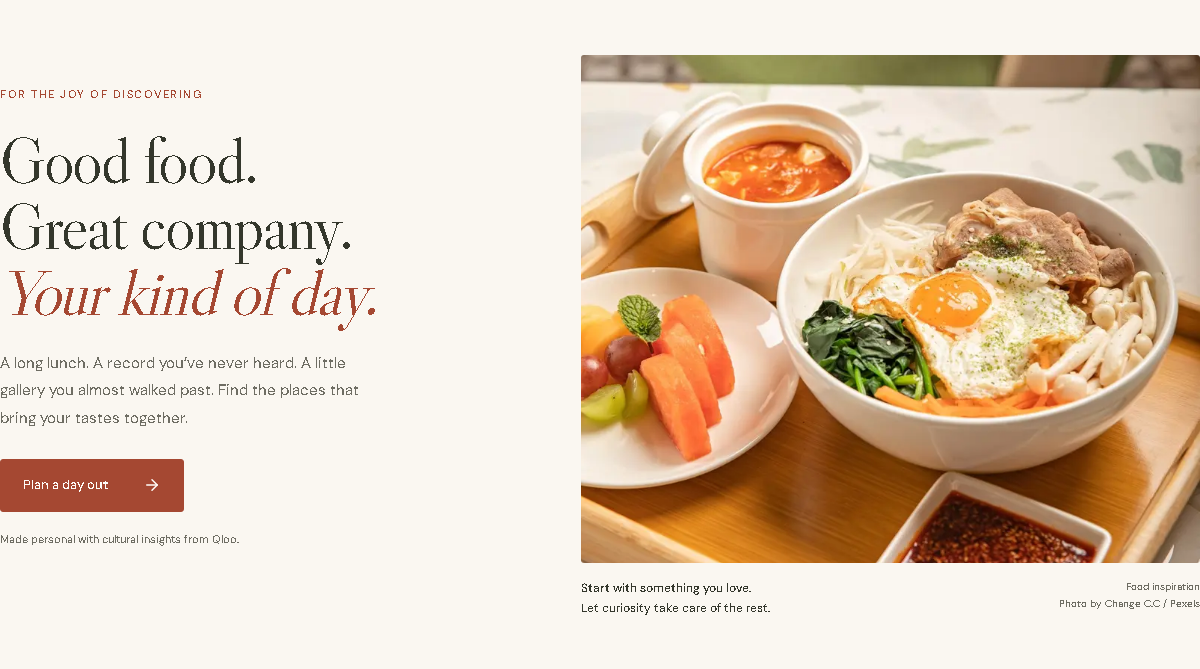
Landing page with Taste DNA
-
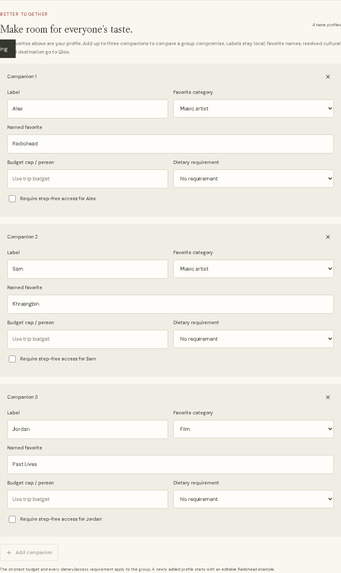
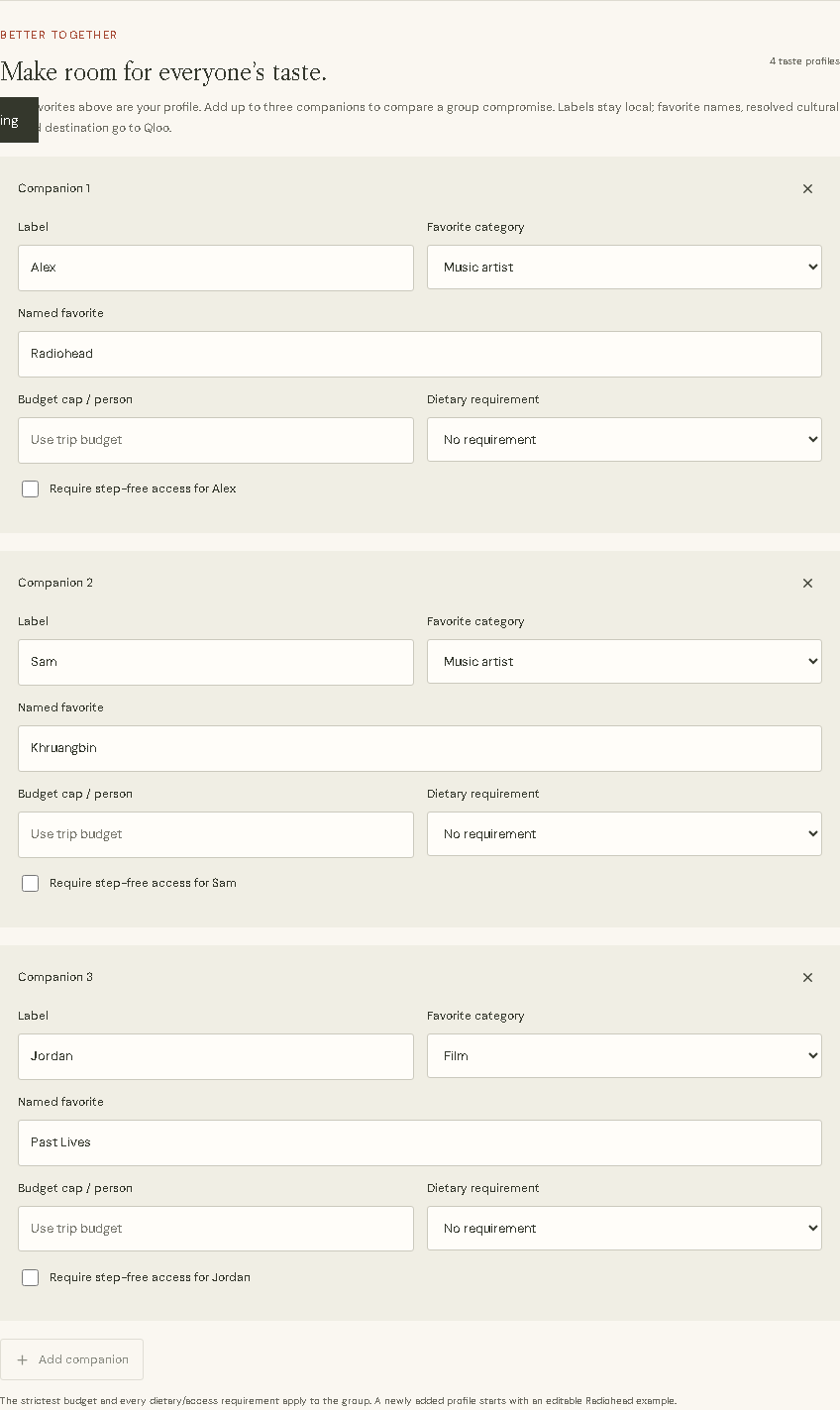
Multi-member group profiles
-
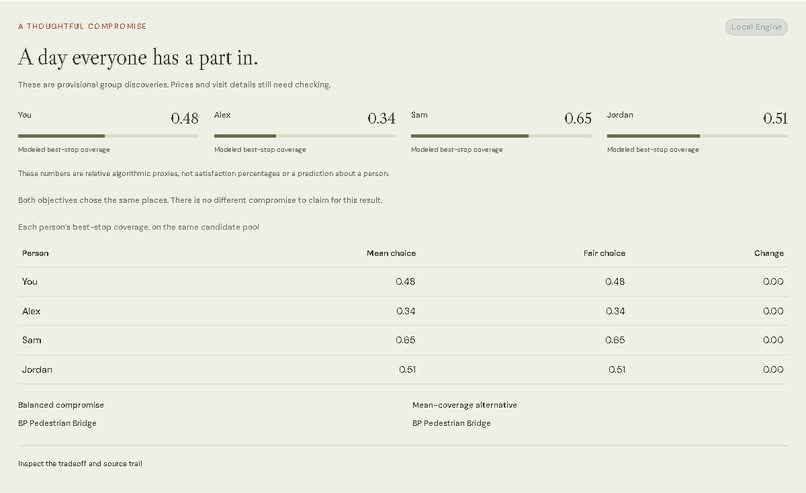
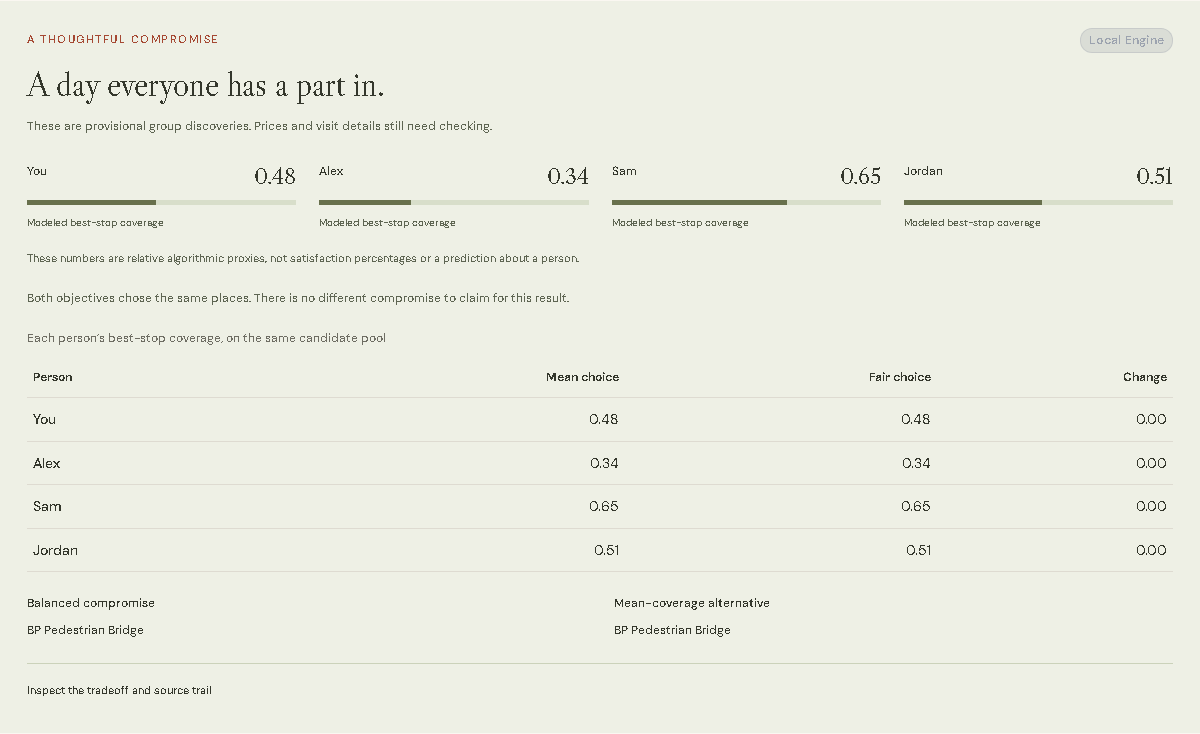
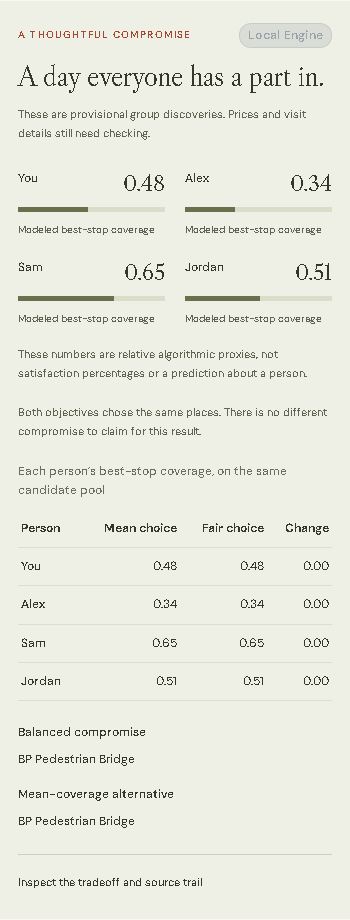
Fairness comparison & compromise breakdown
-
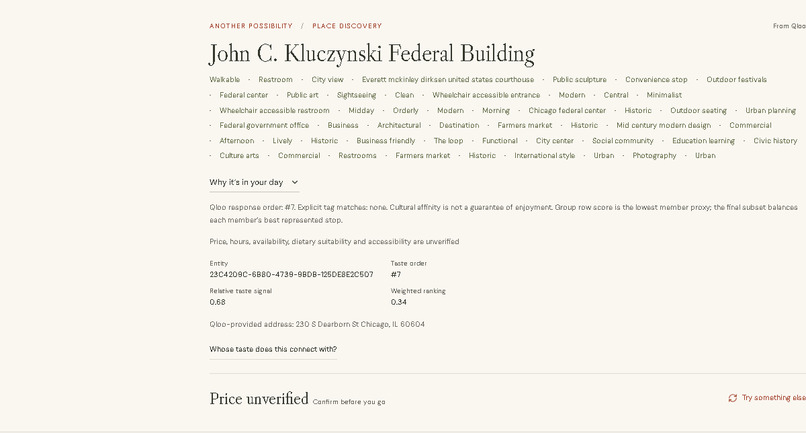
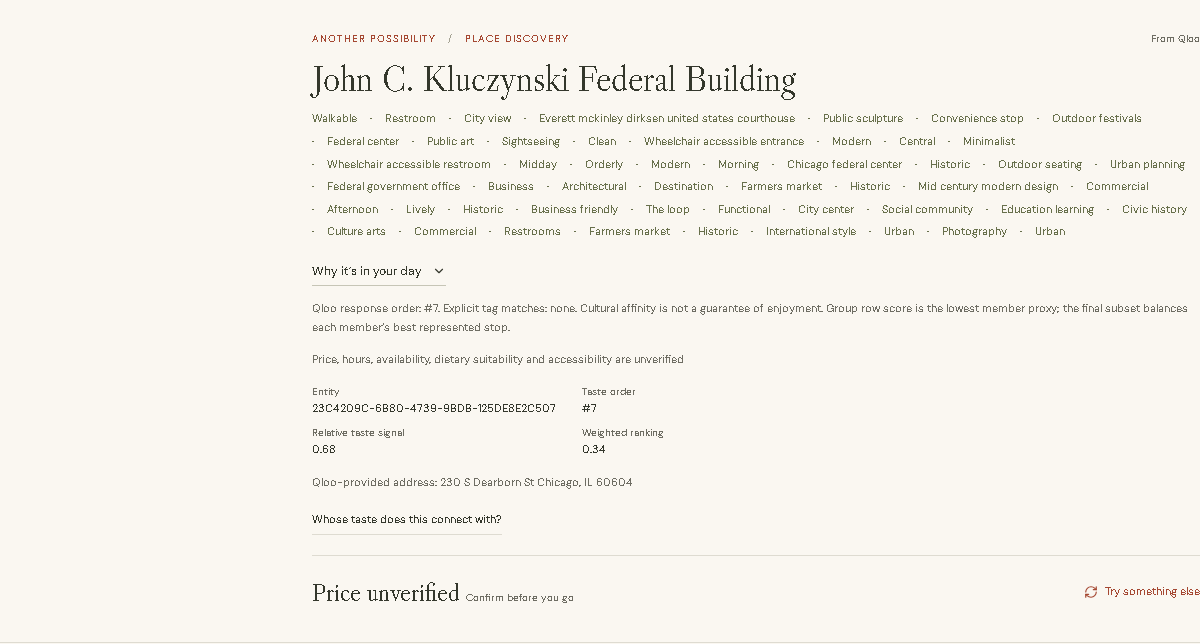
Qloo entity evidence & transparent provenance
-
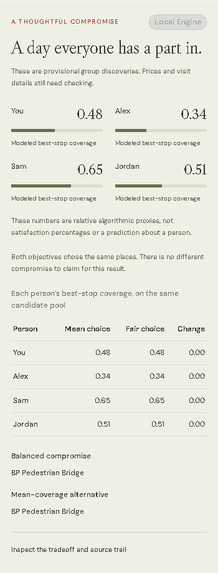
Mobile responsive UI & trade-off table
TastePilot AI: Discover Together, Without Compromising Everyone's Taste
A cultural discovery and group planning engine powered by Qloo.
Inspiration
Planning a day out with friends sounds simple until everyone starts sharing their preferences.
One person wants indie music and hidden cafés. Another prefers art museums and architecture. Someone else wants Japanese food, while another has dietary restrictions and a tight budget.
Most recommendation apps solve this by showing popular places or averaging everyone's preferences. But averaging doesn't always produce a fair result. Sometimes, one person ends up compromising on everything.
That made us wonder: What if an AI could understand everyone's cultural taste and find a plan that genuinely works for the whole group?
That's why we built TastePilot AI.
What it does
TastePilot AI turns people's cultural interests into personalized recommendations and fair group itineraries.
Instead of relying only on generic categories, users can enter the music artists, movies, books, brands, and cuisines they enjoy. TastePilot uses Qloo's cultural intelligence to discover places that align with those interests.
But the most interesting part happens when multiple people plan together.
Taste DNA
Every person has a different cultural identity. TastePilot builds individual preference profiles using real cultural entities discovered through Qloo.
Group Intelligence
When several people plan together, TastePilot evaluates recommendations against each person's preferences.
Instead of simply maximizing the group's average satisfaction, we use max-min fairness optimization to prioritize the least-satisfied member. The goal is to find a compromise without leaving someone completely behind.
Explainable Recommendations
We didn't want another AI that says, "You'll love this place," without explaining why.
TastePilot exposes cultural matches, Qloo entity references, individual satisfaction scores, and the reasoning behind each recommendation.
Users can also explore counterfactual comparisons to understand how the itinerary would change without a particular group member's preferences.
Real-World Constraints
A recommendation isn't useful if someone cannot afford it, access it, or safely eat there.
TastePilot accounts for budgets, dietary requirements, allergies, and accessibility needs. When important venue information cannot be verified, the system identifies that uncertainty rather than inventing details.
Conversational Refinement
Users can refine their plans naturally with requests such as "Make it cheaper" or "Add a peanut allergy for Alex."
The application interprets these requests while preserving existing preferences and constraints.
How we built it
We built TastePilot with a Python and FastAPI backend, a Next.js and React frontend, and Qloo's cultural intelligence APIs.
Qloo is central to the experience.
We use its Search API to resolve cultural interests into real entities and its Insights API to discover relevant places. This allows recommendations to be connected to cultural relationships instead of depending entirely on an LLM's assumptions.
For group planning, we implemented a fairness optimization engine that evaluates each candidate across individual preference profiles, compares trade-offs, and calculates counterfactual outcomes.
We also built an evidence layer that tracks where recommendations come from and distinguishes verified information from unknown details.
The frontend uses Next.js, TypeScript, and custom responsive styling. The application is containerized with Docker and deployed on Heroku.
Challenges we ran into
1. Making recommendations fair
Our first major challenge was figuring out what a good group recommendation actually means.
A place with a high average score might still be a terrible choice for one person.
We addressed this by implementing max-min fairness optimization, which prioritizes improving the satisfaction of the least-served group member.
2. Working with incomplete real-world data
Cultural relevance doesn't guarantee that a venue's price, operating hours, or accessibility information is available.
We didn't want to invent missing information just to make the itinerary look complete.
Instead, we built evidence checks and uncertainty labels so users can distinguish confirmed details from information that still needs verification.
3. Keeping conversational changes safe
Natural-language planning introduces another challenge: a request to change one preference shouldn't silently overwrite someone else's constraints.
We worked on preserving group profiles, validating requested changes, and preventing malicious instructions from bypassing important restrictions.
Accomplishments that we're proud of
The biggest accomplishment is building something beyond a standard AI recommendation interface.
TastePilot combines cultural discovery with actual group optimization, individual satisfaction analysis, counterfactual explanations, and transparent evidence.
We're especially proud of making the compromise inspectable. Users can see not only which places were selected, but also who benefits and why.
We also developed an automated test suite with 73 passing tests covering constraints, recommendation behavior, failure handling, and regression scenarios.
What we learned
We learned that cultural discovery is much more interesting than matching someone to a cuisine or tourist category.
The music someone listens to, the films they enjoy, and the books they love can reveal meaningful connections across different cultural experiences.
We also learned that building a trustworthy recommendation system requires more than producing good-looking results.
It needs to explain its decisions, acknowledge missing information, and treat people's constraints seriously.
Most importantly, we discovered that the best group recommendation isn't necessarily the most popular one. It's the one that makes the compromise worth it for everyone.
What's next
We want to extend TastePilot with real-time venue availability, reservations, collaborative planning sessions, group voting, and transit-aware routing.
Our longer-term vision is to make TastePilot a cultural discovery companion that understands not just where people want to go, but why those experiences matter to them.
Try TastePilot AI: https://tastepilot-ai-43e15cc919d5.herokuapp.com/
Source Code: https://github.com/leninathikam/tastepilot-ai
Built With
- algorithms
- artificial-intelligence
- docker
- fastapi
- heroku
- httpx
- next.js
- openai
- pydantic
- python
- qloo-api
- react
- typescript

Log in or sign up for Devpost to join the conversation.