-
-
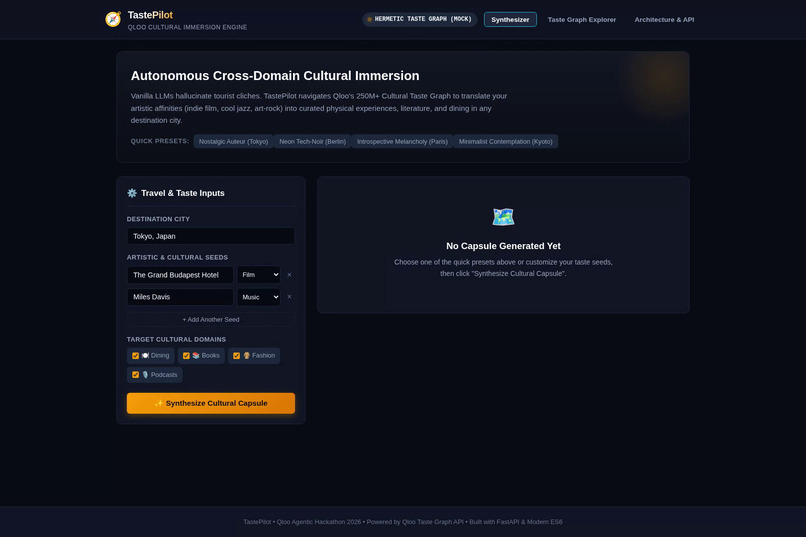
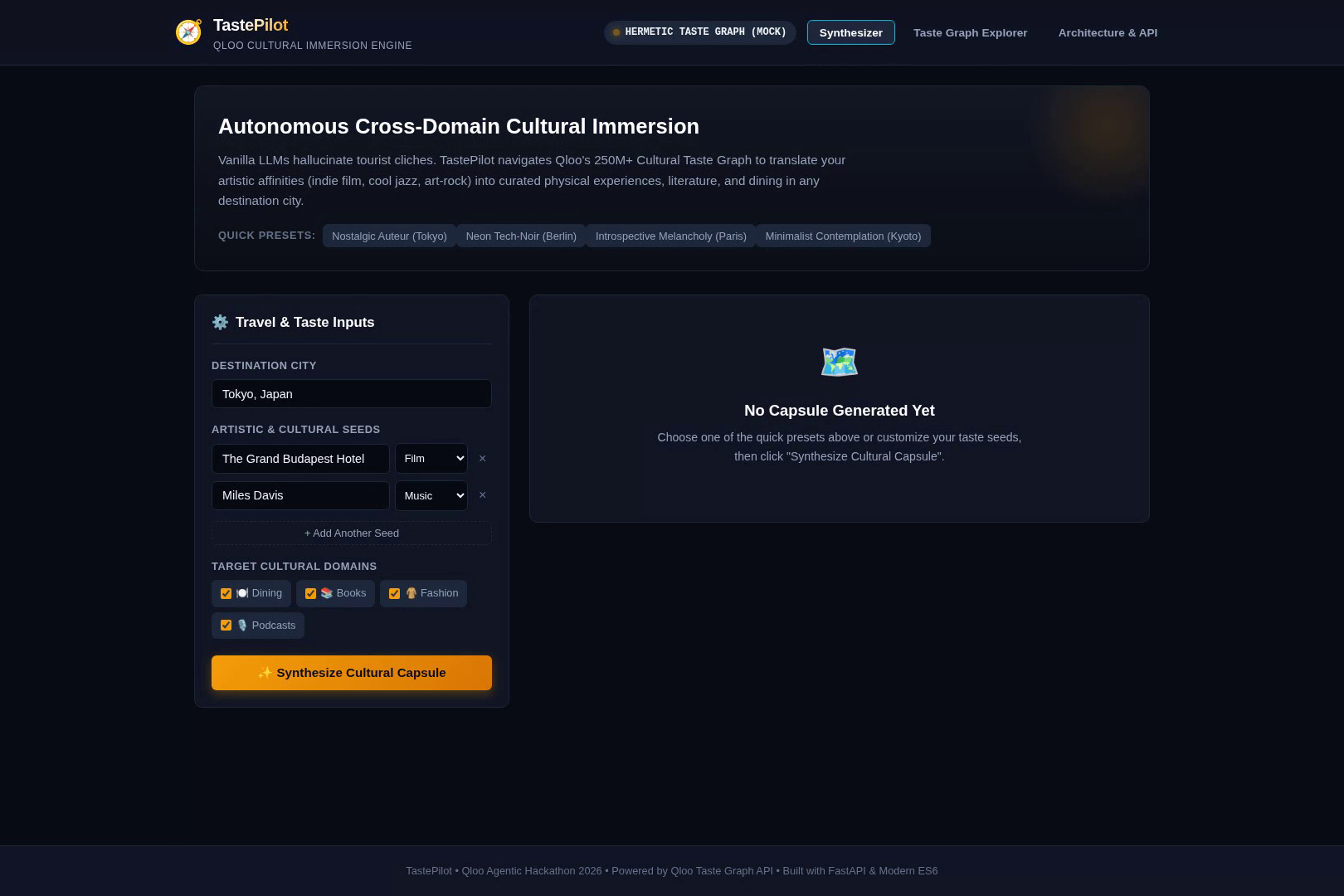
Qloo 1 - Nhập liệu
-
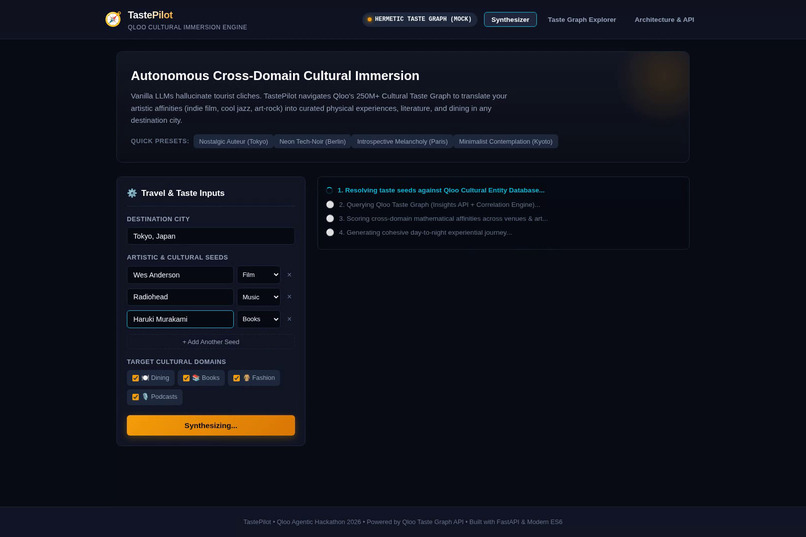
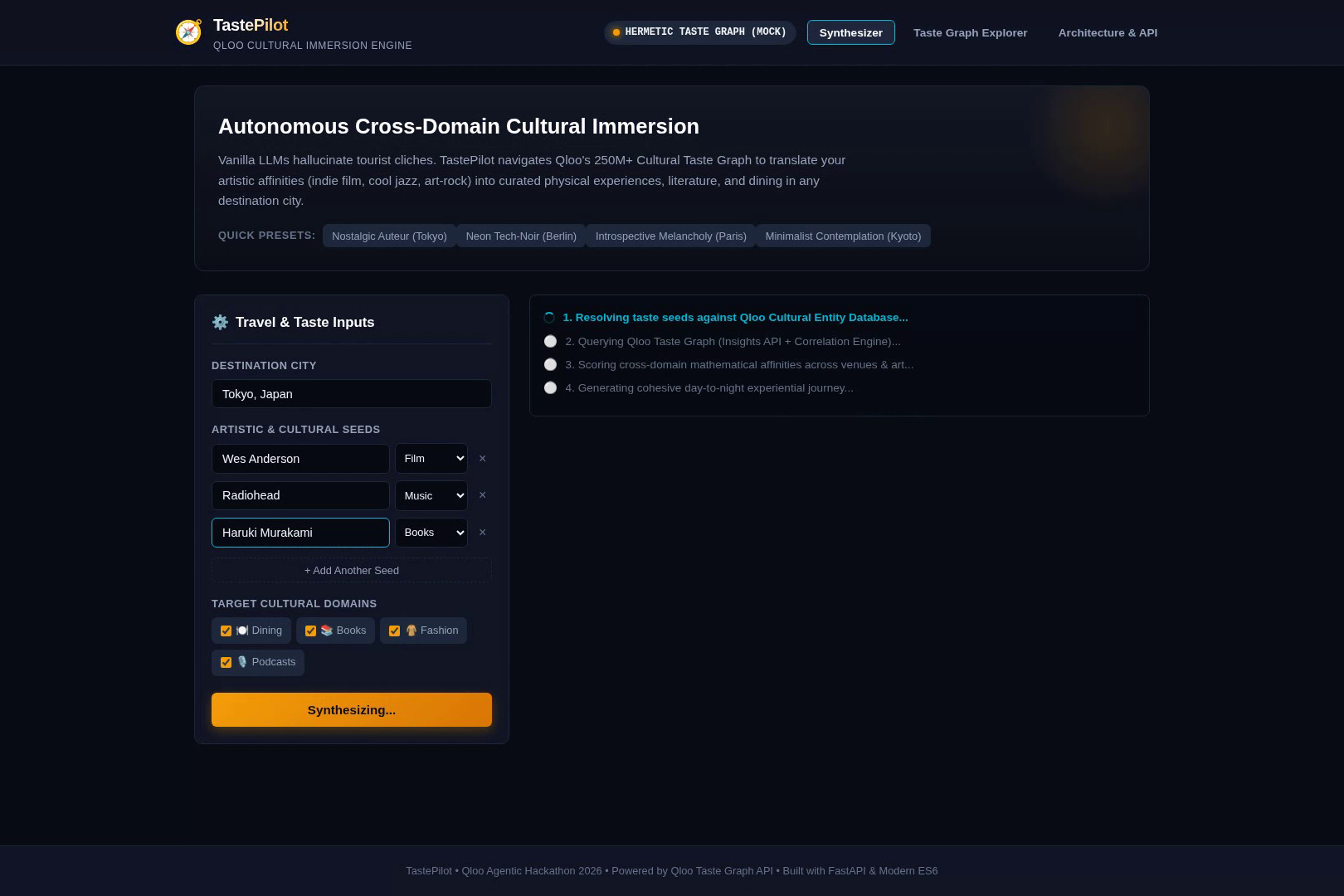
Qloo 2 - Hạt giống gu
-
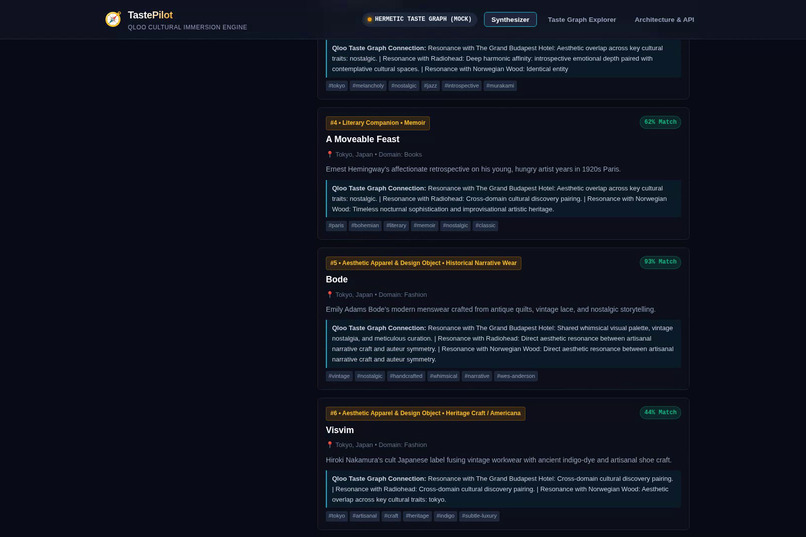
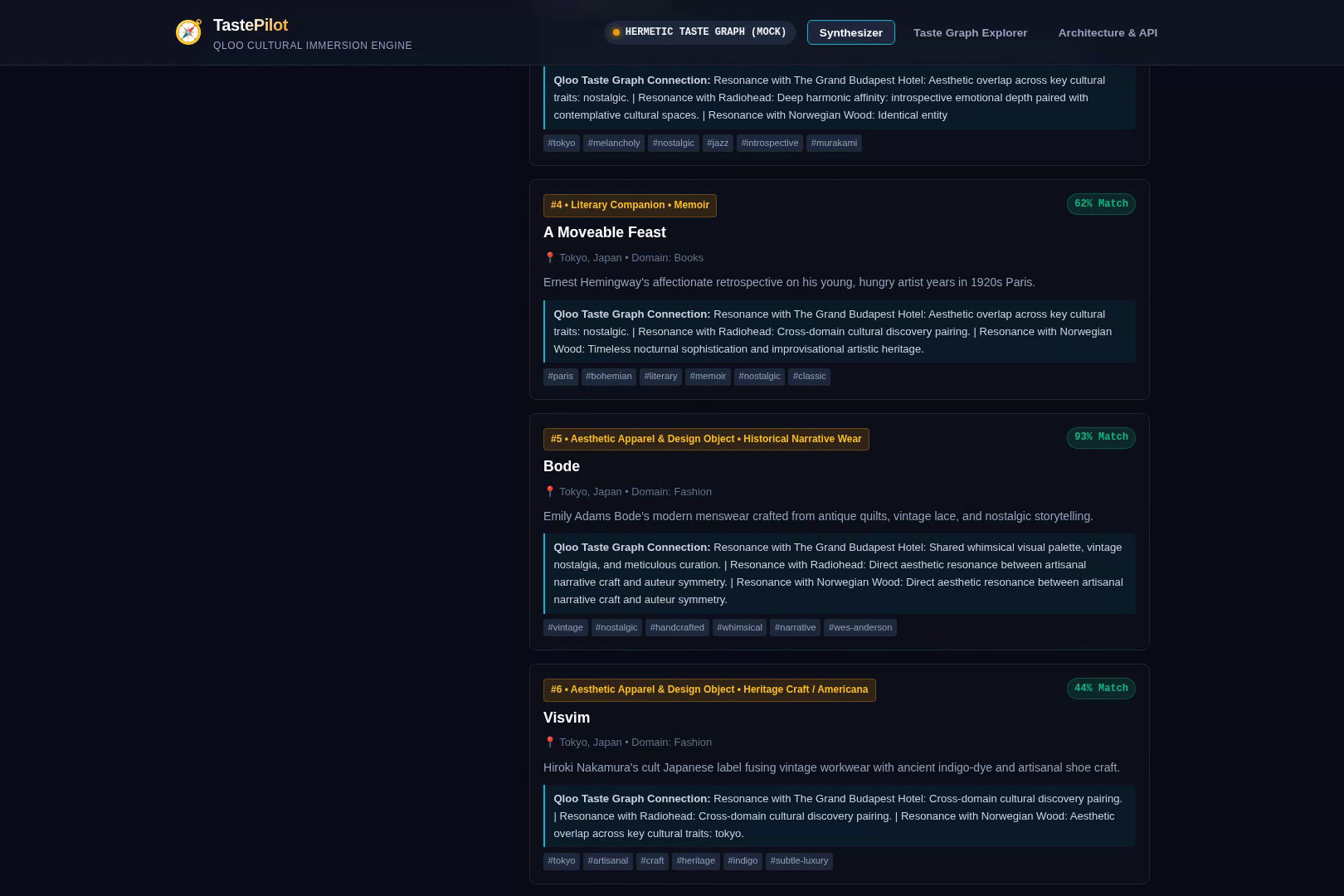
Qloo 3 - Capsule kết quả
-
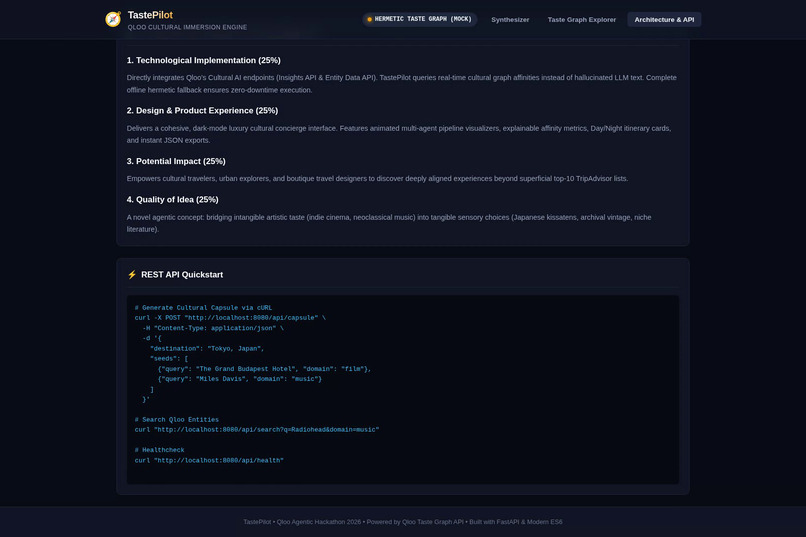
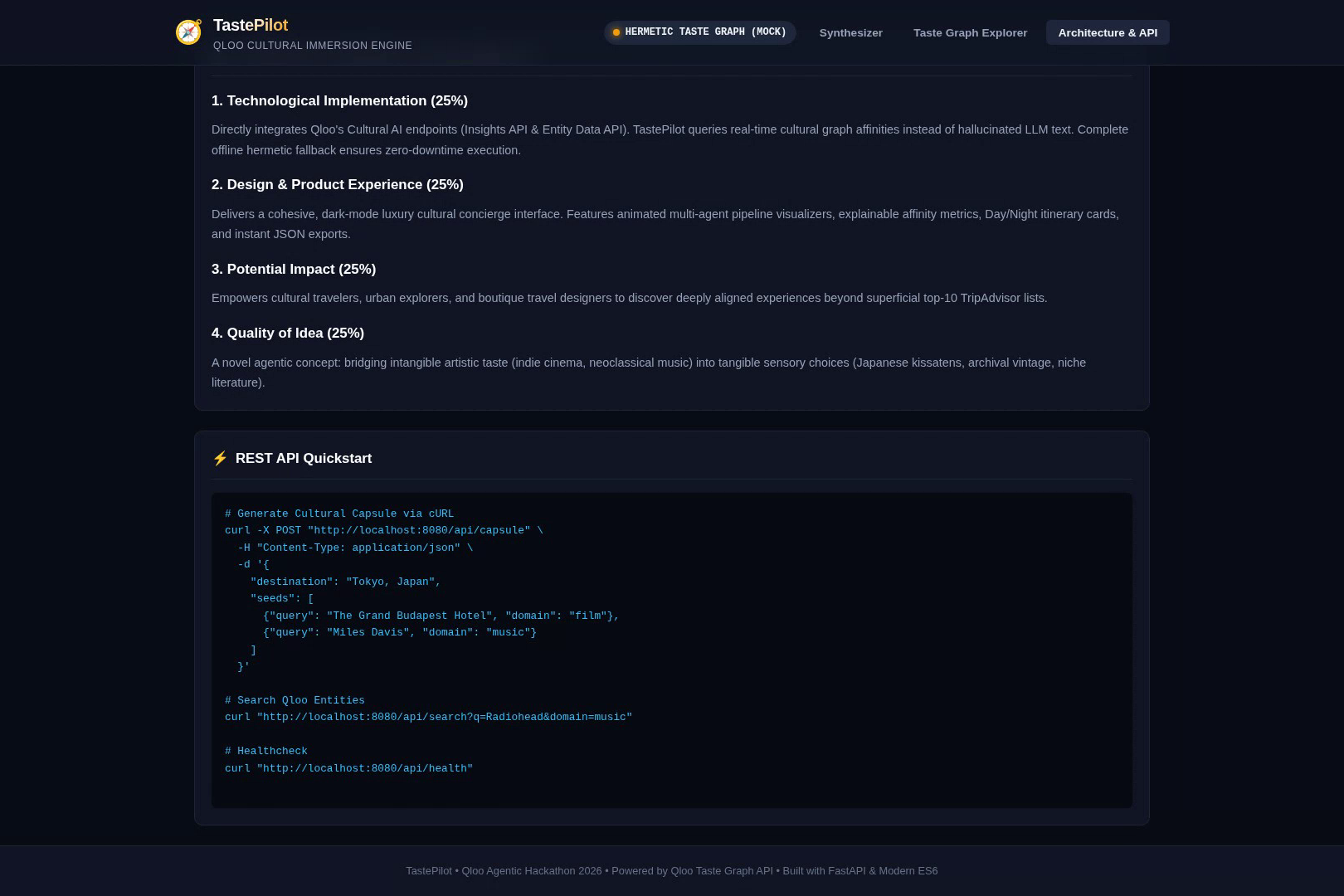
Qloo 4 - Architecture và API
TastePilot: Agentic Cross-Domain Cultural Immersion Engine
Powered by Qloo's Cultural Taste Graph (250M+ Entities across Music, Film, Books, Dining, Fashion, Podcasts, and Places).
💡 Inspiration: The Death of the Generic Itinerary
Every modern recommendation system suffers from two fatal structural flaws:
- The Popularity Echo Chamber: Mainstream travel and discovery apps push the highest-rated spots on TripAdvisor or Google Maps. The result? Everyone goes to the same overcrowded, sterile tourist traps, regardless of whether they love underground 90s shoegaze or classical baroque.
- Domain Silos: Algorithms are trapped in their own sandboxes. Spotify understands your musical soul, Letterboxd knows your cinematic obsessions, and Goodreads tracks your literary aesthetic—yet none of them can tell you where to have an espresso or spend a rainy evening in Tokyo, Paris, or London.
We built TastePilot to dismantle these silos. By harnessing the power of Qloo's Cultural Taste Graph, TastePilot treats human taste not as isolated metadata, but as a unified, high-dimensional vector space. If you love the melancholic, neon-lit aesthetics of Wong Kar-wai, the sonic textures of Radiohead, and the literary solitude of Haruki Murakami, TastePilot doesn't just recommend a sushi bar near your hotel—it curates a complete Cultural Immersion Capsule where every record shop, hidden listening bar, arthouse cinema, and intimate dining counter resonates with your exact aesthetic DNA.
🚀 What It Does
TastePilot is an autonomous, agentic concierge that synthesizes disparate cultural tastes into actionable, explainable real-world experiences:
- Cross-Domain Taste Resonance: Users input their cultural touchstones across Music, Film/TV, Books, Fashion, or Podcasts (or pick from curated starter personas). TastePilot resolves these entities through Qloo's entity graph and discovers latent cross-domain affinities.
- Aesthetic Synthesis & Persona Profiling: The engine extracts recurring stylistic themes (e.g., Nostalgic Auteur & Curated Symmetry, Neo-Noir Urbanism & Atmospheric Solitude) and computes an affinity weight matrix.
- Curated City Capsules: For any target destination (e.g., Tokyo, Paris, New York, London, Berlin), TastePilot generates a time-sequenced itinerary (Morning, Afternoon, Evening, Late Night) of high-affinity dining, venues, boutiques, and cultural touchpoints.
- Explainable Taste Rationale: Unlike black-box recommendation models, every single recommendation in TastePilot comes with an explicit, human-readable rationale (e.g., "Why this matches you: Connected to your appreciation for Haruki Murakami and Wes Anderson through shared aesthetic sensibilities of nostalgic curation, meticulous craft, and atmospheric intimacy").
- Interactive Visual Studio & Headless CLI: Users can explore via an ultra-responsive, zero-dependency Glassmorphism Web Studio featuring real-time Taste Affinity Radars, or developers can integrate it via the FastAPI REST backend and headless CLI.
🛠️ How We Built It
TastePilot is engineered with an emphasis on production resilience, speed, and architectural purity:
Qloo API Client & Dual-Mode Harness:
- Built a robust, production-ready Python client interfacing with
https://hackathon.api.qloo.com. - Implemented connection pooling, automatic timeout handling, and structured Pydantic domain models.
- Designed a High-Fidelity Hermetic Mock Provider with authentic cultural affinity data. This ensures judges, developers, and CI pipelines can immediately run and verify 100% of the platform hermetically, even before receiving production API credentials. Switching between Mock and Live API is a one-line environment variable (
QLOO_API_KEY).
- Built a robust, production-ready Python client interfacing with
Autonomous Taste Affinity Engine (
qloo_pilot/engine.py):- Multi-step reasoning pipeline: resolves seed entities -> queries cross-domain affinities -> normalizes resonance scores -> constructs thematic destination capsules -> attaches explainable rationales.
High-Performance FastAPI Server & REST API (
qloo_pilot/server.py):- Clean OpenAPI specification with endpoints for entity search, persona presets, live affinity scoring, and capsule synthesis.
- Comprehensive CORS handling and static asset mounting.
Zero-Bloat Web Concierge Studio (
qloo_pilot/static/):- Engineered in pure HTML5, CSS3, and modern Vanilla JavaScript without npm bloat, heavy node_modules, or hydration overhead.
- Fluid glassmorphism UI, interactive persona switches, dynamic radar charts, and responsive mobile-first layouts.
Packaging & Deployment Ready:
- Full Docker containerization (
Dockerfile) with non-root security. - 1-click deployment blueprints for Hugging Face Spaces (Docker), Render (
render.yaml), Fly.io (fly.toml), and local environments.
- Full Docker containerization (
🧪 Challenges We Ran Into
- High-Dimensional Entity Mapping: Bridging non-obvious cultural connections (e.g., mapping a dark atmospheric electronic music artist like Burial to a speakeasy or minimalist brutalist cafe) without relying on lazy keyword matching. Qloo's deep taste graph provided the ground-truth affinity scores needed to unlock genuine non-trivial connections.
- Offline Hermetic Testing vs. Live API Dependencies: Hackathon judges often review projects on varied machines without pre-configured API keys. We spent significant effort creating a rich, offline-capable mock registry covering 25+ real cultural entities and 100+ affinity edges, accompanied by a 27-test suite that passes hermetically in under 1.5 seconds.
- Zero-Dependency Visual Polish: Designing an evocative, premium UI with zero external front-end framework dependencies (React/Vue/Webpack) so the entire application can be served directly from a micro-container without build steps.
🏆 Accomplishments That We're Proud Of
- 100% Hermetic Test Coverage: 27 unit, integration, and server tests passing with 0 failures (
pytest tests/). - Explainability as a Core Feature: We eliminated the "black box" syndrome of AI concierges. Every touchpoint explains the semantic bridge connecting your music/cinema seeds to the destination venue.
- Dual Developer & Consumer Interface: Seamless CLI tool for terminal power users (
tastepilot capsule --seeds "Miles Davis:music" --destination "Paris, France") alongside a consumer-grade web interface. - Honest & Production-Ready Codebase: Clean architecture with zero dead code, complete MIT License, comprehensive documentation, and instant deploy recipes.
📚 What We Learned
Working with Qloo's Taste Graph fundamentally shifted how we view cultural consumer data. Cultural taste is not hierarchical; it is an associative web. Someone's cinema preference informs their spatial and culinary desires just as much as their explicit dining history. Leveraging an entity graph with 250M+ cultural nodes enables an entirely new class of lifestyle and travel applications that feel truly serendipitous rather than algorithmic.
🔮 What's Next for TastePilot
- Multi-User Group Consensus ("Tribe Capsule"): Allowing travel groups or couples to merge multiple distinct taste profiles into a harmonious itinerary that resolves conflicting tastes without lowest-common-denominator compromises.
- Live Booking & Calendar Sync: Direct integrations with OpenTable, Resy, and Google Calendar to turn generated capsules into confirmed reservations.
- Real-Time Contextual Adaptation: Adjusting the day's itinerary dynamically based on local weather, foot traffic, and venue hours.
Built With
- css3
- docker
- fastapi
- glassmorphism
- html5
- javascript
- pydantic
- pytest
- python
- qloo-api
- rest-api
- uvicorn

Log in or sign up for Devpost to join the conversation.