Inspiration
AI planners hallucinate. Ask a generic assistant for "a slow weekend in Kyoto" and it will invent charming ramen counters and jazz bars that no data source ever supported — stated with total confidence. Taste is one of the few domains with a real, structured source of truth behind it: Qloo's taste graph knows that loving a film genuinely predicts the restaurants, music, and places you will love. TastePilot was built to make that connection trustworthy: the agent may propose, but a deterministic evidence layer disposes.
What it does
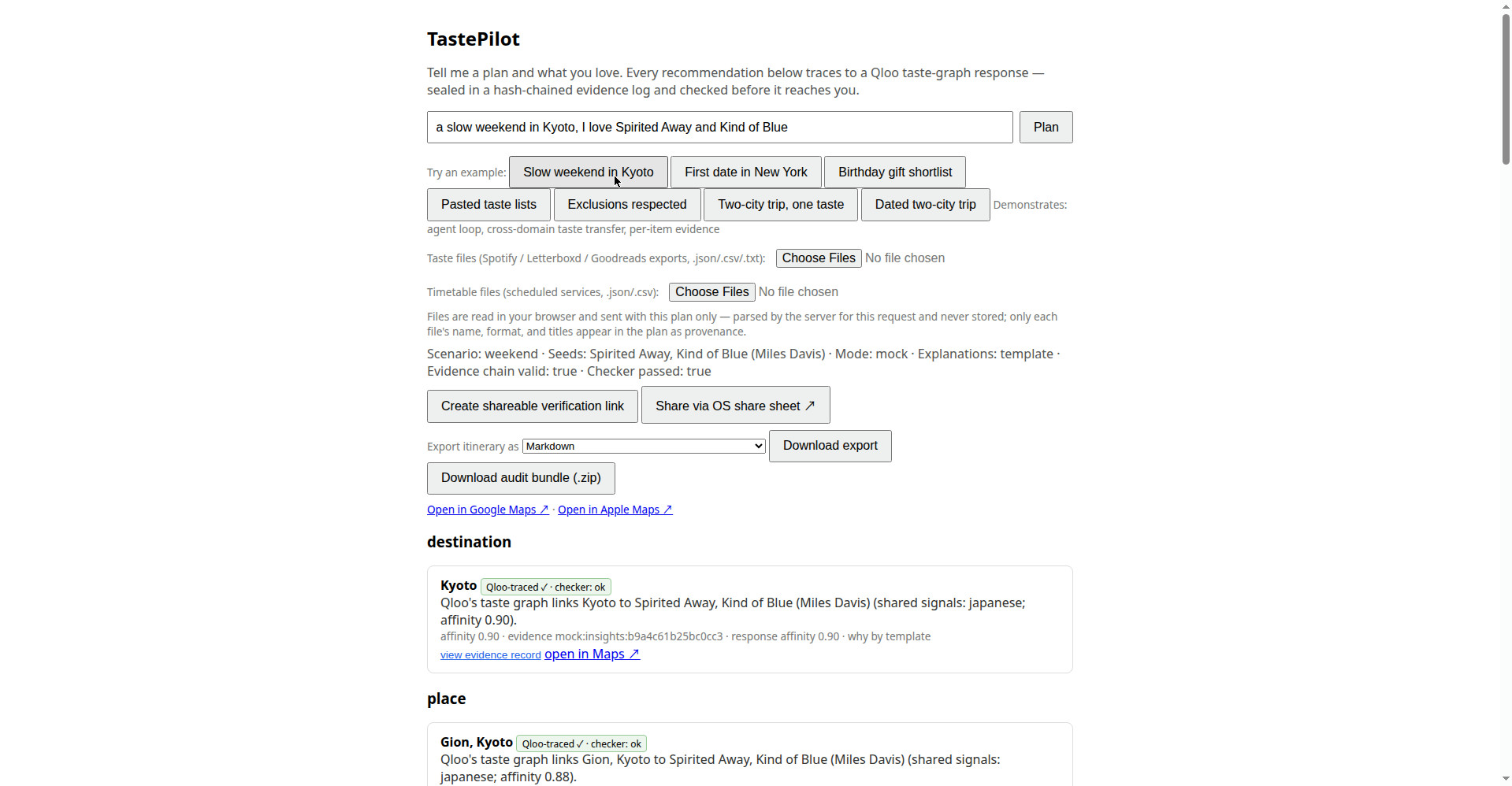
You state a plan in natural language — "a slow weekend in Kyoto, I love Spirited Away and Kind of Blue", "a first date in NYC", "a birthday gift shortlist for someone who loves Amélie". TastePilot:
- Parses the request deterministically — scenario, location, and the seed entities you named. Seeds can also arrive as a pasted list — a watchlist, a playlist, a reading list — and every item becomes a seed, including titles outside the demo catalogue, which are passed verbatim to Qloo search. Seeds can also arrive as an exported taste file the user downloaded from their own accounts — a Spotify playlist export, a Letterboxd watchlist CSV, a Goodreads library CSV (or a generic CSV/JSON/text list) — parsed entirely offline by
plan --import-file, with the file's format and items recorded as provenance in the plan; no account login is involved. The same files can be attached directly on the demo page: the browser reads the file and sends its contents with the plan request, the server parses them with the same parsers for that plan only (no upload store, nothing persisted), and a timetable file attaches the same way for the feasibility check below. The same schema can also arrive from a taste-feed endpoint serving it over HTTP (plan --import-url): fetched once with bounded retries, no credential ever sent, with only the endpoint's host recorded as provenance and its format stamped as an API source — a fetched list is never presented as a downloaded file, or vice versa. - Plans by decomposing the scenario into taste domains (film, music, food, places, books, brands, destinations). A request naming several cities composes a multi-city trip: each city is a leg, planned in mention order with the same resolved seeds — your taste carries across legs — while each leg's Qloo calls are location-filtered and sealed separately, so a leg's items cite that leg's own responses. Legs are date-aware: explicit, range, duration, and relative dates attach to the leg whose city was most recently mentioned, the plan reports per-leg start/end/nights, and out-of-order, overlapping, or reversed legs are surfaced as schedule warnings — never silently repaired, never blocking. Each leg change also passes an inter-leg travel-time feasibility check: an offline door-to-door estimate (great-circle distance between the leg cities; surface travel under 400 km, air travel above) is compared against the window the schedule leaves for the transfer, and tight or physically impossible transfers surface as travel warnings in the same report-never-repair shape. The estimate source is pluggable: a timetable file the user supplies (the scheduled flights and trains they are actually considering, parsed entirely offline) replaces the estimate for the city pairs it covers — and so does a timetable API endpoint serving the same schema over HTTP, fetched once with bounded retries, with only its host recorded as provenance — and every transfer records which source judged it — a scheduled duration is never presented as an estimate, or vice versa.
- Calls Qloo — seeds are resolved with
GET /search, and cross-domain recommendations come fromGET /v2/insights(filter.type+signal.interests.entities). Qloo is load-bearing: remove it and there is nothing left to recommend from. Composes a grouped itinerary where each item carries a "why this fits your taste" line grounded in the Qloo correlation that produced it (Nemotron via Nebius Token Factory, with a deterministic template fallback; the LLM writes explanations only — it can never create a recommendation). A request can also state negative preferences — "no jazz", "avoid ramen and wine", "allergic to shellfish" — which are captured deterministically and applied as a filter after the evidence check: an excluded item is reported with the phrase it matched and its (passing) verification, removed by preference and never confused with a checker rejection. And each plan carries evidence-backed alternatives: every insights call asks Qloo for two more results than the plan shows, and the overflow is offered as a swap option for the same domain and leg — checker-verified against the sealed record before it is kept, filtered by the same exclusions, and covered by every verification surface, so tampering with an alternative fails verification exactly as tampering with a primary item does. An alternative is also a one-tap swap: its card's swap button exchanges it with the primary for its domain and leg, but only after the swap module recomputes the plan's preconditions (sealed chain valid, whole plan passing, both items traced) — a tampered plan is refused, never re-sealed — and the exchange itself is then sealed into the evidence record as a swap event, so the re-signed record attests the original Qloo calls and every swap at once. The swap history is an audit trail every surface recomputes from those sealed events — the UI's history block, the verify report, the itinerary exports, a
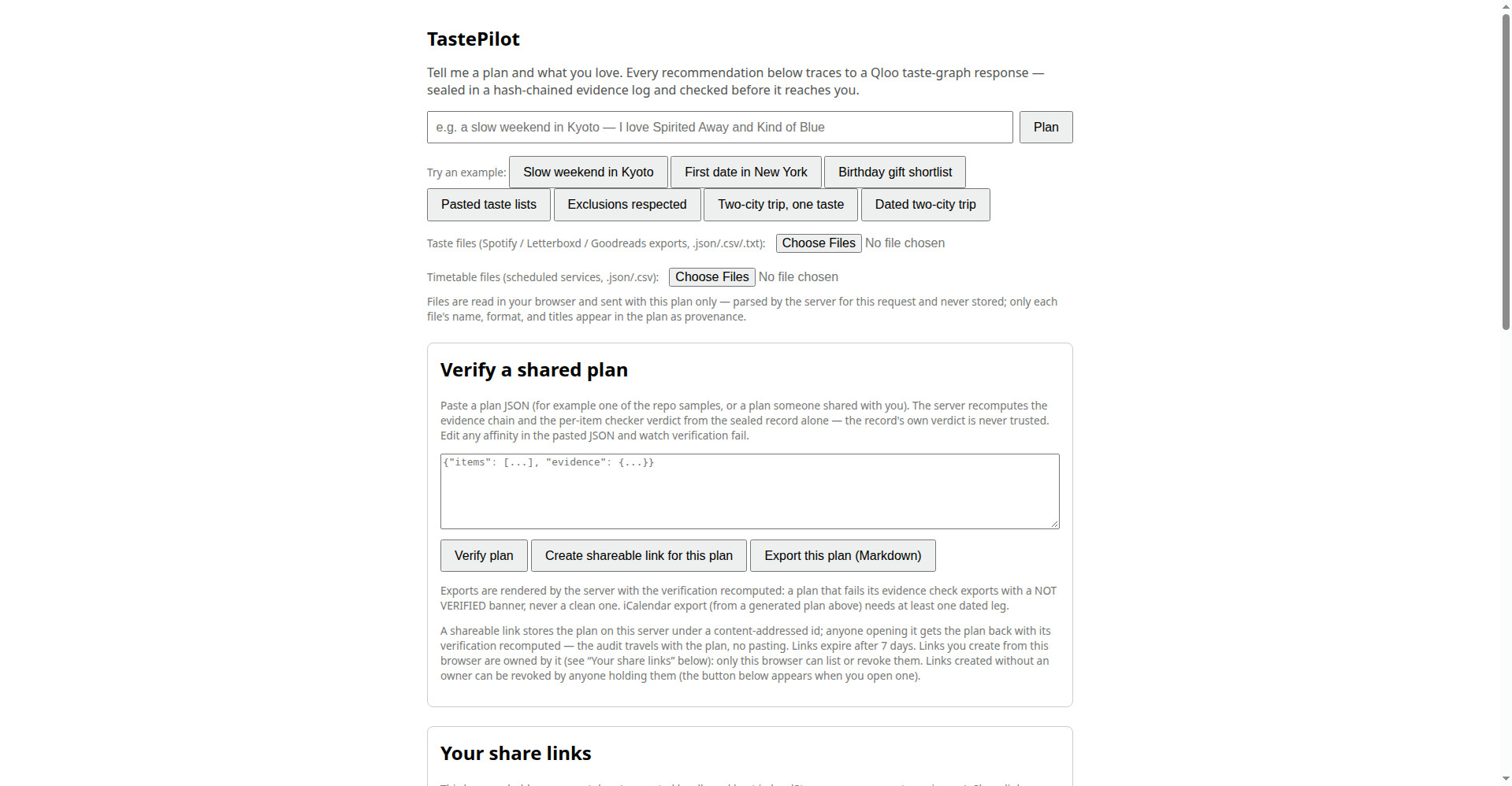
historycommand — never from a plan's stored swap list, and the newest swap can be reversed with one Undo tap: the reversal is read from the sealed history, re-checked against every precondition, and sealed as a further event naming the swap it reversed, so the record attests swaps and their undos alike and nothing is ever deleted from the chain. And swap paths can be compared before committing to one: a branch spec forks the plan into named branches — one swap path each, applied to the base independently through the same re-check-and-reseal path — and the explorer (UI button, API, and CLI alike) lines the branches up by their recomputed verdicts, with a path that does not apply reported beside the successful branches rather than aborting the comparison; loading a branch gives an ordinary swapped plan that verifies, undoes, and swaps further like any other. And the agent guides which branches are worth exploring: guided branch suggestions rank every verified primary/alternative pair by affinity delta and taste coverage (tags the alternative would add that no primary carries) — with both non-affinity score components bounded so the ranking stays on the affinity scale against the live graph's hundred-plus keyword tags per entity: the coverage bonus saturates at five tags and the learned adjustment below clamps to ±0.30 per candidate — and propose the top single swaps plus a combined guided-tour branch picking the best swap in each domain — as branch specs the explorer accepts unchanged, with a score and rationale per suggestion. Suggestions propose only: the base is verified first, never mutated, and a tampered plan is refused rather than suggested from. And the ranking learns from the user's own past swap choices: swap events sealed in a plan's evidence record — plus any history plans supplied with the request — are read back as training signal, where a swap the user kept adds weight to the tags and domain of the alternative they chose and a swap they later undid subtracts it (undoing an undo restores it). The resulting profile folds into each candidate's score as a bounded, fully reported adjustment — every candidate names the learned tags behind its adjustment, and a history plan whose sealed chain does not verify is ignored and counted rather than believed, so the personalisation is as tamper-evident as everything else in the plan. Persistent preference profiles carry that learning across plans and sessions: the profile is stored under the hash of the owner's token (the same per-browser credential that owns share links — no account, no sign-up), written only by deriving it from sealed swap histories and merging it additively under the learner's own caps (no surface accepts caller-supplied weights), optionally persisted to a file so it survives restarts, clearable by its owner at any time, and folded into later suggestion rankings for that token — reported as a stored profile applied — while other owners' rankings are never touched. The profile also travels between devices and servers as a sync document (export / import over the API, the CLI, and the profile panel): two copies of one owner's profile merge under deterministic conflict rules — the newer document wins a disputed weight, a timestamp tie goes to the larger absolute weight, and the counts take the maximum so the shared history two devices both learned from is never double-counted — with every conflict reported in the import result, and a document naming another owner refused outright. And any two plans can be compared directly: the diff names the items one plan has that the other lacks, the affinity changes on the slots both keep, and the alternatives and schedule changes between them — with both plans' verdicts recomputed from their own sealed records, so the branch explorer can state exactly what a swap path changed (+added, −removed, ~rescored) instead of asking the reader to eyeball two item lists. And the branches render as a visual timeline: recommendation slots grouped by the trip's legs, one column per branch beside the base plan, each cell marked kept, added, removed, or re-scored with its affinity, and each column headed by its recomputed verdict — a tampered branch is a FAIL column in the grid, never a clean one. And that timeline also leaves as one of the plan's take-away exports: the same grid rendered into Markdown and plain-text itinerary exports (CLI, API, and the explorer's download buttons), its banner and every column verdict recomputed at export time — a tampered branch exports as a FAIL column under a NOT VERIFIED banner, exactly as a tampered single plan exports. And the timeline leaves as a calendar too, as one of the timeline take-away exports: an iCalendar export with one event series per branch — for every dated leg, an all-day event naming its branch and carrying that branch's recomputed verdict and that leg's recommendations in that branch — so a recipient can compare swap paths on their own calendar; a tampered branch's series reads NOT VERIFIED, and a timeline with no dated leg in any column is refused rather than assigned invented dates. And that calendar has a paced form too: a paced iCalendar timeline export with one event series per branch at day granularity — for every dated day of that branch's own day-by-day pacing, an all-day event naming its branch and the day and carrying only that day's recommendations in that branch — so a recipient can compare swap paths day by day; a tampered branch's days read NOT VERIFIED, and a timeline with no dated day holding recommendations in any column is refused rather than assigned invented dates. And that calendar also travels as live calendar subscriptions, not just a file: a timeline can be stored as a feed under a stable URL that a calendar app subscribes to and polls — every poll re-renders the stored timeline with its verdicts recomputed — and the feed's owner can replace the timeline in place when a branch is re-sealed, so subscribers see the new series under the same URL instead of importing a new file; feeds expire, can be revoked, and follow the same owner-token rules as share links. The single-timeline feed has a paced form too: the same feed URL with?format=ics-daysserves one paced event per dated day per branch instead of one per leg, under its own ETag (the feed etag — a hash of the stored timeline — with a-dayssuffix), so a leg-level poller and a paced poller each get a cheap 304 only for the variant they asked for, and an in-place update changes both etags at once. And several timelines travel together as one multi-timeline subscription: a bundle of named timelines stored under a single feed URL whose calendar carries every timeline's branch series at once, each timeline's verdicts recomputed on every poll. The bundle has a paced form too: a paced bundle calendar with one event series per timeline per branch at day granularity — for every dated day of that branch's own pacing, an all-day event naming the timeline, the branch, and the day and carrying only that day's recommendations in that branch — served by the same feed URL with?format=ics-daysunder its own ETag, and downloadable without a subscription as a take-away export; a tampered branch's paced days read NOT VERIFIED, and a bundle with no dated day holding recommendations anywhere is refused rather than assigned invented dates. The bundle also leaves as a document, not just a calendar: a Markdown or plain-text bundle export with one grid section per timeline under a bundle banner recomputed over every column of every timeline — a tampered branch deep in the bundle is a FAIL column under a NOT VERIFIED banner naming its timeline and column — downloadable from the demo, renderable from the CLI (export --bundle), and available for undated bundles too, since documents need no dates even though calendars refuse them; the subscription feeds themselves stay calendar-only. The bundle feed is versioned and keeps a change log — one entry per creation and per in-place update, naming the timelines it carries and the verdict recomputed at write time — and its calendar response carries an ETag, so a subscriber polling with If-None-Match gets a cheap 304 while nothing changed and the new series (with a new etag) the first poll after an update: poll-based change notification. And change also pushes: a subscriber can register a webhook on the bundle feed — registration fires one test delivery, and every in-place update then POSTs the change (new version, etag, timeline names, recomputed verdict) to every registered webhook with bounded retries, each delivery's outcome recorded in the feed's delivery log; the webhook URL is stored only inside the feed entry and named everywhere else by host label only, and a failed delivery never fails the update that triggered it. A failed delivery is not lost, either: every record is stamped with a delivery id and keeps the payload it attempted, so the subscriber can have it redelivered on demand — the resend goes to the webhook's current URL and is recorded as a new delivery naming the original, which is never edited — or redelivered in bulk: one call resends the latest attempt of every failed delivery chain on the feed, while a failed record a later resend already superseded is reported as skipped and never resent, so a recovered receiver is brought up to date without duplicate pushes. Pushes are verifiable, too: a signed webhook's deliveries carry an HMAC-SHA256 signature header over the exact body bytes — the subscriber supplies the signing secret at registration or has one generated and shown exactly once — so a receiver can prove a push genuinely came from TastePilot and was not altered, and a signed delivery's redelivery is signed the same way. Signed pushes are also replay-protected: each carries anX-TastePilot-Timestampheader and a second, timestamped signature (X-TastePilot-Timestamp-Signature, over"<timestamp>." + body), and a subscriber who verifies that signature within five minutes of the timestamp rejects a captured push replayed later — even though its body signature still verifies. The timestamp is stamped once per delivery, so retries of one delivery share it, and a redelivery is stamped fresh. Pushes also carry an idempotency key (X-TastePilot-Idempotency-Keyon the wire,idempotency_keyon the delivery record): a deterministic digest of the webhook and the exact payload, shared by a delivery's retries and by a redelivery of the same change to the same webhook, so a receiver can drop a duplicate push instead of applying the change twice — dedupe that also works for unsigned webhooks, since the key authenticates nothing and is no secret. A webhook whose endpoint keeps failing is paused, not hammered: three consecutive failed deliveries pause it (a delivered push resets the count), later pushes are recorded as skipped with their payload kept — so the missed change can be redelivered once the subscriber resumes the webhook, which clears the count. An auto-pause is a circuit breaker, not a life sentence: it is stamped with its reason and the moment it paused, and after a one-hour cooldown the next update push probes the endpoint with that push itself — a delivered probe revives the webhook with its count cleared, a failed probe restarts the cooldown — while a webhook the subscriber paused by hand is never probed, because a deliberate pause is an instruction, not a symptom. Secrets are maintainable, too: a webhook's signing secret rotates in place — a fresh secret generated and shown once, the subscriber's own installed, or an explicit null un-signing the webhook — and the old secret stops verifying the moment the new one is stored, without the webhook losing its id, pause state, or failure count to a remove-and-re-register. Endpoints are maintainable the same way: a webhook's URL rotates in place (rotate-url) — validated exactly as at registration, the id recomputed from the new URL, the rotation moment stamped — and the signing secret, pause state, failure count, and registration moment all survive, so an endpoint migration costs the subscriber nothing but the edit; rotating onto an already-registered URL is refused, and delivery records keep the old id and host as the audit trail. Subscriptions are selective, too: a webhook names the events it wants — at registration or later in place (set-events), with an explicit null resetting it to every event — and a push whose event it filtered out is never sent to it (no attempt, no delivery record, no failure-count effect), while an explicit on-demand redelivery still resends, because that is the subscriber's own act. And a webhook can be test-pushed on demand (POST .../webhooks/<id>/test): onemulti_feed.testdelivery to that webhook alone, sent regardless of its filter and refused while it is paused, so a subscriber who rotated an endpoint or a secret can verify the endpoint — and the signature — without forcing a feed update. And a subscriber can see every one of their webhooks at once: the subscriber directory (GET /api/subscriber/webhooks, owner token required) lists each webhook registered on a multi-feed that token owns, across all of the owner's feeds, with its feed's version, timeline names, and expiry, its signed/paused state and event filter, and its delivery tallies from the feed's log — read-only, host labels only, and webhooks on unowned or other owners' feeds never appear in it. And a subscriber can see every one of their calendar subscriptions at once: the subscriber feed directory (GET /api/subscriber/feeds, owner token required) lists each live single-timeline and multi-timeline feed that token owns, with its stable feed URLs (leg-level and paced), expiry, branch/timeline names, and the verdict recomputed from its stored timeline at list time — a feed whose branch no longer verifies lists as FAIL — read-only, metadata only, and feeds owned by another token, or by no token, never appear in it. And one view summarises all of a subscriber's artefacts at once: the subscriber overview (GET /api/subscriber/overview, owner token required) aggregates the same rows the shares dashboard, the feed directory, and the webhook directory return — counts, share and feed verdict tallies recomputed at list time, webhook delivery tallies, and whether a persistent preference profile exists — so the overview can never disagree with the directory it summarises.Evidence-verifies the result. Every Qloo call is sealed in a hash-chained, HMAC-signed evidence log. A deterministic checker admits an item only if its cited response exists in the sealed log, is an insights call, contains the entity, and matches the affinity exactly. Anything else is rejected as a hallucination and shown as rejected, with the reason. The web UI surfaces this per item: checker badge, the affinity found in the cited response, and an evidence-record viewer that opens the sealed Qloo call behind any recommendation. And because a plan is just JSON, anyone can audit one they did not produce: the UI's "Verify a shared plan" panel recomputes the chain and every checker verdict from the sealed record alone — the record's own verdict is never trusted. Plans also travel as shareable verification links: a plan can be stored under a content-addressed id, and anyone opening the link gets the plan back with its verification recomputed — storing grants a plan no trust, so a tampered shared plan still fails by link. Links expire after 7 days, can be revoked by anyone holding them, and — with an opt-in JSON file store — survive a server restart. Links can also be owner-managed without any account system: the browser that creates a link presents an owner token (generated locally, kept in localStorage; the server stores only its hash), and only that token can list the owner's links — each shown with its recomputed verdict — or revoke them. The token is portable: every owned surface names it only by a fingerprint (the first 12 characters of its hash), and pasting the token into another browser — validated against the server before it is adopted — gives that browser the identical dashboard, so a user's links follow them between devices with no sign-up at all. And a plan leaves the app as a take-away itinerary: Markdown, plain-text, and iCalendar exports (one all-day event per dated leg; a dateless plan is refused rather than assigned invented dates), each carrying a verification banner recomputed at export time — a tampered plan exports as NOT VERIFIED, never clean. And a plan hands off to the user's own apps in one tap: a Google Calendar template link per dated leg and a Google Maps link per leg and per recommendation, rendered in the UI, the CLI, and the Markdown/text exports — recomputed from the plan on every surface (a stored link field is never trusted), with no account or sign-in on TastePilot's side: the user's own browser completes the action. The same handoffs also come in each platform's native dialect — an Apple Maps link and an Android
geo:intent for every leg and recommendation — and as an OS share sheet payload (Web Share API): a title and a short text naming the legs and their recommendations, whose verification line is recomputed from the sealed evidence, so a plan shared to the user's own messaging or notes apps carries its PASS — or its NOT VERIFIED — with it. And every plan is paced day-by-day: each dated leg's recommendations are distributed deterministically across its days (plan order, as evenly as possible), rendered as a day-by-day itinerary in the demo UI, the CLI, and the Markdown/text exports — recomputed from the plan on every surface, with undated legs left unscheduled rather than assigned invented days, and every primary recommendation paced exactly once. The pacing also drives a paced iCalendar export (formatics-days, alongside the leg-levelics): one all-day event per dated day carrying only that day's recommendations, so a calendar import shows the trip day by day instead of as one block per leg — empty days and undated legs get no event, and paced event UIDs are namespaced apart from the leg calendar's, so both files can be imported side by side. And a plan's whole proof travels as one file — an audit bundle: a deterministic ZIP (CLIbundle, the demo's audit bundle button,POST /api/bundle) carrying the plan exactly as supplied, its sealed evidence record on its own, a verification report recomputed at packing time, the take-away itineraries, and a manifest hashing every other file — andverify-bundlere-audits an archive offline, checking the manifest hashes and recomputing the packed plan's verdict rather than trusting the report packed inside it.
Real mode, verified live (2026-10-13): against the live Qloo hackathon API, "a slow weekend in Kyoto, I love Spirited Away and Kind of Blue" produced 9 recommendations (Kyoto as destination; ROCK BAR CRUNCH and Mount Kurama as places and food; Brian Wilson and Tom Waits for music; Kiki's Delivery Service and My Neighbor Totoro for film) plus 8 checker-verified alternatives — checker PASS, evidence chain valid, and the saved plan re-verified offline with tastepilot verify. All seven catalogue examples were run end-to-end in real mode the same day (8–19 recommendations each, every one checker PASS with a valid chain), including the exclusion example, where "no jazz" removed Björk on the live graph's own tagging while she kept her passing verification. One honest caveat the live run surfaced: the hackathon API returns no per-entity affinity score, so real-mode items carry a neutral 0.5 affinity and within-domain order is the API's own — the evidence invariant (every item traced to a sealed live response) holds unchanged.
How we built it
Python 3.11+, standard library only — no dependencies to install, so judges can run everything offline. A hand-rolled, transparent agent loop (parse → plan → Qloo tool calls → compose → evidence-verify) instead of a black-box framework. The Qloo adapter has one interface with two clients: a real client for the hackathon API (X-Api-Key header, key kept only in a gitignored .env, never logged) and a deterministic mock client whose fixtures follow the public API examples, so the full flow — including the evidence checker — runs in a zero-key Judge Mode. The evidence log's hash-chain + HMAC design is ported from the entrant's VerifyGate project. A one-command smoke check (tastepilot smoke) validates the live payload shape on first real-key use, seals both calls, and re-verifies the chain before reporting. The demo server is hardened for a public URL (input caps, security headers, bounded evidence cache, leak-free error responses, and per-client rate limiting: every POST route is capped per client — 30 requests per 60 seconds by default — and a client over the limit gets a 429 with a Retry-After header, while GETs and the health check stay unlimited) and ships with a Dockerfile, a PaaS Procfile, and a deployment guide. The demo opens with a curated catalogue of example requests — one per headline feature, served from a single source (examples.py) to the web UI's example buttons, GET /api/examples, and the examples CLI subcommand — and the test suite runs every example end-to-end in mock mode asserting checker PASS with a valid evidence chain, so the demo script judges follow is verified, not aspirational.
Challenges we ran into
- Response-id collisions: places and food share Qloo's
urn:entity:placefilter type, so identical request parameters first produced identical response ids and legitimate items were rejected by our own checker. The id now also hashes the result entity ids — the checker catching our own bug was the invariant working as designed. - Reasoning-model token budgets: the explanation model's reasoning trace silently consumed the whole completion budget and returned empty content with HTTP 200. The failure is now recorded as provenance (source, model, fallback reason) on every item instead of being hidden.
Keeping the LLM honest by construction: the architecture had to guarantee — not merely prompt — that no language-model output can become a recommendation. The checker, not the model, has the final say, and it re-derives admissibility from the sealed evidence alone.
Accomplishments we're proud of
A recommender whose every claim is independently re-verifiable:
tastepilot verifyre-checks a saved plan against its sealed evidence record, and editing any affinity in the file makes verification fail — tamper-evidence you can try yourself in the repo samples.794 automated tests, all green in mock mode, covering the mock and real clients, the evidence chain (including tamper cases), the checker, the smoke ritual, the hardened server, and end-to-end agent runs.
Zero-install Judge Mode: the entire demo, checker included, runs from a fresh clone with no keys and no
pip installof the app itself.
What we learned
Cross-domain taste transfer is only impressive if it is accountable. The most valuable component turned out not to be the agent loop but the boring deterministic layer underneath it: once every recommendation carries a verifiable citation to the taste graph, the agent's fluency stops being a liability and becomes pure upside.
What's next for TastePilot
- Named taste-account API integrations — a specific provider's own API (the Spotify Web API's OAuth flow and schema, a Letterboxd API) wired behind the built generic HTTP taste-feed provider, so seeds refresh themselves from that account instead of arriving as a downloaded file or a generic-schema endpoint.
- Named timetable API integrations — a specific flight/train provider's own API (its auth, its schema) wired behind the built generic HTTP timetable provider, so scheduled services refresh themselves from that provider instead of arriving as a supplied file or a generic-schema endpoint.
- Full user accounts (sign-up/login) on top of the built token-owned share management and token portability, so a user's identity is an account they sign into instead of a token they carry between browsers themselves.
- A native mobile app on top of the built share-sheet payload and platform maps links, with two-way calendar sync, instead of the one-tap template/search links and one-way share payload the handoff layer already produces.
- Cloud-synced, account-backed preference profiles — the built token-owned persistent profile (derived only from sealed swap histories, stored beside the token-owned share data) and its built sync documents with deterministic conflict resolution (newer document wins a disputed weight, counts take the maximum so shared history is never counted twice, every conflict reported) graduating to a hosted sync service behind an account, so the profile follows the user across devices without them carrying a token or a document, instead of the single-server store and hand-carried exports the built profile uses.
- Hosted push-notification accounts for calendar subscriptions — the built generic webhooks (a subscriber registers an endpoint on their multi-timeline feed; registration pings it once, and every in-place update pushes the change to it with bounded retries, each delivery recorded in the feed's log, a failed delivery redeliverable on demand from its stored payload, deliveries HMAC-signed with a per-webhook secret the subscriber supplies or has generated and shown once — a secret that also rotates in place, the old one stopping verifying the moment the new one is stored, and an endpoint URL that likewise rotates in place, the id recomputed from the new URL while the secret, pause state, and registration moment survive, and an event filter the subscriber sets at registration or replaces in place, so a webhook receives only the events it named and a filtered-out push is never sent to it at all, and an on-demand test push the subscriber can fire at any time to verify a rotated endpoint or secret without forcing a feed update, and a timestamped second signature on every signed push (
X-TastePilot-Timestamp+X-TastePilot-Timestamp-Signature) that lets a subscriber reject a captured push replayed after a five-minute window even though its body signature still verifies — and an idempotency key on every push, shared by a delivery's retries and by a redelivery of the same change to the same webhook, so a receiver can drop a duplicate push instead of applying a change twice — and a webhook auto-paused after consecutive failures until the subscriber resumes it or a half-open probe — the next update push after a one-hour cooldown — revives it, and a subscriber directory listing a token's webhooks across all of its feeds with their delivery tallies, and a feed directory listing a token's single- and multi-timeline subscriptions with their recomputed verdicts, and a subscriber overview aggregating a token's shares, feeds, webhooks, and profile state with recomputed verdict tallies) graduating to a hosted notification service with subscriber accounts — managed endpoints, email delivery, and provider-side delivery guarantees — instead of endpoints a subscriber registers per feed on a single server.

Log in or sign up for Devpost to join the conversation.