-
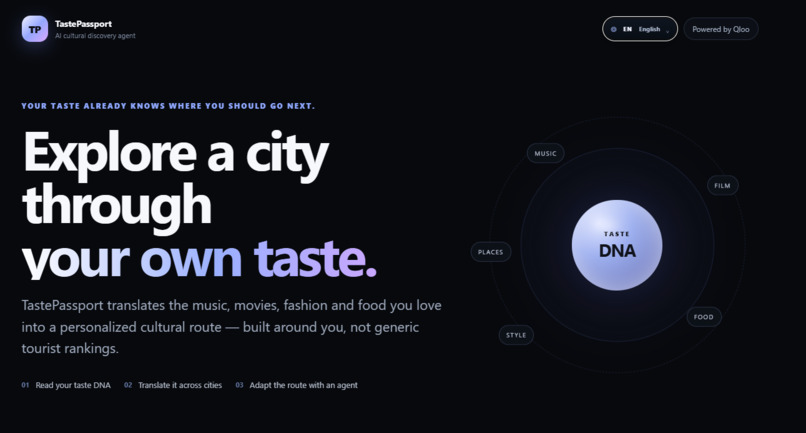
TastePassport AI — translate your cultural identity into another city through your own taste.
-
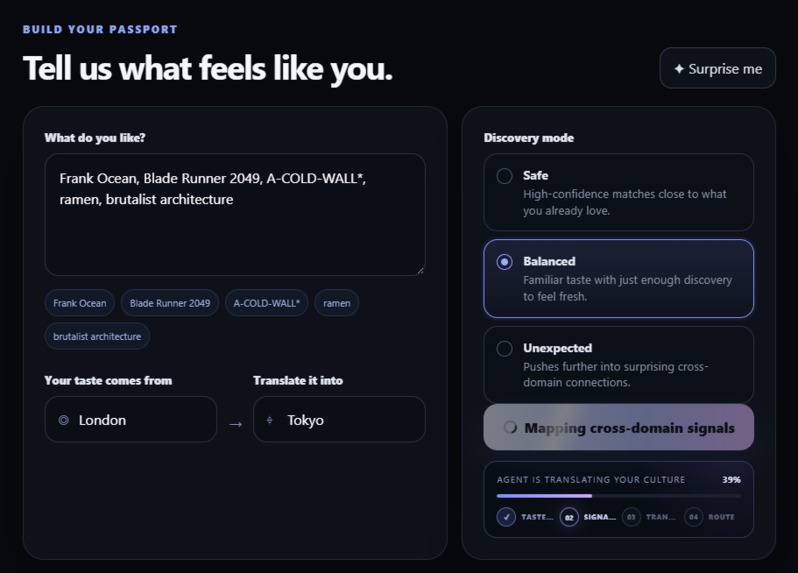
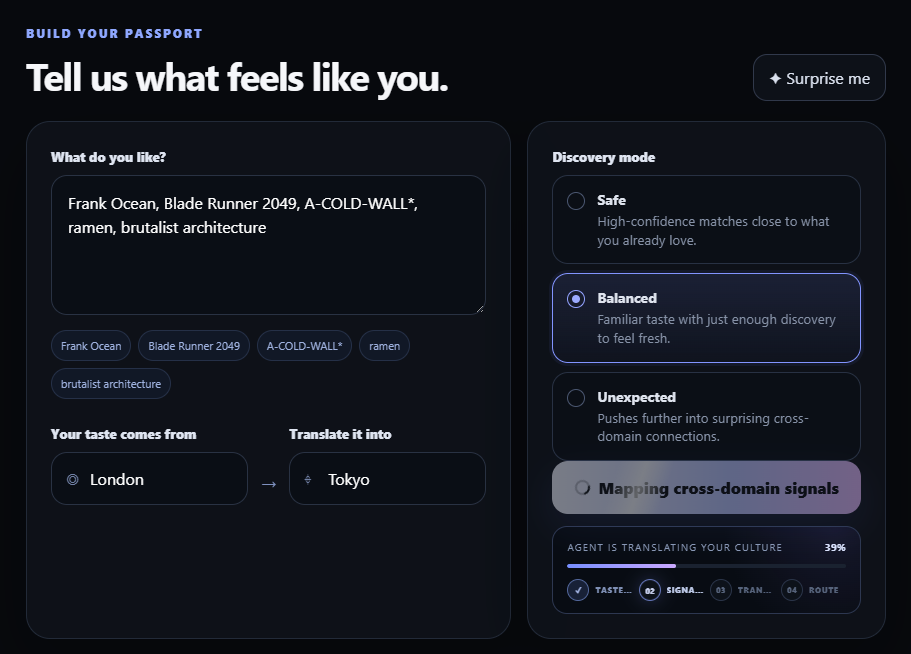
Build your TastePassport with interests, origin, destination and discovery mode while the agent maps your cultural signals.
-
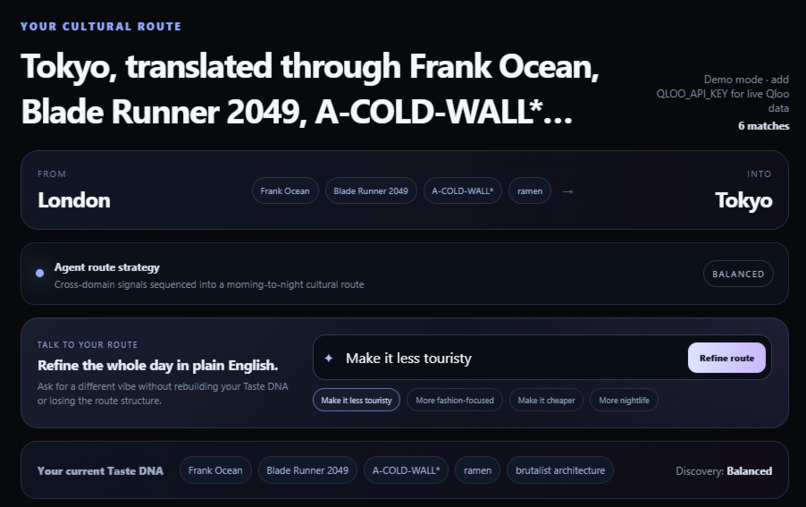
Agentic route refinement — reshape the whole cultural route in natural language while preserving your Taste DNA.
-
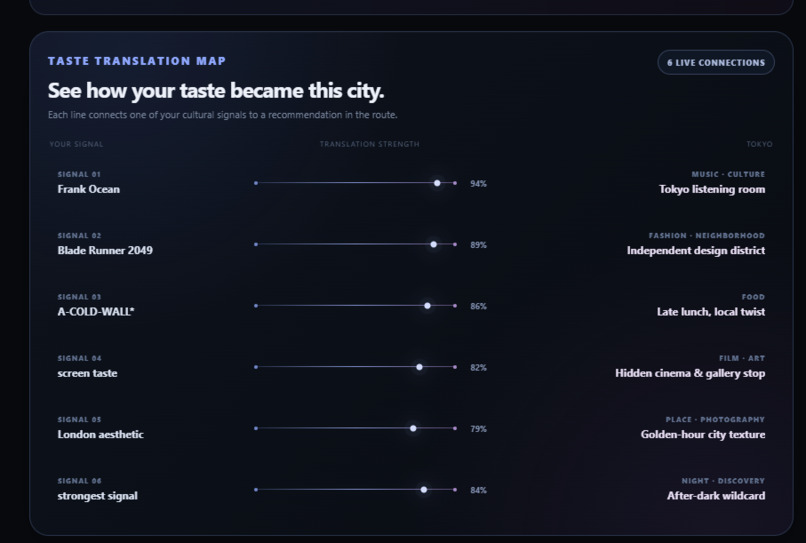
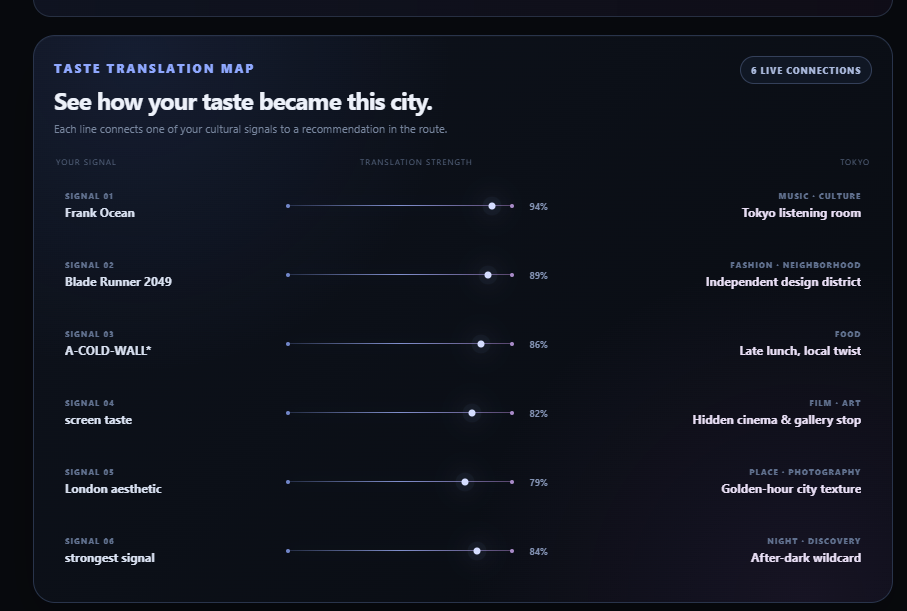
Taste Translation Map — see how individual taste signals connect to recommendations across the city.
-
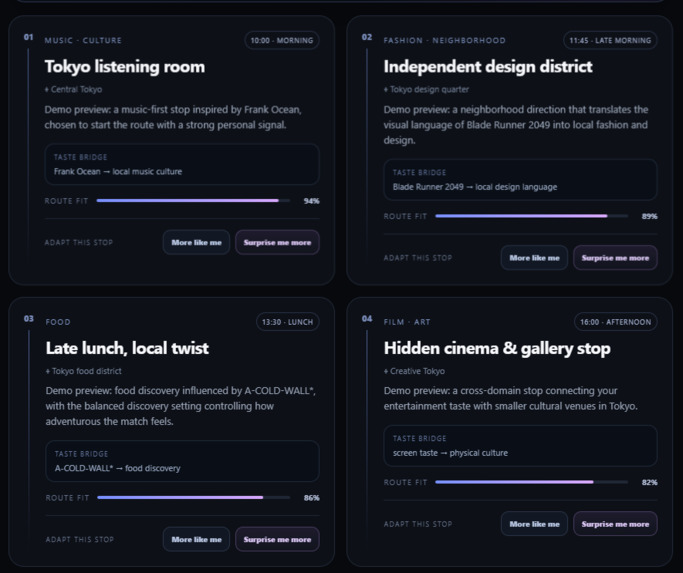
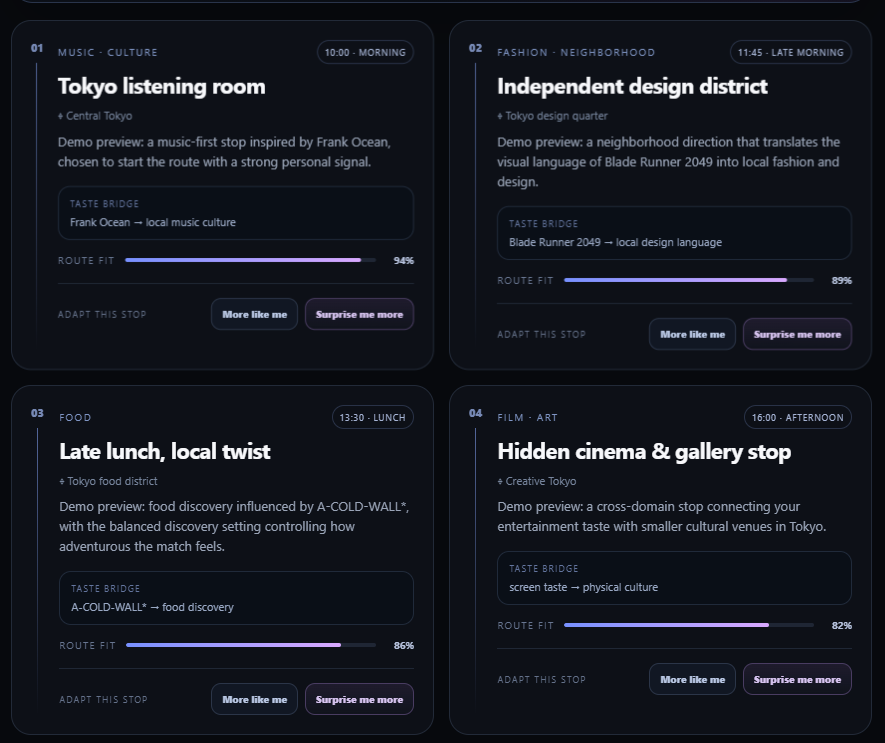
Personalized morning-to-night route with Taste Bridges, Route Fit scores and stop-by-stop agentic adaptation.
-
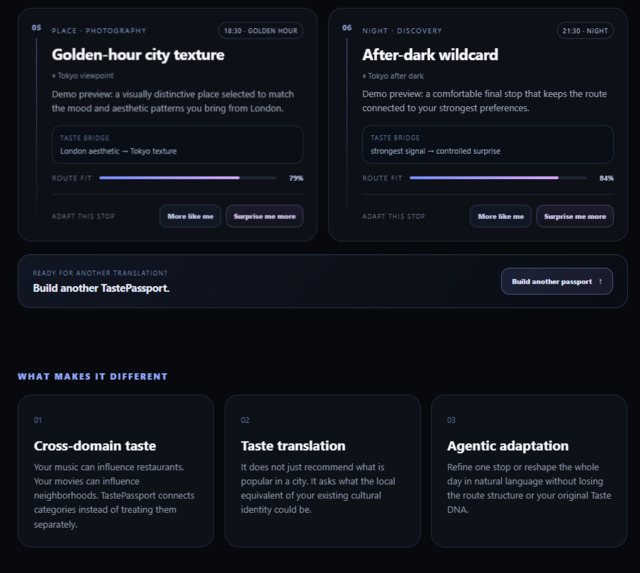
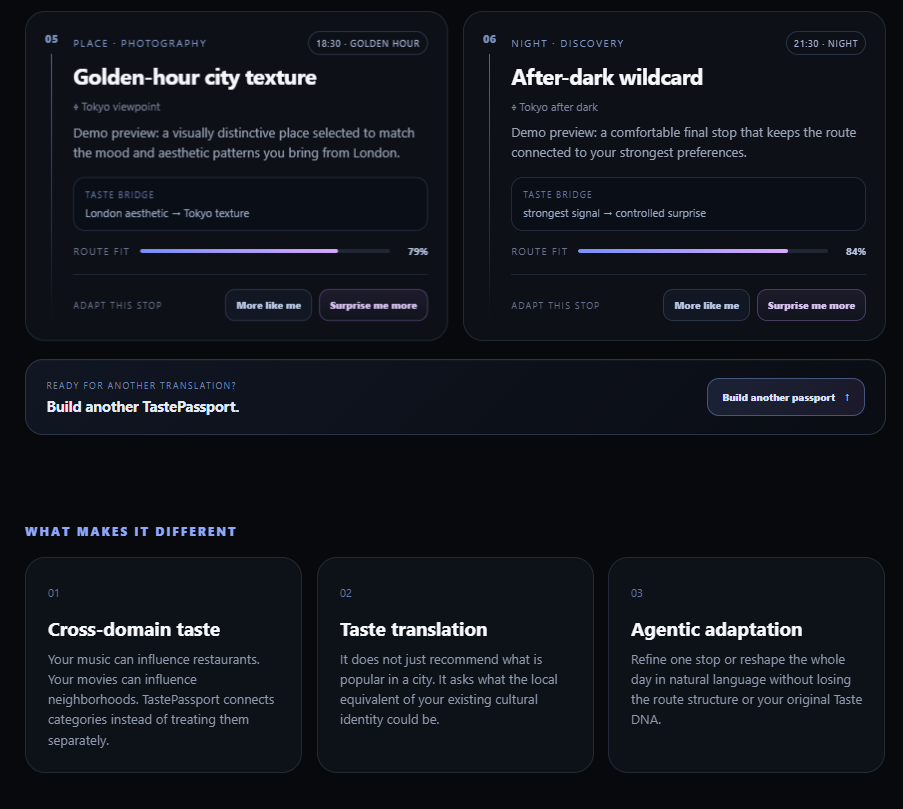
A complete cultural route with six personalized stops and the option to instantly build another TastePassport.
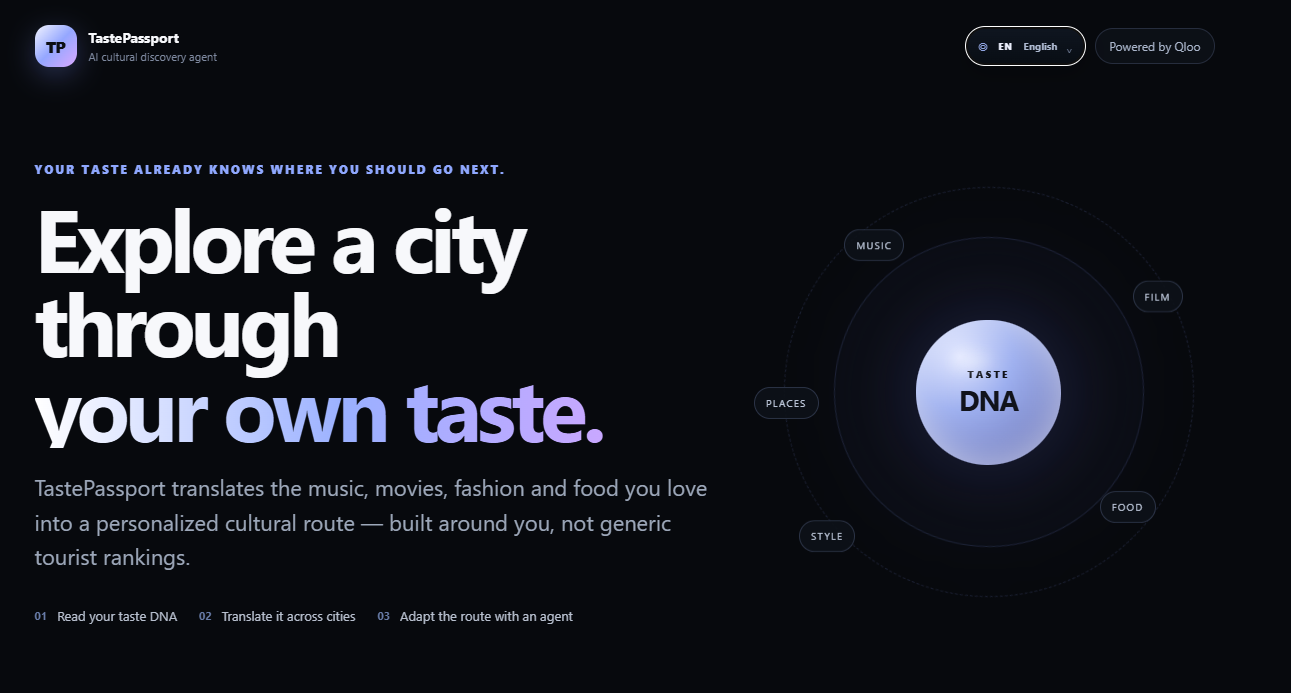
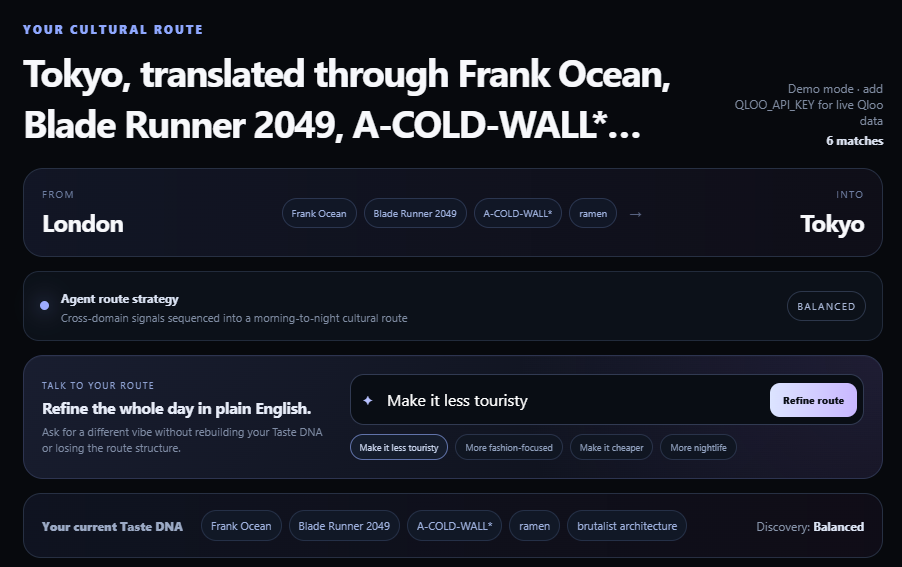
Inspiration Travel recommendations are usually built around popularity: top restaurants, top attractions, top neighborhoods. But people do not experience cities as generic tourists. They already have a cultural identity shaped by music, films, fashion, food and places they love. We wanted to build an agent that could answer a different question: If this is my taste at home, what does that taste look like somewhere else?
That became TastePassport AI. What it does TastePassport AI is a cultural taste translator between cities. A user enters a few signals from their personal Taste DNA, for example:
- Travis Scott
- Interstellar
- Stone Island
- Japanese food They also choose:
- where their taste comes from
- the destination city
- a discovery mode: Safe, Balanced or Unexpected TastePassport then builds a personalized morning-to-night cultural route. Every stop includes a category, time of day, explanation, Taste Bridge and Route Fit score. The experience does not stop after generation. Users can adapt a single stop with:
- More like me
- Surprise me more Only that stop changes, while the rest of the route stays intact. Users can also talk to the whole route in plain English with instructions such as:
- “Make it less touristy”
- “More fashion-focused”
- “Make it cheaper”
- “More nightlife” The agent then reshapes the whole day while preserving the route structure and the user’s original Taste DNA. We also added a Taste Translation Map, which visually connects the user’s interests to the generated recommendations and shows how strongly each taste signal influenced the route. How we built it TastePassport AI is built with Next.js, React and TypeScript and deployed on Vercel. The backend is structured around the Qloo Insights API for cross-domain cultural discovery. The main recommendation endpoint receives the user’s Taste DNA, origin city, destination city and discovery mode, then transforms recommendation data into a sequenced cultural route. A separate endpoint handles single-stop adaptation, while another endpoint handles full-route natural-language refinement. This gives the product two levels of agentic control:
- targeted changes to one stop
- high-level changes to the entire route The interface also includes a cinematic multi-step generation sequence that shows the agent reading Taste DNA, mapping signals, translating culture and building the final route. The hero section includes an interactive Taste DNA sphere that reacts to the user’s cursor, while scroll-based animations make the experience feel more dynamic without distracting from the product. The application also contains a clearly labelled Demo Mode so the product remains testable while live API access is unavailable. Once QLOO_API_KEY is configured, the backend is designed to switch to live Qloo-backed recommendations. Challenges we ran into The biggest challenge was avoiding another generic AI travel planner. Instead of asking “what should everyone visit in this city?”, we focused on a different concept: What is the local cultural equivalent of my existing identity?
That led us to the idea of taste translation. Another challenge was making the product feel truly agentic. Regenerating the entire itinerary every time a user dislikes one recommendation feels destructive and loses context. We solved this by letting users replace one specific stop while preserving the rest of the route. We also wanted users to understand why recommendations were made, not just receive a list. That led to Taste Bridges, Route Fit scores and the Taste Translation Map. Accomplishments that we're proud of
- Built and deployed a complete interactive web experience
- Created a distinct Taste DNA and taste translation concept
- Built a morning-to-night cultural route system
- Added explainable Taste Bridges for every stop
- Added Route Fit scoring
- Added Safe, Balanced and Unexpected discovery modes
- Added single-stop agentic adaptation
- Added natural-language full-route refinement
- Added a visual Taste Translation Map
- Added cinematic multi-stage route generation
- Added a cursor-reactive Taste DNA visualization
- Added responsive mobile polish
- Kept the project publicly accessible and open source What we learned Recommendation quality is only one part of a good discovery product. Users also need to understand why something was recommended and need a way to control how close or surprising recommendations should be. We learned that context preservation is especially important for agentic products. If a user dislikes one stop, the agent should not forget the entire plan and start over. We also learned that explainability makes cross-domain recommendations much more useful. Connecting music, fashion, films and food to real-world places becomes more meaningful when users can see the bridge between them. What's next for TastePassport AI
- Validate and improve the live Qloo integration once API access is available
- Use real Qloo relationship signals inside the Taste Translation Map
- Add real images for interests and recommended places
- Add smarter geographic route ordering
- Add a visual city map with route stops
- Add saved Taste DNA profiles
- Add shareable TastePassport routes
- Add deeper Qloo-powered explainability
- Expand cultural categories and cross-domain relationships
Built With
- api
- css
- next.js
- node.js
- qloo
- react
- rest
- restapi
- typescript
- vercel

Log in or sign up for Devpost to join the conversation.