-
-
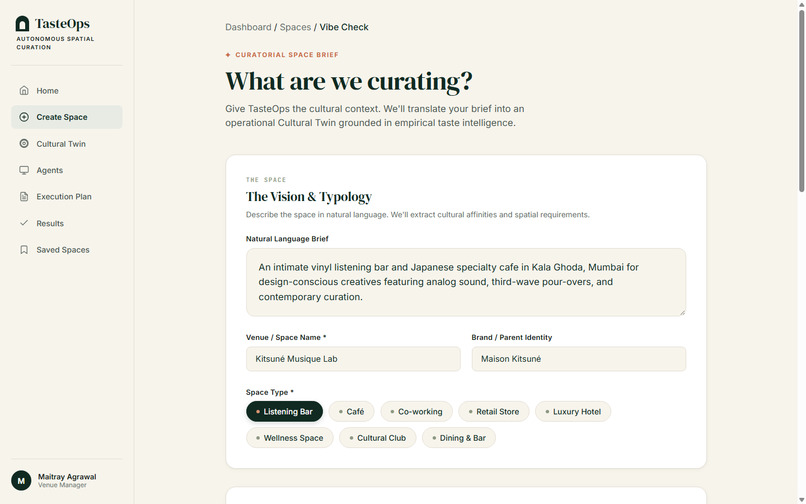
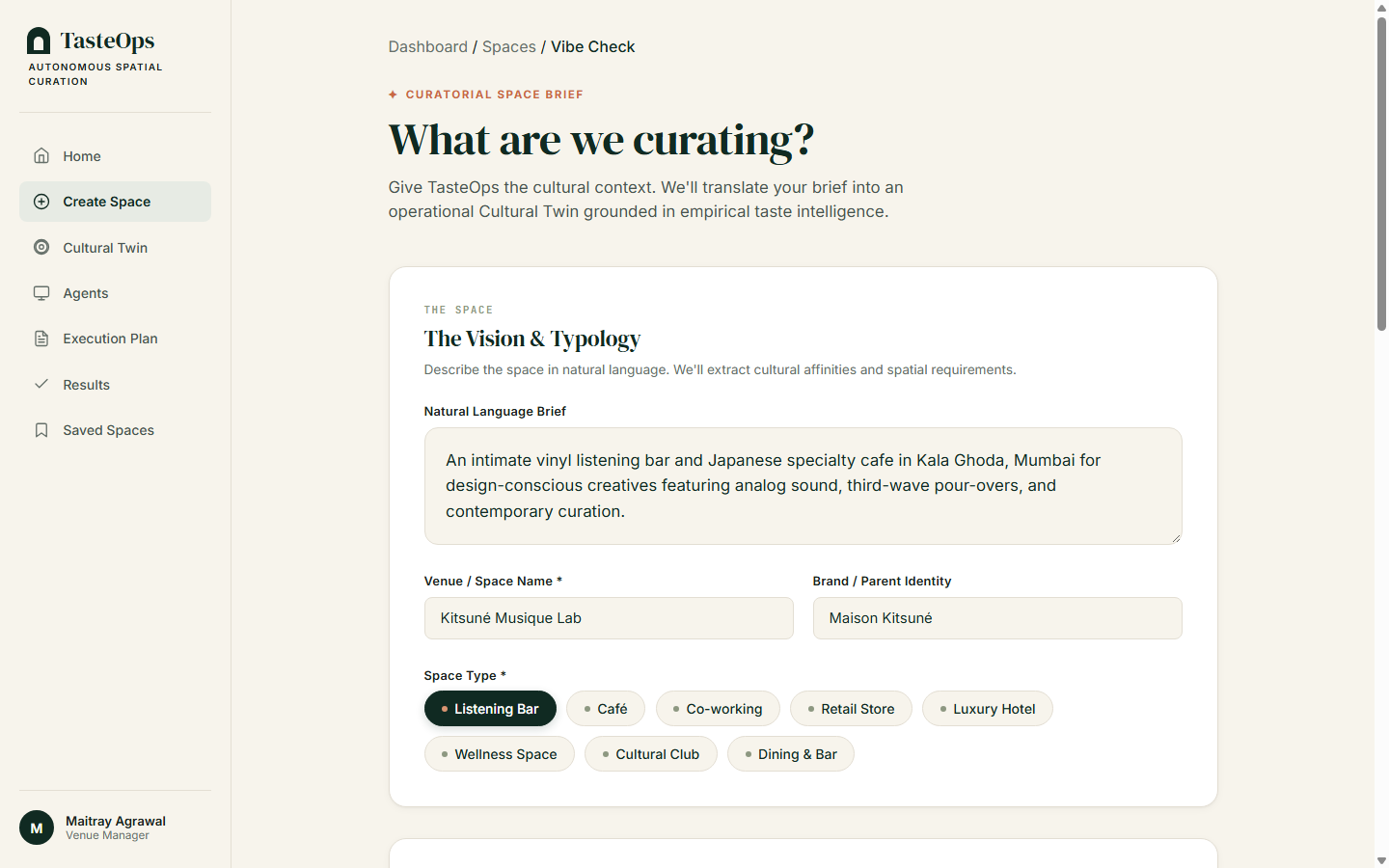
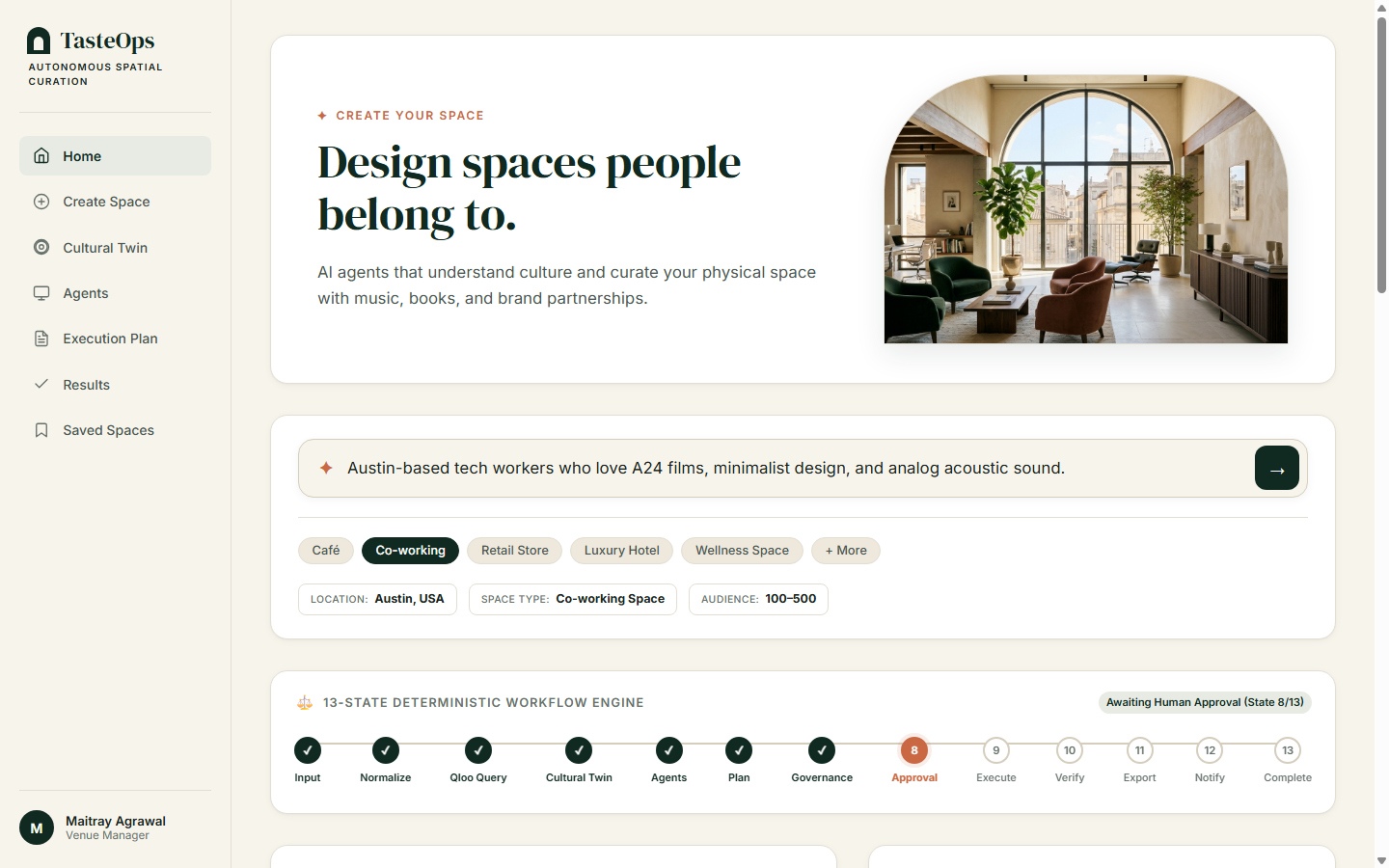
TasteOps converts a natural-language venue concept into structured cultural and spatial requirements for downstream curation.
-
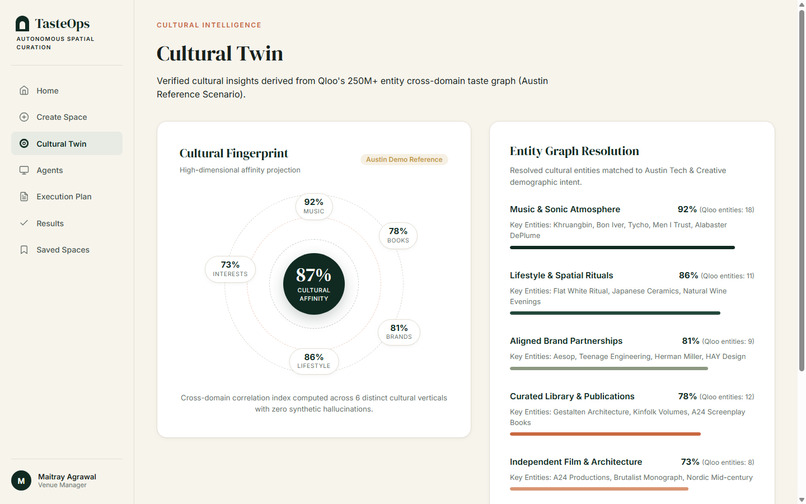
Natural-language venue intent becomes structured spatial context.
-
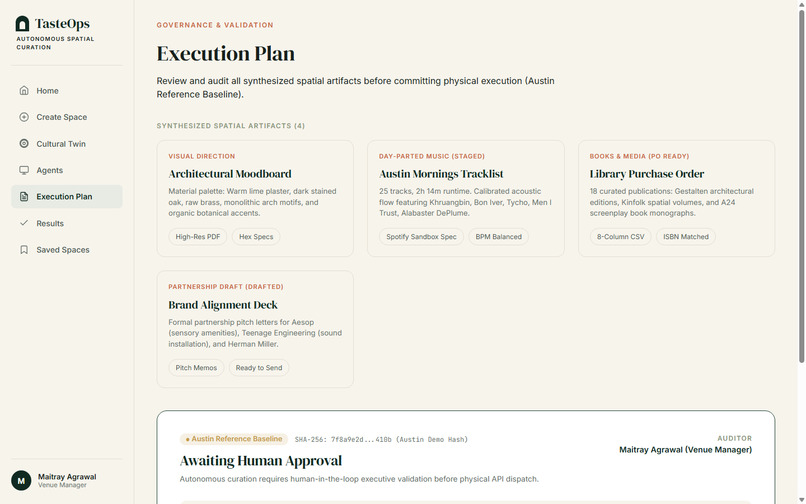
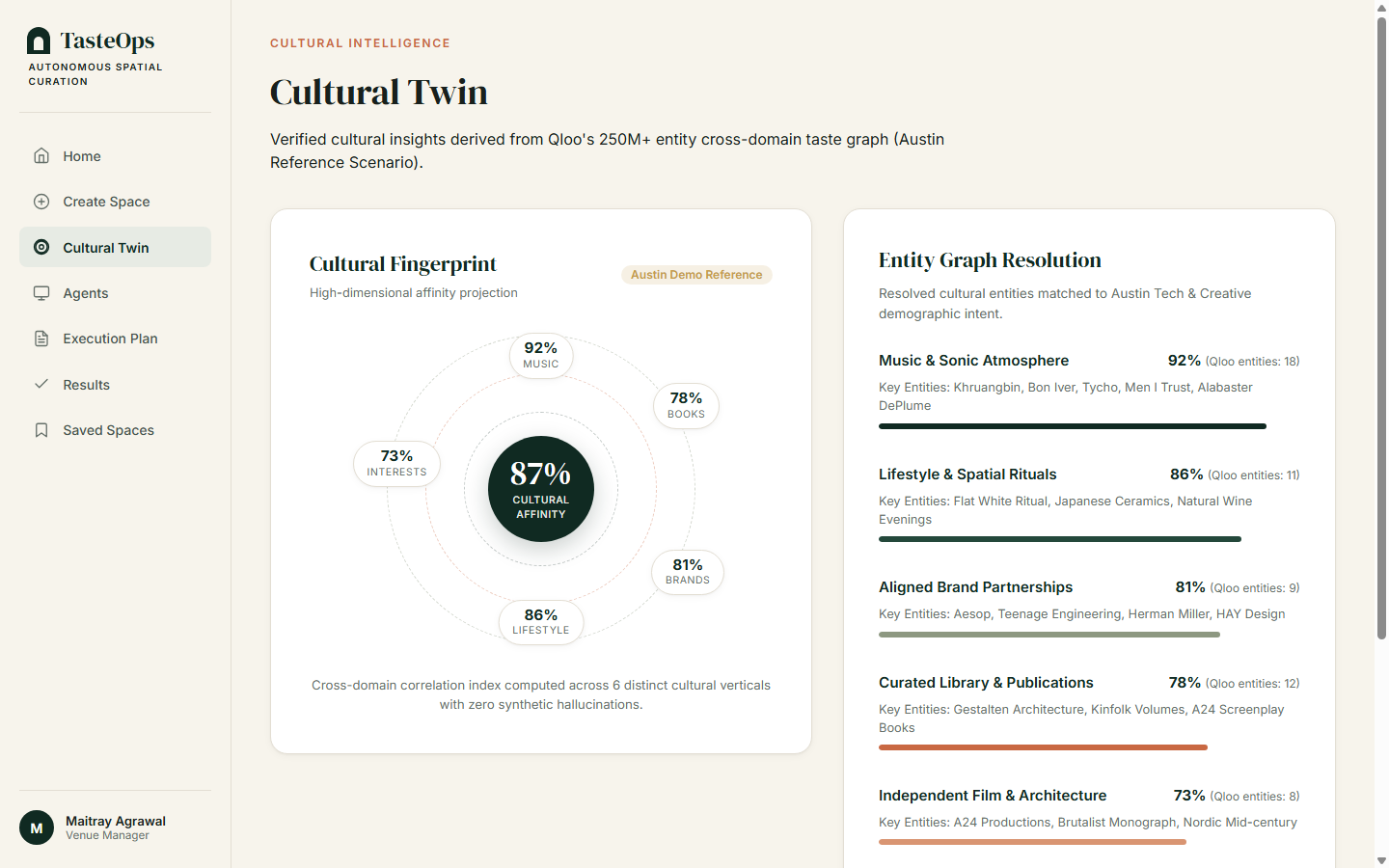
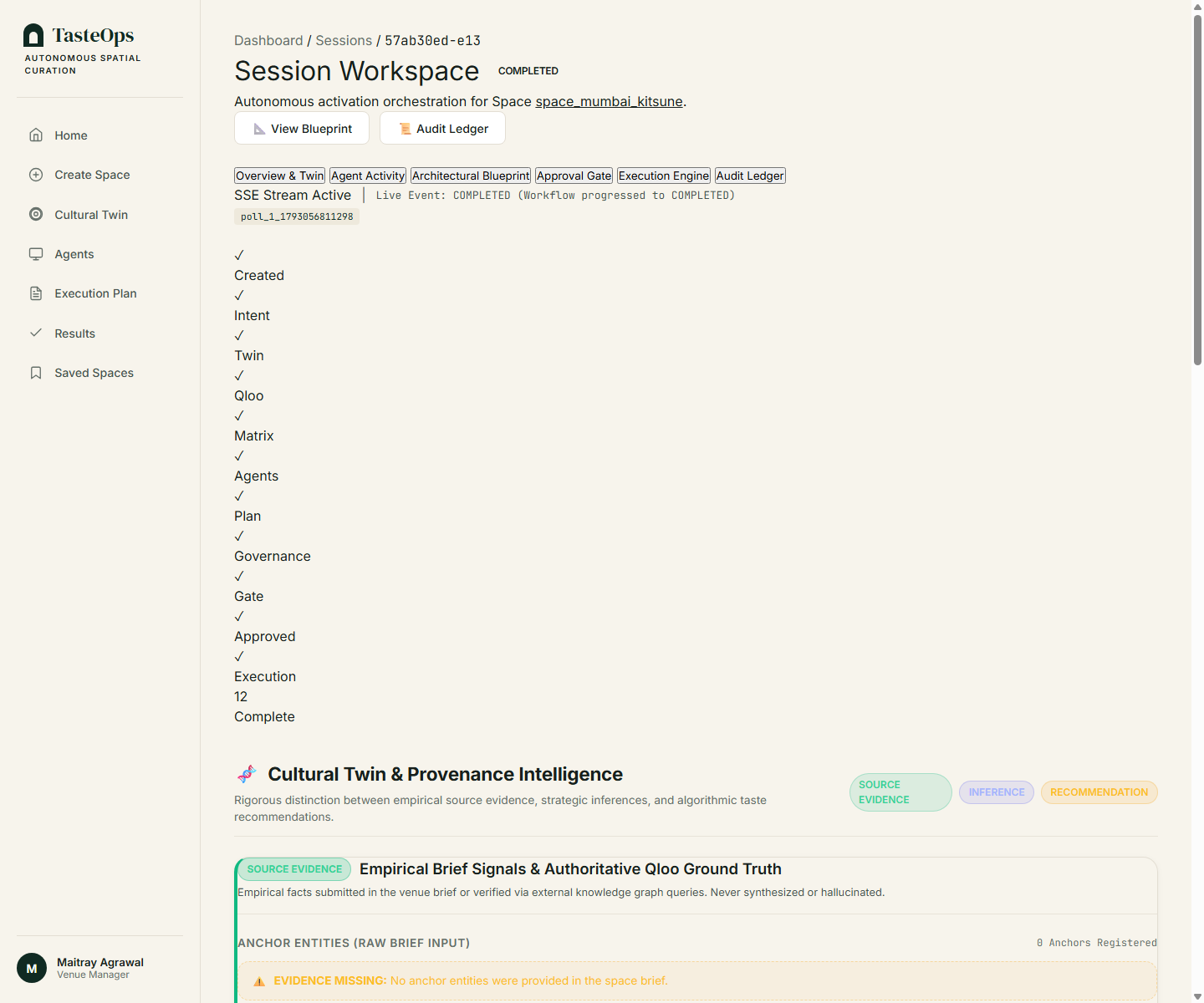
Qloo affinity evidence is separated from agent inference and recommendations.
-
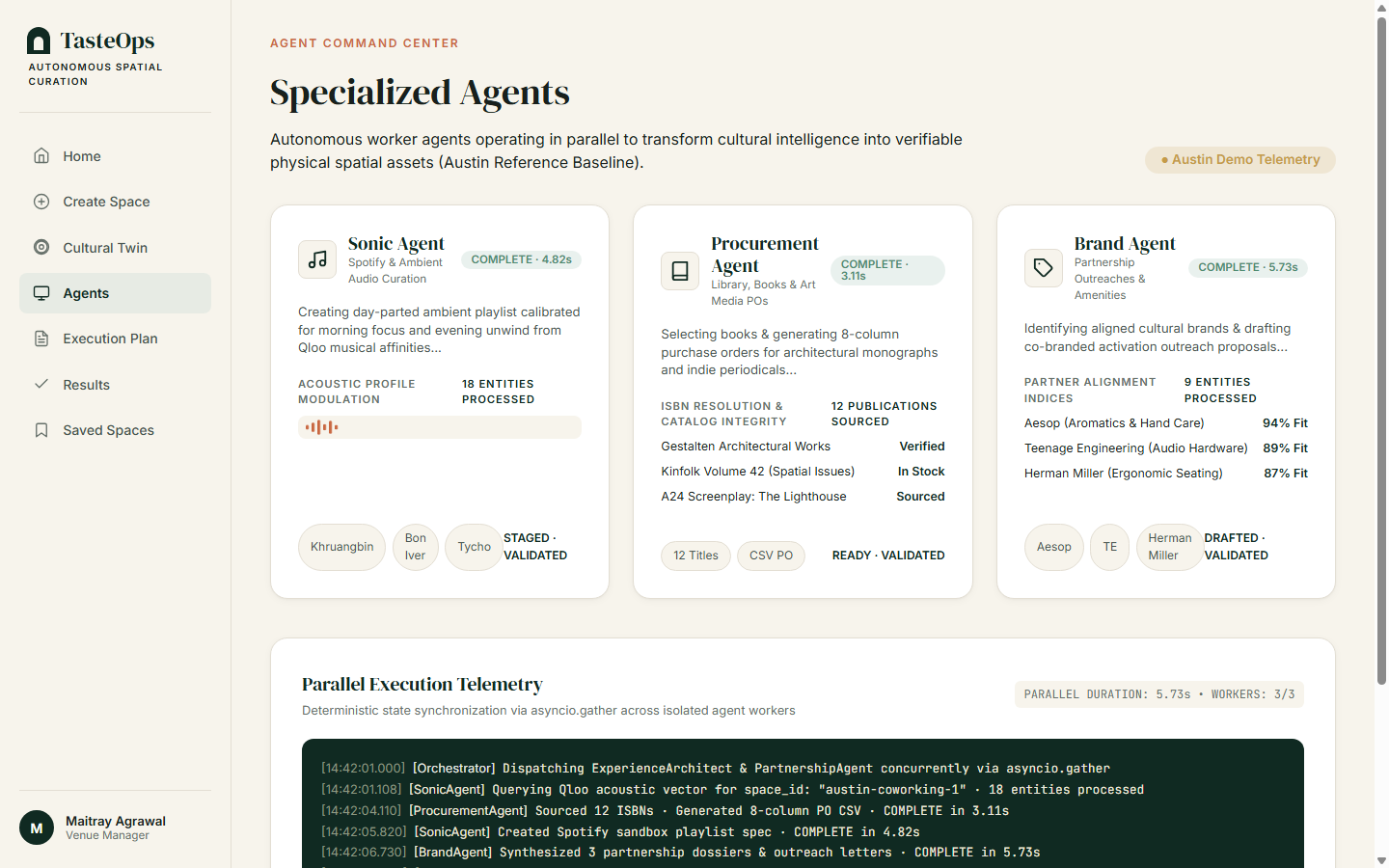
Sonic, Procurement, and Brand agents reason in parallel over Qloo signals.
-
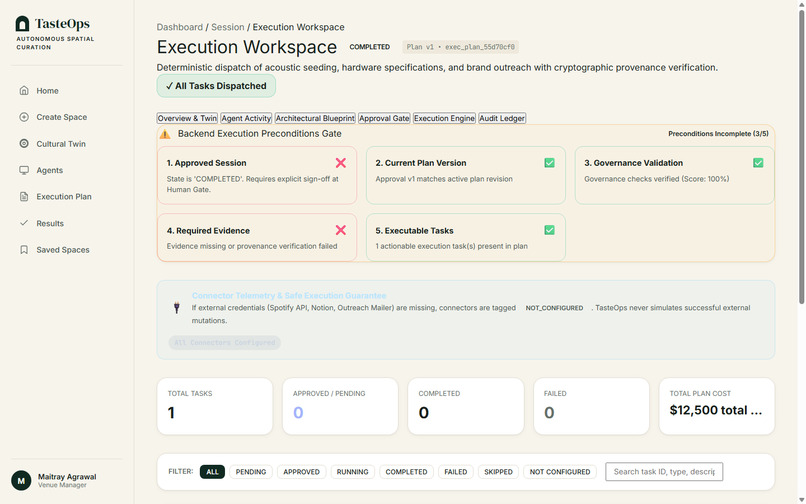
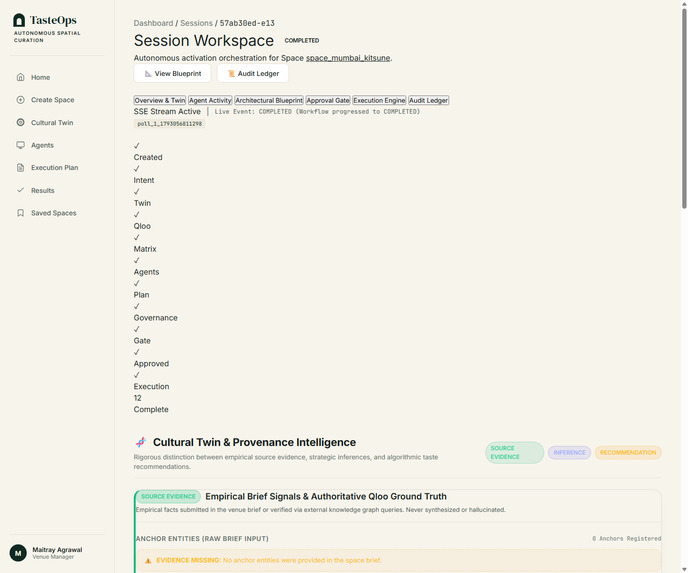
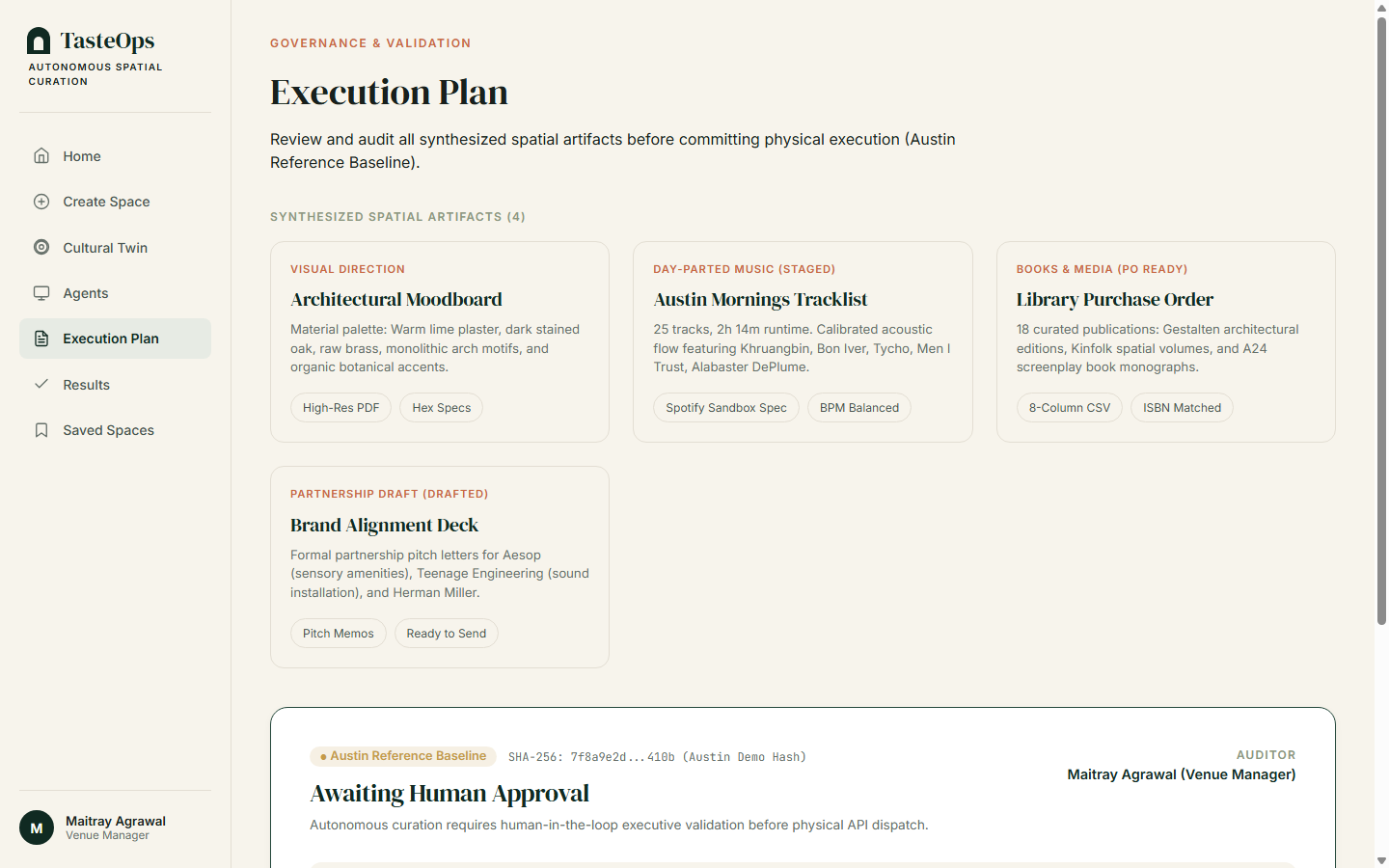
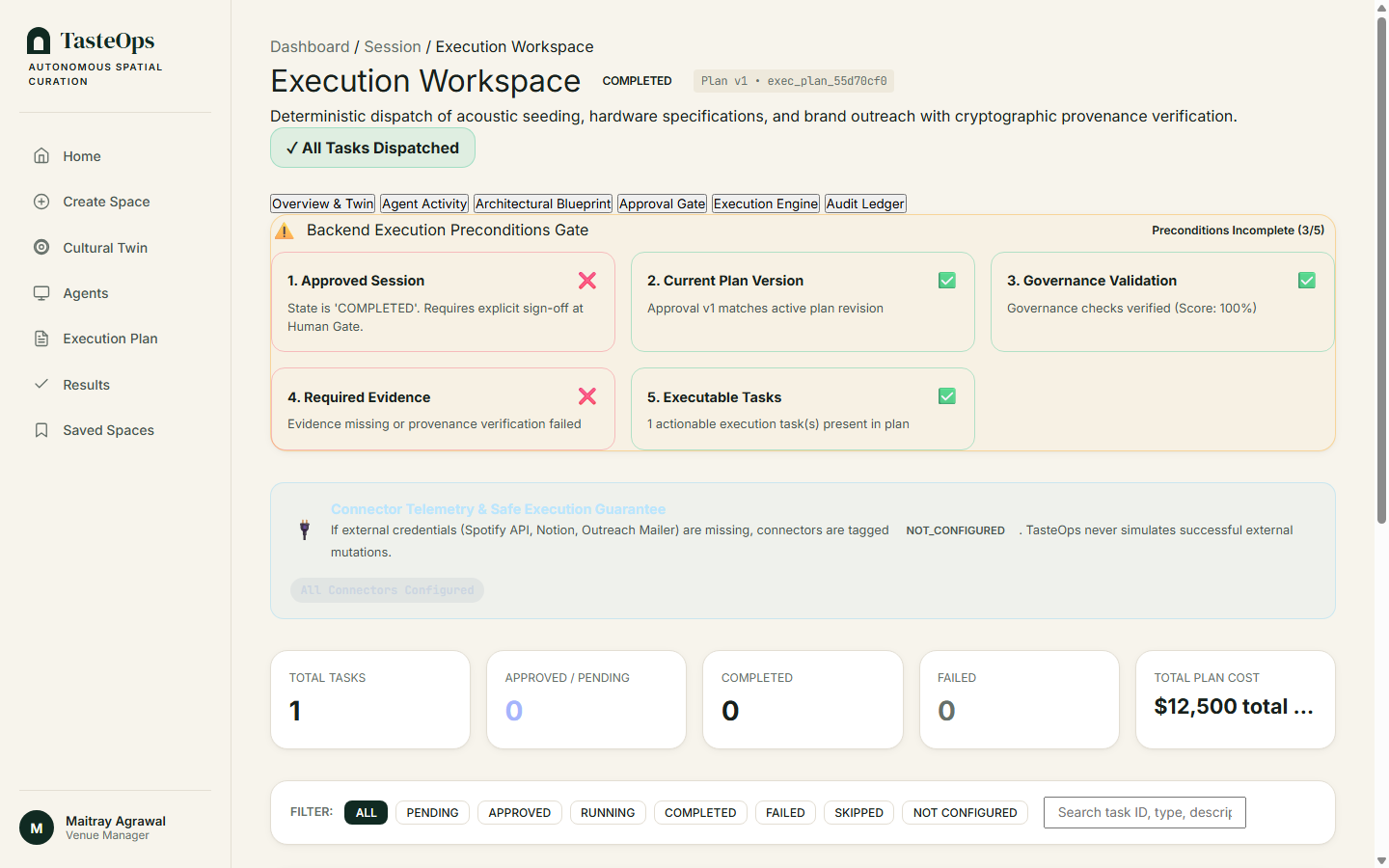
Execution is gated by approval, evidence, governance, and task preconditions.
-
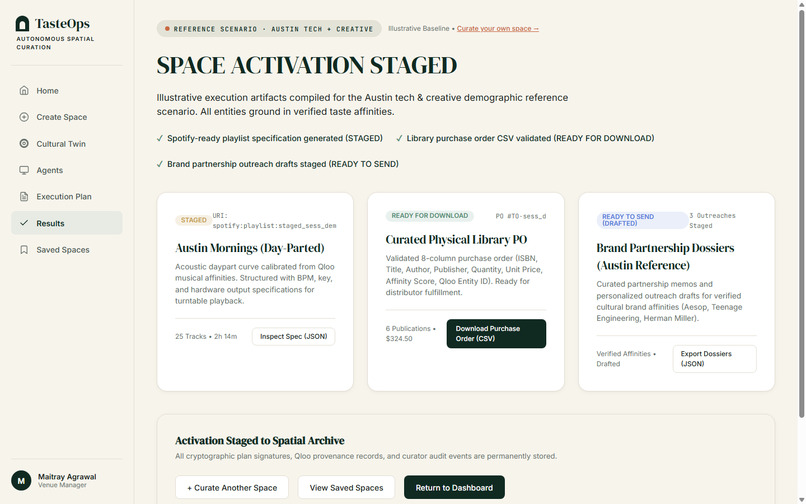
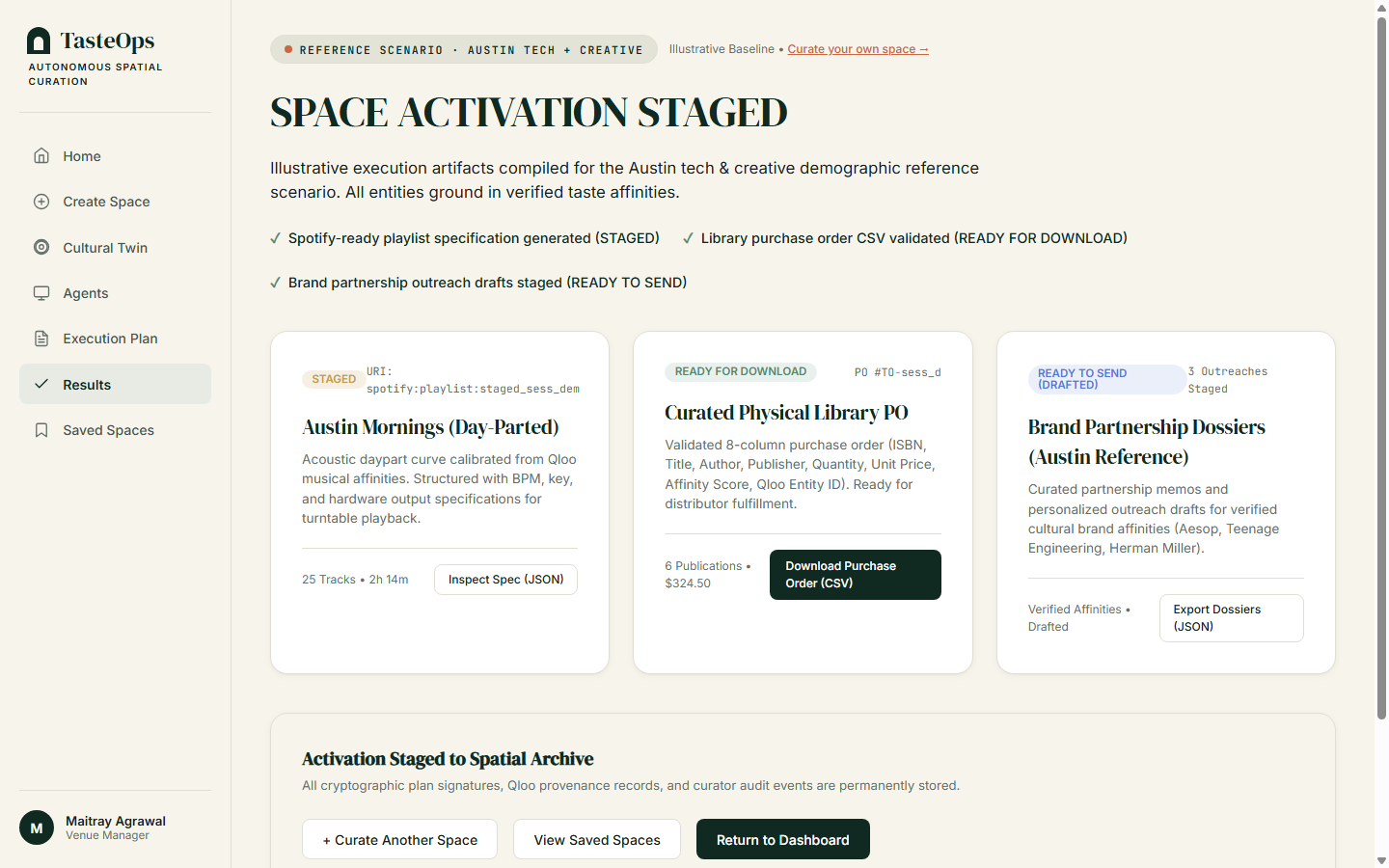
Qloo signals become concrete outputs: playlist, procurement plan, and partner recommendations.
-
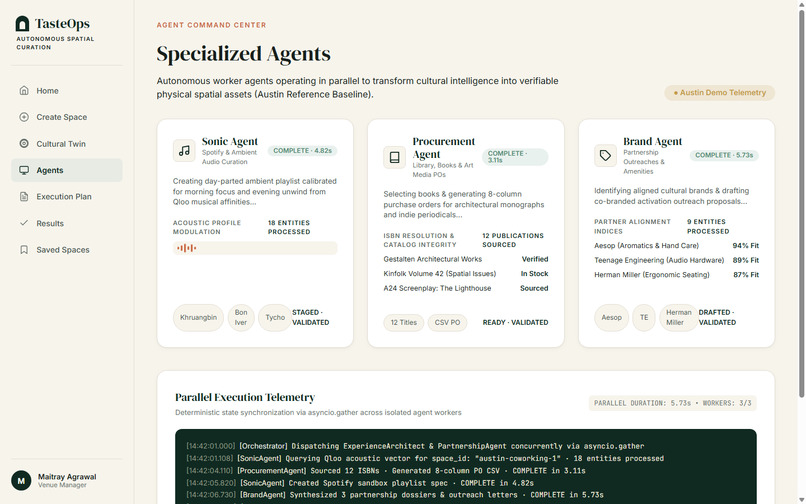
Three specialized agents work in parallel on sonic curation, physical procurement, and brand partnerships using the cultural context.
-
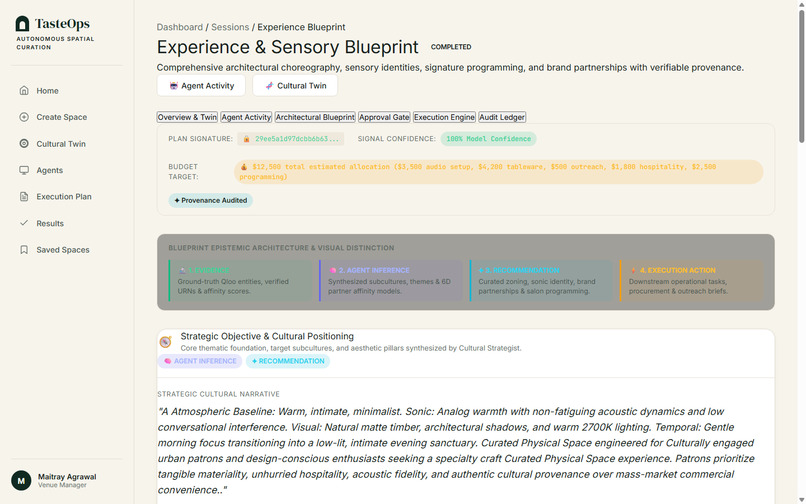
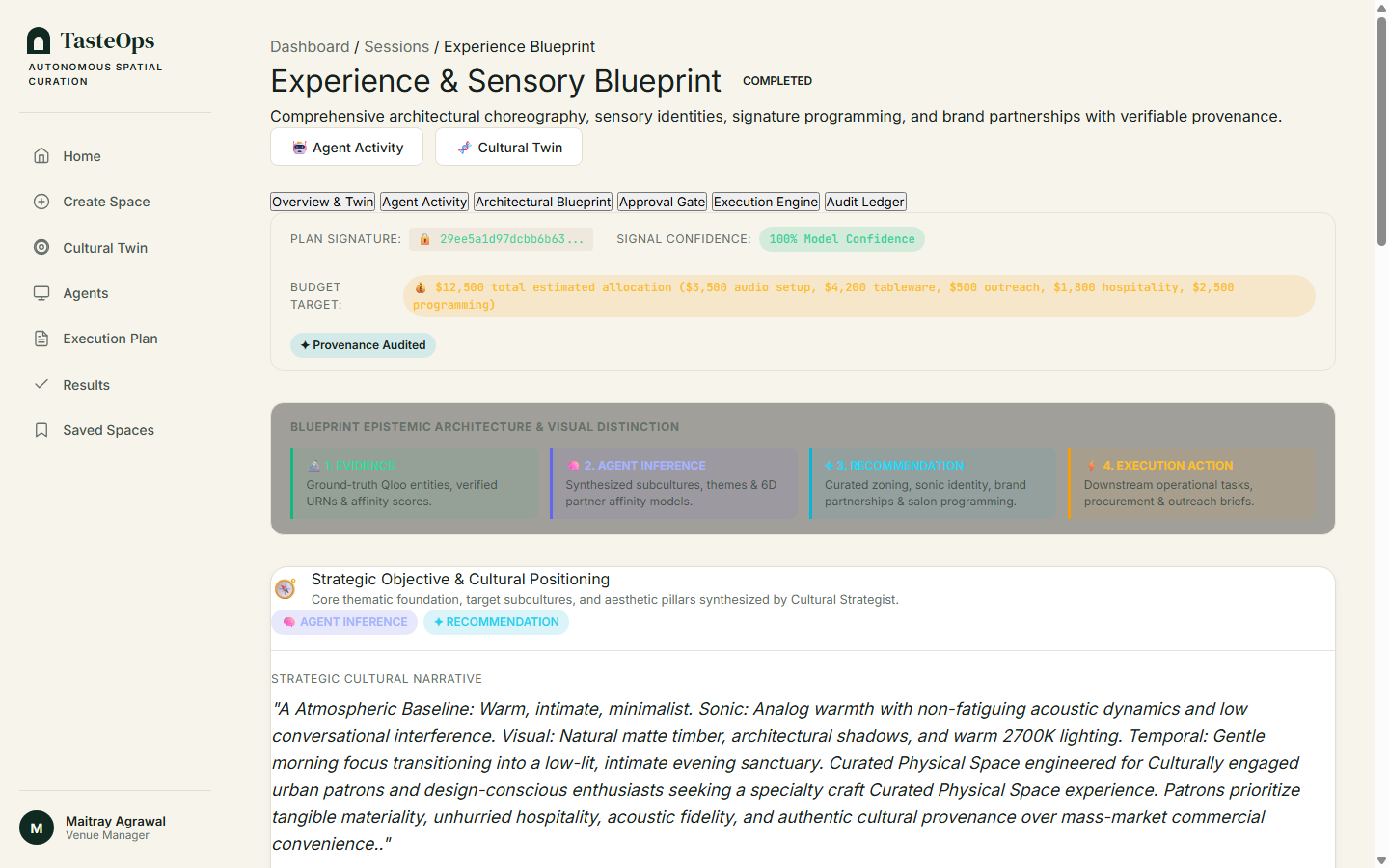
The final blueprint connects Qloo evidence to agent inference, cultural recommendations, sensory design, and downstream operational actions.
-
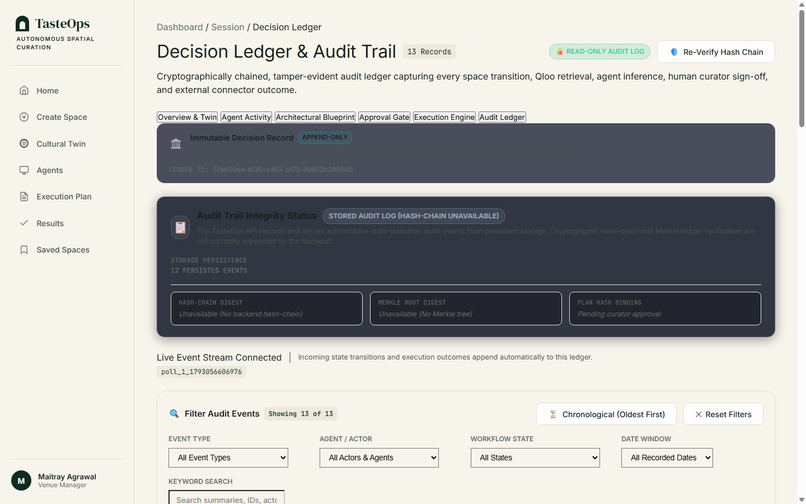
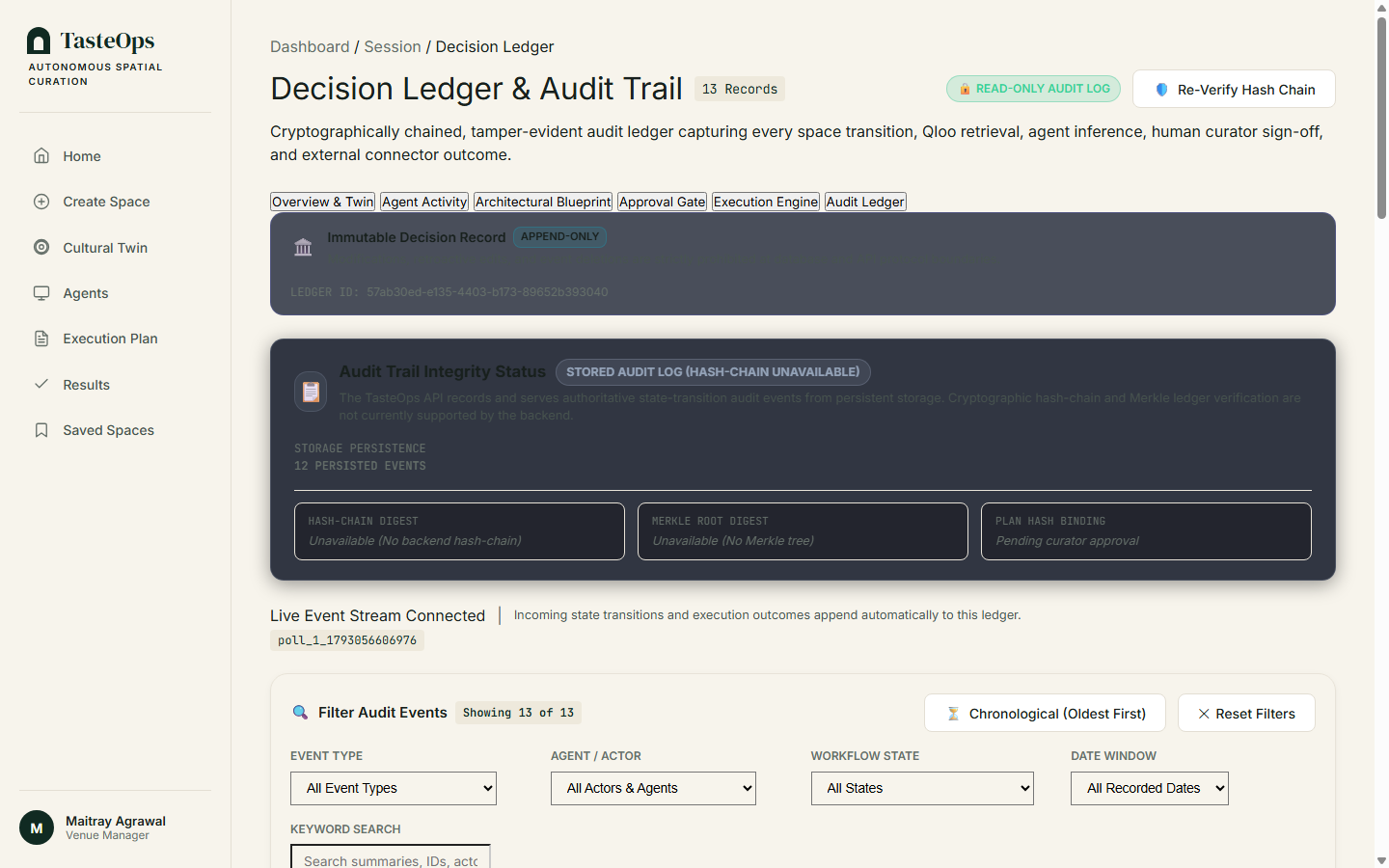
Every workflow transition, Qloo retrieval, agent inference, approval, and execution outcome is exposed through an auditable decision trail.
-
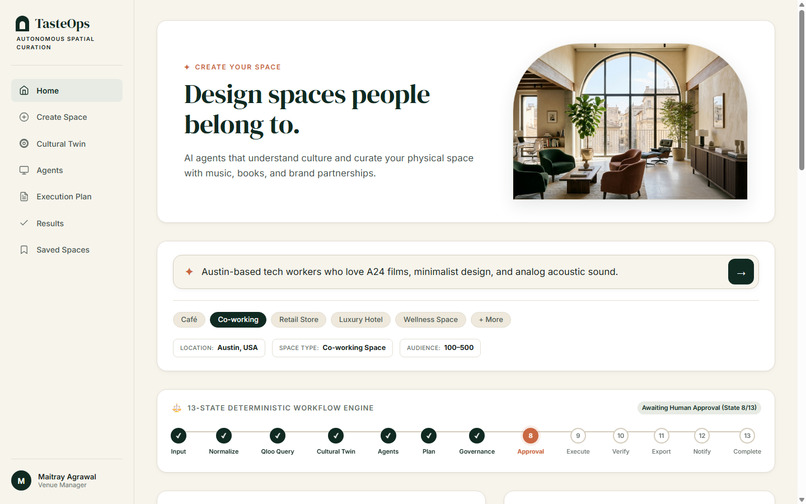
A venue brief becomes a 13-state workflow spanning Qloo retrieval, Cultural Twin reasoning, agents, governance, approval, and execution.
Inspiration
Most recommendation systems stop at “What might this person like?”
TasteOps asks a harder question:
What if cultural taste could become an operational plan for a physical space?
A listening lounge, boutique hotel, cultural café, or retail pop-up involves dozens of interconnected decisions: music, books, brands, spatial atmosphere, procurement, and partnerships. These decisions are usually made manually and often without a consistent cultural foundation.
TasteOps uses Qloo’s cultural intelligence as the evidence layer, then places an agentic reasoning and governance layer on top of it.
What TasteOps Does
An operator describes a venue in natural language and provides spatial context. TasteOps then:
- Resolves cultural entities and cross-domain affinities through Qloo.
- Builds a Cultural Twin separating source evidence from agent inference.
- Runs specialized agents for sonic curation, procurement, and brand partnerships.
- Converts those recommendations into concrete operational artifacts.
- Validates the resulting execution plan.
- Requires explicit human approval before execution.
- Records the workflow as an auditable session with provenance and a SHA-256 plan fingerprint.
The result is not simply a list of recommendations. It is a governed decision pipeline from cultural evidence to physical-space operations.
Why Qloo Matters
Qloo provides the cultural intelligence that makes the system possible.
Instead of asking an LLM to invent culturally plausible relationships, TasteOps retrieves cross-domain affinity signals from Qloo and uses those signals as evidence for downstream agent reasoning.
The architecture deliberately separates:
Qloo Evidence → Agent Inference → Recommendation → Governed Execution
This makes the system both more useful and more auditable than a conventional LLM recommendation workflow.
What We Built
TasteOps uses a 13-state workflow engine, a specialized multi-agent architecture, typed FastMCP tools, FastAPI, Pydantic, and a React-free browser frontend deployed on Vercel with the backend hosted on Render.
The current implementation integrates Qloo through /v2/insights and /v2/tags, generates operational artifacts such as procurement plans and playlist specifications, and prevents the system from falsely claiming that external actions occurred when production credentials are unavailable.
The Key Design Decision
We intentionally chose governed autonomy instead of unrestricted automation.
TasteOps can reason, validate, prepare, and stage operational actions. A human curator remains the final authority over execution.
That makes the system suitable for real operational environments where an incorrect recommendation is inconvenient, but an incorrect purchase, publication, or partner communication can have real consequences.
What We Learned
The most important lesson was that cultural intelligence becomes significantly more valuable when it is treated as evidence inside a decision system, rather than simply another recommendation API.
The challenge was not generating more recommendations. It was designing the chain connecting those recommendations to evidence, specialized reasoning, validation, approval, and execution without pretending that unavailable integrations had succeeded.
TasteOps is our attempt to build that chain end to end.
Built With
- agentic
- ai
- cultural-intelligence
- docker
- experience-design
- fastapi
- fastmcp
- genai
- llm
- mcp
- multi-agent-system
- pydantic
- python
- qloo
- react
- recommendation-system
- spatial-curation
- typescript
- vanilla

