Inspiration
Independent hotels can't hire a brand consultancy, but every hotel still needs a whole-store concept — minibar, playlist, welcome ritual, retail, atmosphere. I wanted to see if a neighborhood's cultural taste, read live from the Qloo Taste Graph, could do that job in one search.
What it does
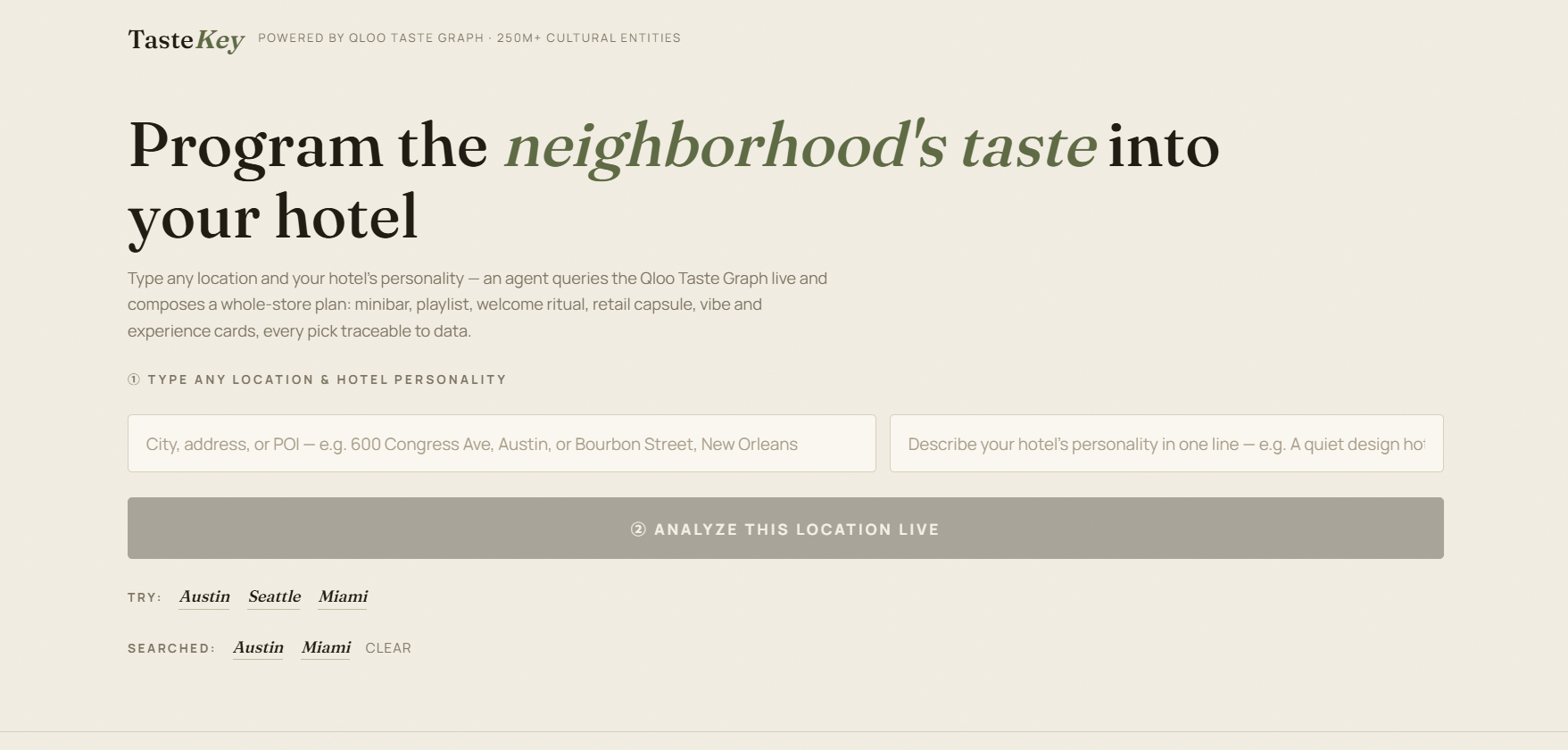
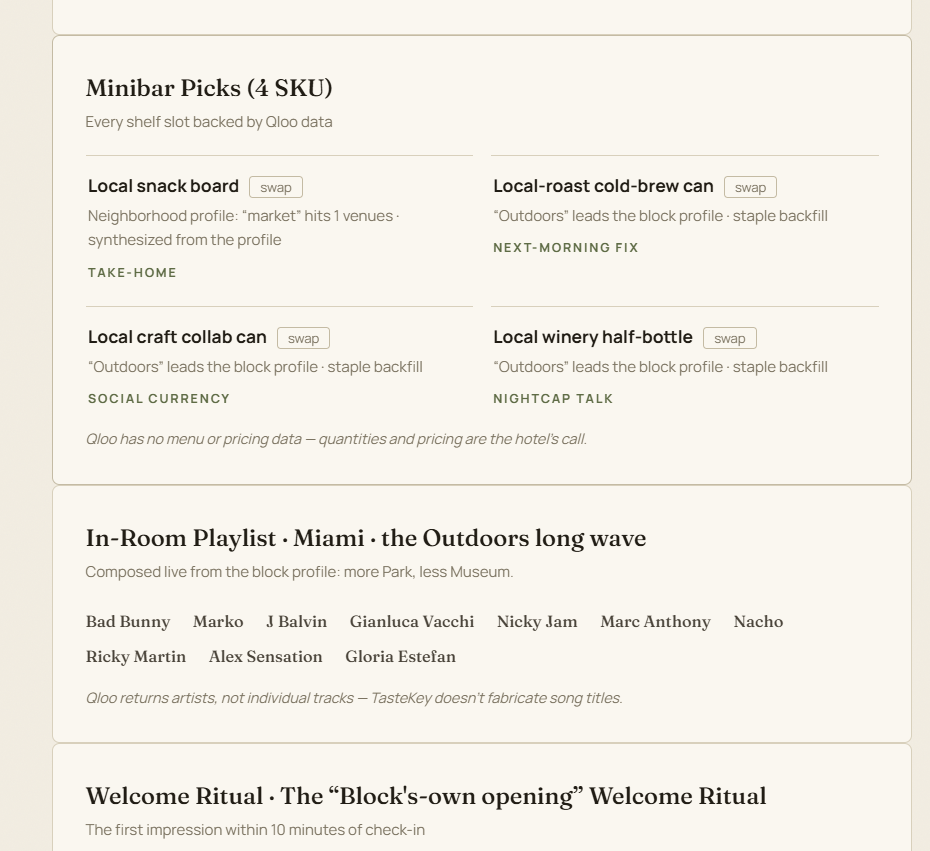
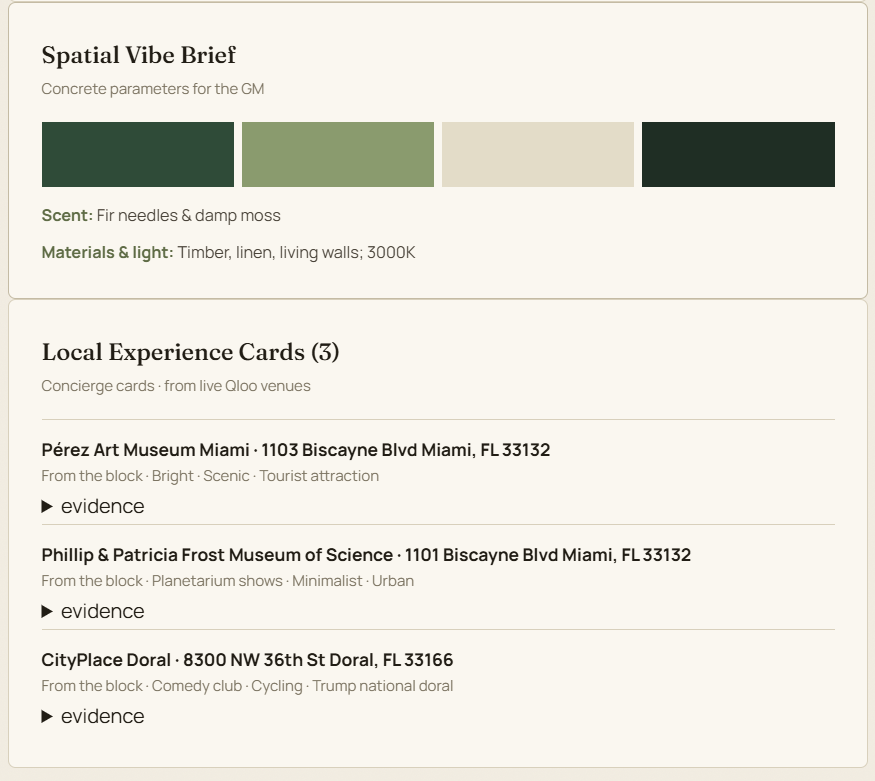
TasteKey is an agent that programs the Qloo Taste Graph into a hotel's whole-store experience plan. Give it any address and a hotel personality in plain words — "a quiet design hotel," "a moody cocktail bar hotel" — and it composes the minibar, in-room playlist, welcome ritual, retail capsule, spatial vibe brief, and local experience cards around the taste of that block.
Why Qloo — and only Qloo
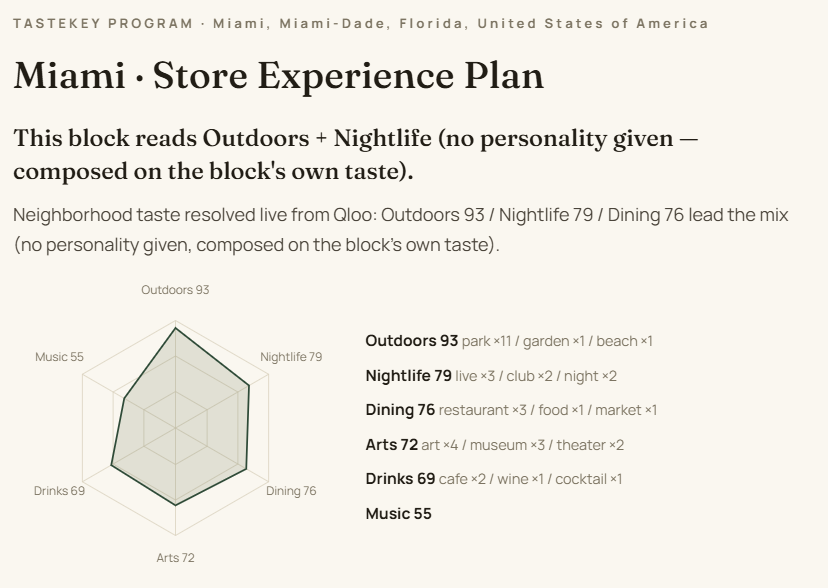
A maps API can list what's nearby, and a language model can invent a nice-sounding concept — but neither can do this job. Only a taste graph knows that a block over-indexes on, say, jazz, natural wine, and brutalist design at the same time, and that those three facts are one aesthetic, not three coincidences. That shared taste spine is what lets a single personality coherently drive all six slots — minibar, playlist, welcome ritual, retail, atmosphere, experiences. Take Qloo away and the concept collapses into either a generic nearby-list or an LLM hallucination: plausible, but with no real venues, no real brands, and no evidence behind any pick.
How I built it
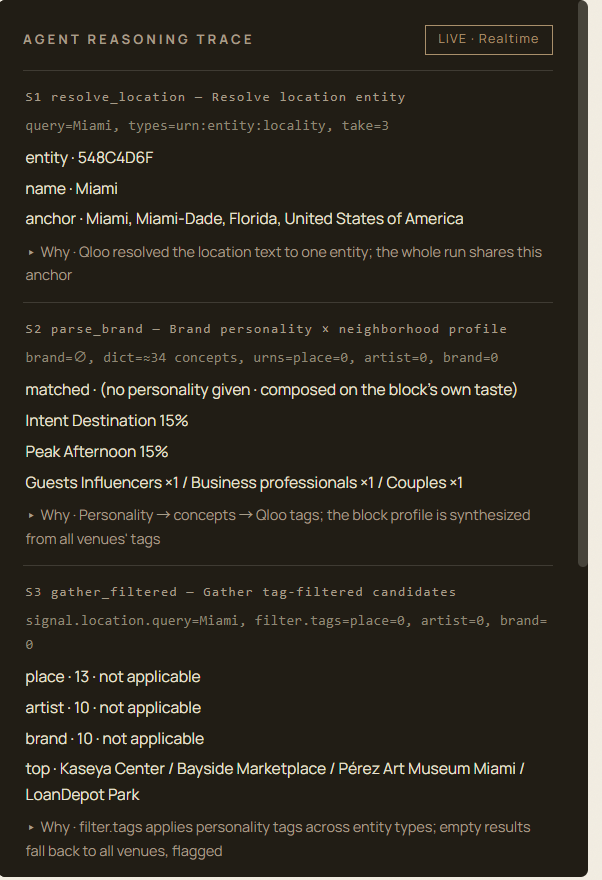
The frontend is a static page; the backend is a single serverless function on Vercel sharing one pipeline with the local dev server. A five-step agent trace runs every search — resolve location, parse personality, gather filtered places, score brand fit, compose plan — and each step shows its evidence. The interface is bilingual (English/Chinese).
Challenges I ran into
The hard rule was honesty: every pick must trace to real Qloo data. The plan never invents what Qloo doesn't return — no fabricated prices, no fabricated tracks — and empty results fall back openly instead of silently faking it. Deployment had its own trap: Vercel auto-detected the repo as a Node server project, so the working setup is Root Directory ./ with Framework Preset Other.
Accomplishments that I'm proud of
A complete, working product in two days: a live Qloo pipeline (not a mock), where every pick in all six slots traces to real entities and tag evidence — and the plan would rather show an honest fallback than a fabricated answer. Plus a bilingual interface and a fully open-source codebase.
What I learned
A tag graph can carry a whole brand concept: ~34 curated concept words map to hand-verified Qloo tag URNs, and any other adjective is looked up live against the tags API, so open-vocabulary personalities really participate in filtering and ranking instead of being decoration.
What's next for TasteKey
Next: more property types beyond independent hotels (B&Bs, hostels, small chains), deeper playlist data as Qloo's music coverage grows, and saved plans hotels can re-run each season instead of starting over.
Built With
- css
- html
- javascript
- node.js
- qloo
- vercel

Log in or sign up for Devpost to join the conversation.