-
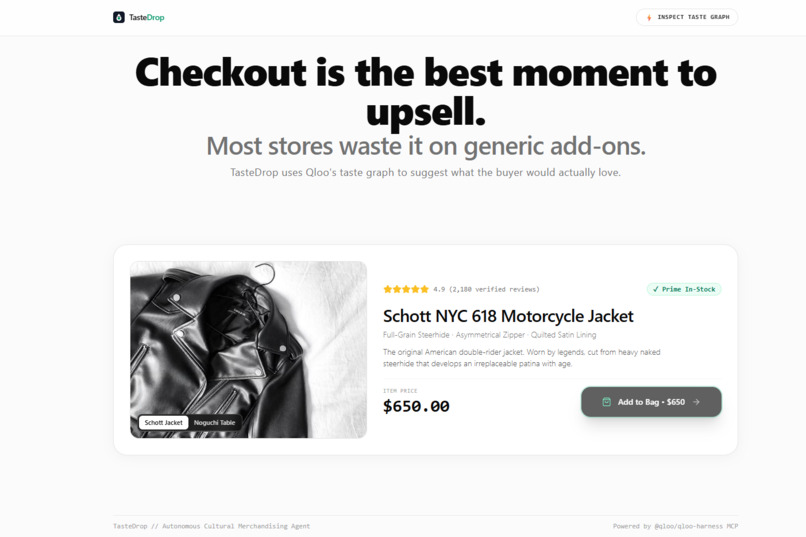
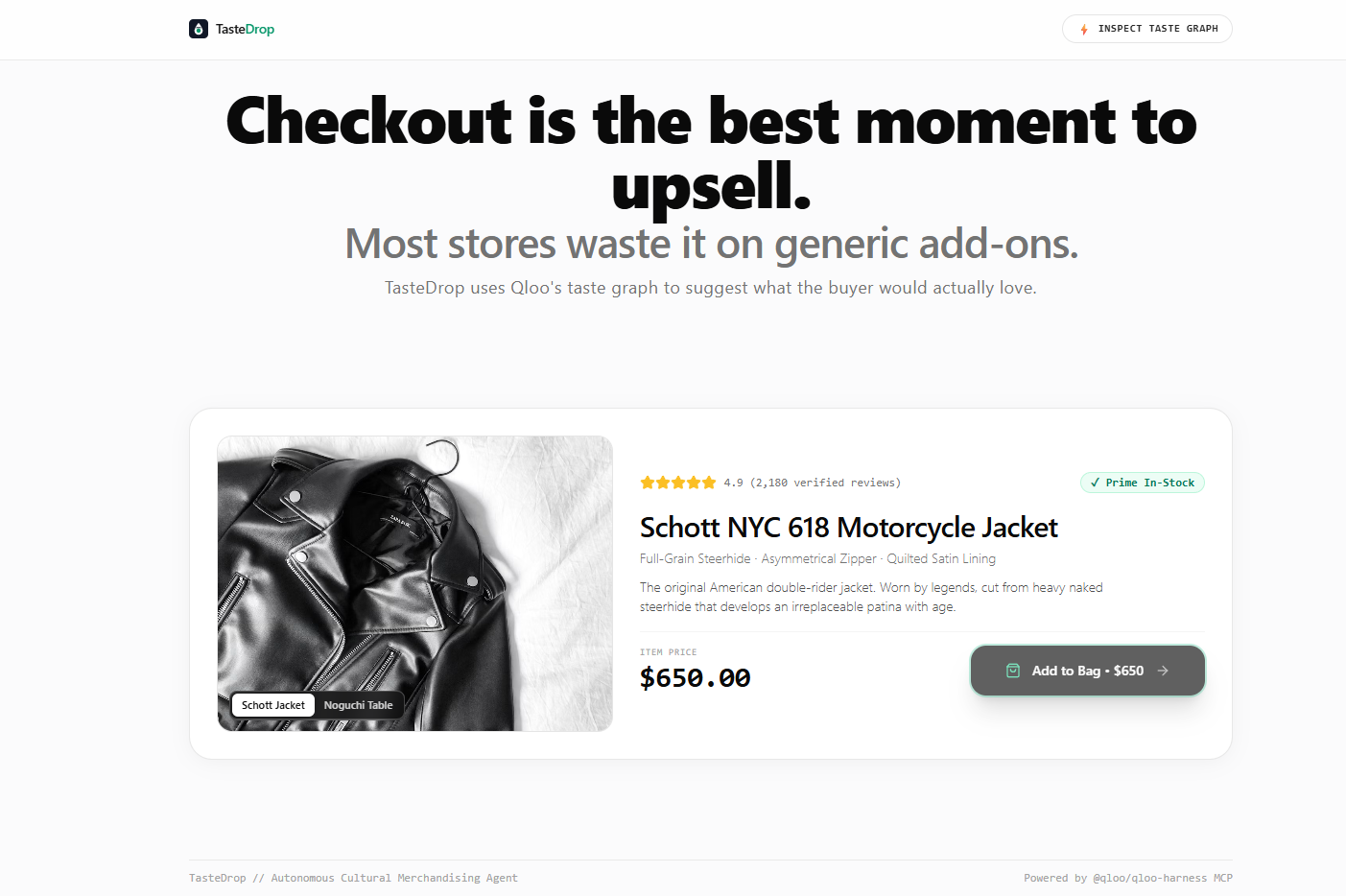
Traditional e-commerce add to cart simulation page
-
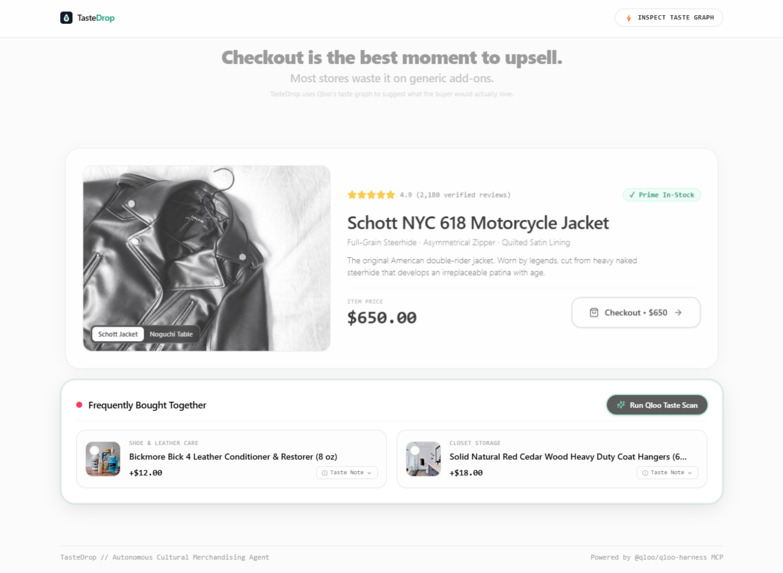
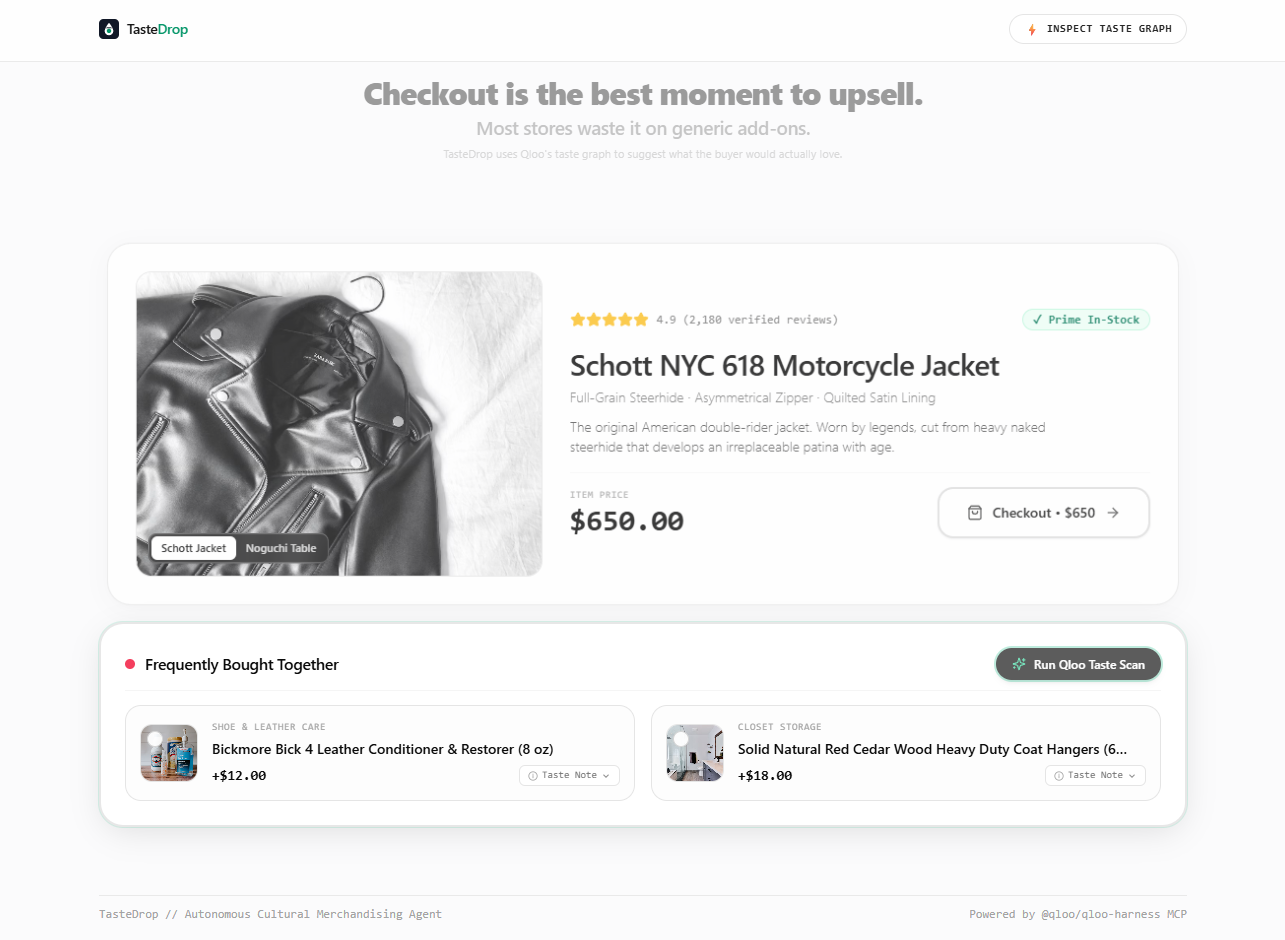
Traditional e-commerce recommends $12 leather cleaner with a $650 Schott jacket—commodity maintenance slop that degrades brand taste.
-
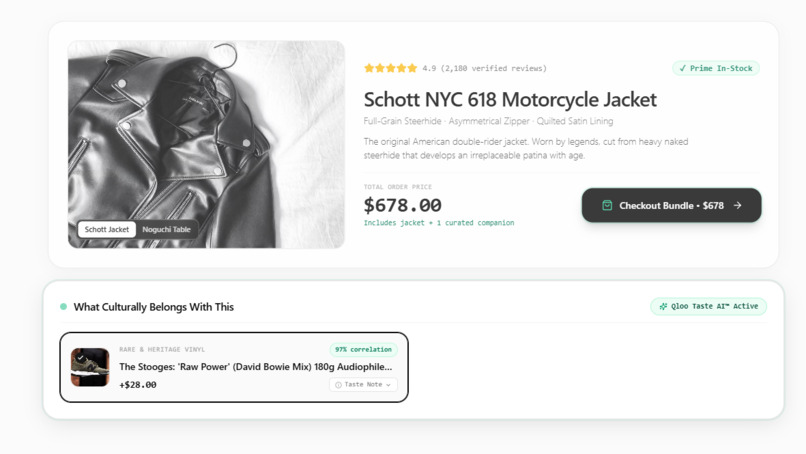
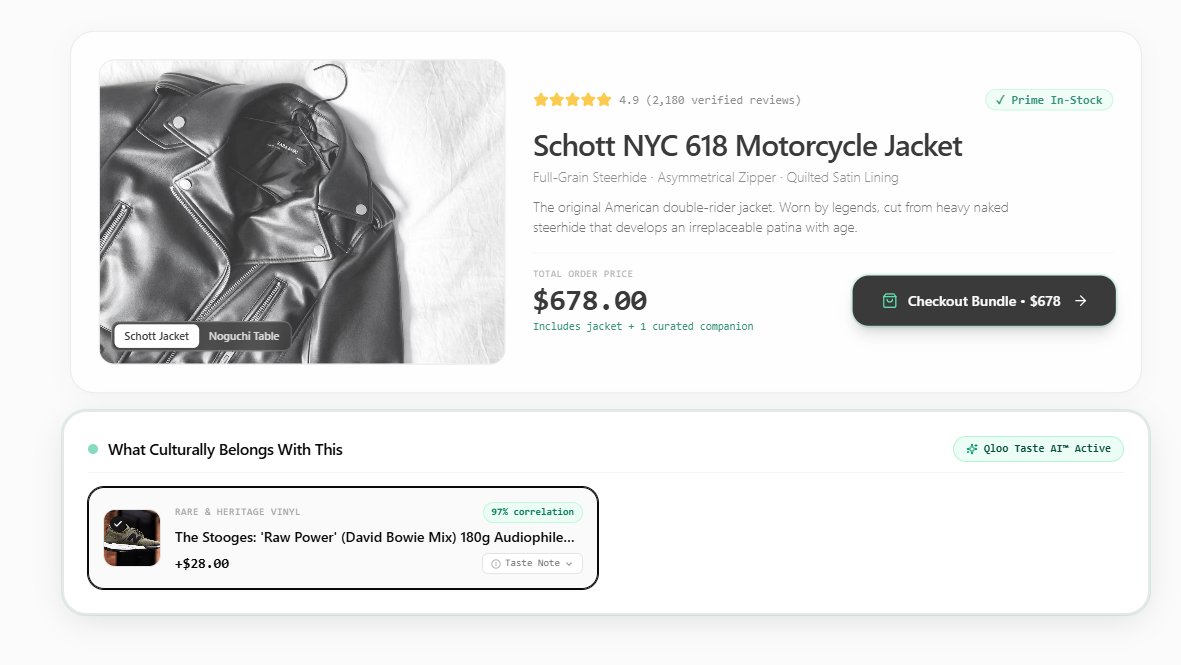
1-click Qloo Taste Scan evicts utility items, discovers live proto-punk affinities (97%), and bundles The Stooges vinyl for $678 total.
-
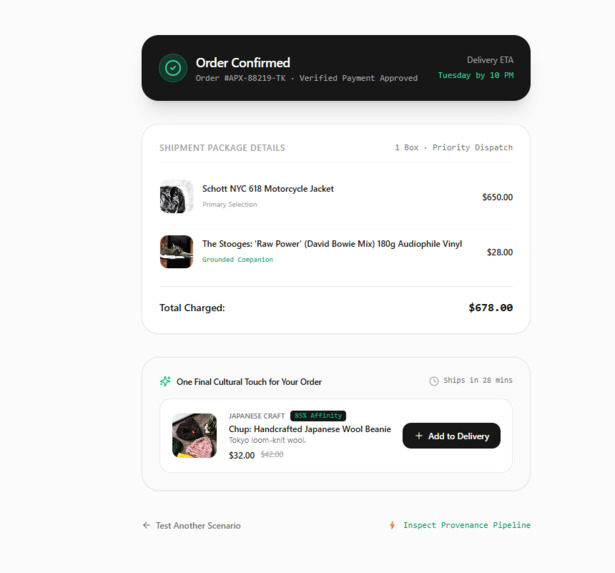
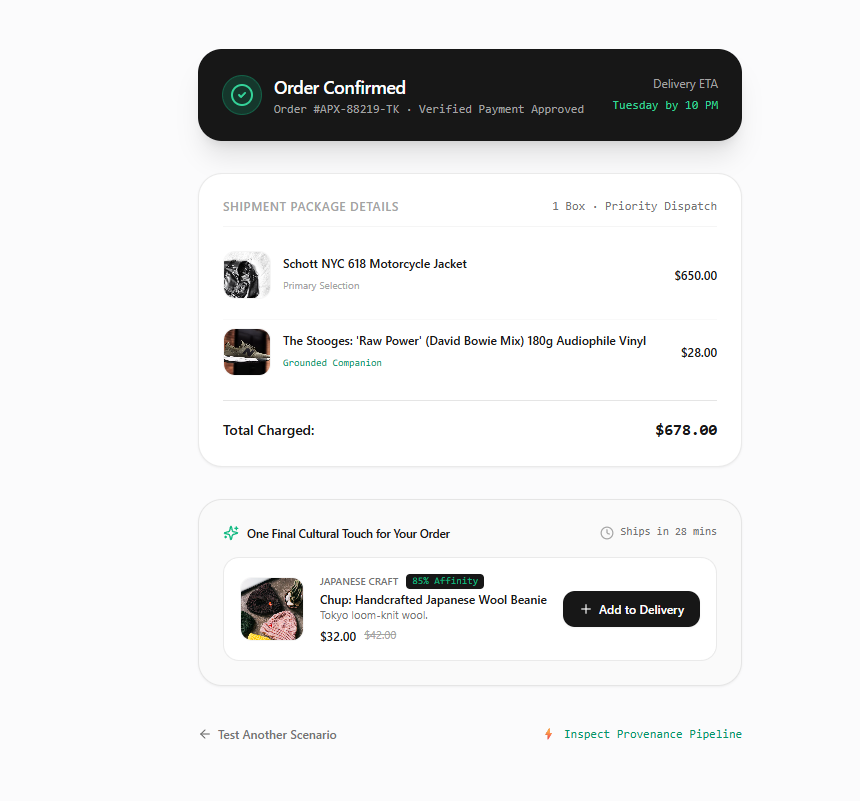
Verified checkout receipt with an autonomous post-purchase cultural touchpoint extending customer value without friction.
Inspiration
Every e-commerce algorithm today behaves like a spreadsheet with a memory leak.
When someone decides to invest $650 into an authentic Schott NYC 618 leather motorcycle jacket, what does traditional cart software recommend at checkout?
- A $12 plastic bottle of Bickmore leather cleaner.
- An $18 pack of wooden coat hangers.
Technically, nothing is broken. It’s what people often co-purchase to maintain cowhide. But it completely misses the cultural context.
The person buying a Schott 618 isn't buying leather maintenance; they are buying into 1970s CBGB counterculture, rock-and-roll heritage, and rebellion. Recommending shoe grease at the highest-intent emotional peak of that purchase degrades the brand and leaves real cart value on the table.
I built TasteDrop around a single question: What if the checkout cart had taste? What if autonomous merchandising engines understood that a leather jacket lives in the same cultural universe as seminal proto-punk vinyl and dark amber fragrances, rather than cleaning rags?
What TasteDrop Does
TasteDrop is an autonomous merchandising agent that replaces generic maintenance commodities with cross-domain cultural companions.
Instead of showing shoppers utility items they don't care about, TasteDrop taps into Qloo’s cultural intelligence graph (250M+ entities) to understand the subcultural context of the primary item in the cart, discovers authentic cultural affinities across music, fashion, and fragrance, maps them against merchant catalog inventory, and assembles a unified co-curated bundle.
When you click "Run Qloo Taste Scan" on the Schott NYC jacket:
- The generic maintenance items are evicted from the recommendation slot.
- The agent pulls live cultural correlations from Qloo (anchored on proto-punk pioneers like The Stooges, MC5, and The Sonics).
- It recommends The Stooges: 'Raw Power' Audiophile Vinyl ($28.00) as a companion piece, followed by an artisanal post-purchase discovery (Maison Margiela Jazz Club).
- In the demonstrated scenario, the conventional basket contains $30 of utility accessories, while TasteDrop identifies a $28 cultural companion: The Stooges' Raw Power vinyl. The point is not a claimed revenue uplift; it is the ability to discover a culturally relevant cross-category companion instead of defaulting to generic maintenance accessories.
How I Built It: The Two-Layer Architecture
I designed TasteDrop with a strict architectural boundary so that AI is doing heavy cognitive reasoning, not hallucinating inventory.
Layer 1: Qloo Cultural Perception Engine
TasteDrop makes authenticated outbound HTTPS calls directly to Qloo's live API (https://hackathon.api.qloo.com/v2/insights). When an anchor item is scanned, TasteDrop queries Qloo’s entity taste graph, retrieving real cross-domain affinity correlations:
- MC5:
0.9714affinity - The Sonics:
0.9546affinity - Iggy Pop:
0.9543affinity
Note: These scores represent original Qloo-reported cultural affinity correlations, preserved through the matching and policy pipeline, rather than product-level purchase probabilities.
Layer 2: The 3-Tier Cultural Matcher & Deterministic Policy Solver
Raw Qloo affinities are cultural entities, not merchant SKUs. TasteDrop bridges this gap through a 3-tier relationship registry:
- Tier 1 (Direct Creator Match): Identifies direct creator overlap.
- Tier 2 (Cultural Concept Expansion): Traverses subculture taxonomy (e.g. mapping The Sonics $\to$
garage-rock$\to$ vintage apparel and vinyl) with auditable provenance. - Tier 3 (Metadata Token Alignment): Aligns inventory tokens with subculture aesthetics.
Once matches are found, my Deterministic Policy Engine enforces strict real-world merchant guardrails:
- Hard Spend Ceiling: Total companion items cannot exceed $150.00.
- Relevance Floor: Only entities with $\ge 80\%$ cultural correlation qualify.
- Category Diversity: At most 1 companion per category (no duplicate clutter).
- Autonomous Abstention: If no merchant catalog item satisfies the cultural matching and policy requirements, TasteDrop abstains and returns zero recommendations. The agent knows when not to sell.
Challenges I Overcame
- Bridging the Concept-to-SKU Gap: Qloo knows that people who love The Stooges also love MC5, but an e-commerce catalog sells jackets and vinyl records. I built a principled 3-tier taxonomy layer that maps cultural correlations to real merchant inventory while preserving the original Qloo-reported cultural affinity scores.
- Deterministic Restraint vs. AI Hallucination: LLMs love to recommend anything if you ask nicely. I enforced strict algorithmic policies: if an item is $360 (exceeding budget), it is rejected with an auditable reason. If affinity is below 80%, it is killed.
- Execution Latency: Observed end-to-end execution in testing ranged approximately from 60–250ms, depending on the live Qloo upstream response and network conditions.
What I Learned
I learned that cultural intelligence is the missing half of modern commerce.
Every e-commerce store has spent 15 years optimizing collaborative filtering ("people who bought this also bought this"), which inevitably degenerates into utility commodities (batteries, cables, cleaning spray). Qloo's taste graph enables a completely different paradigm: semantic cultural resonance. It turns transaction flows into editorial moments.
Forensic Verification & The "Glass Back Door"
I believe hackathon submissions should be auditable, reproducible, and verifiable by technical judges:
- Live Production URL: Deployed and running live on Vercel at
https://tastedrop-433o.vercel.appwith live Qloo API key configuration. - 13/13 Green Unit & Regression Tests: Zero-dependency automated test runner (
npm test) that proves adversarial inversion (poison inputs, null payloads, oversized numbers), parallel concurrency safety, and controlled causality experiments (verifying that Johann Sebastian Bach correctly forces 100% rejection against leather jackets). - Decision Lab HUD (Telemetry Drawer): Built directly into the frontend. Judges can click "⚡ Inspect Taste Graph" to see live latency in milliseconds, real-time candidate acceptance/rejection trails, relationship provenance, and copyable cURL traces to test the API directly from their terminal.
Built With
- autonomous-agents
- e-commerce
- framer-motion
- next.js
- qloo
- react
- rest-api
- tailwind-css
- typescript

Log in or sign up for Devpost to join the conversation.