-
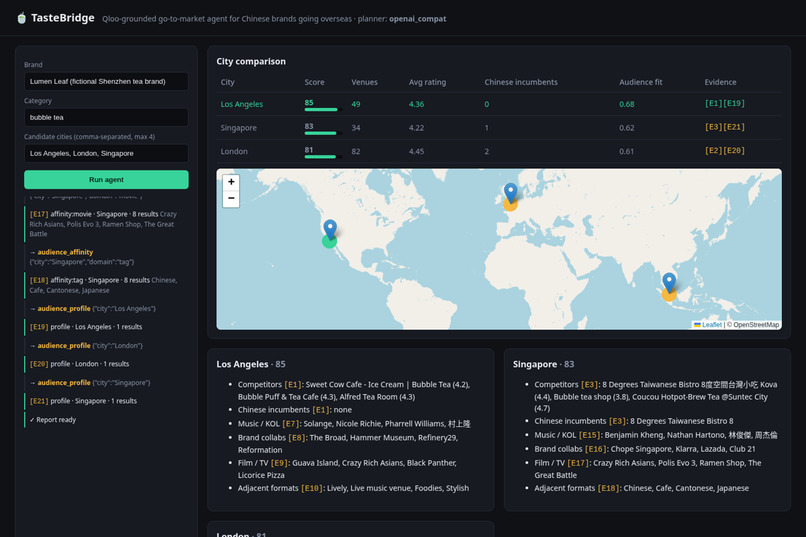
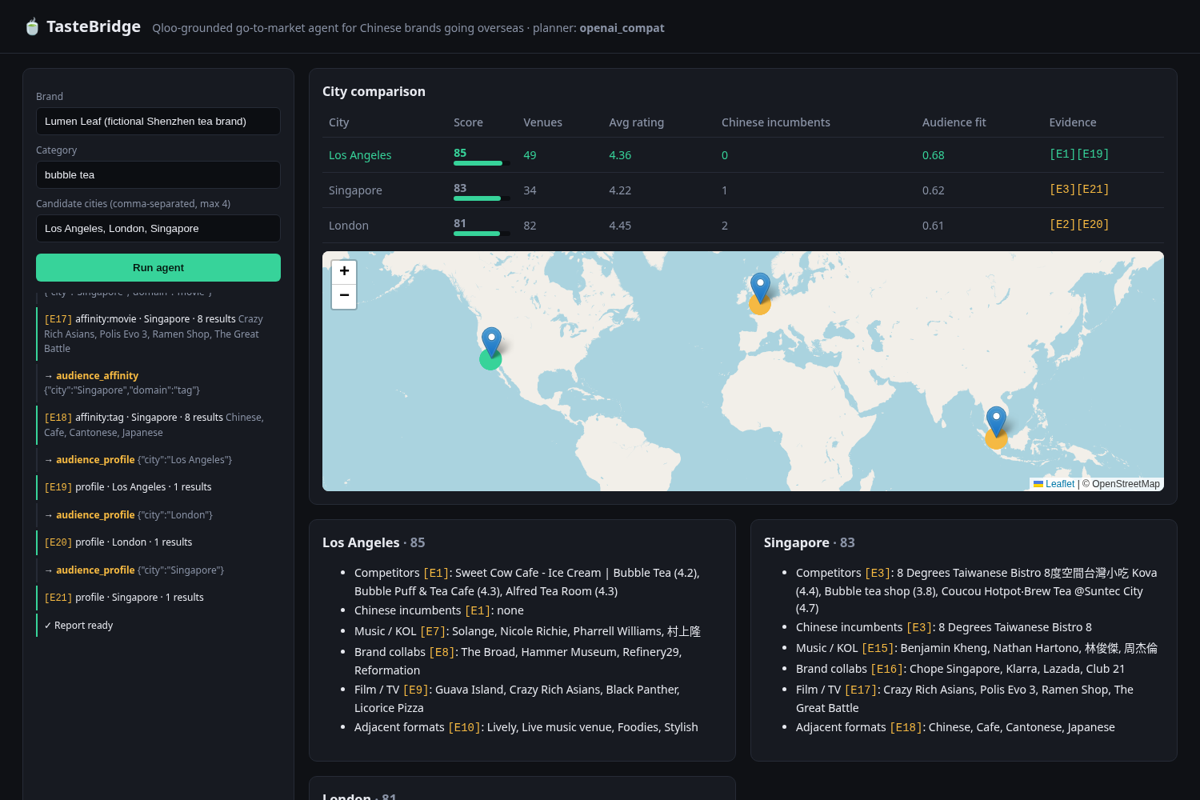
City ranking table with transparent score parts and evidence IDs
-
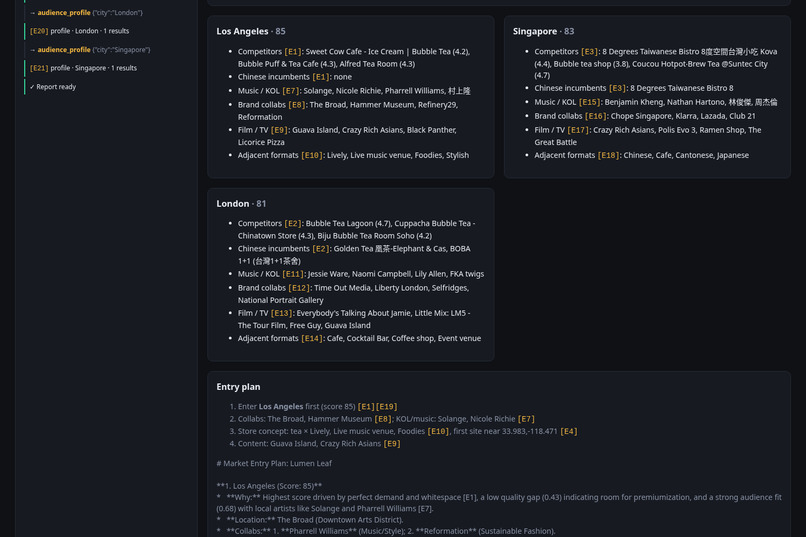
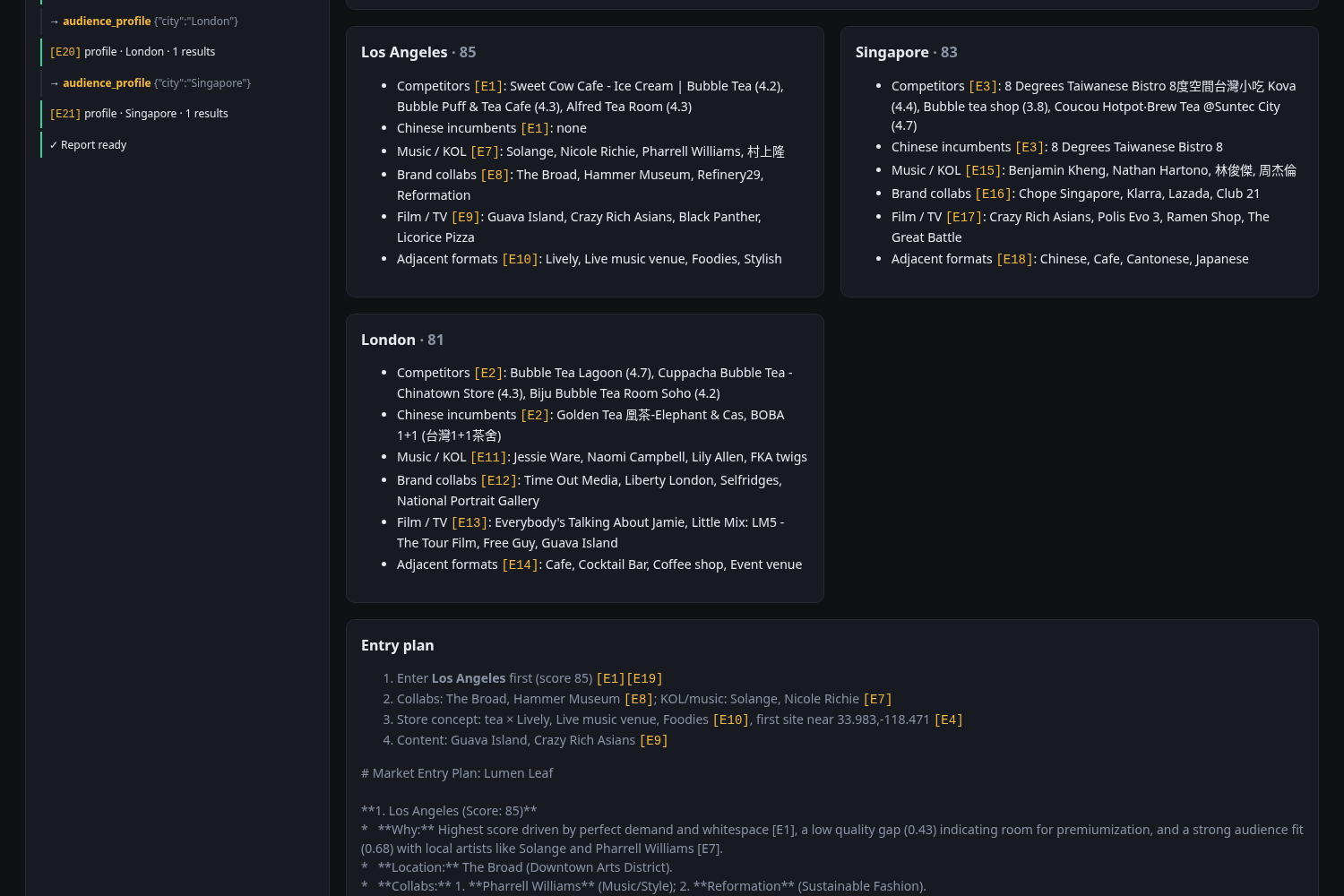
Per-city view: competitors, Chinese incumbents, KOLs, collabs, film/TV
-
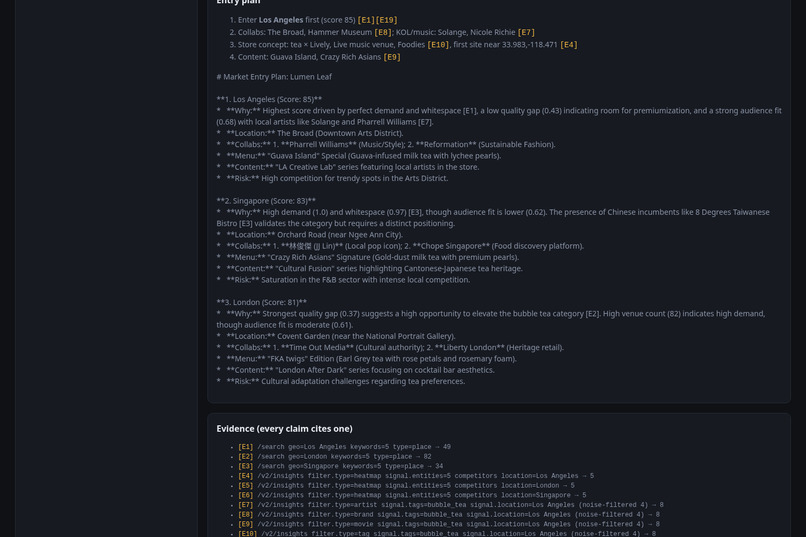
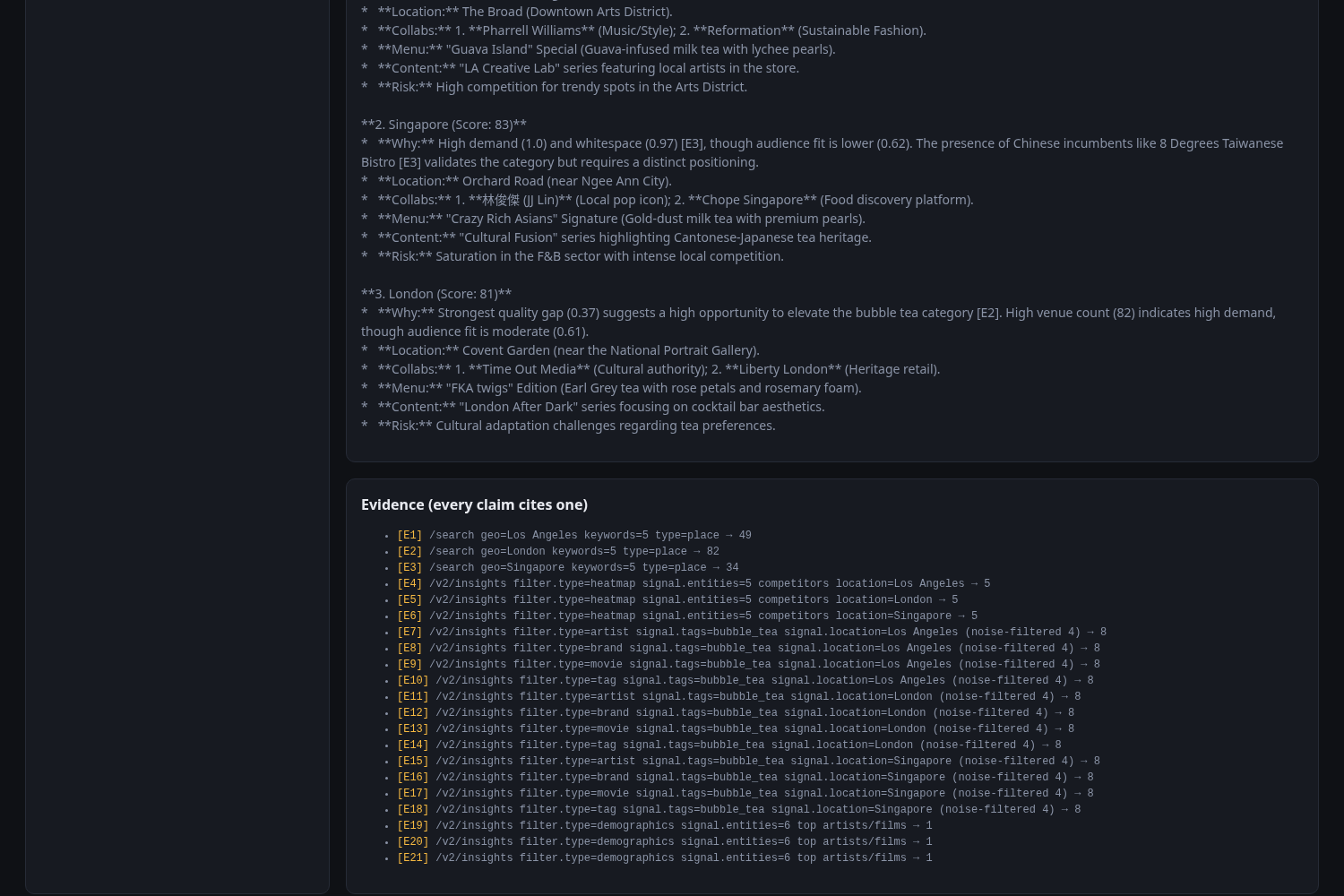
Every Qloo tool call is logged as numbered evidence (E1–E21)
-
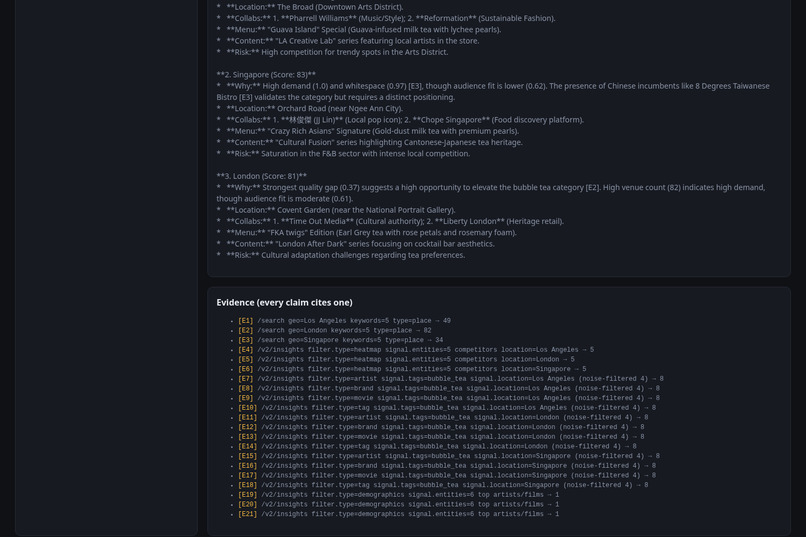
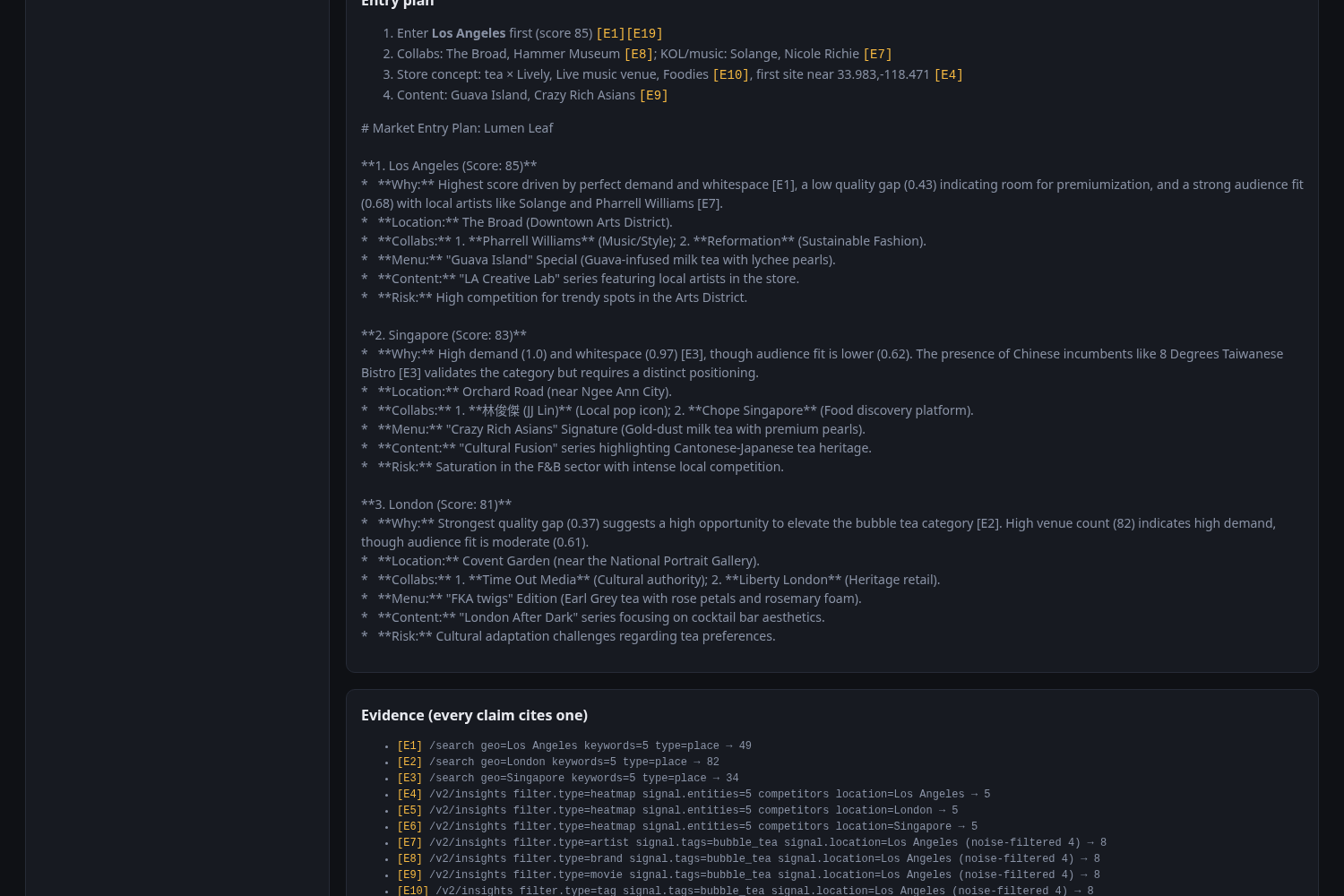
Grounded entry plan that follows the Qloo-backed ranking
Inspiration
Chinese consumer brands expanding overseas often pick a first city from gut feel, diaspora density, or a generic LLM brief. Those briefs sound fluent, but they invent competitor maps, miss local taste adjacency, and cannot show why a market fits. Qloo's Agentic Hackathon brief put it clearly: agents can reason, but without cultural grounding they are guessing. TasteBridge exists for the use case where that guess is expensive—choosing where to open, who to collab with, and how to position a Chinese brand in a foreign city.
Earlier Qloo projects (e.g. GeoTaste, last edition's winner) turn one location into a market-analysis report; TasteBridge instead answers a cross-border decision, which overseas city a Chinese brand should enter first, by ranking several cities against the audience that already buys Chinese brands abroad, with every number traceable to a Qloo call.
What it does
TasteBridge is a cultural go-to-market agent for Chinese brands entering overseas cities. In the live demo, a fictional Shenzhen tea brand Lumen Leaf compares Los Angeles, London, and Singapore.
For each city the agent:
- Plans tool calls with an OpenAI-compatible LLM (planner).
- Pulls Qloo evidence: geo competitor venues, audience affinities (artists, brands, movies, tags), demographics, and hotspots.
- Scores cities deterministically (transparent weights judges can inspect): 25% demand + 30% whitespace (fewer Chinese incumbents) + 10% quality gap + 25% audience fit + 10% momentum. Audience fit is measured against a target audience derived from Qloo: the demographics of the audience that already follows Chinese tea incumbents (HEYTEA, CHAGEE, ...) found in the candidate cities. Momentum comes from Qloo Trending for each city's taste anchors.
- Compares cities head-to-head with Qloo Analysis Compare (
/v2/insights/compare): which taste themes two cities' competitor audiences share, and which are unique to one city, each cited with an evidence ID. - Writes a grounded entry narrative that must follow that ranking and cite evidence IDs like
[E3]—not free-form chat.
Outputs include a ranked city table, competitive set and Chinese incumbents, store hotspot coordinates, collab/content candidates from the taste graph, and a short market-entry plan with risks.
Live demo: https://tastebridge.onrender.com
Source: https://github.com/ChrisTu117/tastebridge (MIT)
Free Render hosting sleeps after ~15 minutes idle; cold start is about one minute. Please open the link once before evaluating.
With vs. without Qloo
| Question | LLM only | TasteBridge with Qloo |
|---|---|---|
| Who are my competitors in London? | Plausible but invented or outdated names | Dozens of geo-filtered venues from Qloo search (65 in a live London run), Chinese incumbents flagged with an evidence ID |
| Who is my customer? | A guess ("Gen Z, female") | Age/gender skew of the audience that follows Chinese tea incumbents abroad (Qloo demographics) |
| How is LA different from London? | Stereotypes | Qloo Analysis Compare: shared themes vs. themes only one city's audience has |
| Who should we collab with? | Generic celebrities | Artists, brands, films with measured affinity to the category in that city |
| Where should store #1 go? | "Downtown" | Qloo heatmap coordinates of the competitor audience |
| Is this taste rising? | Unknown | Qloo Trending percentiles of the city's taste anchors |
Remove Qloo and the ranking, the target audience, the comparison and the collab list all disappear: the LLM only writes the narrative, constrained to evidence IDs.
How we built it
- Agent loop (
tastebridge/agent.py): LLM plans function calls → Qloo tools → evidence store → deterministicsynthesize()ranking → second LLM pass constrained to those facts for the narrative. - Qloo tool layer (
tastebridge/qloo.py): stdlib-only HTTP client against the hackathon API—search (geo-filtered competitors),/v2/insightsfor affinities / demographics / heatmap,/v2/insights/comparefor city-vs-city comparison,/v2/trendingfor momentum, caching, retries, and an audit trail of calls as evidence. - LLM: pluggable OpenAI-compatible endpoint (demo uses Z.ai
glm-4.7-flash); can fall back to an offline mock planner for local runs without an LLM key. - Serving: Python standard-library HTTP server (
tastebridge.server) with a small web UI and streaming NDJSON at/api/run. Secrets stay server-side. - Hosting: Docker on Render free tier (
render.yaml).
No agent framework lock-in—just a clear planner → tools → evidence → score → grounded write loop so judges can see what Qloo returned and how it changed the answer.
Challenges we ran into
- Geo truthfulness: plain text search is not city-local. Competitors are geo-filtered with location + radius, multi-keyword scans, and dedupe so the competitive set is actually in-city.
- Noise in affinities: location-tagged cultural results can include irrelevant entities; the agent noise-filters before scoring and citing.
- LLM inventing numbers: the narrative is not trusted as the score source. Ranking is computed from evidence first; the LLM must recommend cities in that order and only cite real evidence IDs.
- Free-tier cold starts: Render sleeps after idle; documented for judges so a slow first load is not mistaken for a broken demo.
- Keeping the stack small: stdlib server + thin Qloo client so the "Qloo-powered" path is easy to read in a short judging pass.
Accomplishments that we're proud of
- A working, externally hosted agent demo—not a slide deck or local-only notebook.
- Qloo is the differentiator: without competitors, affinities, demographics, and hotspots, the ranking and collab ideas do not exist.
- Evidence-cited UI/report (
[E1],[E2], …) so every claim traces to a Qloo call. - Transparent scoring weights instead of a black-box "trust the model."
- MIT-licensed public repo with README, DEPLOY, and tests (including checks that secrets are not exposed to the browser).
What we learned
Cultural intelligence for GTM is less about prettier prose and more about structured taste evidence—who already competes in a city, what that audience also likes across domains, where affinity concentrates geographically, and whether the demographic skew matches the brand's target. An agent that plans Qloo calls and then refuses to overwrite the math with hallucination is more useful than a chatbot that "sounds strategic."
What's next for TasteBridge
- More categories beyond tea / bubble tea (beauty, snacks, lifestyle retail) with the same evidence loop.
- Richer hotspot maps and side-by-side city comparison UI.
- Exportable one-pagers for brand / agency workflows.
- Optional multi-brand benchmarking once more Qloo signals are wired in.
Try it out
- Open https://tastebridge.onrender.com (wait ~1 min if the free instance was sleeping).
- Run the Lumen Leaf demo across LA / London / Singapore (or your own brief).
- Inspect the ranking, evidence IDs, hotspots, affinities, and grounded entry plan.
- Clone https://github.com/ChrisTu117/tastebridge to run locally with
QLOO_API_KEY.

Log in or sign up for Devpost to join the conversation.