-
-
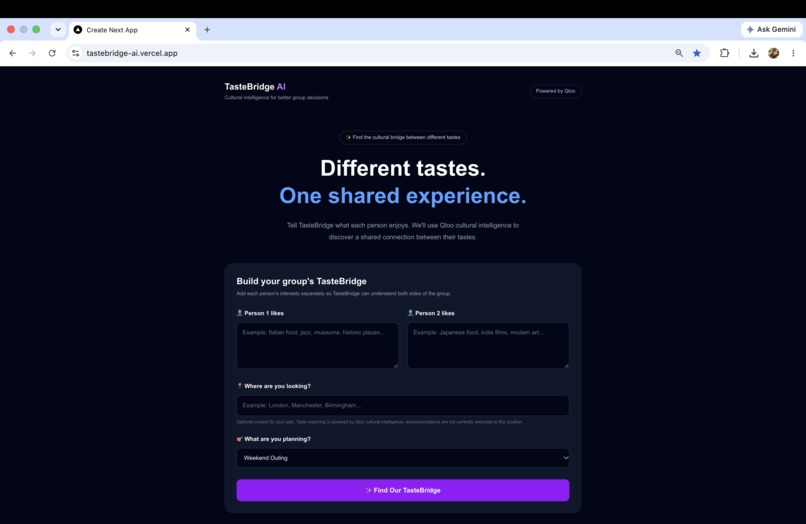
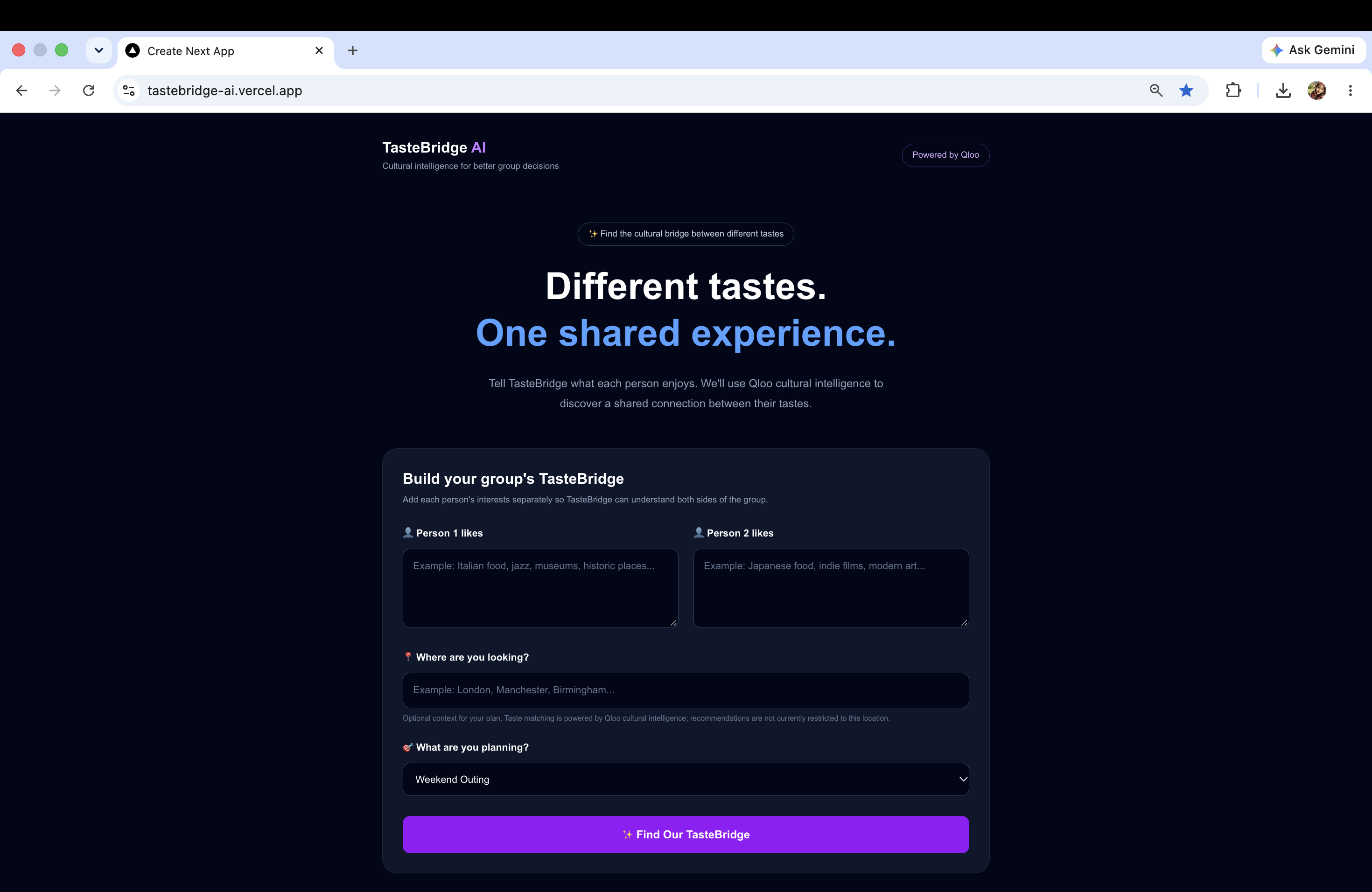
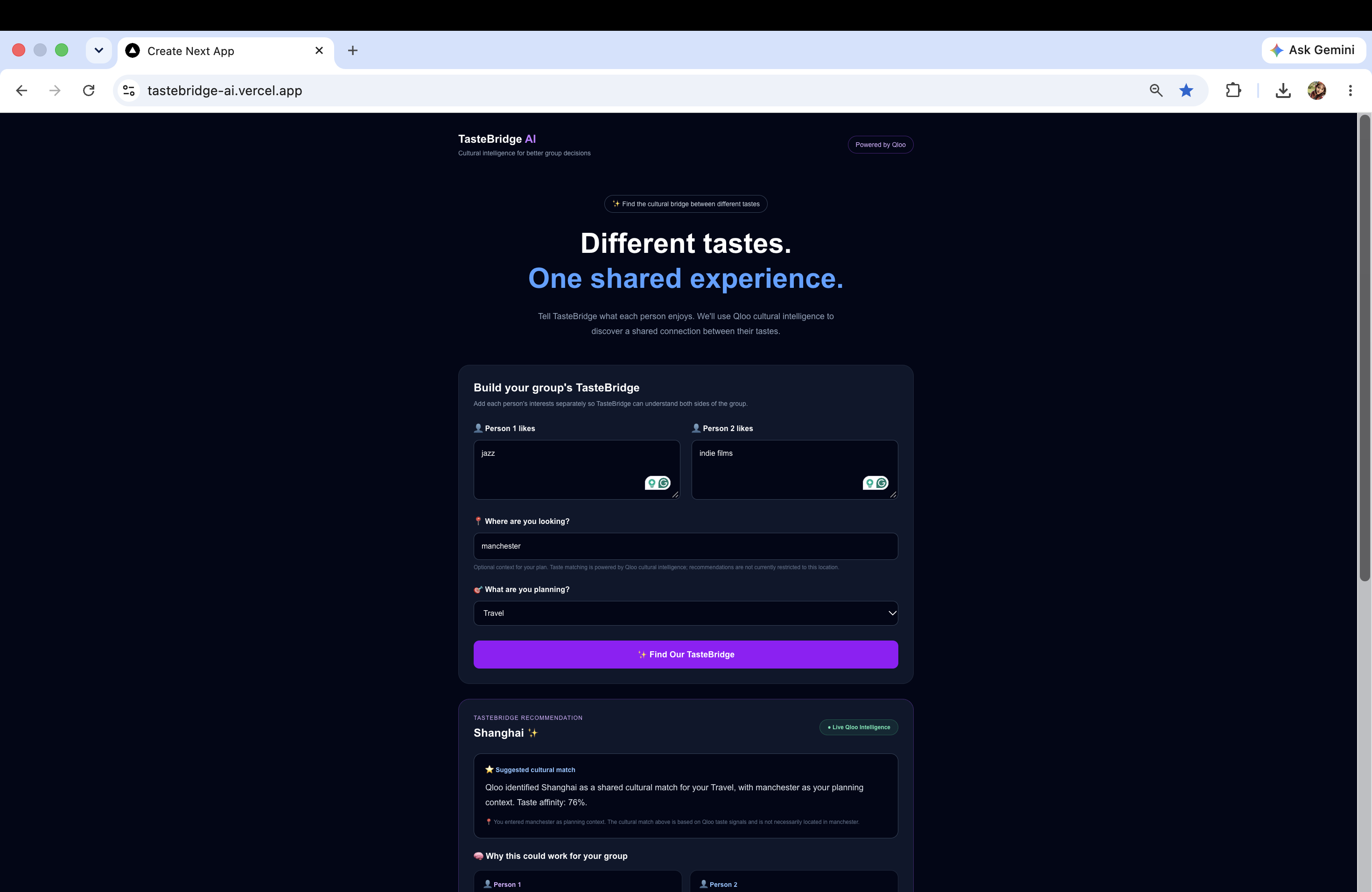
Home / Input Screen
-
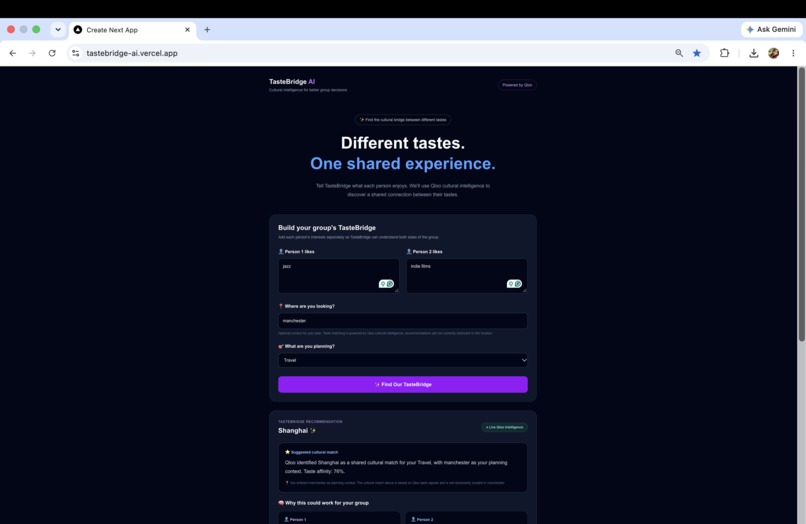
Live Qloo Recommendation
-
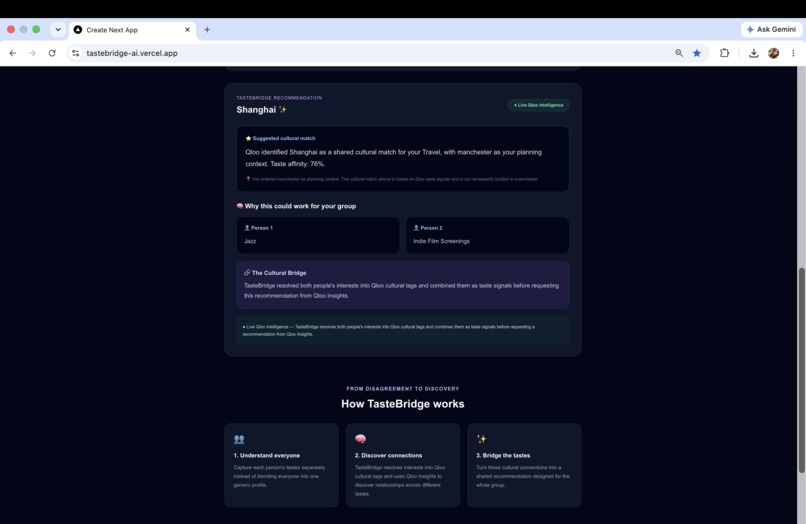
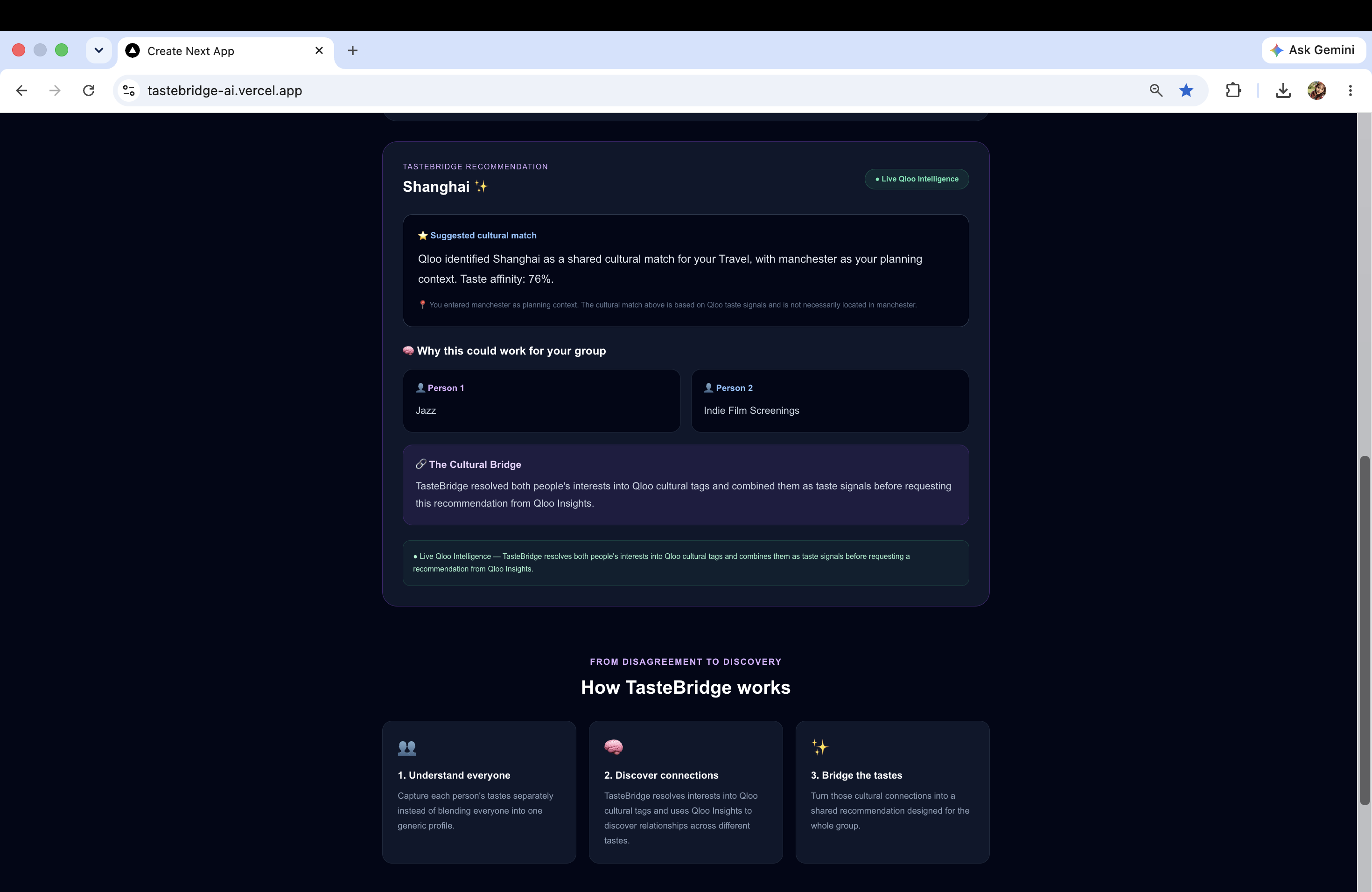
Cultural Bridge + How It Works
Inspiration
Planning something together sounds simple until two people have completely different tastes.
One person may love jazz, museums and Italian food, while another prefers indie films, modern art and Japanese food. Most recommendation systems are designed around an individual preference. I wanted to explore a different question:
What could we both enjoy together?
That idea became TasteBridge AI — a cultural recommendation experience that uses Qloo's cultural intelligence to discover connections between different tastes.
What it does
TasteBridge AI allows two people to enter their interests and choose what they are planning, such as travel, a date, food, entertainment or a weekend activity.
Instead of choosing one person's preferences over the other's, TasteBridge combines their cultural signals and searches for a shared recommendation.
The application:
- accepts free-text interests from Person 1 and Person 2
- resolves those interests into Qloo cultural tags
- combines both people's taste signals
- understands the type of experience they are planning
- queries Qloo Insights for culturally relevant matches
- evaluates Qloo affinity data
- returns a shared recommendation
- explains how both people's interests contributed to the result
The optional location field is currently used as planning context. The cultural recommendation itself is driven by Qloo taste intelligence rather than being restricted to that location.
Agentic recommendation workflow
TasteBridge AI functions as an agentic recommendation tool rather than a static recommendation list.
After receiving the users' preferences and planning intent, the backend autonomously carries out a multi-step decision workflow.
Step 1 — Understand both taste profiles
TasteBridge parses each person's free-text input into separate interests.
For example:
- Person 1: Jazz
- Person 2: Indie Films
Step 2 — Resolve cultural signals with Qloo
For each interest, TasteBridge queries Qloo's /v2/tags endpoint.
This converts free-text preferences into valid Qloo cultural tags that can be used as recommendation signals.
Step 3 — Build the shared TasteBridge
The application combines the resolved Qloo tags from both people.
Neither person's interests are discarded. Both sets of cultural signals contribute to the shared recommendation request.
Step 4 — Decide what type of entity to explore
TasteBridge uses the selected plan to determine which type of Qloo entity should be requested.
For example:
- Travel → destinations
- Entertainment → artists
- Restaurant, date, family, team or weekend plans → places
This allows the workflow to adapt its Qloo request according to the user's intent rather than using one fixed recommendation type.
Step 5 — Query Qloo Insights
TasteBridge sends the combined cultural signals to Qloo's /v2/insights endpoint using the entity type selected by the workflow.
The Qloo API key remains server-side and is never exposed in the browser.
Step 6 — Evaluate the recommendations
TasteBridge processes the entities returned by Qloo, removes duplicate results and evaluates available Qloo affinity data.
It then selects the strongest available shared match.
Step 7 — Explain the bridge
Finally, TasteBridge transforms the selected Qloo result into a human-readable recommendation.
The interface shows:
- the shared recommendation
- each person's matched cultural interests
- the Qloo taste affinity when available
- an explanation of how the two taste profiles were bridged
The workflow therefore decides how to translate user input into Qloo signals, which type of cultural entity to explore, how to evaluate the returned results, and how to explain the final shared recommendation.
Qloo provides the cultural intelligence, while TasteBridge orchestrates the multi-step workflow that turns two different taste profiles into one shared experience.
How I built it
TasteBridge AI is built with:
- Next.js
- React
- TypeScript
- Tailwind CSS
- Node.js
- Qloo API
- Vercel
- GitHub
The frontend collects both people's preferences, optional location context and the type of plan they want to make.
The Next.js server-side API route then orchestrates the recommendation workflow.
The core flow is:
User Preferences → Qloo Tags → Combined Taste Signals → Intent-Based Entity Selection → Qloo Insights → Affinity Evaluation → Shared Recommendation
Qloo API calls are made only from the server so the API key is protected.
The production application is deployed on Vercel and the source code is publicly available on GitHub.
I also added retry handling for temporary Qloo gateway errors such as 502, 503 and 504 responses. This improves reliability while keeping every recommendation grounded in live Qloo data rather than replacing failed requests with hard-coded recommendations.
Challenges I ran into
One of the biggest challenges was understanding how to convert natural user preferences into valid Qloo signals.
Free-text interests cannot simply be passed directly into every recommendation request. I therefore created a two-stage Qloo workflow:
- resolve user interests through
/v2/tags - use the resulting tag URNs as signals for
/v2/insights
Another challenge was handling location correctly. Location is currently presented as planning context rather than claiming that every cultural recommendation is geographically located there.
I also encountered occasional gateway timeouts from the live Qloo Insights API. To make the production experience more resilient, I added controlled automatic retries for temporary 502, 503 and 504 responses.
Accomplishments that I'm proud of
I am proud that TasteBridge AI is not based on a hard-coded list of recommendations.
The application uses live Qloo cultural intelligence to turn two different sets of interests into a shared recommendation.
I am also proud of building an end-to-end working application with:
- live Qloo API integration
- free-text interest resolution
- multi-person taste bridging
- intent-based recommendation decisions
- affinity-based result selection
- server-side API security
- temporary API timeout handling
- a responsive user interface
- a public production deployment
Most importantly, the project demonstrates a different way of thinking about recommendations: not just "What do I like?", but "What connects us?"
What I learned
This project taught me that cultural recommendation systems require more than simply matching keywords.
I learned how Qloo represents cultural interests through tags and entities, how those signals can be passed to Qloo Insights, and how affinity information can help identify meaningful connections.
I also learned how important orchestration is when building an agentic workflow. The application has to interpret the inputs, resolve cultural signals, decide which type of entity to explore, call the appropriate API, evaluate the response and explain the result.
Building TasteBridge also gave me practical experience with API integration, Next.js server routes, TypeScript, deployment, environment variables, debugging and production reliability.
What's next for TasteBridge AI
There are several ways I would like to expand TasteBridge AI.
Future improvements include:
- richer location-aware recommendations
- interest autocomplete powered by cultural data
- location autocomplete
- more planning categories
- multiple shared recommendations instead of only one result
- richer explanations of why each recommendation connects both people
- support for larger groups rather than only two people
- saved TasteBridge profiles
- improved performance and caching
- broader use of Qloo cultural signals and entity types
The long-term vision is for TasteBridge to become a shared cultural decision agent that helps couples, friends, families and teams discover experiences they can genuinely enjoy together.
Try TasteBridge AI
Live application: https://tastebridge-ai.vercel.app
Source code: https://github.com/meenakshikandwal194-del/tastebridge-ai
Built With
- css
- github
- next.js
- node.js
- qloo
- react
- tailwind
- typescript
- vercel


Log in or sign up for Devpost to join the conversation.