-
-
...
Inspiration
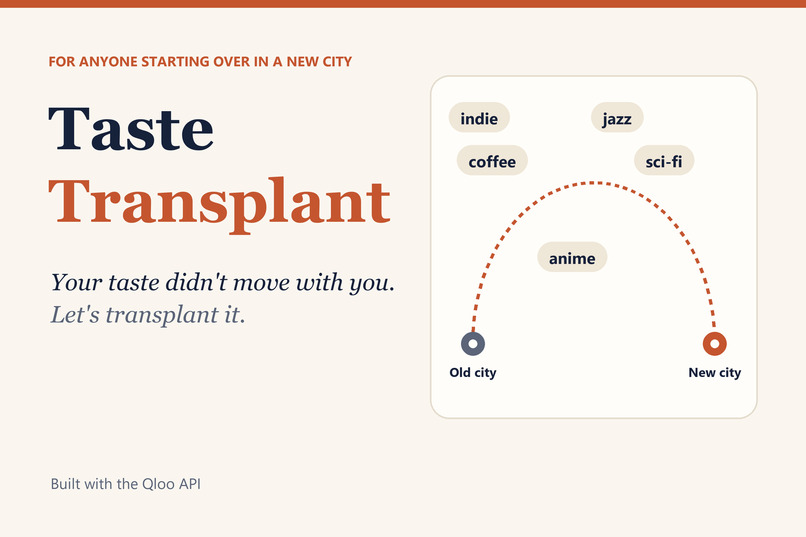
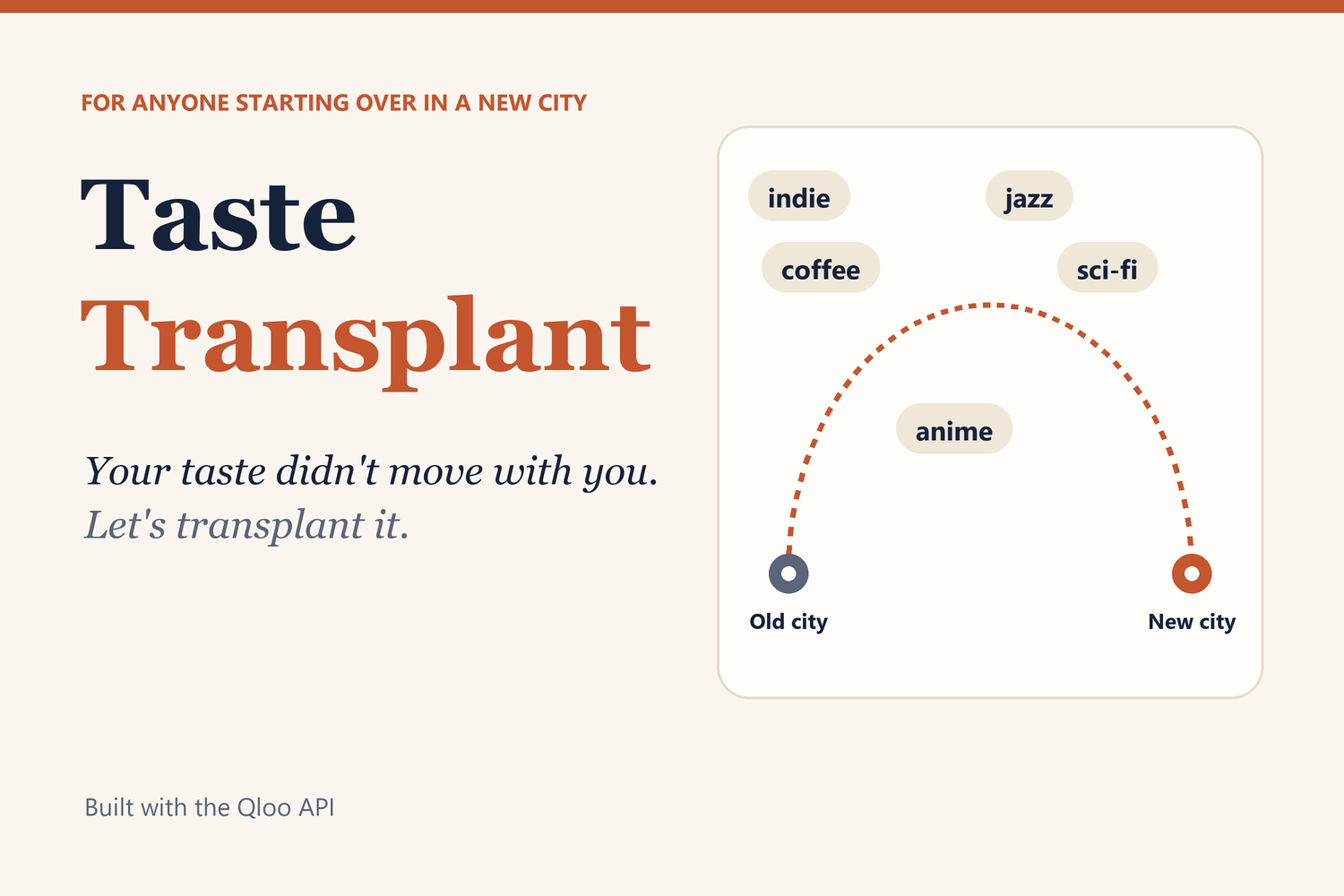
When you move to a new city, your taste stays the same but your map is gone. The cafés, venues, playlists and films you relied on belong to a place you no longer live in. Review apps rank by popularity, not by fit, and chatbots give confident lists with no evidence behind them.
What it does
Taste Transplant takes 1 to 5 favorites from any domain (artists, films, shows, brands, places) and the city you moved to. It uses Qloo's taste graph to find places, local-scene artists and films in that city that match your taste, then builds a short "first three weeks" settling-in plan.
Every pick shows its evidence, and the exact Qloo queries are visible in the app. A swap test lets you change one favorite and see how many results are new, dropped or kept, which shows the results respond to taste rather than to a prompt.
How we built it
- A search step resolves your favorites to real Qloo entity IDs, so free text is never treated as an ID.
- A bounded agent pipeline runs: plan, retrieve, verify, compose, narrate.
- Retrieval runs in parallel Qloo Insights queries, one per category (places, artists, movies), using your favorites as taste signals and your city as the location.
- Results are de-duplicated, your own favorites are removed, and a failed category stays visible instead of being replaced with made-up data.
- An optional LLM layer can rephrase reasons strictly from the returned data. Every line is labeled "AI-written" or "Template".
- Vanilla JavaScript front end, Node.js server functions, zero runtime dependencies, API keys kept server-side, input validation, timeouts and rate limiting.
How Qloo powers it
/searchresolves favorites to Qloo entities./v2/insightswithsignal.interests.entitiestranslates taste across domains into places, artists and movies.filter.location.queryandsignal.location.queryground results in the destination city.- If Qloo fails, the app shows an error. It never falls back to invented recommendations.
Challenges we ran into
Qloo silently ignores unsupported parameters, so we verified every request against the official documentation. Hackathon keys also work only on the hackathon base URL, which is an easy mistake to make. We also had to keep any AI-written text from inventing facts, so it may only paraphrase data Qloo returned.
What we learned
Making evidence visible (the exact queries, tag counts, the swap test) matters as much as the recommendations themselves. A recommendation you can't inspect is hard to trust.
What's next
Partner or roommate taste merge, neighbourhood-level trails, consented saved profiles, and university onboarding.
Current status
The app is built against Qloo's documented hackathon endpoints and covered by 13 automated tests. Source code (MIT licensed): https://github.com/saikumar1125/taste-transplant
Not affiliated with or endorsed by Qloo.## Inspiration
What it does
How we built it
Challenges we ran into
Accomplishments that we're proud of
What we learned
What's next for Taste Transplant
Built With
- api
- css3
- html5
- javascript
- node.js
- qloo
