Inspiration
AI agents can reason, plan and book things, but they are culturally blind about you. Ask one for "a perfect Saturday in Tokyo" and you get the world's most average Saturday. We wanted to fix the input side: before the question is even asked, the agent should already hold a structured, explainable model of your taste.
What it does
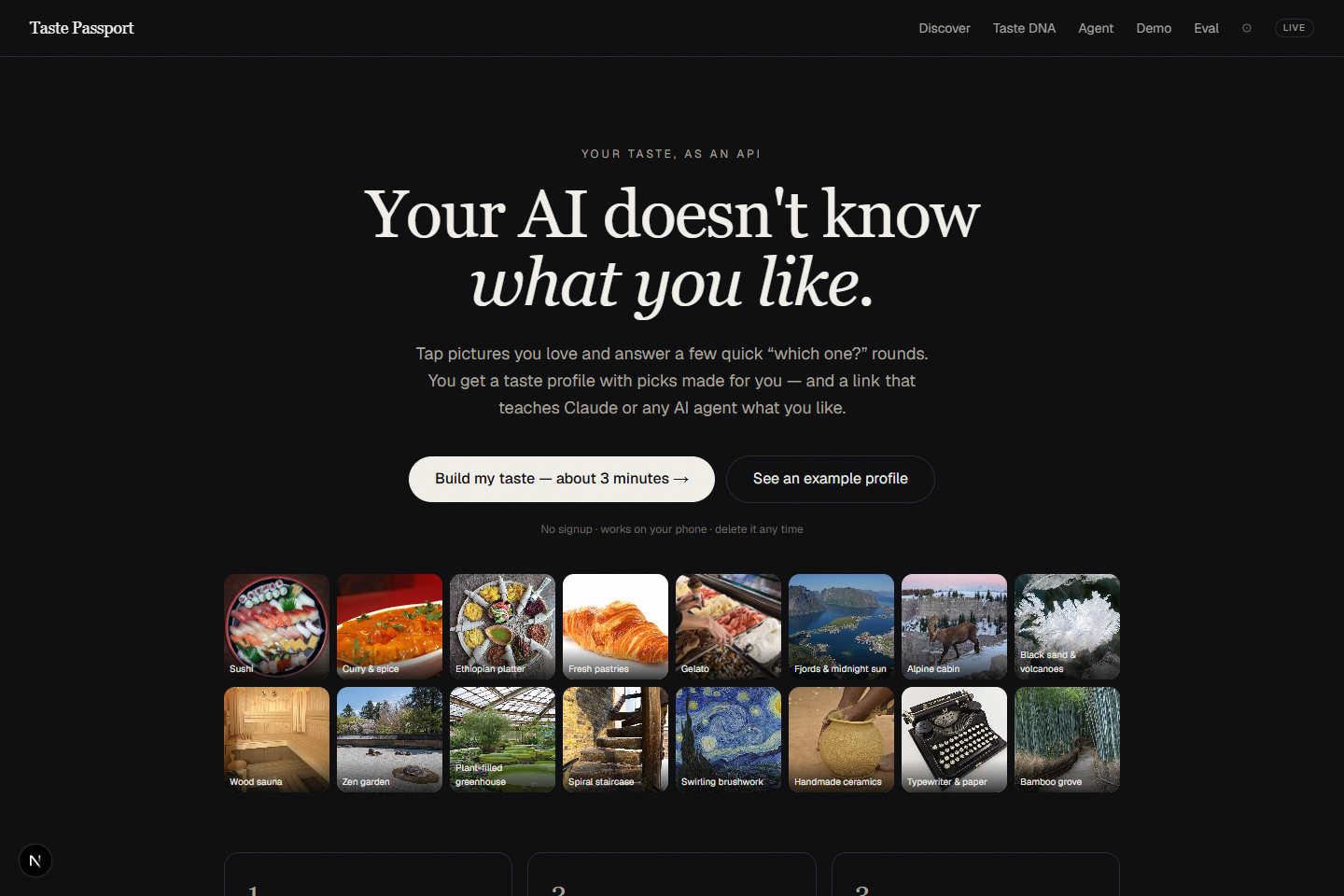
Taste Passport turns a few minutes of tapping into a portable cultural fingerprint.
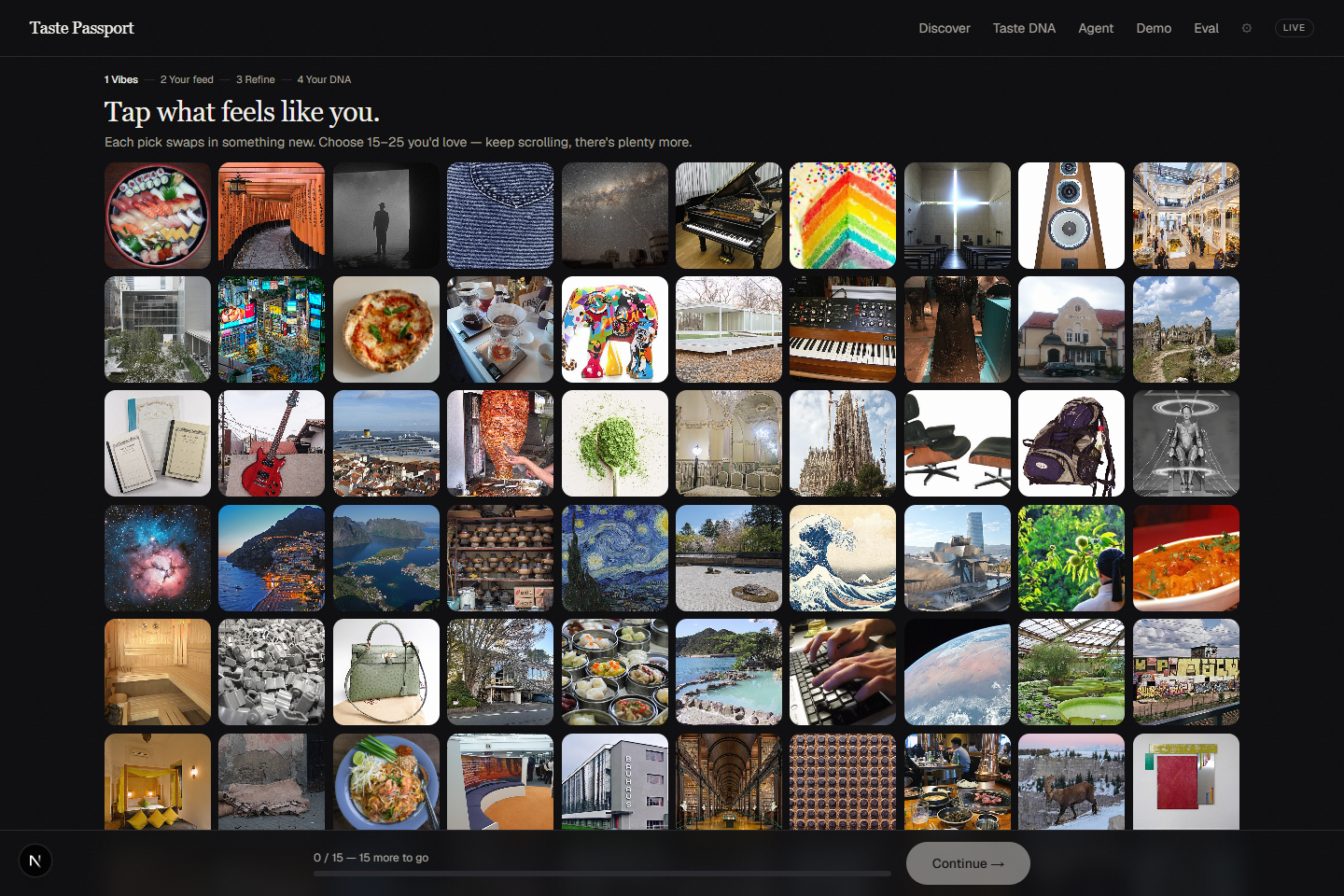
- Vibe wall: tap 15–25 people-free photos (dishes, places, rooms, textures) that feel like you. Each pick swaps in something new.
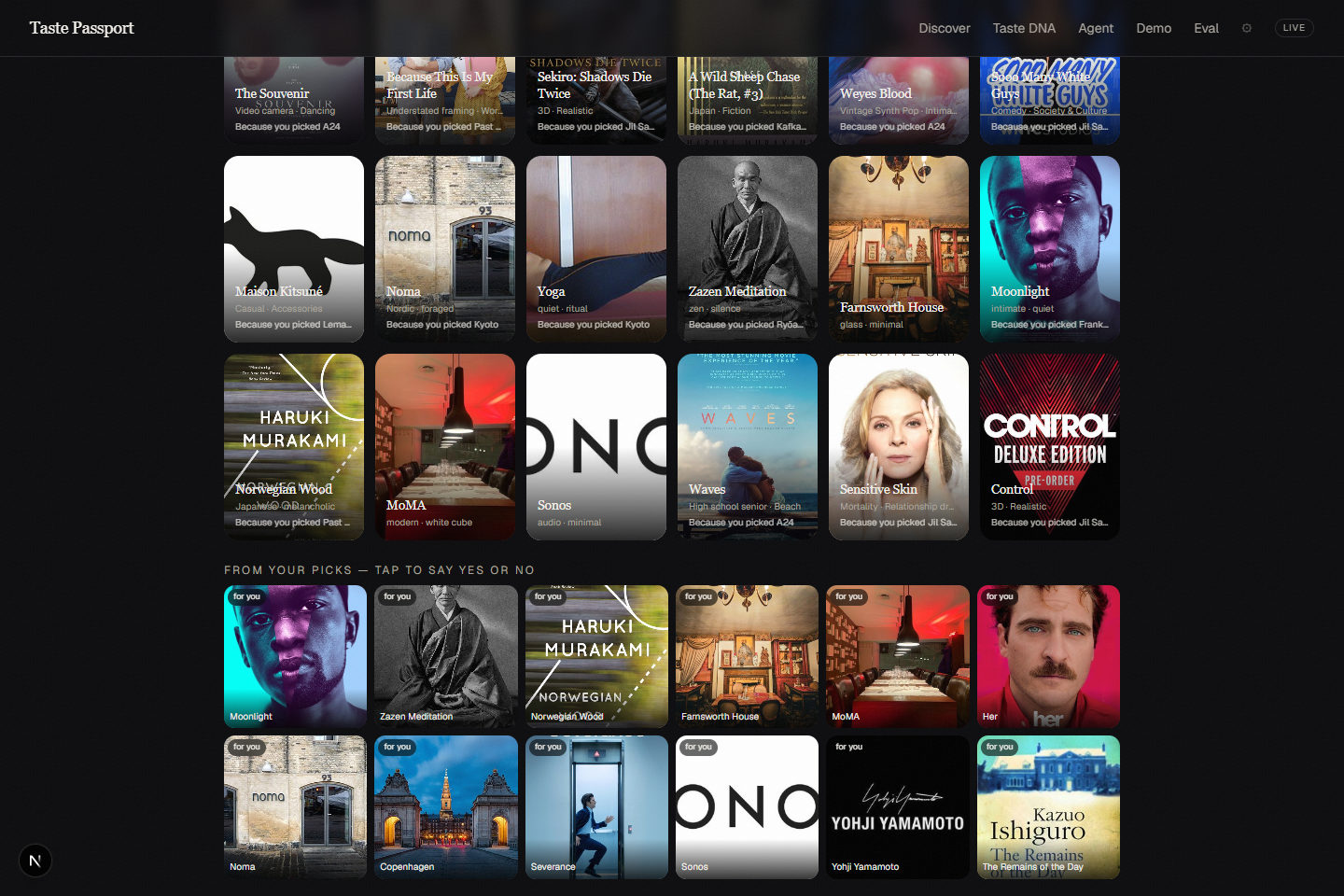
- Adaptive feed: every card resolves to a real cultural entity (artist, film, brand, place, book, game). Each batch is re-scored against Qloo and mixed 70% close to your taste, 20% adjacent, 10% deliberate surprise.
- Four-way rounds: three short chapters of "which one?" questions (film, food, books, art, TV, sports & hobbies), each built from your previous answer, plus a "Sharpen" chapter that targets what we know least about.
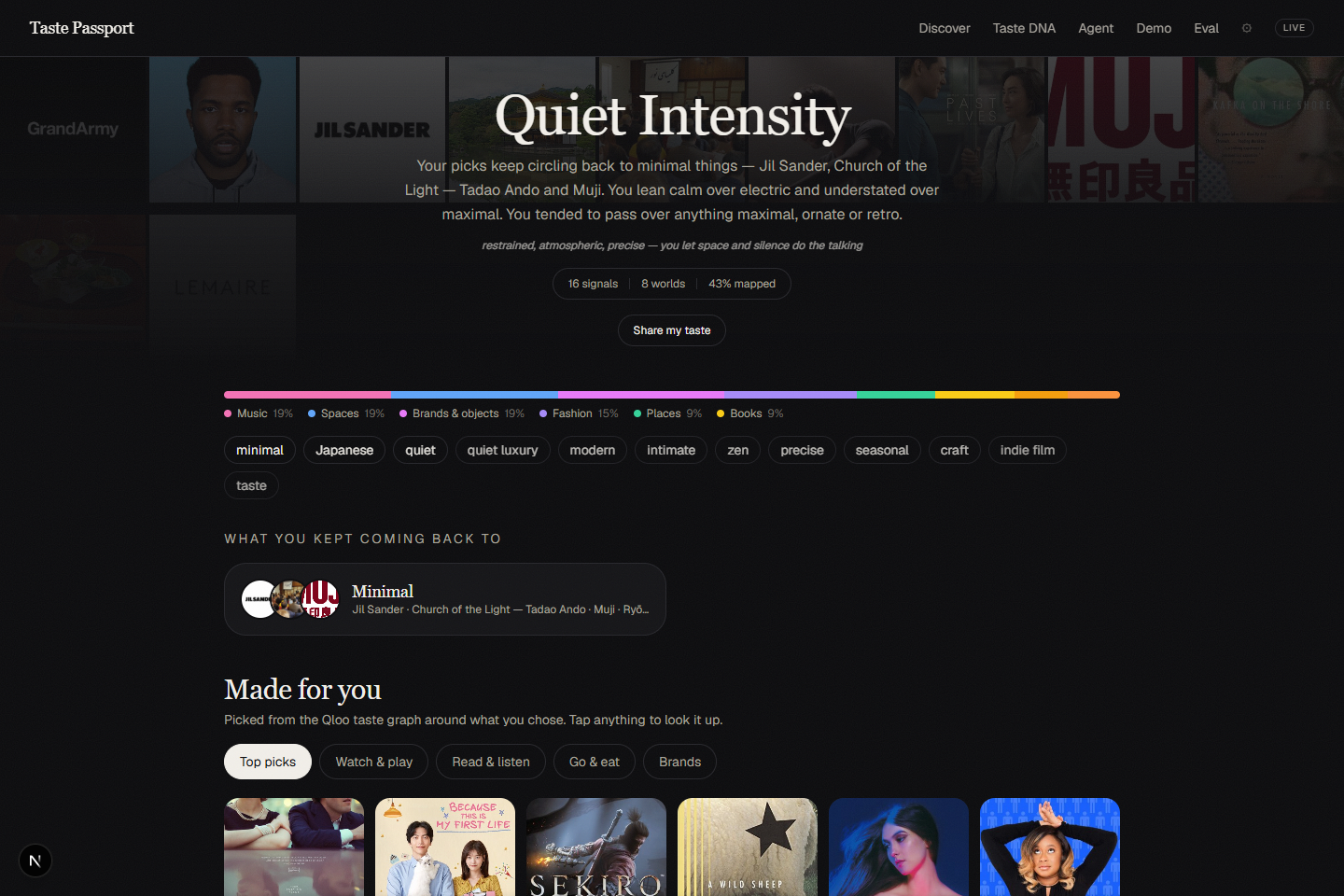
- Taste DNA: an archetype, a constellation of your clusters, and Unexpected connections: cross-domain bridges from Qloo with a "Why this?" that cites which of your signals drove each one.
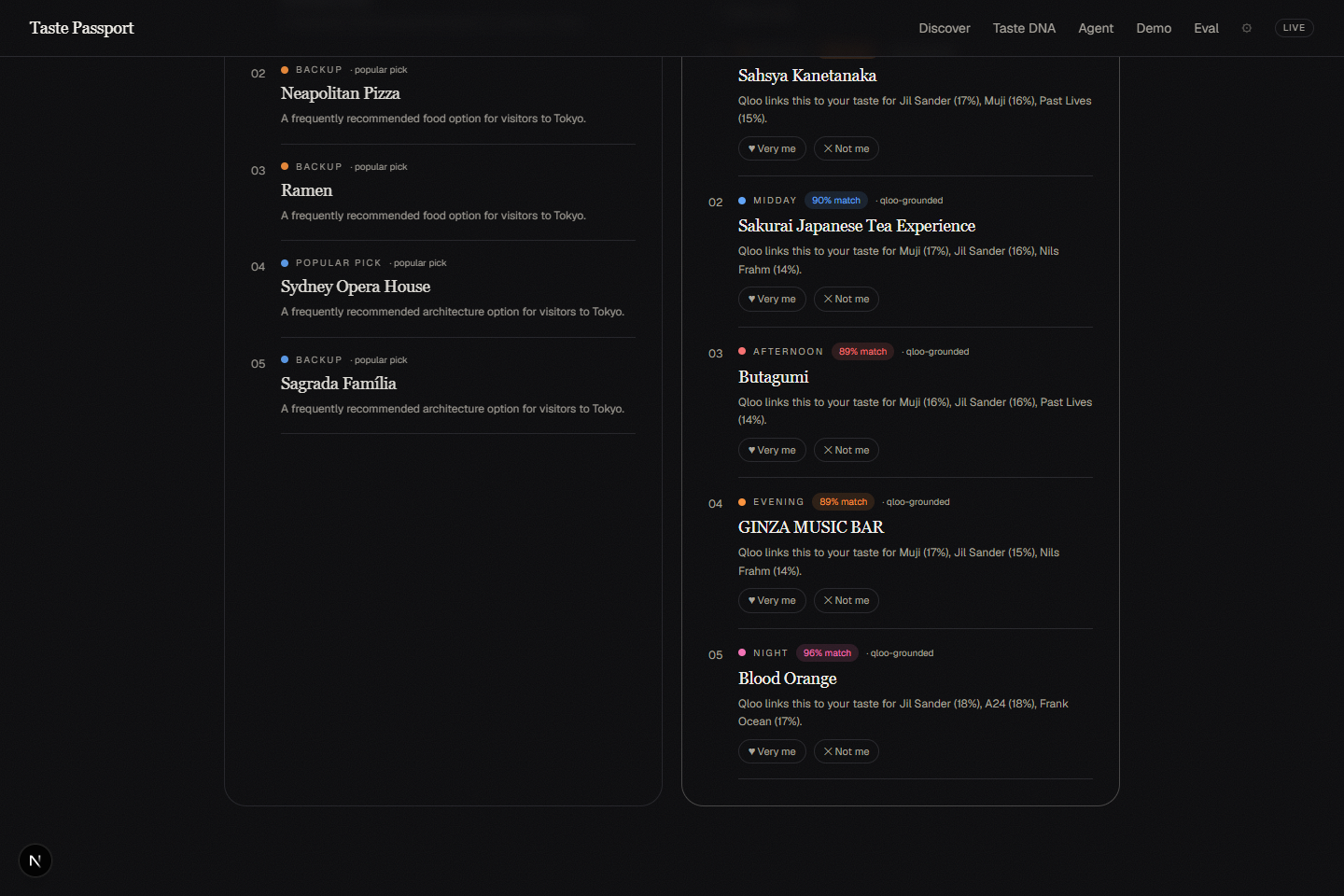
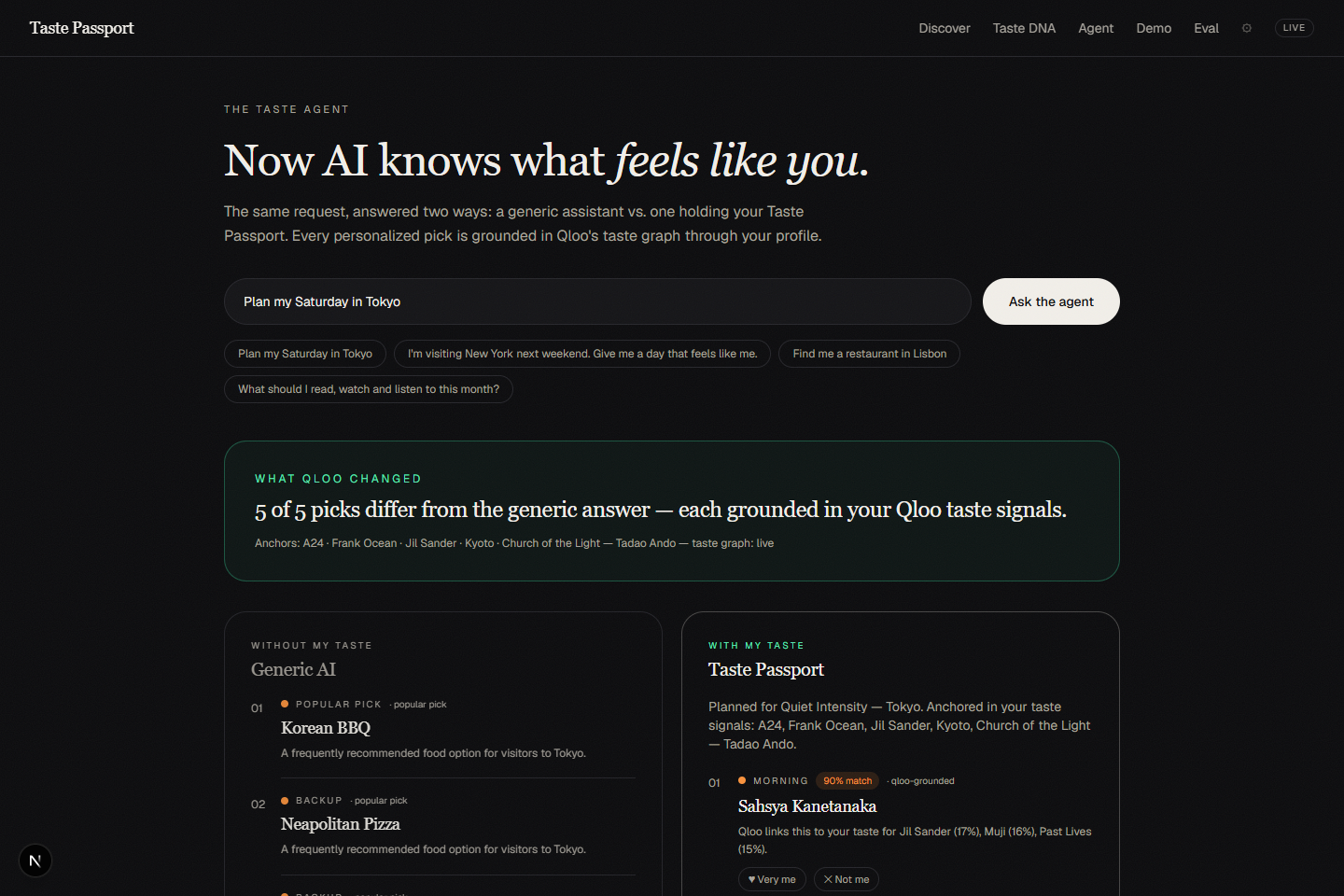
- Agent mode: "Plan my Saturday in Tokyo" answered twice, generically and taste-grounded, side by side in a What Qloo changed panel with match % and per-item provenance. Tapping "♥ Very me" feeds back into the profile.
- Portable: any agent can read the profile through a JSON API or an MCP server (
get_taste_context,recommend_for_context,explain_taste_match,record_feedback, and more), hosted over HTTP or run locally over stdio.
How we built it
- Next.js App Router on Vercel. All Qloo calls run in server routes, so the API key never reaches the browser (a test enforces it).
- Qloo adapter:
/searchfor entity resolution and/v2/insightswith explainability for cross-domain affinity, behind one interface with a TTL cache, metrics and graceful fallback. - Taste engine: pure, unit-tested TypeScript. Likes attract and dislikes repel with diminishing returns, recency weighting and per-domain balancing. Ranking:
0.40·qlooAffinity + 0.25·bridgeSimilarity + 0.15·tagSimilarity + 0.10·domainBalance + 0.10·novelty. In four-way rounds the pick counts ×1.6 and the three passed-over options count lightly against (×0.25), so every answer is relative. - Taste agent: retrieval → Qloo ranking → grounded plan. The optional LLM only polishes prose from structured Qloo-derived data; it never invents picks.
- MCP server with the same tools for external agents, plus
/demopersonas (Maya and Alex) and a/devdashboard showing Qloo latency, cache and weights.
Challenges we ran into
- Making a photo tap mean something cultural: every card had to map to a real entity, and food and lifestyle photos had to actually match the dish or activity they stood for.
- Keeping rounds feeling personal and fast: each round is built one step ahead on the server so it reflects the choice just made.
- Balancing exploitation and exploration so the profile doesn't become a filter bubble ("taste isn't a prison").
Accomplishments that we're proud of
- Cross-domain transfer you can see: liking Jil Sander, Kyoto and A24 surfaces kaiseki, Ryōan-ji and ambient piano, with Qloo's explanation for each link.
- The side-by-side "What Qloo changed" view, which makes the value of taste data obvious in one screen.
- A profile that is actually portable today through API and MCP, with anonymous sessions, export and delete.
What we learned
Taste transfers across domains far more than single-domain recommenders assume, and Qloo's graph makes that transfer explainable. Agents get dramatically better at personal requests when they get structured taste context rather than a longer prompt.
What's next for Taste Passport
- Postgres/Supabase persistence behind the same store interface.
- Photo → embedding → entity resolution for any image you upload.
- Opt-in shareable taste cards, and more agents consuming
get_taste_context(calendar, shopping, travel). - A benchmark where panel users rate generic vs self-described vs Taste Passport answers on hit rate, novelty and cross-domain relevance.
Problem statement
AI agents give everyone the same "average" answer for personal requests (where to eat, what to watch, how to spend a Saturday) because they have no structured, explainable signal about the person's cultural taste. Questionnaires are tedious and self-descriptions are vague.
Qloo APIs used, and why they fit
We call the Qloo hackathon API (https://hackathon.api.qloo.com) directly from server routes:
GET /searchfor entity resolution: every card the user taps maps to a real Qloo entity ID, so a tap becomes a cultural signal rather than a pixel similarity.GET /v2/insightswithsignal.interests.entities,filter.type,sort_by=affinityandfeature.explainability=truefor cross-domain recommendations. Explainability tells us which of the user's own picks drove each result, so every "Why this?" is grounded in Qloo data, not written by an LLM.GET /v2/tagsto map broad concepts (cuisines, genres, moods) to Qloo tags. The optionalfilter.location.querybiases plans to a city. Results are cached (TTL), metered, and degrade gracefully to curated cards if a call fails.
Request → result (redacted, real example)
- User taps a Jil Sander look and a Kyoto street.
/search?query=Jil Sander&take=1→ brandJil Sander(3DF8B961-…);/search?query=Kyoto&types=urn:entity:destination&take=1→ destinationKyoto(95E19B2C-…). Entity choice: we take the top result constrained to the card's domain type, so "Kyoto" resolves to the destination, not a restaurant or song of the same name. /v2/insights?filter.type=urn:entity:artist&signal.interests.entities=<Jil Sander>,<Kyoto>&take=5&sort_by=affinity&feature.explainability=true→ artists FKA twigs, Kate Bush, Aaliyah, with tags like Art Pop, Avant-Garde, Ethereal, Trip Hop.- The taste engine blends Qloo affinity (40%) with bridge, tag, domain-balance and novelty scores, shows the result as "close to your taste", and cites the contributing picks in "Why this?". The API key header is never sent to the browser.
Setup (clean environment)
Requires Node.js 20+.
git clone https://github.com/manuvamp/taste-passport.git
cd taste-passport
npm install
cp .env.example .env.local
# runs with zero credentials in mock mode (deterministic local graph).
# For real Qloo data, edit .env.local:
#   QLOO_MODE=live
#   QLOO_API_KEY=<your hackathon key>
#   QLOO_BASE_URL=https://hackathon.api.qloo.com
npm run dev        # http://localhost:3000
npx vitest run     # unit tests
Then visit /demo to load the Maya/Alex personas and /agent for the side-by-side Tokyo plan. The MCP server lives in mcp/ (see README).
Responsible data handling
- The Qloo key stays server-side; a test fails the build if it could reach client code.
- Sessions are anonymous (random cookie ID). No names, emails or device IDs are collected or sent to Qloo. Qloo only receives entity IDs, tag queries and an optional city name.
- Users can export or delete their profile.
Known limitations (what the result does NOT establish)
- Qloo results describe what groups of people with similar tastes tend to like. They are not a prediction of what one individual will do, and the profile copy says "your selections suggest…", never "you are…".
- The confidence score reflects how much signal we have, not a psychometric measurement.
- Photo-to-entity mapping uses a curated card catalog; arbitrary photos are not yet resolved.
- The store is a single JSON file (fine for a demo, not multi-instance production).
- We have not yet run a user study proving taste-grounded plans beat generic ones; the side-by-side view is qualitative evidence only.
- The optional LLM only rephrases Qloo-derived data; with it off, all text comes from templates.
Built With
- framer-motion
- mcp
- next.js
- node.js
- qloo
- react
- tailwindcss
- typescript
- vercel
- vitest

Log in or sign up for Devpost to join the conversation.