-
-
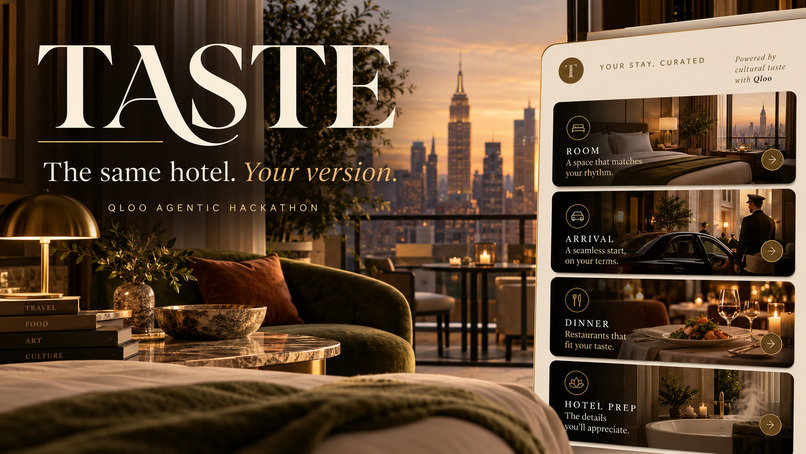
Taste Improving Hotels Experience one booking at a time!
Inspiration
Hotels already collect preferences, but most of those preferences never become meaningful changes to the actual stay.
Taste explores a simple question:
What if the same hotel could feel different for every guest?
Instead of recommending another hotel, Taste adapts the hotel the guest has already chosen.
A guest gives Taste three cultural references they love, such as:
Bad Bunny A24 Soho House
and selects the kind of stay they want, such as Rest, Explore, Romance, Nightlife, or Food.
Taste uses Qloo to turn those references into cross-domain cultural intelligence, then translates that intelligence into concrete hospitality decisions.
What it does
Taste creates a personalized version of the same hotel.
For each guest, it generates:
room setup direction arrival soundtrack direction welcome beverage or bite primary and backup dining recommendations after-dinner recommendation next-day local discovery an unexpected cultural recommendation a hotel staff preparation card
The hotel location is part of the input, so local and dining recommendations change with the property market.
The goal is not to show the guest a database of affinities.
The goal is to answer:
What should the hotel actually change for this person?
How Qloo powers Taste
Qloo is the core intelligence layer.
Taste uses Qloo to:
Resolve the guest's three references into real Qloo entities. Analyze the combined taste profile. Query related entities across music, film, brands, dining, and local places. Use location-scoped place results for dining and local discovery. Preserve affinity and explainability data for inspection.
Without Qloo, an LLM could only infer a vague aesthetic from three names.
With Qloo, Taste can ground the experience in structured cultural relationships across multiple domains.
The product architecture is:
Guest taste → Qloo entity resolution → Qloo Insights → cross-domain cultural profile → Taste experience synthesis → personalized stay → hotel preparation card
The demo
Taste includes two contrasting guest profiles for the same property.
Guest 01
Bad Bunny A24 Soho House Nightlife
Guest 02
Sade Studio Ghibli Muji Rest
The important demo moment is not simply that the recommendations change.
It is that the same hotel behaves differently for two different guests.
Users can also change the property location and run the same cultural profile in another city, which changes the local dining and place inventory while preserving the guest's broader cultural taste.
Guest experience
The guest-facing result is intentionally simple.
Taste shows:
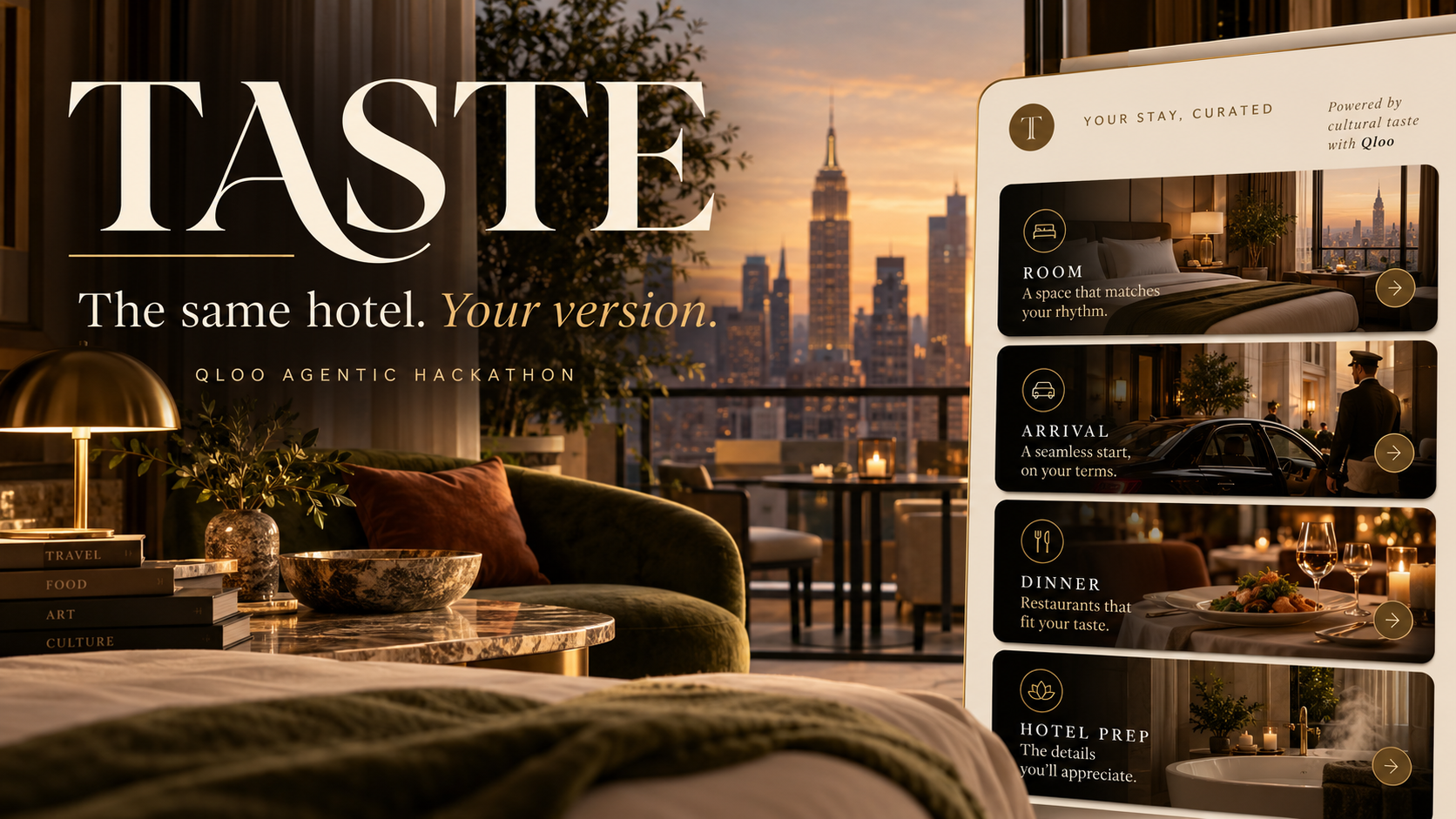
ROOM ARRIVAL WELCOME DINNER AFTER TOMORROW ONE THING YOU DIDN'T ASK FOR
The underlying Qloo data does not dominate the interface.
Instead, it influences the experience.
Hotel Prep
Taste also creates an operational preparation card for hotel staff.
It organizes recommendations into:
ROOM F&B MEDIA LOCAL
This turns taste intelligence into something a hotel team can prepare before arrival.
Why This Fits You
For transparency and hackathon evaluation, Taste preserves an inspectable Qloo evidence layer.
The evidence layer can show:
the original cultural seeds returned Qloo entities affinity values recommendations by domain
The guest experience stays clean while the evidence remains available underneath.
Design
Taste is designed as a hospitality product rather than an AI dashboard.
The visual system uses an editorial hospitality direction with:
warm cream surfaces charcoal typography restrained sage, terracotta, wine, sky, and gold accents serif display typography image-led experience cards minimal technical language in the guest-facing product
Tech stack
Next.js React TypeScript Zod Qloo API Vercel GitHub
Why it matters
Personalization in hospitality is often limited to loyalty status, room type, or generic preference fields.
Taste explores a richer model:
cultural preference as operational context.
The same hotel does not need to become a different property.
It only needs to know which parts of the experience should change for the person arriving.
What's next
Future versions could integrate directly with hotel property-management and guest-experience systems, add reservation and concierge workflows, learn from guest feedback, and allow properties to define which parts of the stay they can personalize.
The larger vision is a hospitality intelligence layer that helps properties turn cultural understanding into better guest experiences.
Built With
- github
- next.js
- qloo-api
- react
- typescript
- vercel
- zod