-
-
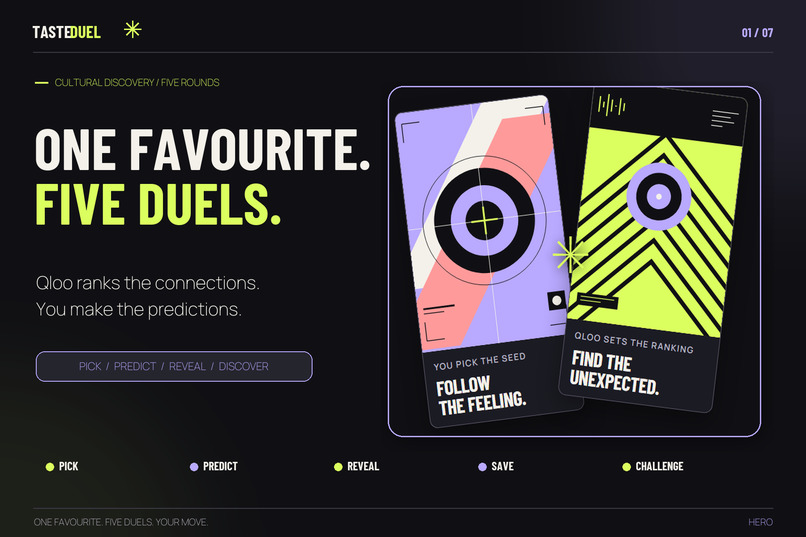
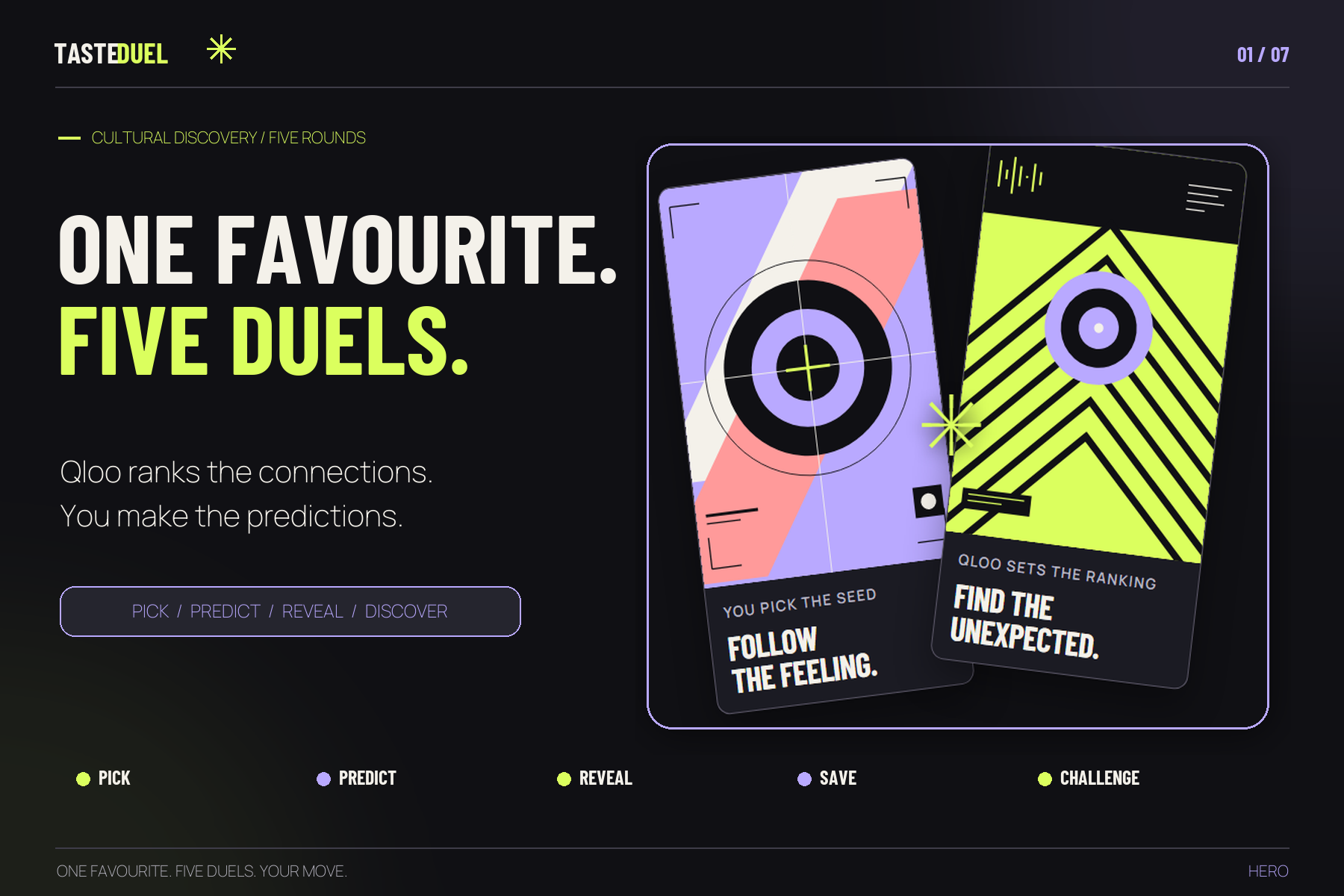
One favourite. Five duels. Predict Qloo-ranked cultural connections, save discoveries, and challenge a friend.
-
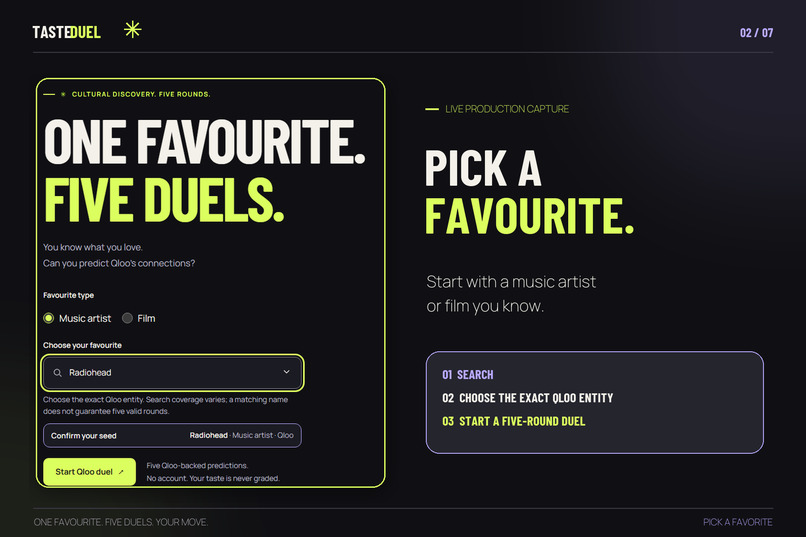
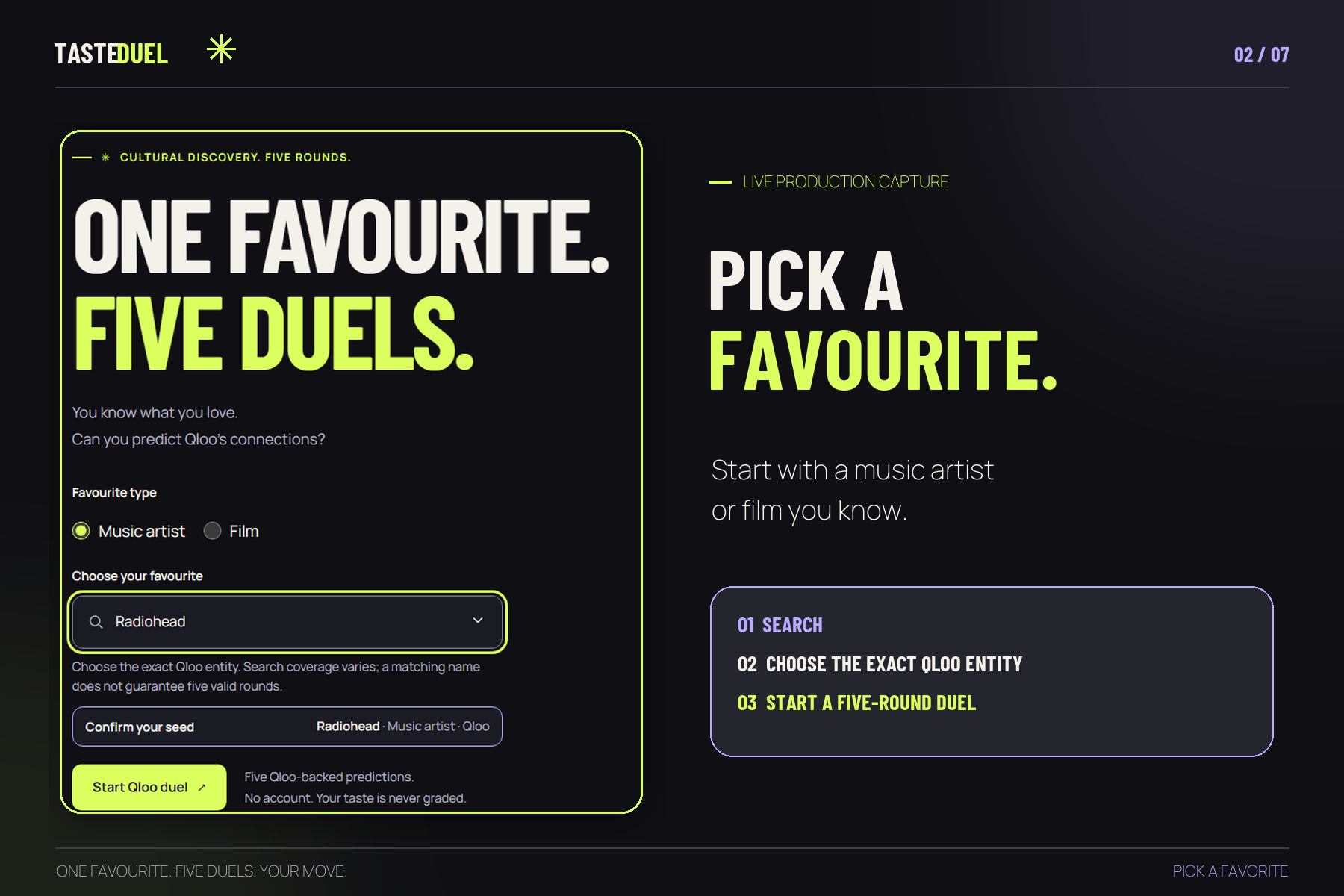
Choose a music artist or film from Qloo search. Radiohead is the selected seed in this production capture.
-
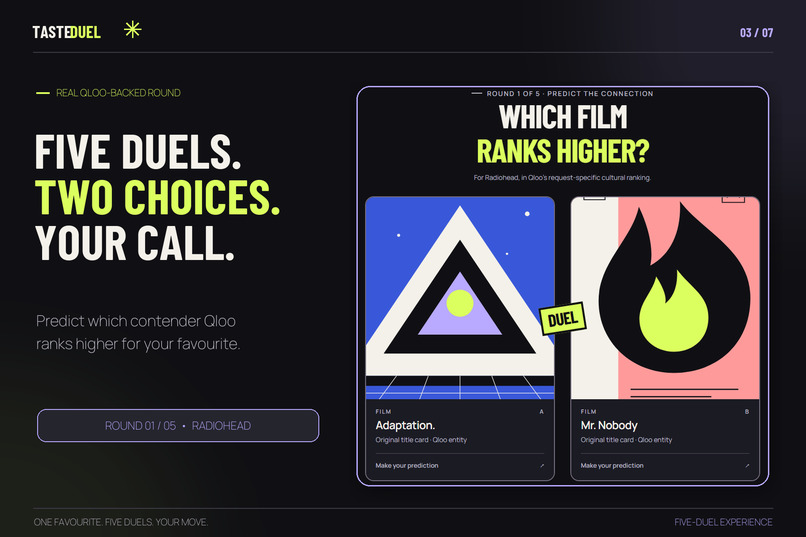
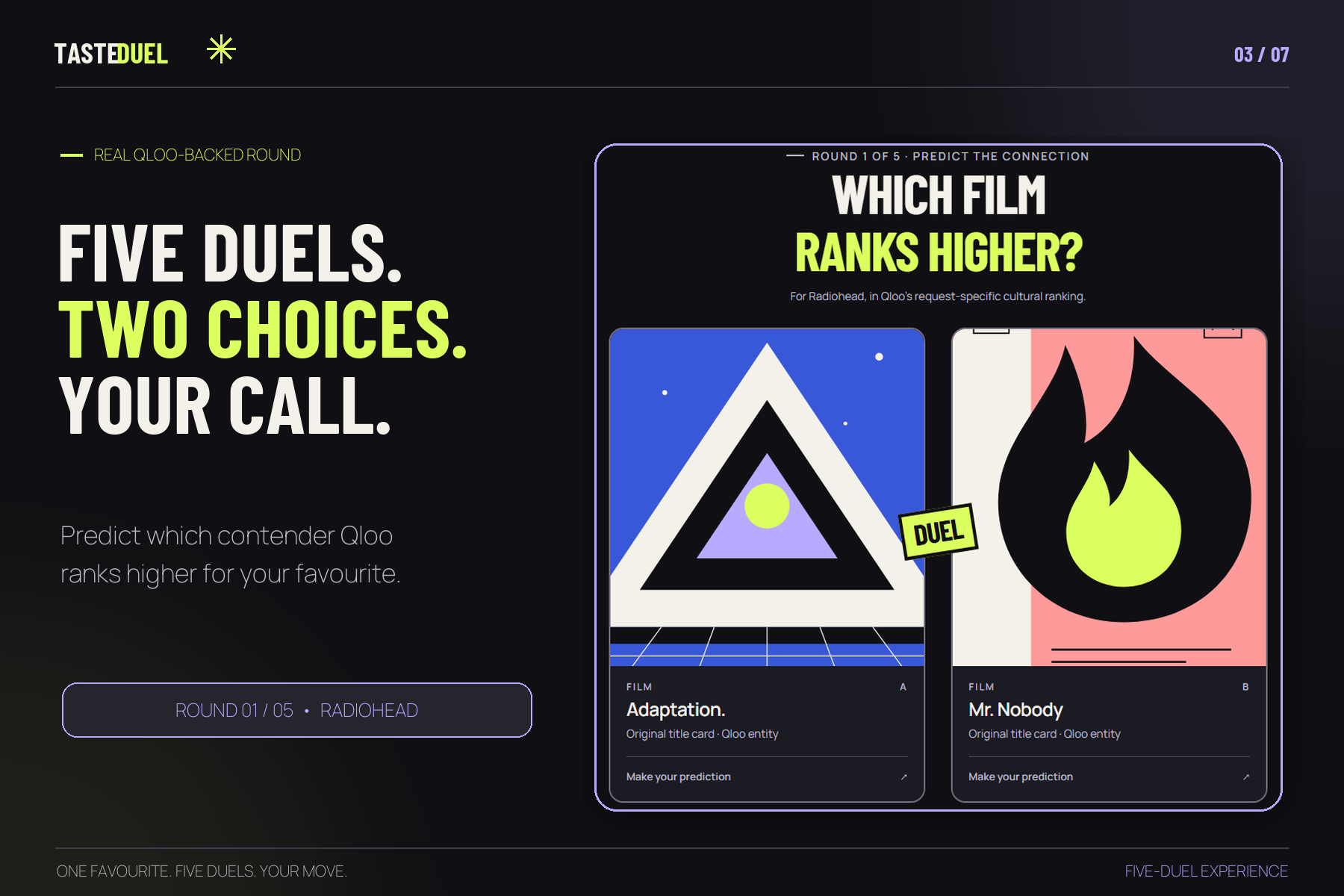
Five rounds, two choices each: predict which film Qloo ranks higher for the selected artist.
-
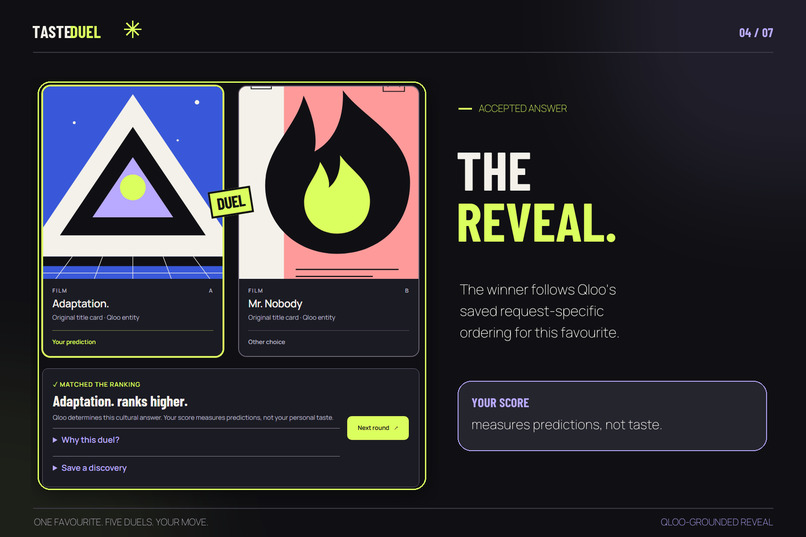
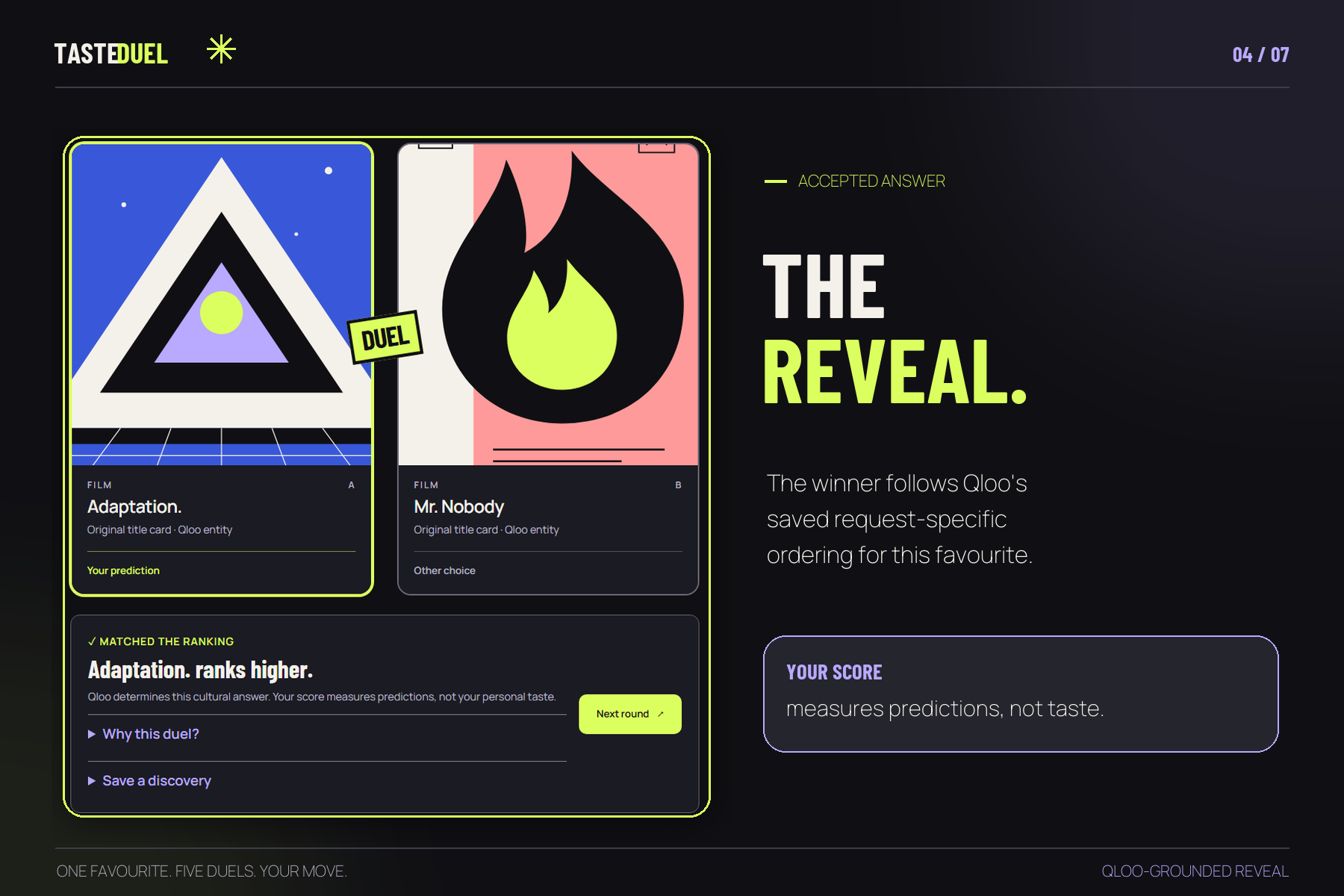
The accepted reveal names Qloo's higher-ranked choice. Your score measures predictions, not personal taste.
-
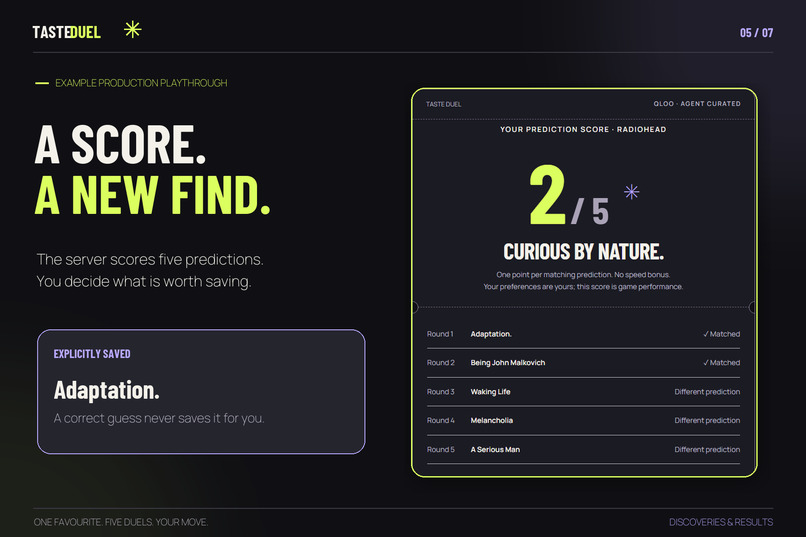
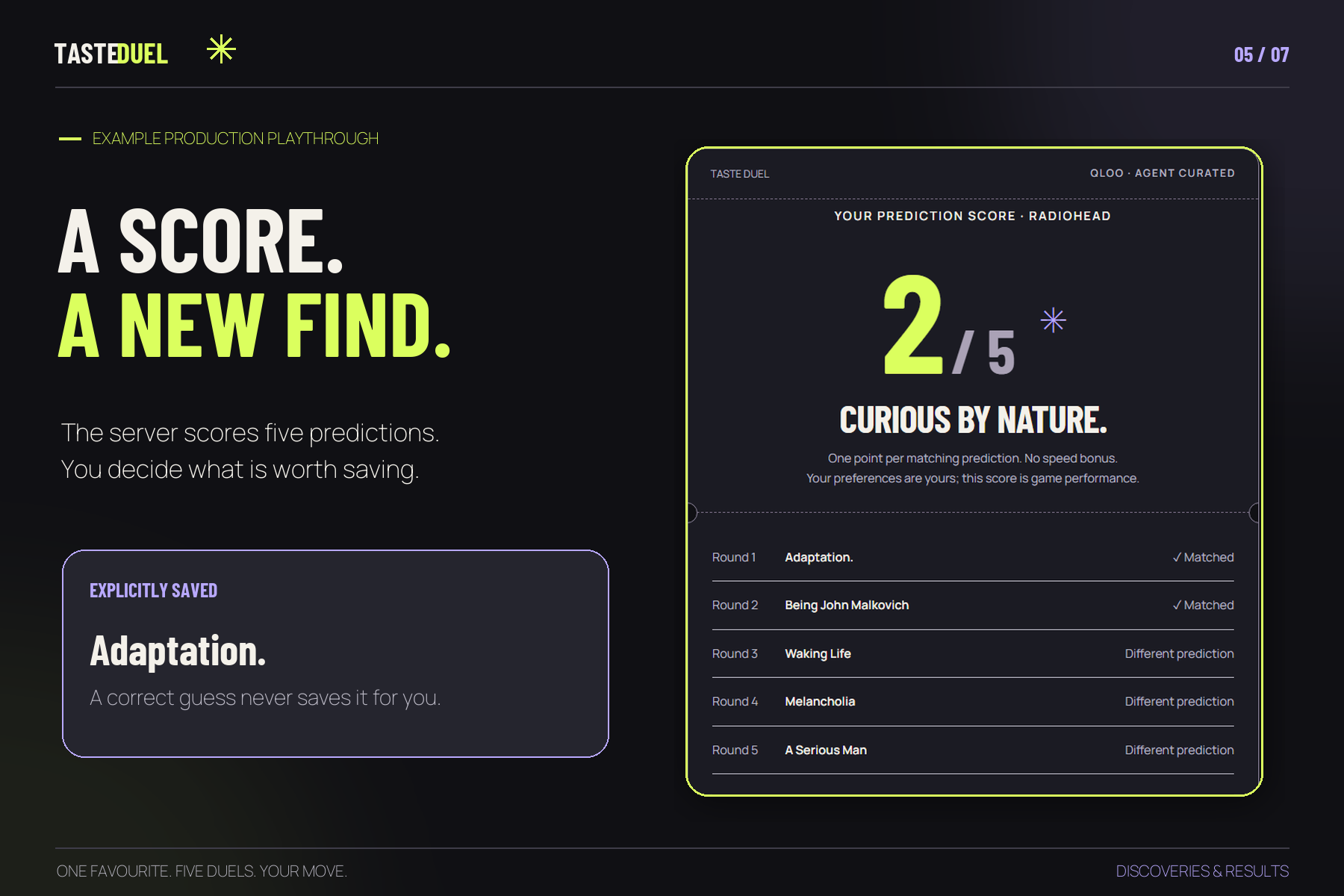
An example 2/5 result and an explicitly saved discovery. Saving is separate from getting a prediction right.
-
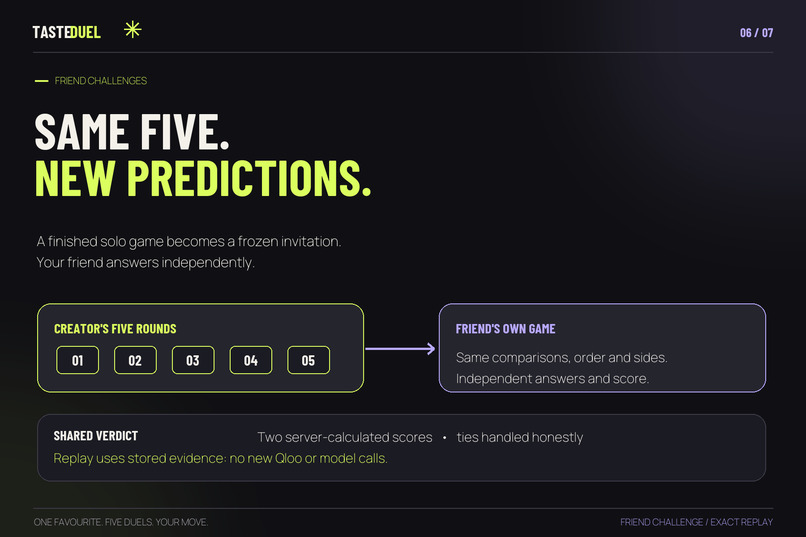
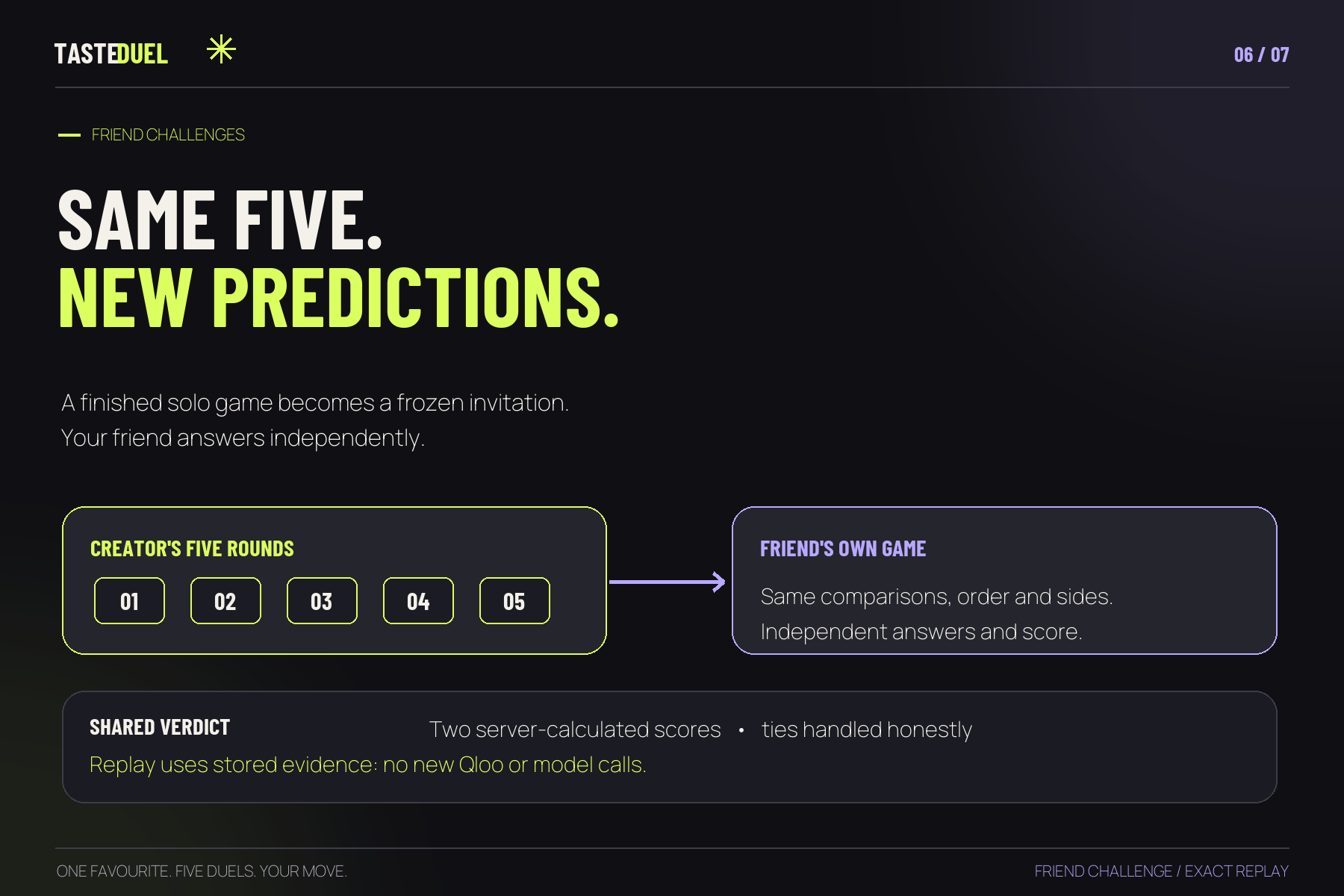
A friend replays the exact five comparisons, order and sides, with independent answers and a shared verdict.
-
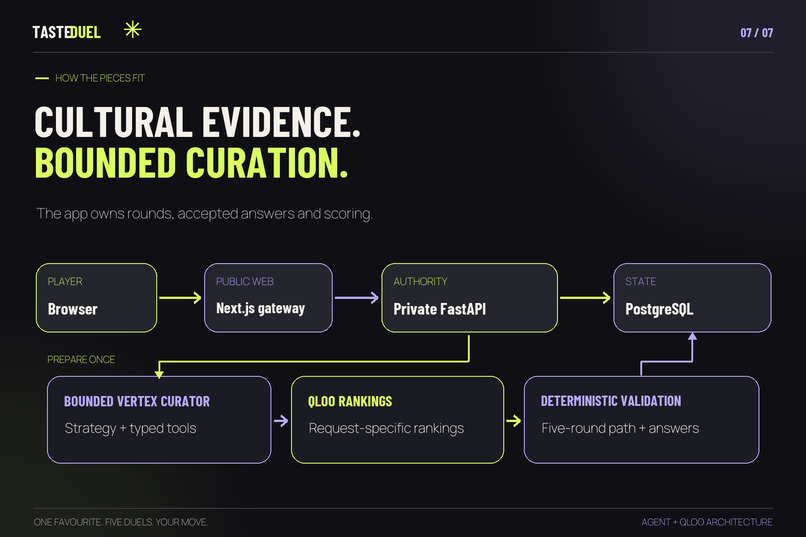
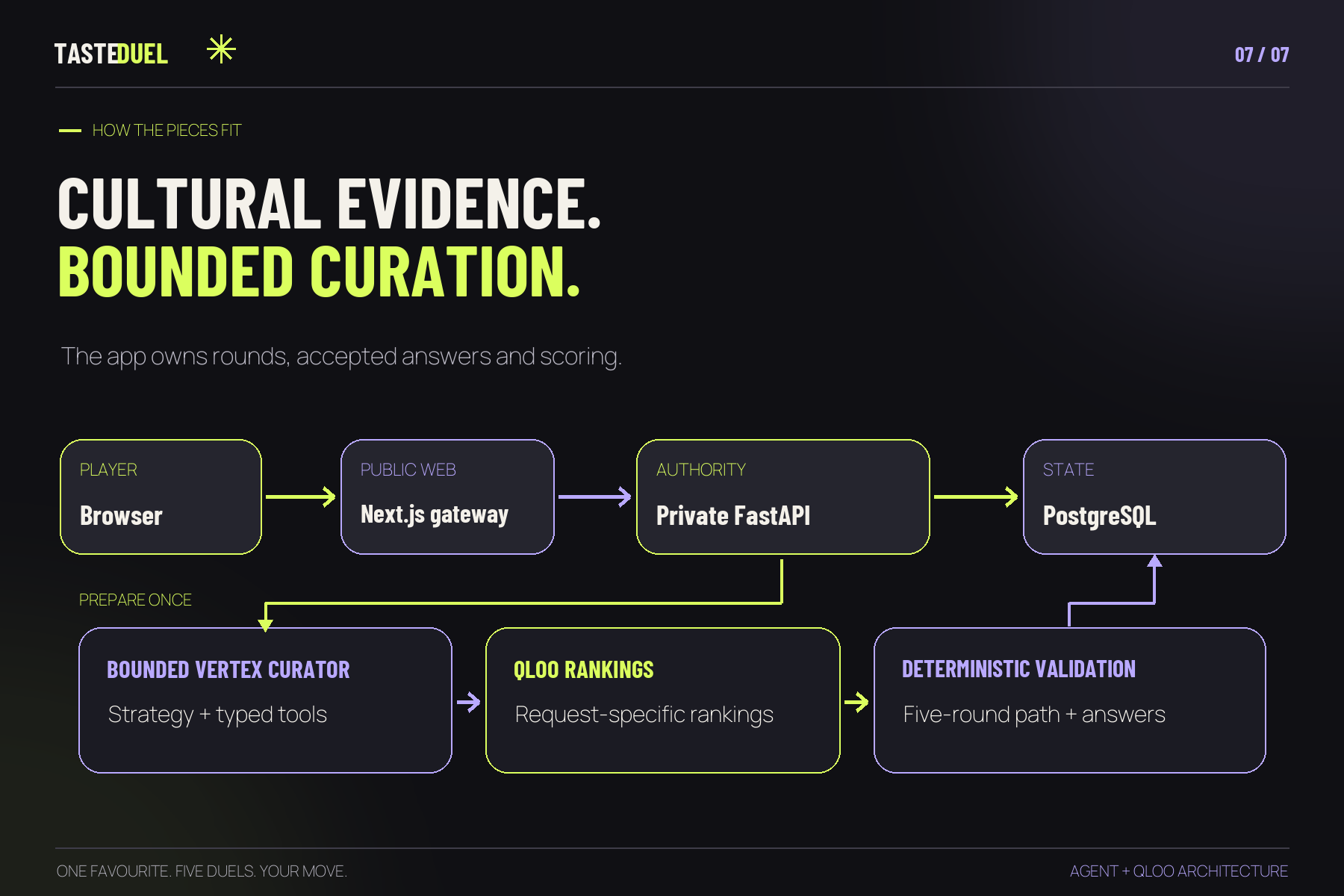
Next.js routes to private FastAPI; bounded Vertex curation uses Qloo evidence and deterministic validation.
Inspiration
AI is very good at sounding confident.
Taste is harder.
Most discovery products eventually become the same thing: “Here are 10 things you might like.” Useful? Sometimes. Memorable? Not really.
We wanted to ask a different question:
What if cultural discovery was something you could participate in, not just scroll through?
Taste Duel starts with one thing you already love—a music artist or a film—and turns that familiar favorite into five culturally grounded duels.
The important part is that we did not ask an LLM to invent what “feels related.”
We use Qloo’s taste graph as the cultural evidence layer, while an agent decides how to construct the discovery journey around that evidence.
Or, in one line:
We gave the agent curiosity. Qloo gave it taste.
That became our core design principle:
Remove the agent and you lose the curator. Remove Qloo and you lose the cultural ground truth behind every duel.
What it does
Taste Duel is an agentic cultural discovery experience that turns one favorite into five Qloo-grounded cultural comparisons.
Start with a music artist or film you already know.
Taste Duel’s curator explores a supported cultural direction, retrieves Qloo-backed candidates, validates that there is enough evidence for a complete five-duel journey, and prepares the experience.
For each duel, you predict which of two contenders Qloo ranked higher for your selected favorite.
Then Taste Duel reveals the accepted Qloo-backed result.
The question is deliberately not:
“Which one should you like?”
It is:
“Which one ranks higher for this seed in Qloo’s taste graph?”
Your score measures your predictions—not your taste.
Along the way, you can explicitly Save Discovery for anything you genuinely want to explore further.
After five duels, you can create a challenge for a friend. But we do not regenerate another loosely similar experience.
We freeze the exact five comparisons you received—the same order, same sides, same cultural context and same rules—and your friend replays that journey with an independent score.
The flow is intentionally simple:
Pick a favorite → Predict → Reveal → Discover → Challenge
Most recommendation engines say:
“You might like this.”
Taste Duel says:
“Make the call.”
How we built it
Taste Duel is designed around a strict separation between agentic strategy, cultural evidence, deterministic validation and user interaction.
The architecture looks like this:
Browser → Next.js → private FastAPI → RoundCuratorAgent → Qloo
with PostgreSQL holding authoritative state and deterministic services enforcing the rules.
The RoundCuratorAgent, powered through Vertex AI, makes bounded decisions about how to build the strongest available five-duel cultural journey. It can choose supported target directions, request Qloo-backed candidates, inspect validation feedback and make a bounded correction when useful.
But the agent is intentionally not allowed to invent winners, affinities or cultural facts.
An LLM can bluff its way through culture. Qloo brought receipts.
Qloo provides the request-specific ranking evidence.
A deterministic pool validator then checks identity, ordering, duplicates, ties, no-repeat feasibility and whether a complete five-duel path actually exists.
Only after those checks pass can a duel be delivered.
Once an answer is accepted, the server owns the result. Identical retries recover the same accepted state, conflicting submissions are rejected, and answering or advancing does not trigger new Qloo calls.
Friend challenges are also deterministic. The creator’s delivered journey is frozen and replayed from stored evidence instead of being regenerated later.
For production, Taste Duel runs a public Next.js web application with an IAM-private FastAPI service, PostgreSQL, scoped Google Cloud identities, Secret Manager references, immutable deployments and Terraform-managed infrastructure.
We also treated media rights as an engineering requirement. Qloo may provide image metadata, but metadata availability does not automatically mean redistribution rights. Taste Duel therefore uses original project-owned visual treatments when rights are not verified.
Challenges we ran into
The hardest problem was not connecting to an API.
It was deciding where intelligence should stop.
Giving an LLM authority over everything would have made the architecture simpler—but much less trustworthy.
So we gave the agent authority over strategy, Qloo authority over cultural ranking, deterministic services authority over eligibility and scoring, and the user authority over what is actually worth saving.
If the agent gets creative, great.
If it gets creative with the facts, the validator says no.
Another challenge was preventing accidental answer leakage. Future contestants, rankings, affinities and the answer key remain private. The browser receives only the current playable duel and receives ranking context only after an answer has been accepted.
Sharing created another subtle problem: if we simply regenerated a friend’s challenge, Qloo data or the curator’s choices could produce a different experience.
So instead we freeze the creator’s actual five delivered duels. Replay uses that immutable evidence and requires zero new Qloo or model calls.
Production reliability added another layer: session isolation, idempotent mutations, interrupted-response recovery, private API access, database migrations, IAM, monitoring and rollback all had to work together without turning a hackathon prototype into an unnecessary collection of services.
We deliberately kept the architecture lean.
Accomplishments that we're proud of
The biggest one is simple:
Qloo is not a logo in our architecture diagram. Qloo is the mechanic.
Remove Qloo and the central question no longer has a grounded answer.
We are also proud that Taste Duel uses a real bounded curator, not an LLM narrating a fixed workflow and being called “agentic.” The curator makes actual tool decisions while deterministic boundaries prevent it from manufacturing cultural truth.
The complete production experience now supports:
real seed selection → Qloo-backed curation → five duels → accepted reveals → score → saved discoveries → challenge → exact isolated friend replay
The public application is deployed, while the API remains private behind the web layer.
Our verification covers genuine Qloo ranking and Vertex tool use, five-round journeys, exact replay, interrupted-response recovery, database isolation, keyboard interaction, reduced motion, mobile layouts, accessibility scans and provider failure paths.
And perhaps our favorite product detail:
Your friend does not receive a freshly generated “close enough” challenge.
They receive your exact cultural journey.
So if they beat your score, unfortunately, the evidence is admissible in the group chat.
What we learned
The biggest lesson was that good agentic systems do not need the model to control everything.
Taste Duel became stronger when we narrowed the agent’s authority.
The agent decides how to explore.
Qloo provides what the cultural evidence says.
Deterministic services decide whether a duel is valid and who actually ranked higher.
And the person decides whether a discovery means anything to them.
We also learned that grounding becomes much easier to understand when it changes the product interaction itself.
Using Qloo only to generate another recommendation list would technically integrate cultural intelligence, but much of its value would remain invisible.
By turning Qloo’s ranking relationships into something you must predict before seeing the result, cultural intelligence becomes something you can interact with, question and remember.
We also learned to be careful about what technical evidence can prove.
Successful API calls and automated tests can prove the system works. They cannot prove that every human will find every cultural connection surprising or valuable.
We would rather state that limitation honestly than manufacture impact statistics.
What's next for Taste Duel
Taste Duel currently focuses deliberately on music artists and films, where we have validated the interaction and cultural-ranking flow.
The next step is not simply “add more categories.”
It is to expand only where Qloo-supported evidence can create equally strong experiences across areas such as dining, fashion, travel and experiences.
We also want to run structured human evaluation around the questions that technical tests cannot answer:
Was the connection genuinely unexpected? Did you discover something worth exploring? Did you save it? Would you challenge someone else?
Longer term, Taste Duel could become a broader cultural exploration layer:
start with one thing you love, let an agent navigate outward through grounded cultural relationships, and decide for yourself which unexpected connections are worth following.
Because “here are 10 things you might like” deserved a plot twist.
One favorite. Five duels. A much bigger cultural map.
Built With
- alembic
- docker
- fastapi
- github-actions
- google-cloud-run
- google-cloud-sql
- google-gemini
- google-secret-manager
- next.js
- playwright
- postgresql
- pydantic
- python
- qloo-api
- qloo-insights
- react
- react-aria
- sqlalchemy
- terraform
- typescript
- vertex-ai

Log in or sign up for Devpost to join the conversation.