-
-
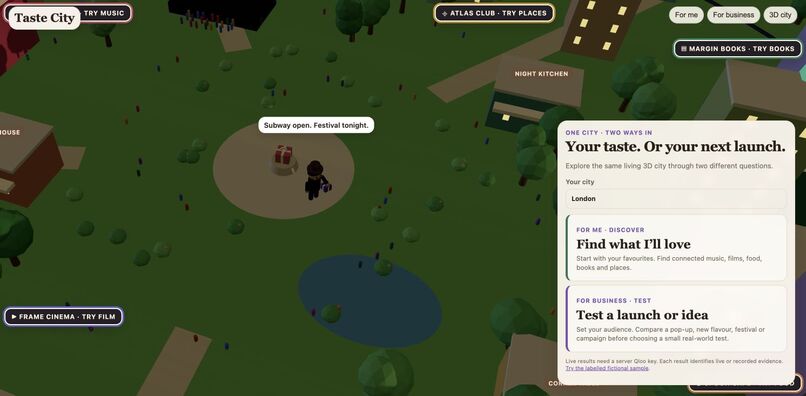
Two paths in the live product: personal discovery and business idea testing.
-
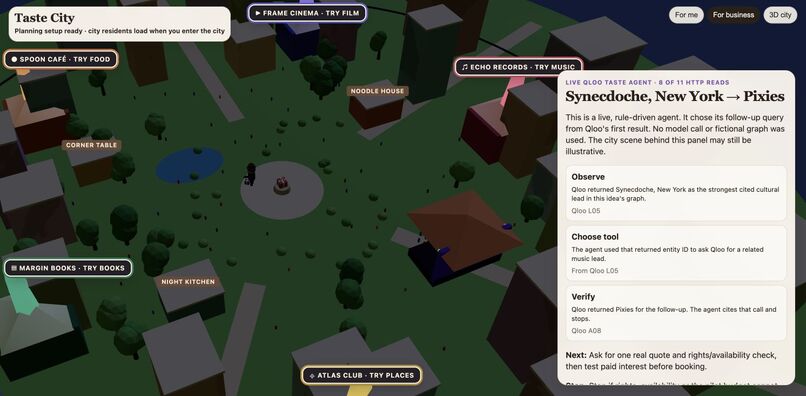
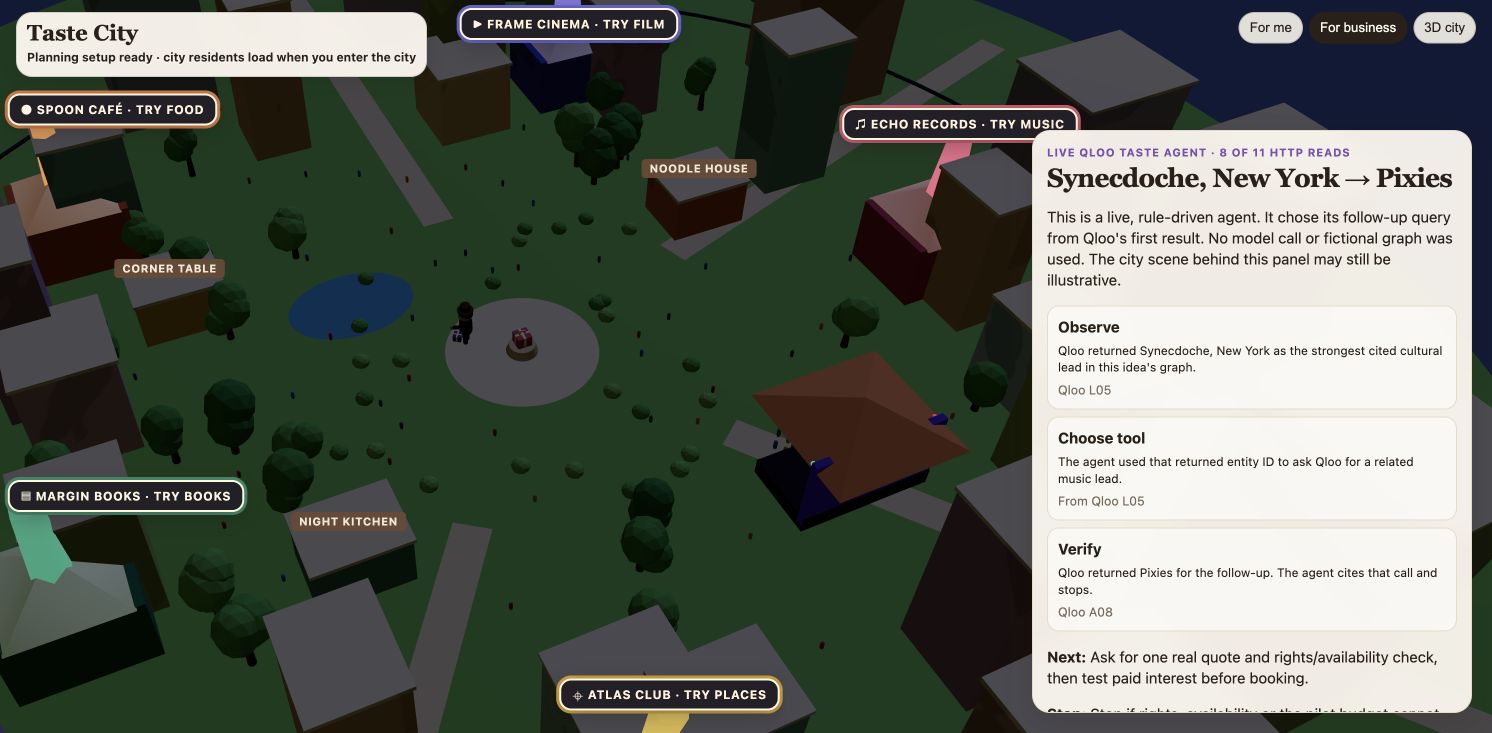
Actual hosted Taste Agent: Synecdoche, New York to Pixies, with Qloo call references; eight reads within the eleven-read cap.
-
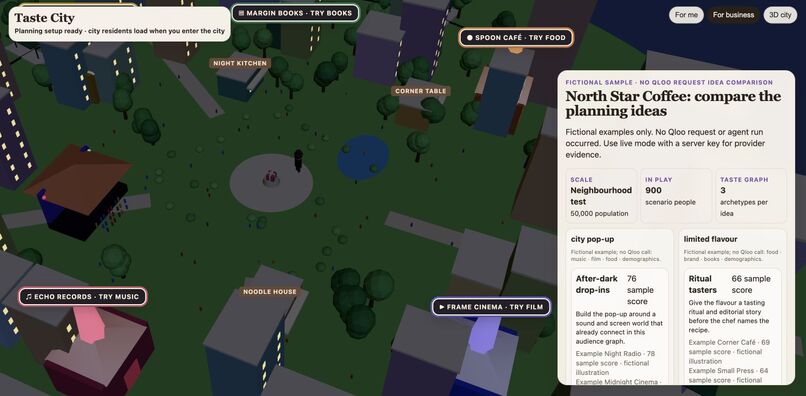
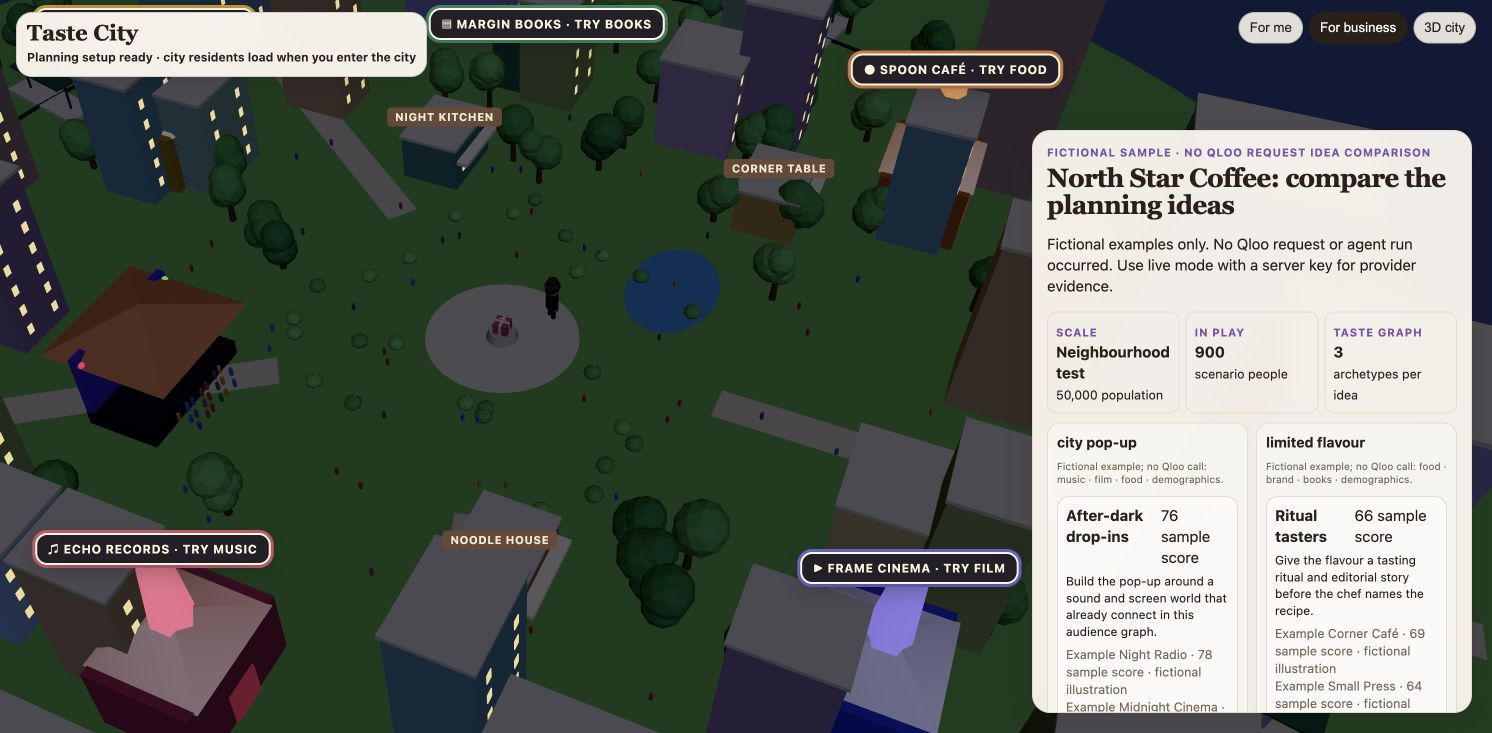
Fictional business comparison sample. No Qloo or agent request; spend figures are scenario assumptions, not a forecast.
Inspiration
Ask an AI model with no audience context what a London coffee pop-up should do, and you get the classic answer: single-origin beans, pour-over, limited seating. Give it Qloo taste profiles and you get Yves Tumor listening sessions, Synecdoche, New York in the decor, and Caffè Estorick as the hospitality reference. All three names came from Qloo's results for this audience, each with a Qloo entity ID you can look up.
Before building, we talked with pop-up shops, cafés and run clubs to understand the problem. Oscar spoke with 3 café owners and 2 bar owners, and they have this issue.
Taste does not stay in one category. The music you love connects to the films, books, food and places you will love next. Taste City turns that into a city you can walk around: one path to discover for yourself, one path to test an idea for a business.
What it does
For me: pick three favourites and a city. Qloo resolves them and returns five discoveries across five domains: music, film, food, books and places. Every result names the Qloo entity and the call it came from, so each one can be checked.
For business: a coffee-shop owner or festival programmer picks audience tastes, a city and two ideas, such as a pop-up versus a new flavour. Taste City compares them through the Qloo taste graph and hands back a next-action brief with a budget cap and a stop rule.
The Live Taste Agent does the research itself. It reads an idea-specific Qloo graph, picks its strongest cultural lead, uses the returned entity ID to query a second domain, checks the result, and proposes a small field test. On the live site it followed Synecdoche, New York into music and came back with Pixies, in 8 Qloo reads against a hard cap of 11.
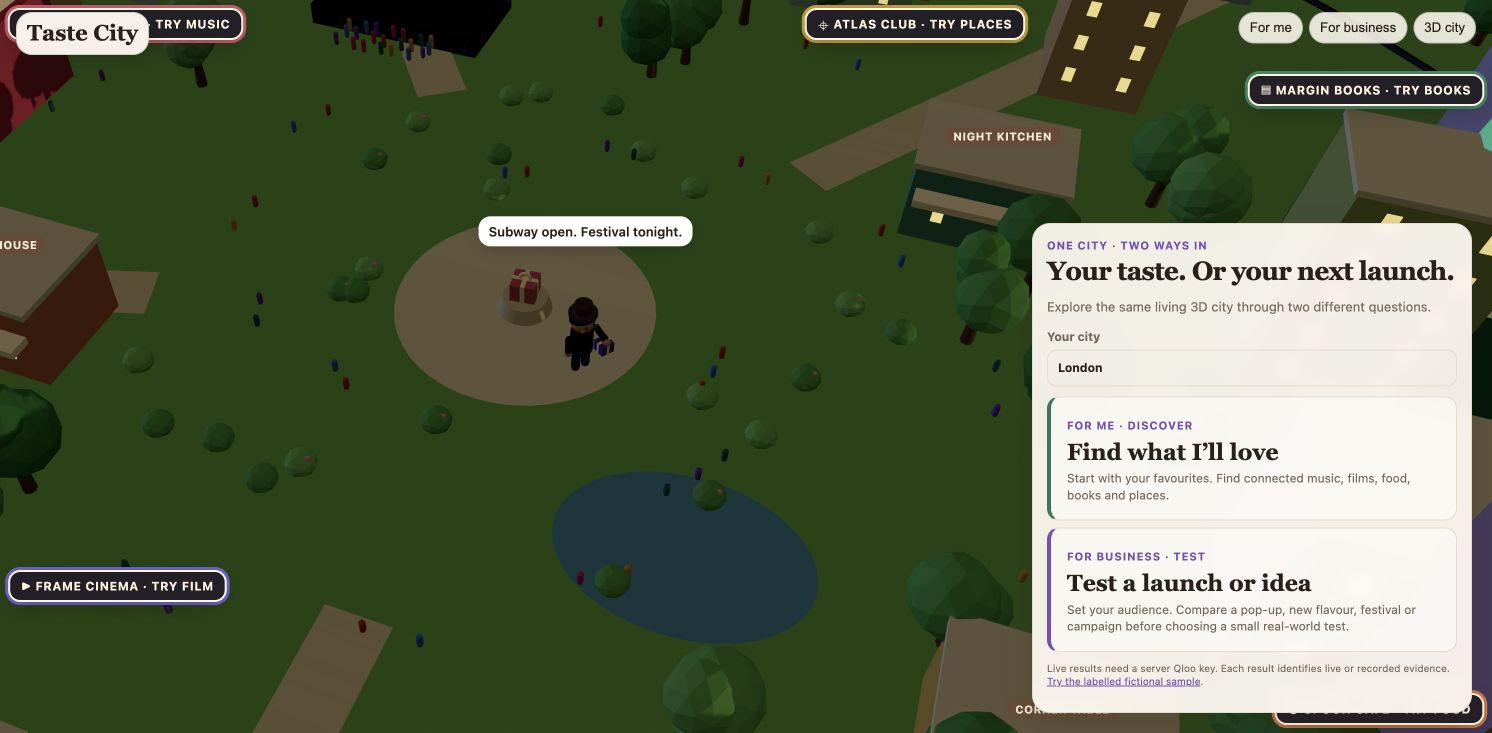
And the city is alive: residents, cultural outlets, a gift game, a subway, a festival and a day/night cycle.
How we built it
Three.js in the browser, a Python backend on Vercel with 11 file-based API functions, and Qloo for every taste link. Keys stay on the server; the repository is public and MIT-licensed.
The agent is a bounded tool loop. Its next query depends on a Qloo-returned entity ID and ranked relationship, so each cultural link it follows starts from an entity Qloo returned, with a call reference you can inspect.
Accomplishments that we're proud of
We tested Qloo against every frontier model we could reach, on a task with a checkable answer: name 5 real places within 500 metres of an address in a smaller European city. Adding Qloo's location filter raised the share of places we could verify within 500 m to 81 to 88% for all 13 models (Claude Opus, Sonnet and Fable, GPT-6.1, Gemini 4, Grok 4.7, Kimi, DeepSeek, Cursor Composer, and GLM 5.3, Qwen 3.8 Max, MiniMax M3 and NVIDIA Nemotron 3 Ultra, the last four run on Venice), up from 32 to 83% without it. That held across 15 questions per model, 10 addresses in 10 cities and two different audiences, and the gain is statistically clear for 7 of the 13 (Composer, Sonnet, DeepSeek, Kimi, GLM, MiniMax and Nemotron). The strongest models were already close, so for them the gain is small; Qloo brings every model up to the same level.
Every Qloo result is traceable. A judge, a planner or a curious user can follow it back to the Qloo entity and call behind it. A language model alone cannot give you that.
We tested it blind. Five frozen business questions, a rubric written before any output existed, and a grader from a different model family that never knew which answer used Qloo. Against the same model with no audience context, answers built on Qloo taste profiles were far more specific: 25 versus 19 on specificity, about a third higher. Qloo answers won 4 of the 5 questions and tied the fifth.
The release passes 180 automated tests.
What we learned
We pushed the test further, and the result sharpened the pitch. With two frontier models, giving the model the audience description already lifts its answers. Adding Qloo facts on top did not make the writing measurably better: one model scored 1.3% higher with Qloo, the other 3.7% lower, inside grader noise. So the value of Qloo here is not nicer prose. It is that every cultural link is real, specific and checkable, and that is exactly what a small business needs before it spends money on an idea.
What's next
Put the briefs in front of real coffee-shop owners and festival programmers and measure which Qloo references they actually act on, and whether those choices work better than the ones they would have made anyway.
Try it
https://taste-city.vercel.app/?setup=1 then choose For business, keep the coffee-shop defaults and click Ask live Taste Agent. For me opens personal discovery.
Built With
- javascript
- python
- qloo
- three.js
- vercel

Log in or sign up for Devpost to join the conversation.