-
-
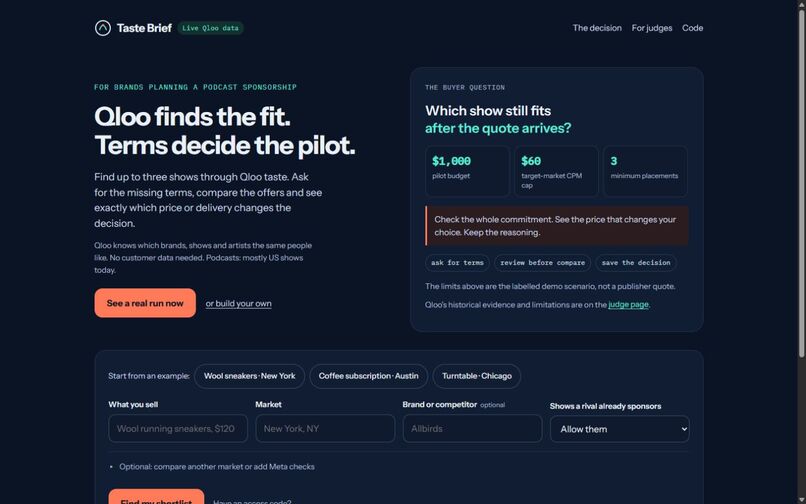
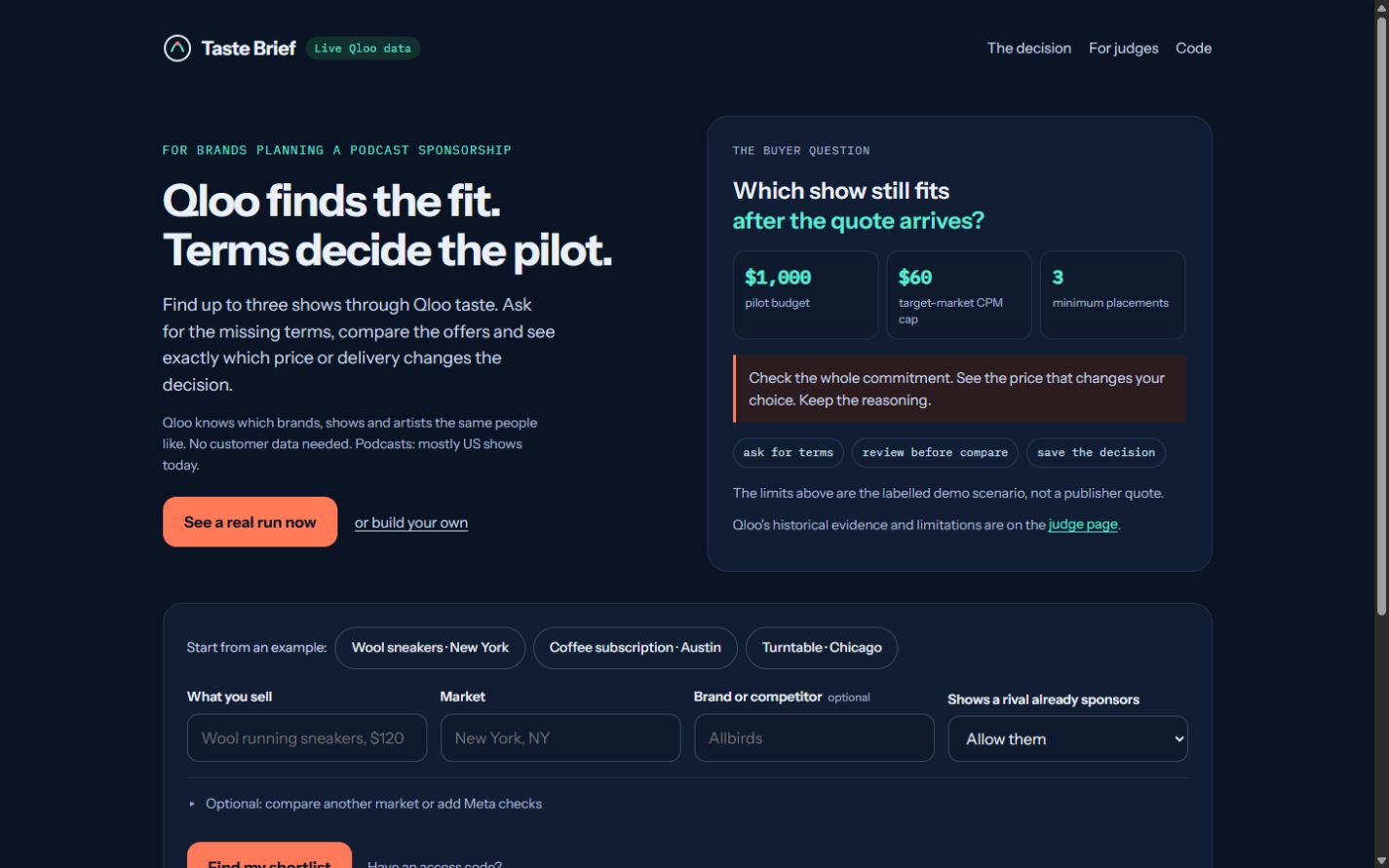
Qloo finds the fit; the buyer supplies the limits. The focused flow starts with four fields.
-
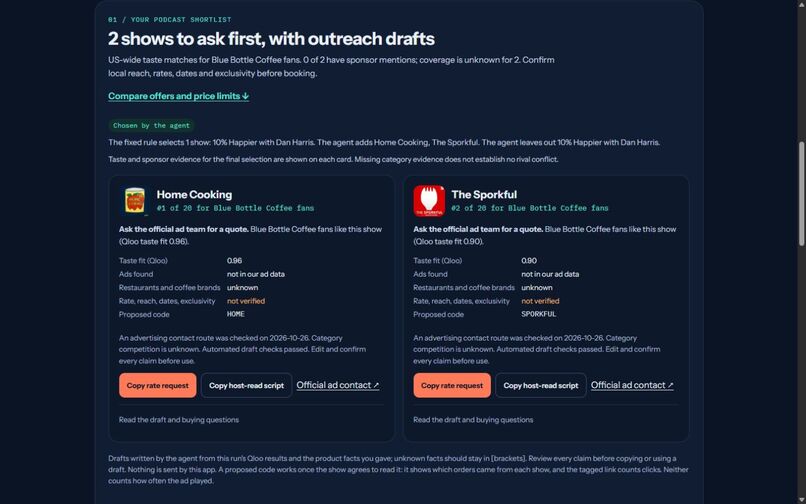
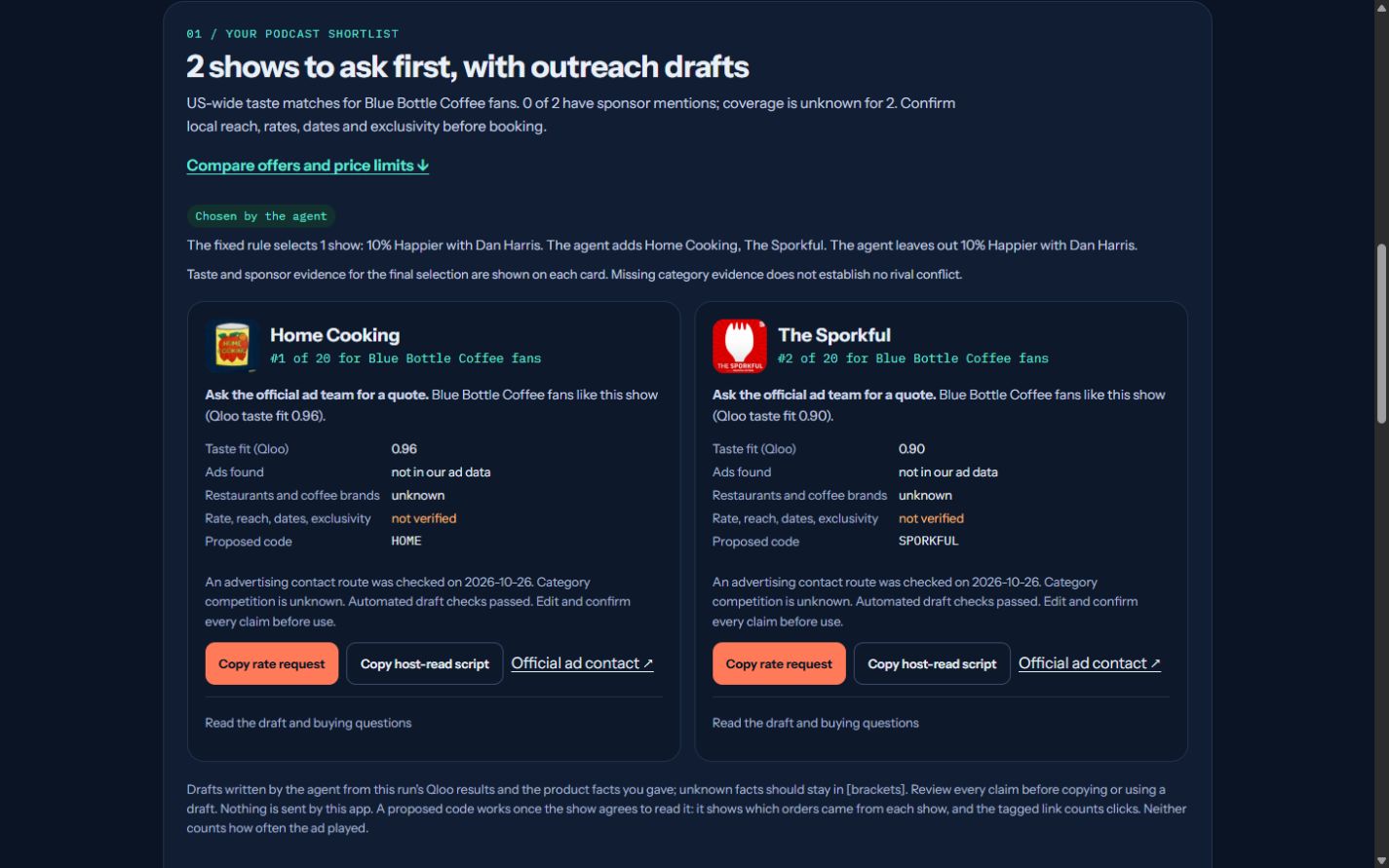
Recorded Qloo coffee results: Home Cooking and The Sporkful, with evidence and rate-request drafts.
-
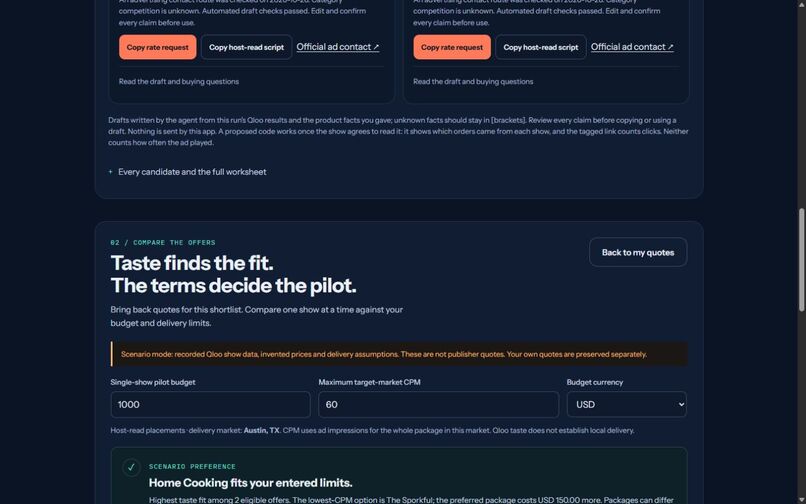
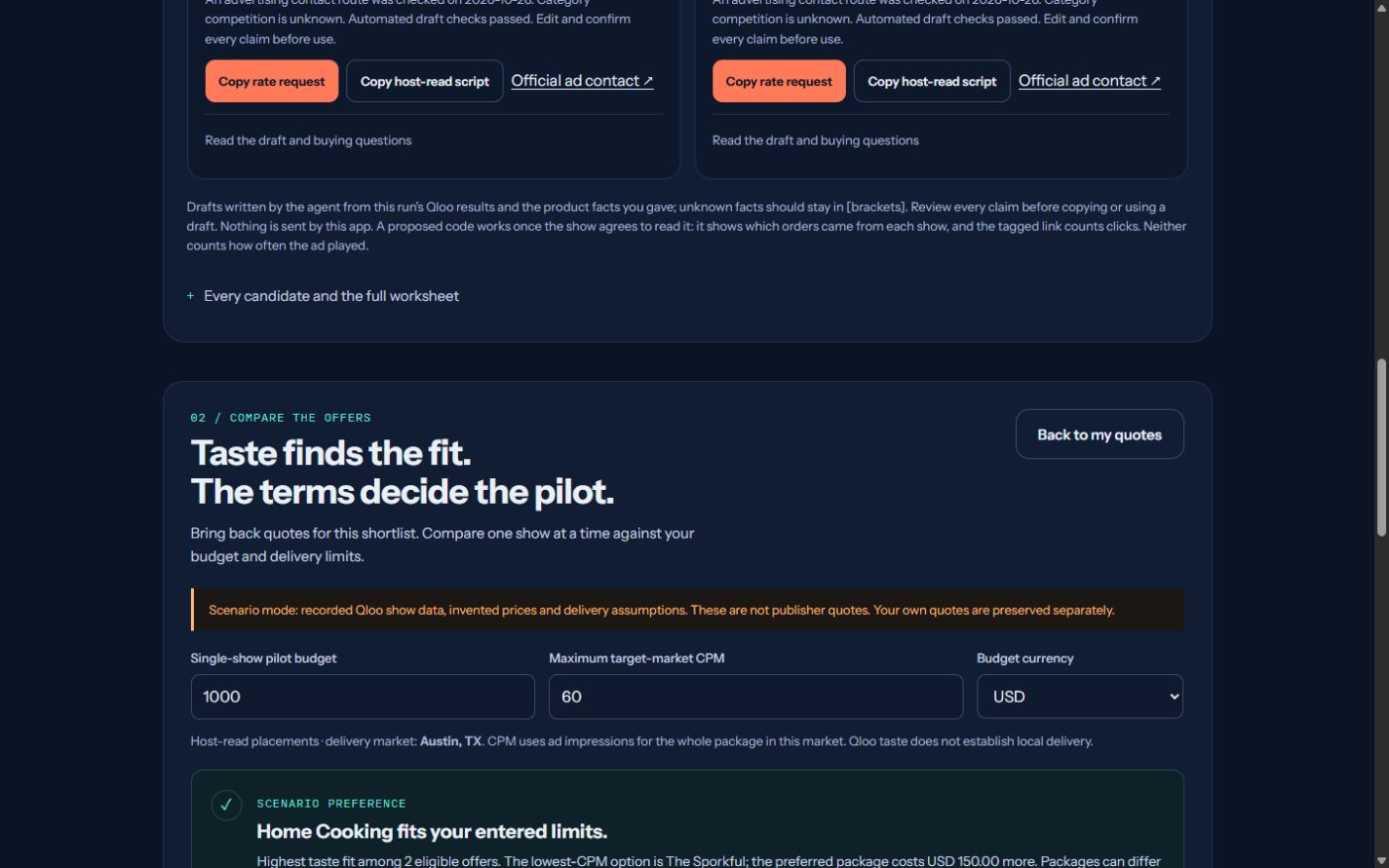
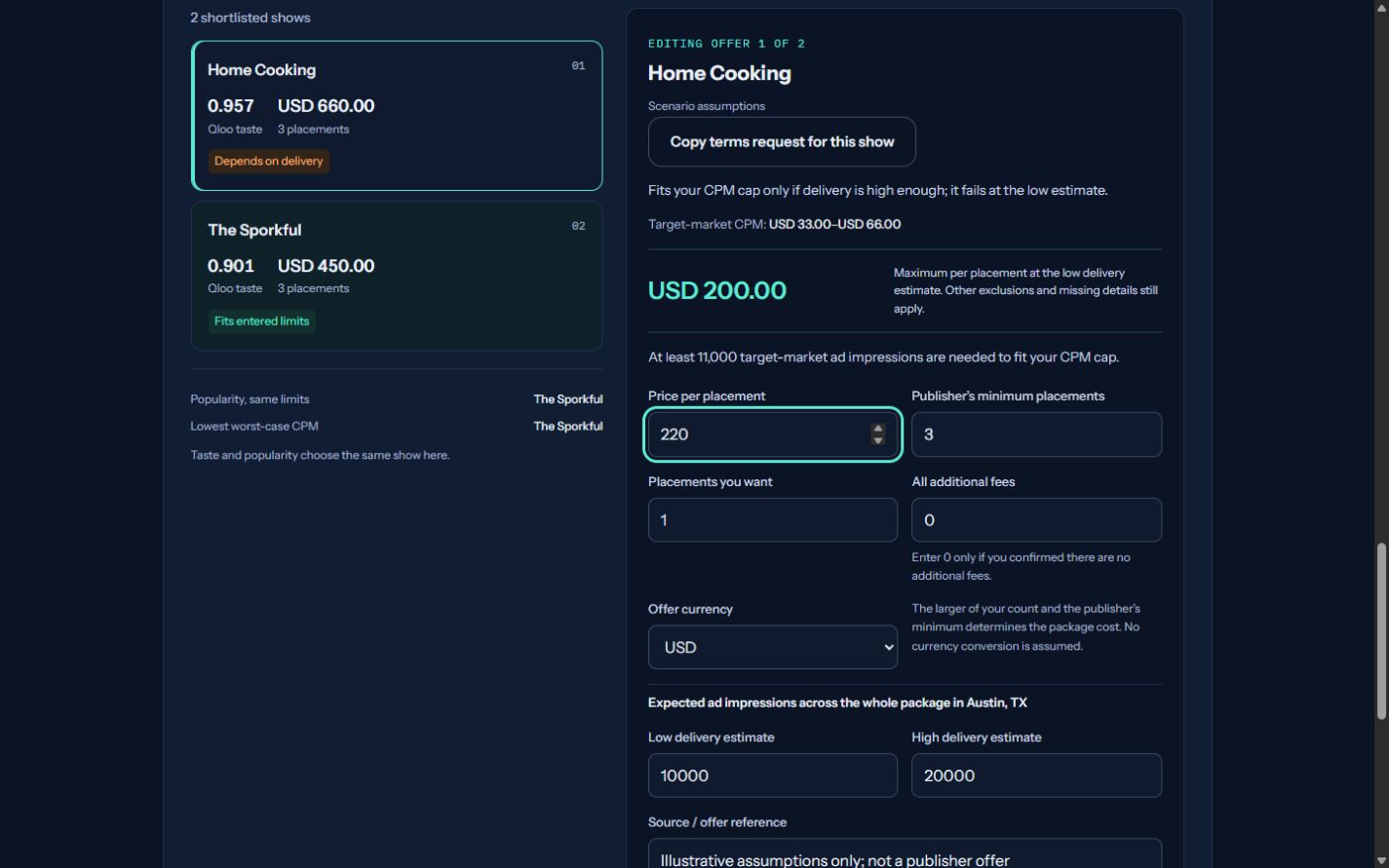
Invented scenario: a $600 Home Cooking package meets the assumed $1,000 budget and $60 CPM cap.
-
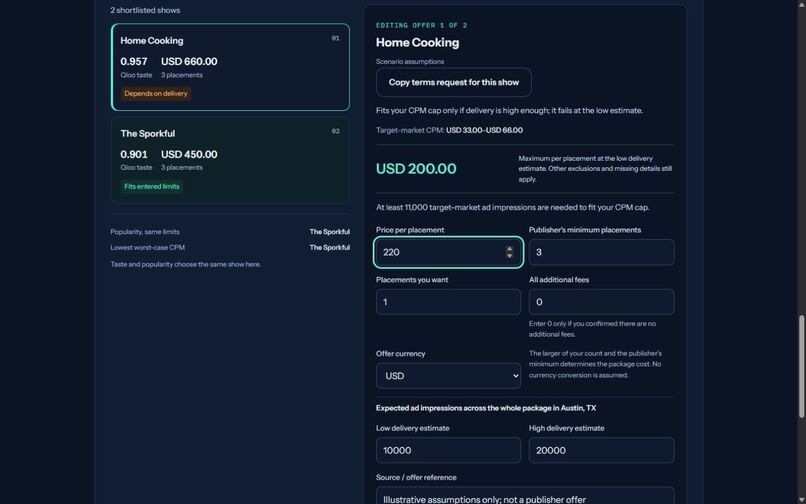
Raise the price above its ceiling: review resets and the preferred pilot changes after re-review.
-
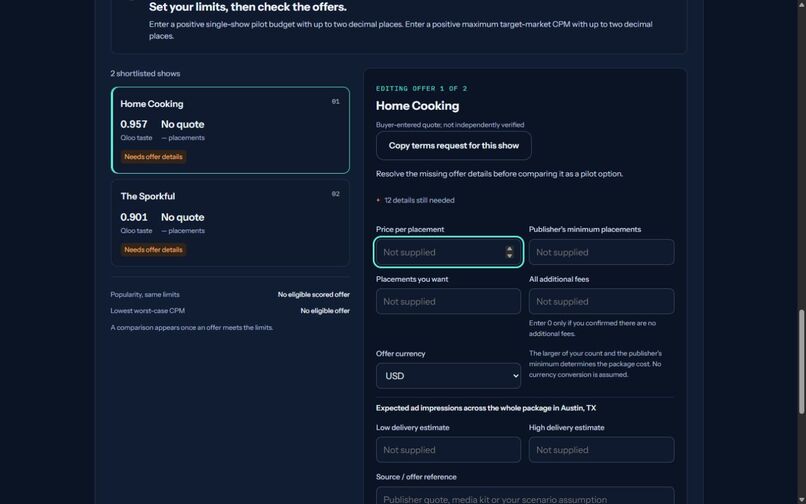
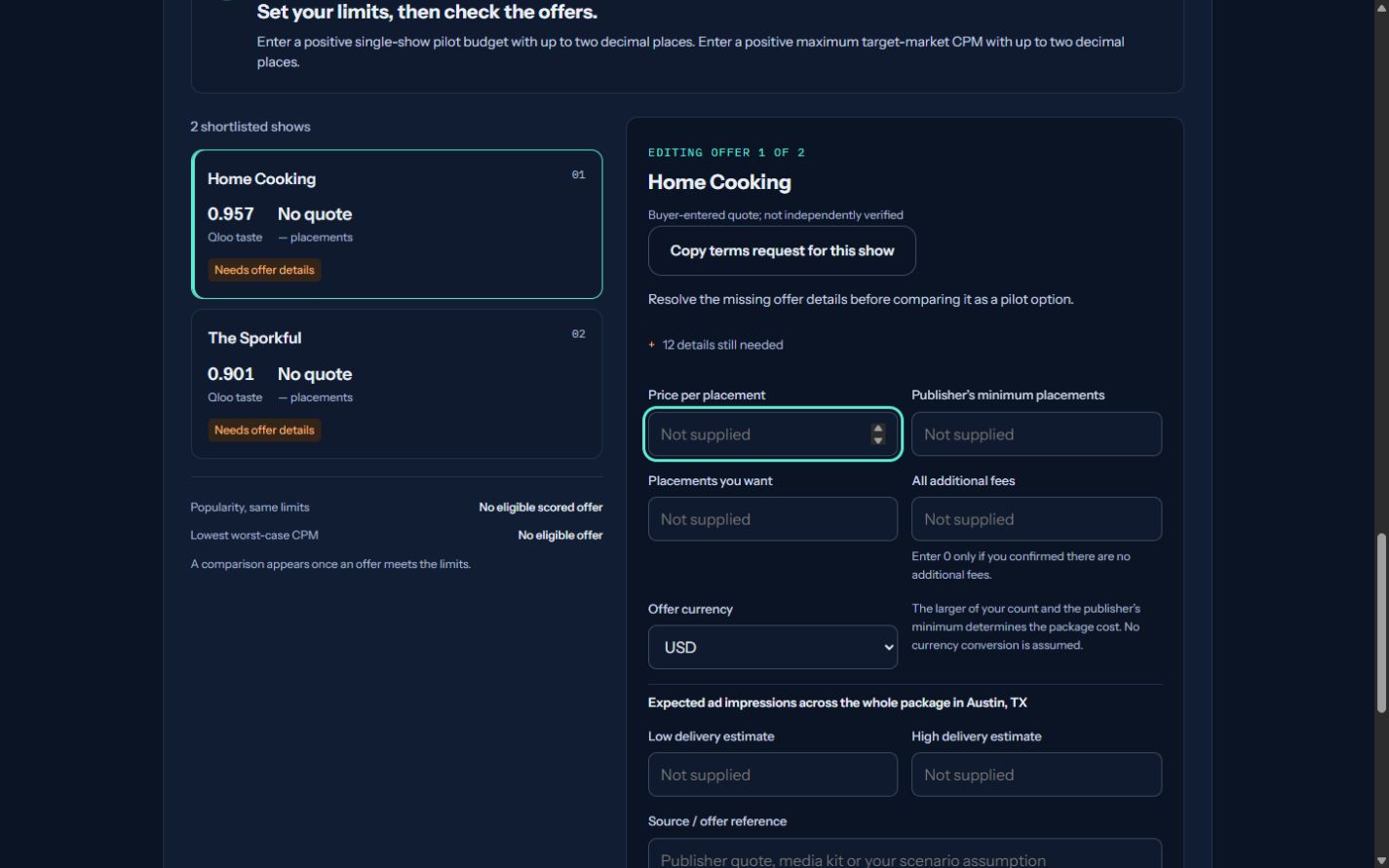
Real quote mode leaves unknown terms blank. Missing delivery or publisher terms holds the decision.
Inspiration
A podcast can fit a brand beautifully and still be the wrong first buy. The minimum commitment can exceed the budget. The audience figure can be worldwide downloads when the buyer needs ad impressions in one city. Recommendation tools stop at "who fits?", and the buyer is left alone with the harder question: at what price is this pilot still worth it?
What it does
Taste Brief is a sponsorship decision desk for a brand's first podcast pilot.
1. Find the fit. Enter a product, a market and a reference brand. A Claude agent resolves the entities in Qloo, reads up to 20 Qloo podcast matches with their descriptions and the sponsor reads found in their episode notes, and picks up to three shows to ask first. For each it writes a rate request and a host-read draft, with an official advertising contact where one is verified. Rival exclusions, ended shows and unknown facts are enforced in code, never left to the model.
2. Check the deal. Bring back the quotes. The desk computes the whole commitment (price, minimum placements, fees), checks it against the pilot budget and a worst-case CPM on target-market ad impressions, and holds any offer with missing terms. A download count is never treated as delivered ads.
3. Know what changes your choice. For every offer the desk shows the highest price per placement that still fits both limits. Push one term past that line and the pick changes on screen. Taste, popularity and lowest CPM are compared under the same limits, so the tradeoff is explicit. The buyer saves a decision memo with every assumption. Nothing is sent by the app.
Why Qloo is the core
We tested Qloo's taste signal against facts that do not come from Qloo: sponsor reads in podcast episode notes. With rules locked before analysis, strict labels cover 216 US podcasts and 62 brands. Qloo ranked a show a brand sponsors above one where no sponsorship was found 65% of the time (AUC 0.647; 95% interval 0.60 to 0.70), against 52% for Apple chart rank. The signal is specific to each brand: its own Qloo score beats other brands' scores on the same shows for 47 of 61 brands (+8 points, interval 4 to 13). A missing label does not prove no sponsorship, and none of this is a campaign forecast.
How the agent works
- Tool use over Qloo. Claude has Qloo search, insights, demographics, tags and podcast tools and decides which to call and when; a Cloudflare Worker streams every step so the buyer watches the work.
- It corrects itself. When a planned Meta interest does not exist, the agent rewrites the plan: across 11 runs with the plan locked first, tests naming a missing interest fell from 14 to 3, and a code gate keeps those 3 out.
- Its words are checked. Rate requests and host reads pass code checks in 17 of 18 cases on 10 products.
- Its limits are published. In a locked comparison on the same shows, the agent's picks found 21 real sponsorships and plain popularity 25. So the agent reads, chooses among Qloo's ranked candidates and writes, while every commercial rule is deterministic code.
- Fast enough to use. The latest live runs finished in 31, 33 and 36 seconds.
What remains unproven
No campaign was launched and no lift was measured. No independent buyer pilot is verified. Published rates do not prove inventory, and the desk compares one-show pilots, not a multi-show plan. Every study, negative result and source record is on the judge page.
Built with
Claude tool use, the Qloo API, Cloudflare Workers, plain JavaScript; 136 tests and six locked research fingerprints. MIT licensed. Built by a paid-social practitioner with Claude Code and Codex.
Try it
- Demo: open the recorded real run (no access code), then try the labelled quote scenario or your own terms.
- Judge evidence: study design, limits and reproducible results.
- Code
- Walkthrough video
Built With
- claude
- cloudflare-workers
- javascript
- node.js
- qloo
