Inspiration
AI has become incredibly good at answering:
“What should I watch, listen to, eat, or explore?”
But we noticed a deeper problem: an AI recommendation can sound convincing without actually being culturally relevant.
A recommendation might share a genre with something a person likes, yet completely miss the context behind their taste — their location, cultural preferences, audience, constraints, or the relationships between different parts of their taste profile.
We wanted to explore a different question:
What if we didn't just ask AI to recommend something — what if we could audit whether the recommendation actually belongs in someone's world?
That became TasteAudit AI.
We built it from the ground up as a cultural quality layer for AI recommendations, using Qloo's cultural intelligence graph as the evidence layer behind the audit.
Our philosophy is simple:
Don't Just Recommend. Verify the Taste.
What it does
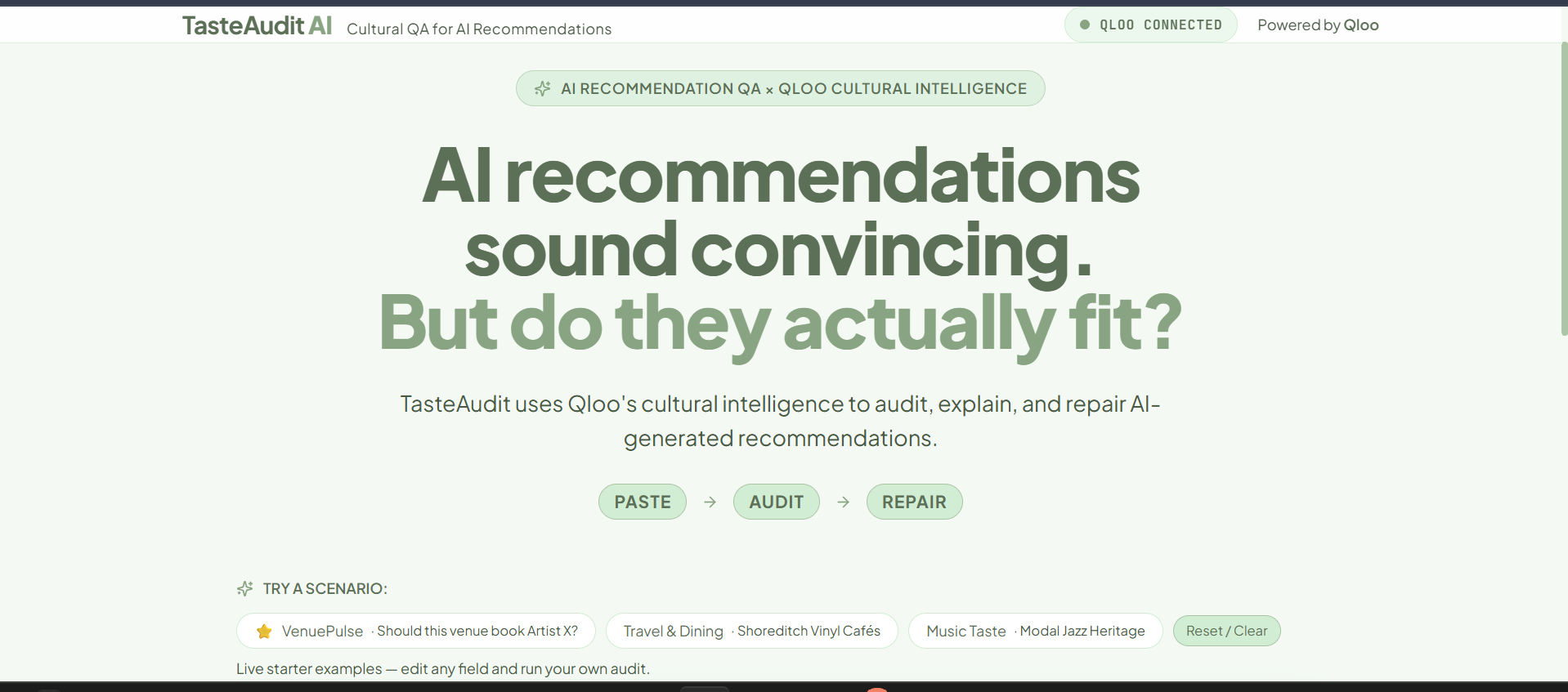
TasteAudit AI takes recommendations generated by an AI and checks whether they are actually culturally grounded, contextually relevant, and supported by evidence.
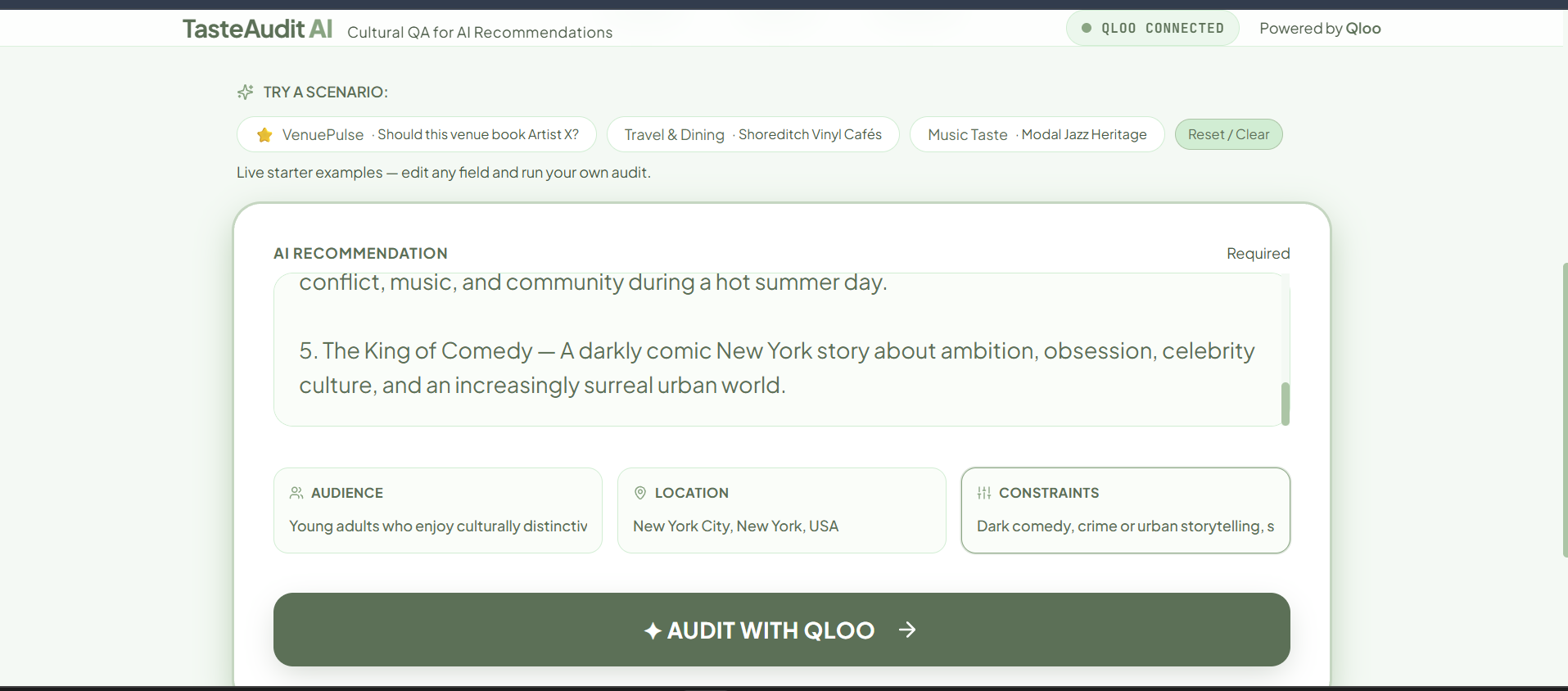
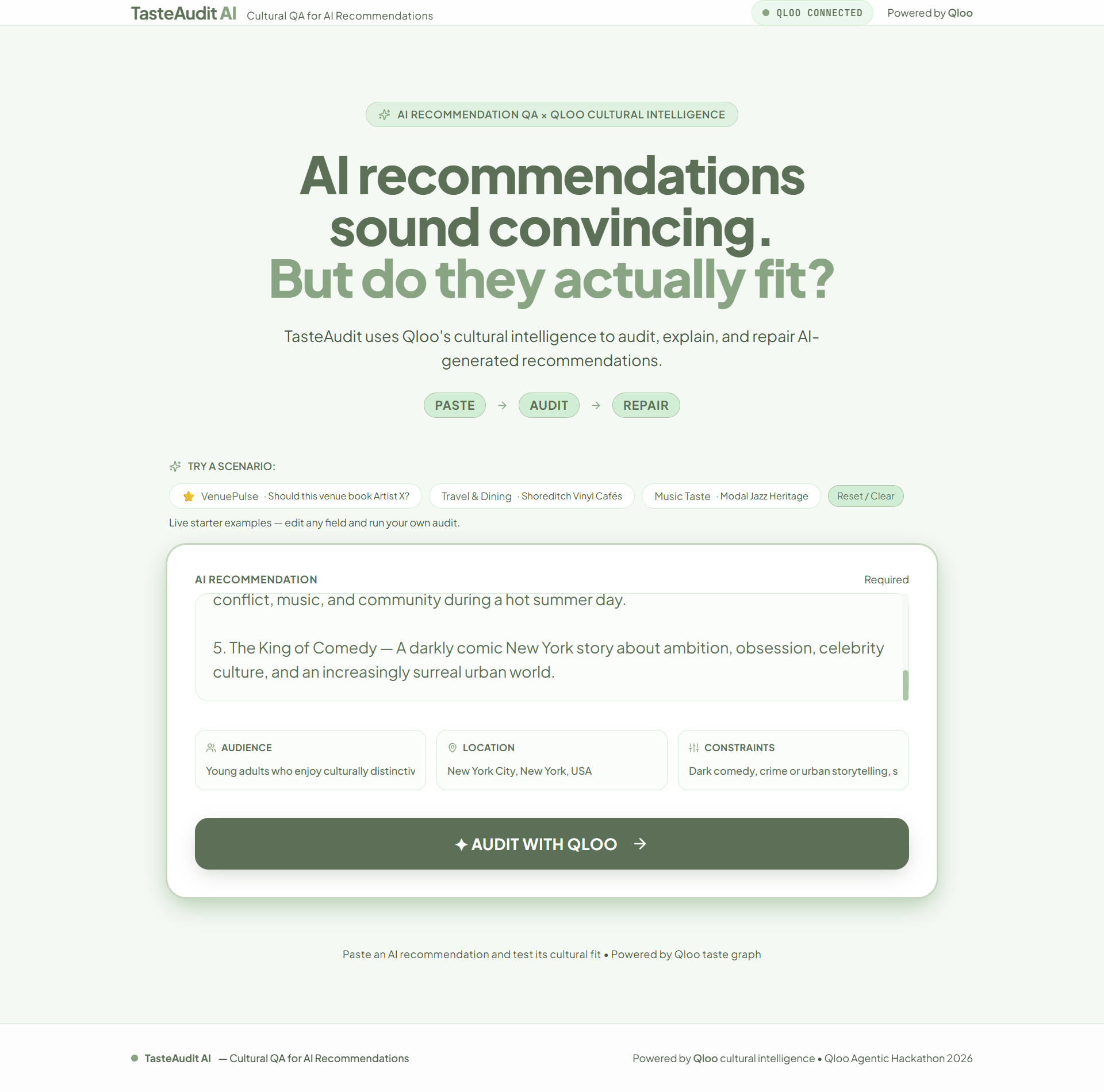
The user provides:
- AI-generated recommendations — a list of movies, restaurants, artists, or other recommendations generated by an AI.
- Audience — who the recommendations are for.
- Location — where the recommendation should make sense.
- Constraints — specific preferences or requirements the recommendations should follow.
The user simply pastes the AI's recommendation response into TasteAudit. The system then handles the verification process automatically.
Instead of generating another recommendation list, TasteAudit asks:
“Can we actually verify that these recommendations make sense for this person and this context?”
How it works
TasteAudit AI follows a multi-stage pipeline:
AI Recommendations
        ↓
      PARSE
        ↓
     RESOLVE
        ↓
   QLOO RETRIEVE
        ↓
      AUDIT
        ↓
  AGENT DECISION
        ↓
 REPAIR / MORE EVIDENCE
        ↓
    RE-AUDIT
        ↓
   FINAL RESULT
1. Parse
The process begins with the AI-generated response.
TasteAudit does not require the response to follow one rigid format. It can extract recommendations from numbered lists, bullet points, headings, and natural-language responses.
For example, if an AI gives five movie recommendations with explanations, TasteAudit identifies the individual candidates while preserving their surrounding context.
2. Resolve
Each recommendation is then matched against Qloo's cultural intelligence graph.
TasteAudit checks whether the recommendation corresponds to a real Qloo entity and whether the resolved entity belongs to the correct semantic domain.
This is important because a name alone is not enough. A result that looks like a match could belong to a completely different category.
3. Retrieve
Once an entity is resolved, TasteAudit retrieves relevant cultural evidence from Qloo.
This can include cultural relationships, affinity signals, contextual connections, entity metadata, and other available Qloo signals.
The system also maintains evidence provenance so that grounded claims can be traced back to their source.
4. Audit
The recommendation is evaluated against the user's actual request.
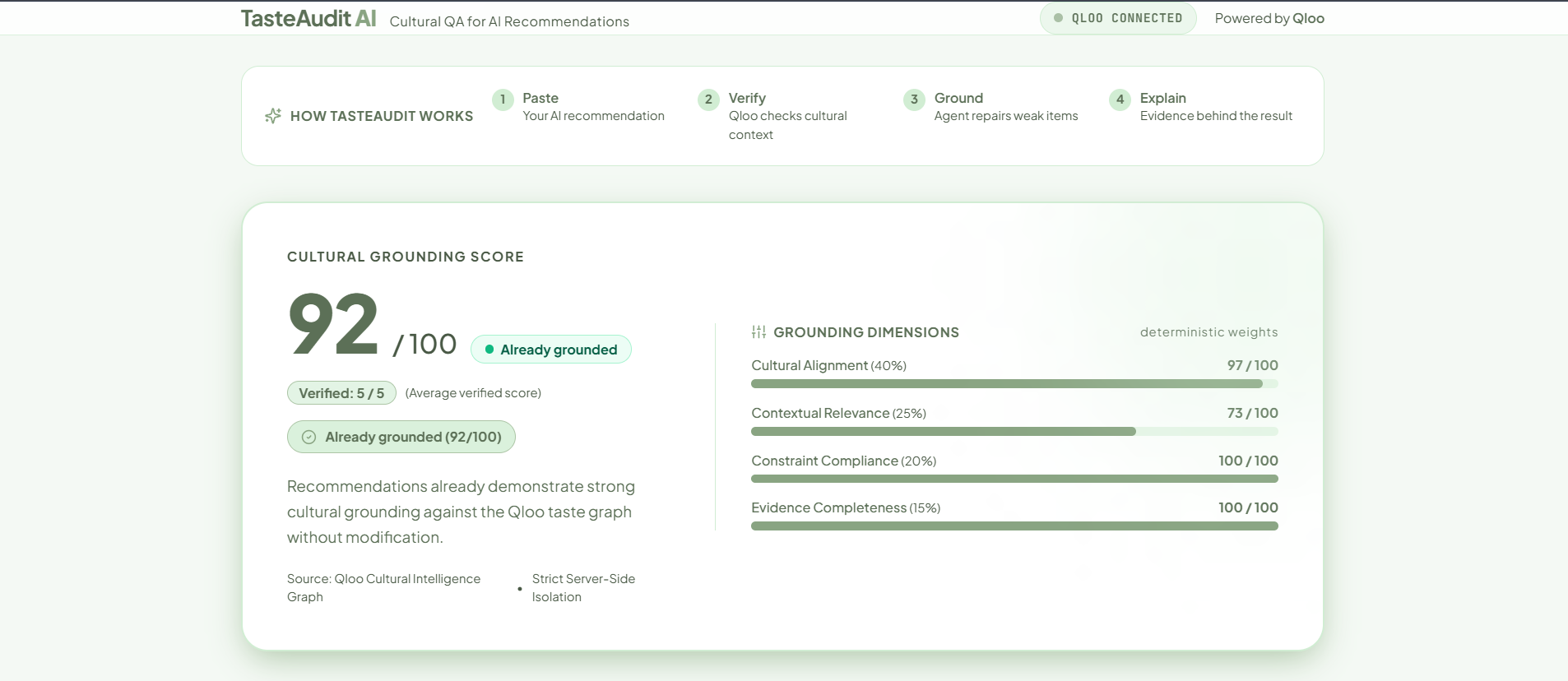
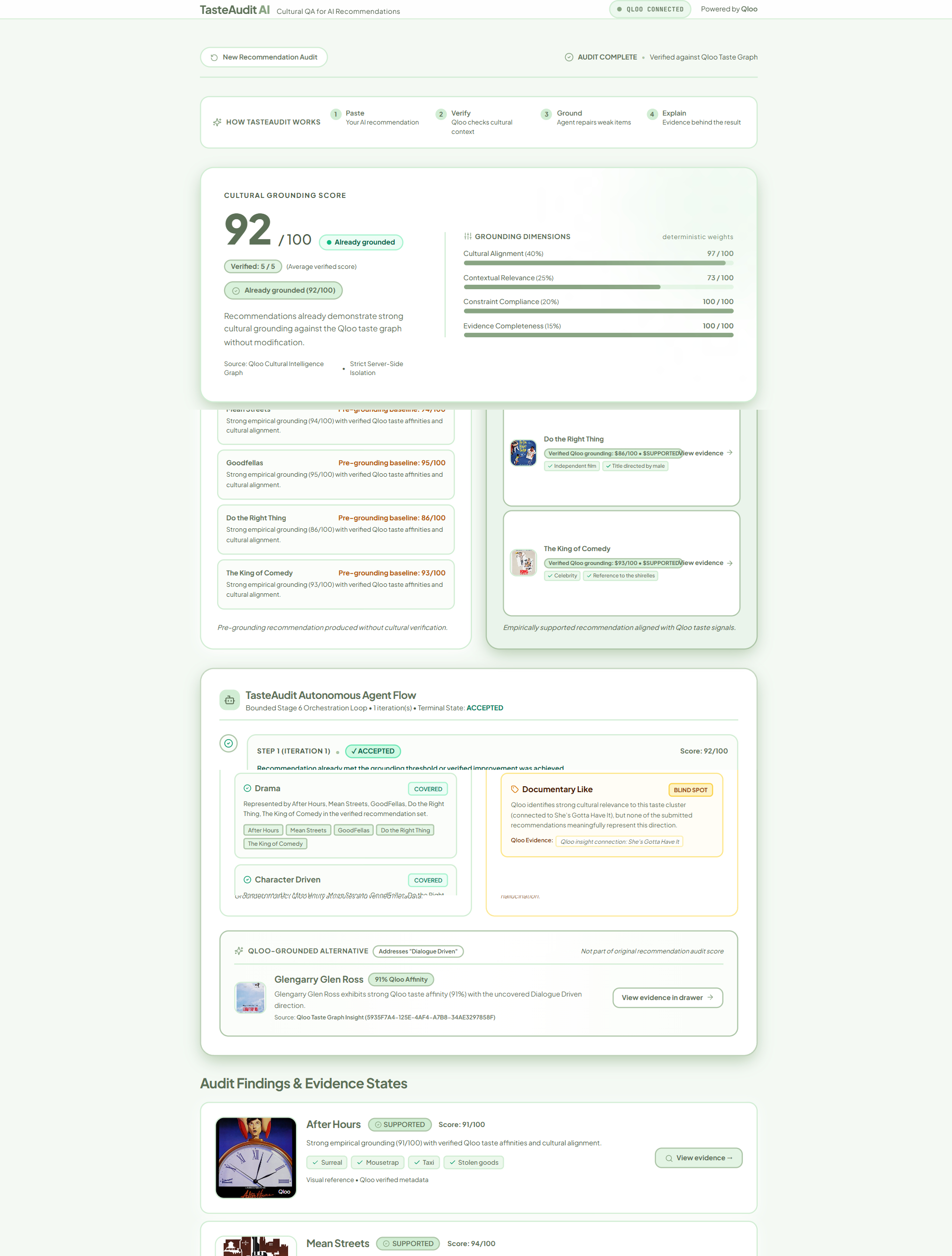
TasteAudit calculates a deterministic Cultural Grounding Score across four dimensions:
- Cultural Alignment — 40%
- Contextual Relevance — 25%
- Constraint Compliance — 20%
- Evidence Completeness — 15%
The final score is calculated by the deterministic audit engine rather than generated by an LLM.
This means an AI model cannot simply produce a convincing explanation and override the actual evaluation.
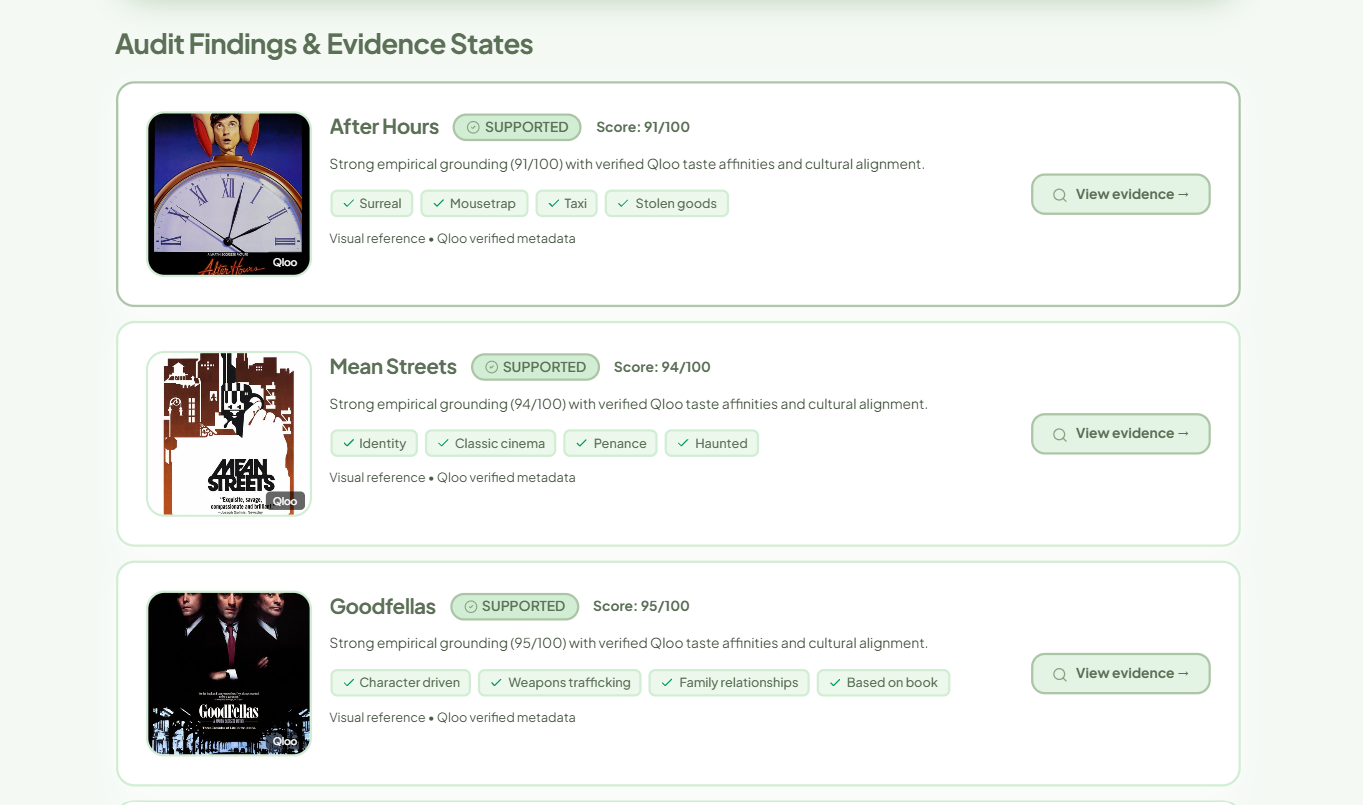
5. Evidence Firewall
TasteAudit separates evidence into three states:
- SUPPORTED — directly backed by Qloo evidence.
- INFERRED — a reasonable interpretation, but not directly established.
- UNVERIFIED — insufficient evidence.
This is a key part of the system's trust model.
If the evidence is insufficient, TasteAudit can say so instead of inventing a cultural connection.
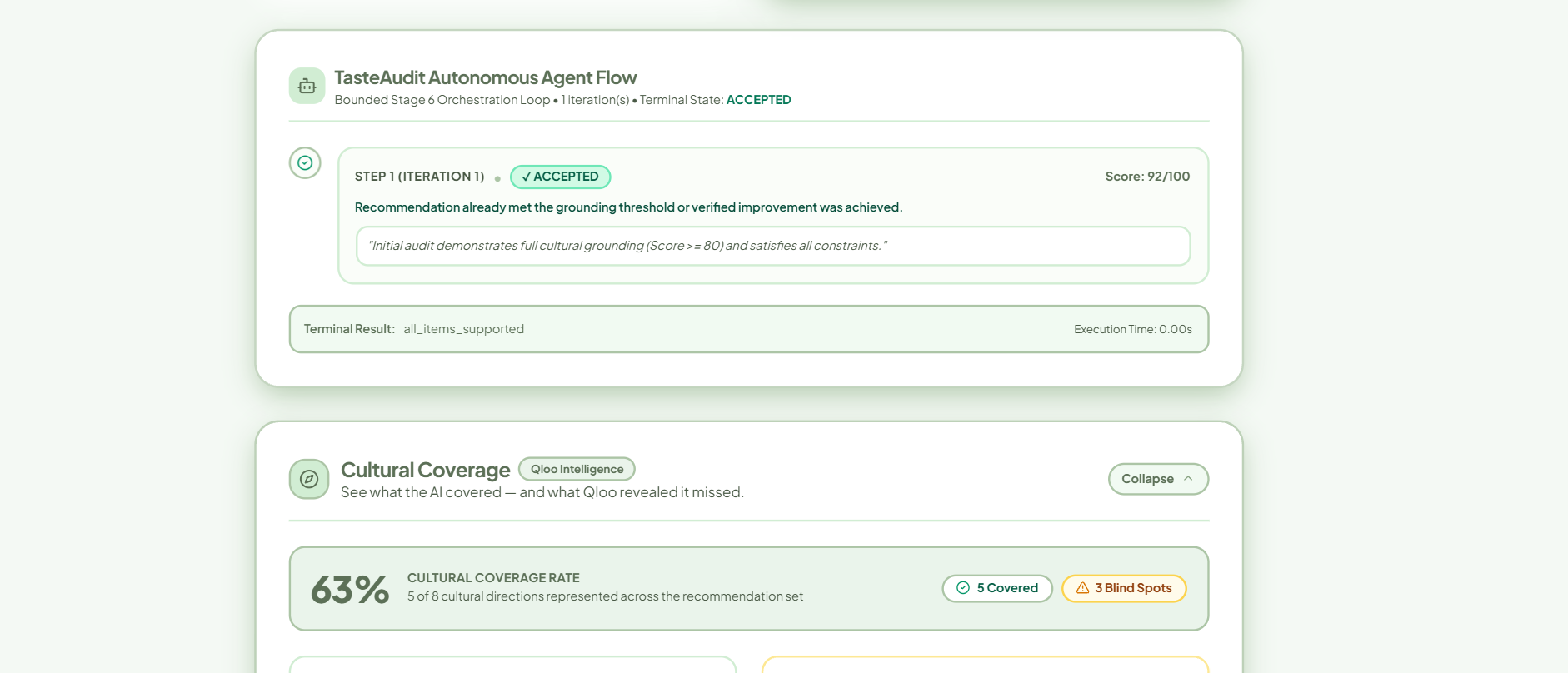
6. Autonomous Agent
After the initial audit, TasteAudit's autonomous agent determines whether the result needs further action.
It can:
- ACCEPT the recommendation set when it is already strong.
- REPAIR a weak recommendation when a better supported option is available.
- MORE_EVIDENCE when additional evidence could resolve uncertainty.
- STOP when further action is not justified.
The agent operates within bounded iterations and includes protection against repeated actions and invalid candidates.
If a repair is performed, the recommendation goes through the audit again.
This means the system does not simply claim that a repair is better — it re-audits the result and measures the outcome.
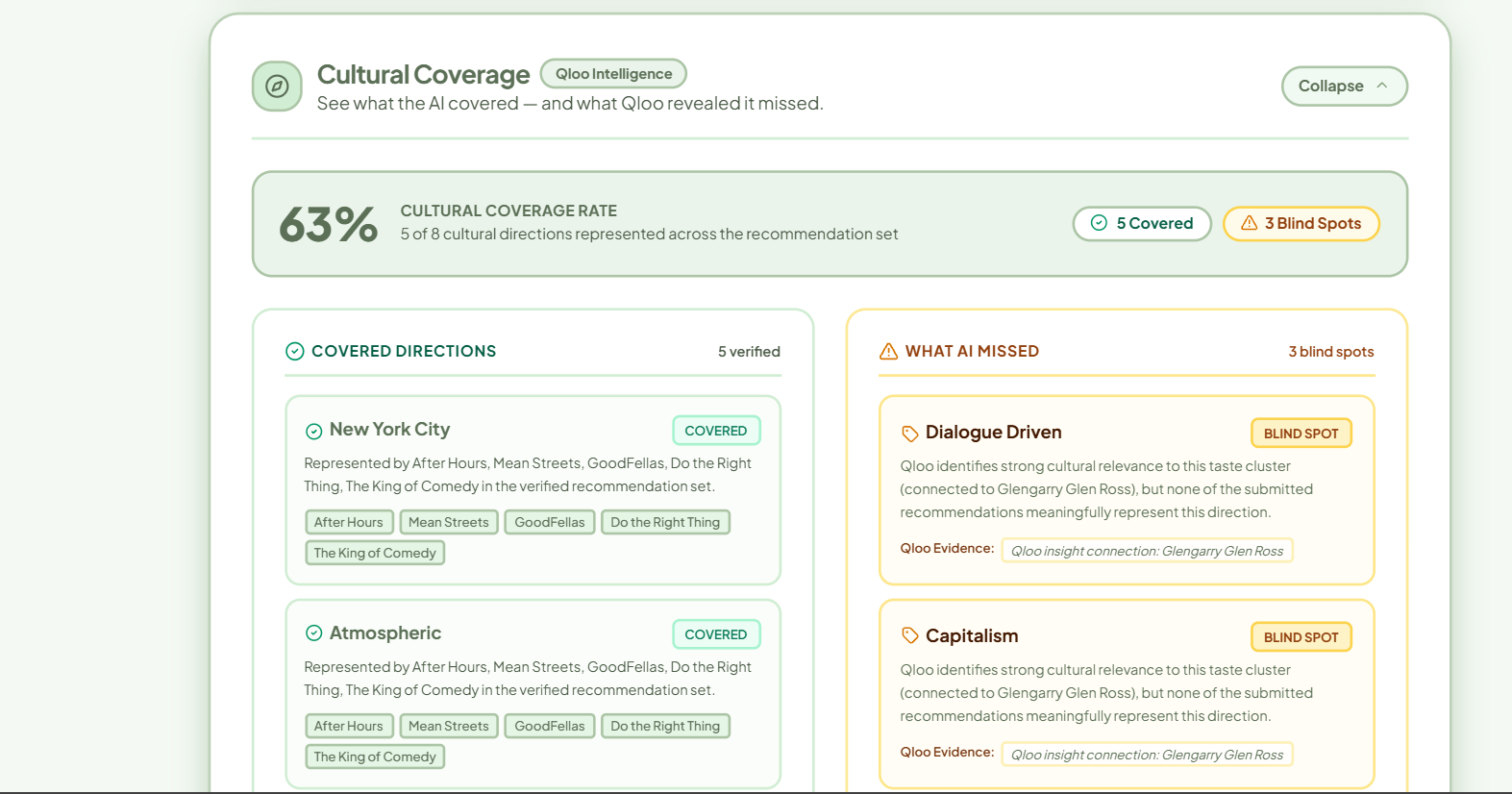
7. Cultural Coverage & Blind Spots
TasteAudit then looks beyond individual recommendation scores.
It analyzes the recommendation set as a whole and asks:
“What cultural directions are represented, and what meaningful directions might be missing?”
The system identifies culturally meaningful directions supported by Qloo evidence and calculates a Cultural Coverage Rate for the recommendation set.
It then separates the result into:
- Covered Directions
- Cultural Blind Spots
When Qloo provides sufficient evidence for an uncovered direction, TasteAudit can surface a Qloo-grounded alternative that addresses that blind spot.
This turns Qloo's cultural graph into something the user can actually understand and act on.
What the user gets at the end
The final output is not just a score.
TasteAudit produces a complete cultural audit of the AI recommendation.
Cultural Grounding Score
The user sees an overall score showing how strongly the recommendations are culturally grounded.
The score is accompanied by the four underlying dimensions:
- Cultural Alignment
- Contextual Relevance
- Constraint Compliance
- Evidence Completeness
This makes the score explainable rather than a black-box number.
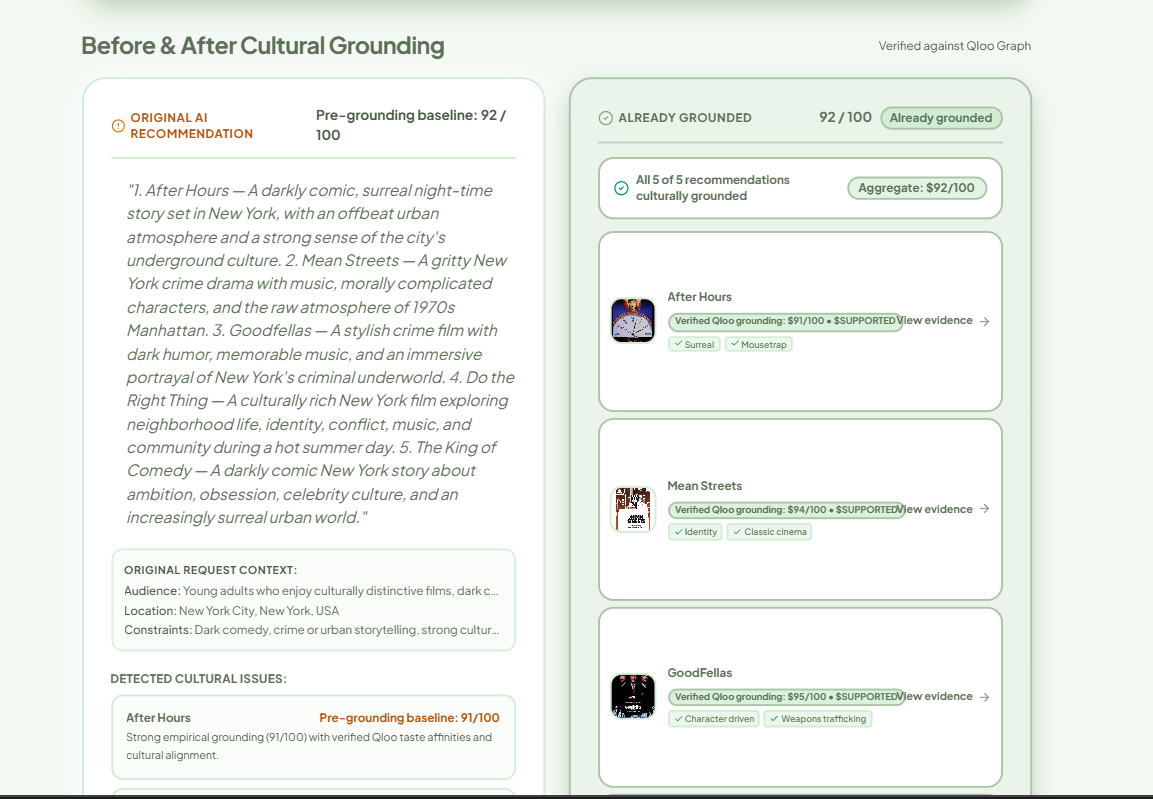
Before & After Cultural Grounding
The interface shows the original AI recommendations alongside the verified results.
If a recommendation needed improvement, the user can see whether the system actually improved it after additional evidence or repair.
If no improvement was justified, TasteAudit can transparently show that as well.
Verified Recommendations
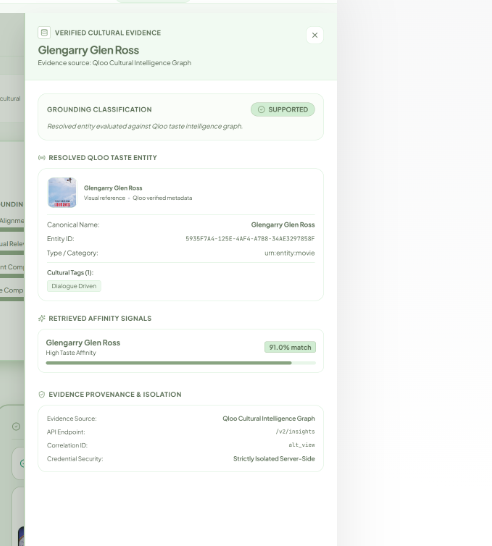
Each grounded recommendation can display:
- Qloo-verified entity
- Cultural signals
- Affinity evidence
- Evidence status
- Qloo provenance
- Visual reference when available
Users can open the evidence drawer to inspect the underlying Qloo grounding instead of simply trusting the interface.
Autonomous Agent Trace
The system also exposes the agent's decision process.
The user can see whether the agent:
ACCEPTED, REPAIRED, requested MORE EVIDENCE, or STOPPED.
This makes the autonomous behavior observable rather than hiding it behind the scenes.
Cultural Coverage
The user gets a broader view of the recommendation set:
- Coverage percentage
- Cultural directions covered
- Cultural blind spots
- Qloo-grounded alternatives, when supported
For example, a movie recommendation set might strongly represent directions such as:
- New York City
- Drama
- Atmospheric
- Character Driven
- Gritty
while Qloo may reveal other culturally relevant directions that are not adequately represented.
Evidence and Uncertainty
Every important claim is tied back to available evidence.
When an entity is ambiguous, unresolved, or insufficiently supported, TasteAudit does not pretend otherwise.
This is intentional.
The system would rather show uncertainty than manufacture confidence.
Challenges we ran into
The hardest part of building TasteAudit was not simply connecting an API.
The real challenge was creating a system that could make AI recommendations measurable and trustworthy.
Messy AI output
AI responses are not structured database records. Recommendations can appear in lists, paragraphs, headings, or mixed natural language.
We had to build flexible extraction logic while preserving the context surrounding each recommendation.
Ambiguous entity resolution
A recommendation name does not always uniquely identify an entity.
We therefore added semantic and domain-aware resolution so that a Qloo match must actually make sense for the recommendation being audited.
Preventing hallucinated evidence
We did not want an LLM to invent a cultural relationship simply because the explanation sounded plausible.
Qloo evidence must support the claim before it can be treated as verified.
Autonomous repair
A repair is only useful if it actually improves the result.
We therefore built bounded agent behavior, repeated-action protection, safe stopping, and deterministic re-auditing so that the agent cannot endlessly modify recommendations without evidence of improvement.
Turning raw cultural signals into meaningful insight
Qloo provides rich cultural signals, but not every raw tag represents a useful cultural direction.
For Cultural Coverage, we built semantic filtering so that incidental objects, plot mechanics, entity names, and other low-value metadata do not get presented as meaningful cultural insights.
Accomplishments we're proud of
TasteAudit AI was built from the ground up around Qloo's cultural intelligence, rather than simply adding Qloo as an API call.
We are particularly proud of:
- Building the complete Parse → Resolve → Retrieve → Audit → Repair → Re-Audit pipeline.
- Using Qloo as the core cultural intelligence and evidence layer.
- Creating deterministic multi-dimensional cultural scoring.
- Building an Evidence Firewall for trustworthy evidence handling.
- Preventing unsupported entities and fabricated cultural evidence from entering the result.
- Building a bounded autonomous repair agent with safe stopping behavior.
- Supporting recommendation auditing across domains such as movies, music, and dining.
- Creating Cultural Coverage & Blind Spot Intelligence.
- Providing evidence drawers that allow users to inspect Qloo grounding.
- Preserving uncertainty instead of hiding it.
The most important accomplishment is that TasteAudit does not ask users to simply trust an AI explanation.
It gives them a way to inspect the evidence behind the recommendation.
What we learned
This project changed how we think about recommendation systems.
We initially thought about recommendations primarily in terms of similarity:
“Is this similar to something the user likes?”
But cultural taste is more complicated than similarity.
Qloo helped us think about recommendations as relationships between entities, preferences, contexts, and cultural signals.
We also learned that building trustworthy AI requires more than a capable model.
The surrounding system matters just as much:
- deterministic rules make decisions measurable
- external knowledge provides grounding
- provenance makes claims inspectable
- semantic safeguards prevent misleading outputs
- bounded agents prevent uncontrolled behavior
- explicit uncertainty makes the system more trustworthy
One of our biggest lessons was simple:
“I don't have enough evidence” can be a better answer than a confident guess.
What's next for TasteAudit AI
TasteAudit AI is currently a working prototype exploring how cultural intelligence can become a verification layer for AI recommendations.
Our next step would be turning this concept into infrastructure that developers and AI products can use directly.
We envision:
- A TasteAudit API for auditing recommendation outputs automatically.
- Integrations with AI assistants and recommendation engines.
- Support for more cultural domains.
- Richer explanations of Qloo relationships.
- More advanced cultural blind-spot discovery.
- User-controlled cultural priorities and constraints.
- Feedback mechanisms for improving recommendation quality over time.
Our long-term vision is bigger than a recommendation dashboard.
We believe AI should not only be able to answer:
“What should I recommend?”
It should also be able to answer:
“Why does this recommendation actually make sense for this person?”
TasteAudit AI is our attempt to build that missing layer of cultural verification between AI-generated recommendations and the people who trust them.
Don't Just Recommend. Verify the Taste.
Built With
- agents
- ai
- api
- css
- cultural
- data
- express.js
- natural
- node.js
- processing
- qloo
- react
- recommendation
- rest
- semantic
- systems
- tailwind
- typescript
- visualization
- vite


Log in or sign up for Devpost to join the conversation.