-
-

inbox
-
plan
-
capacity warning

Inspiration: Assignments, revision reminders, meetings, and small administrative tasks often arrive in different places. A generic task list still leaves students to interpret every notice and decide what can realistically fit into a day. TaskTide focuses on that first step: making an overwhelming set of messages into something small enough to check and act on.
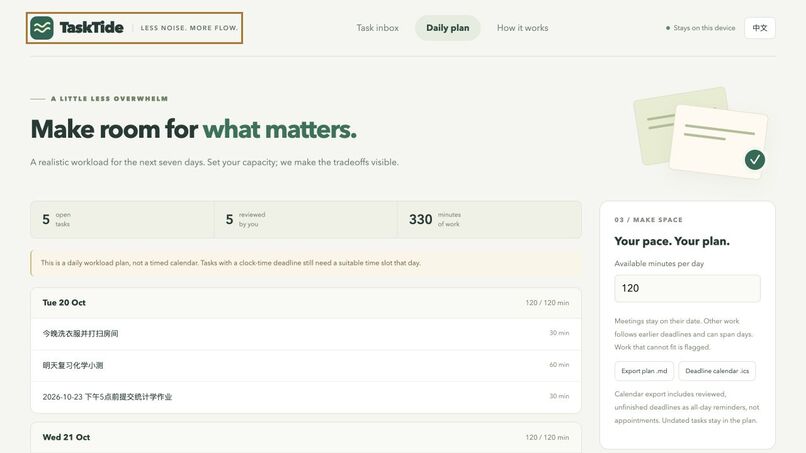
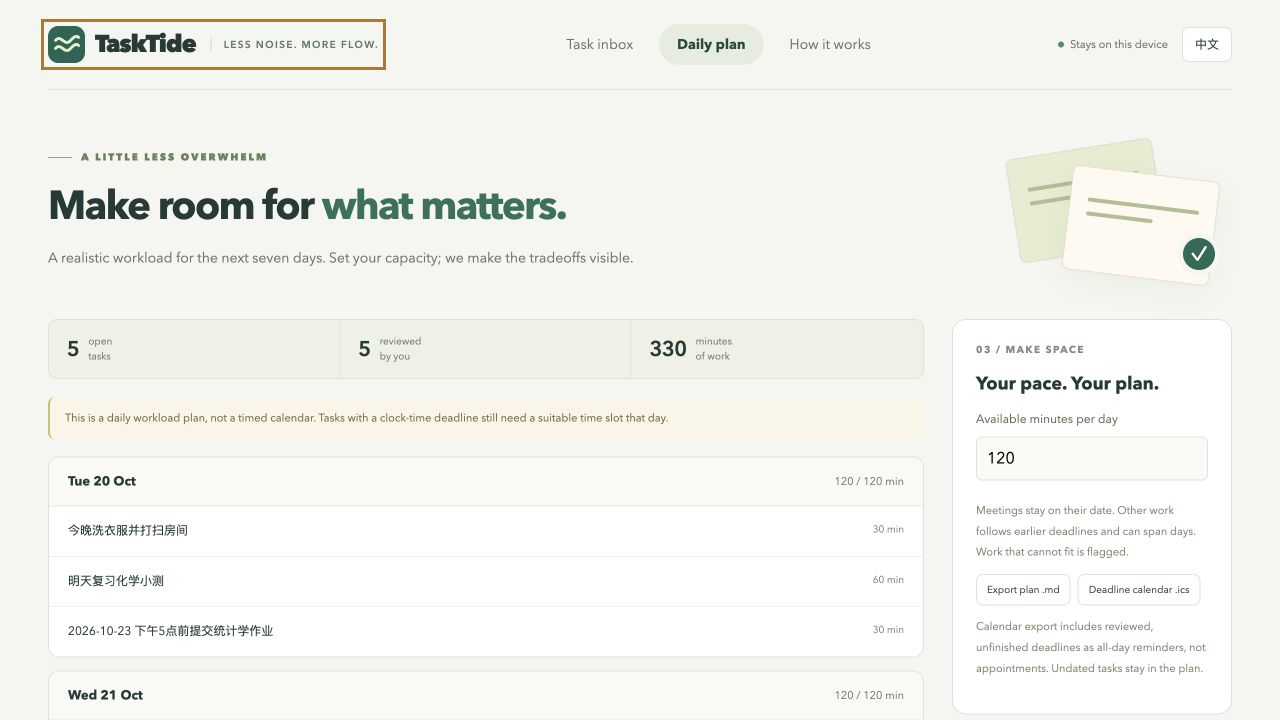
What it does: Paste one notice per line, in English or Chinese. A small local model suggests a category, while explicit parsing rules suggest a deadline and preserve the matching phrase. Correct any suggestion and mark the task Reviewed. TaskTide then allocates work across seven days using the available minutes per day, with visible warnings when effort cannot fit before a deadline. Tasks can be completed, filtered, and exported as Markdown or an all-day deadline calendar. The person using the tool controls the final category, dates, and effort estimates. Nothing enters the daily plan until it has been reviewed. Notice text stays in the browser.
How it was built: The app uses HTML, CSS, JavaScript, and a compact TF-IDF plus multinomial logistic regression model. A deterministic NumPy training script exports weights for browser inference, so there is no runtime Python server, paid API, or external AI account. Dates, scheduling, and calendar export are transparent, testable functions. A static build can run on ordinary web hosting. The training set contains 140 original synthetic bilingual notices. A separate set of 50 synthetic examples reaches 90% accuracy and macro F1 0.8997, compared with a 20% majority-class baseline. This is a small prototype benchmark, not independent validation or a claim about real users.
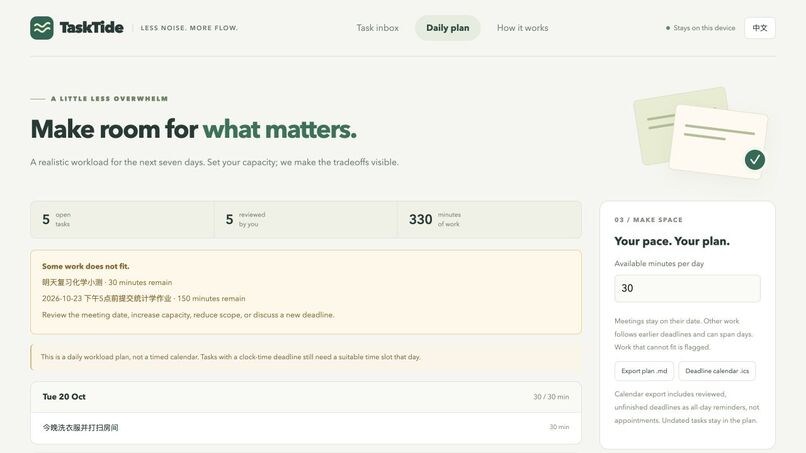
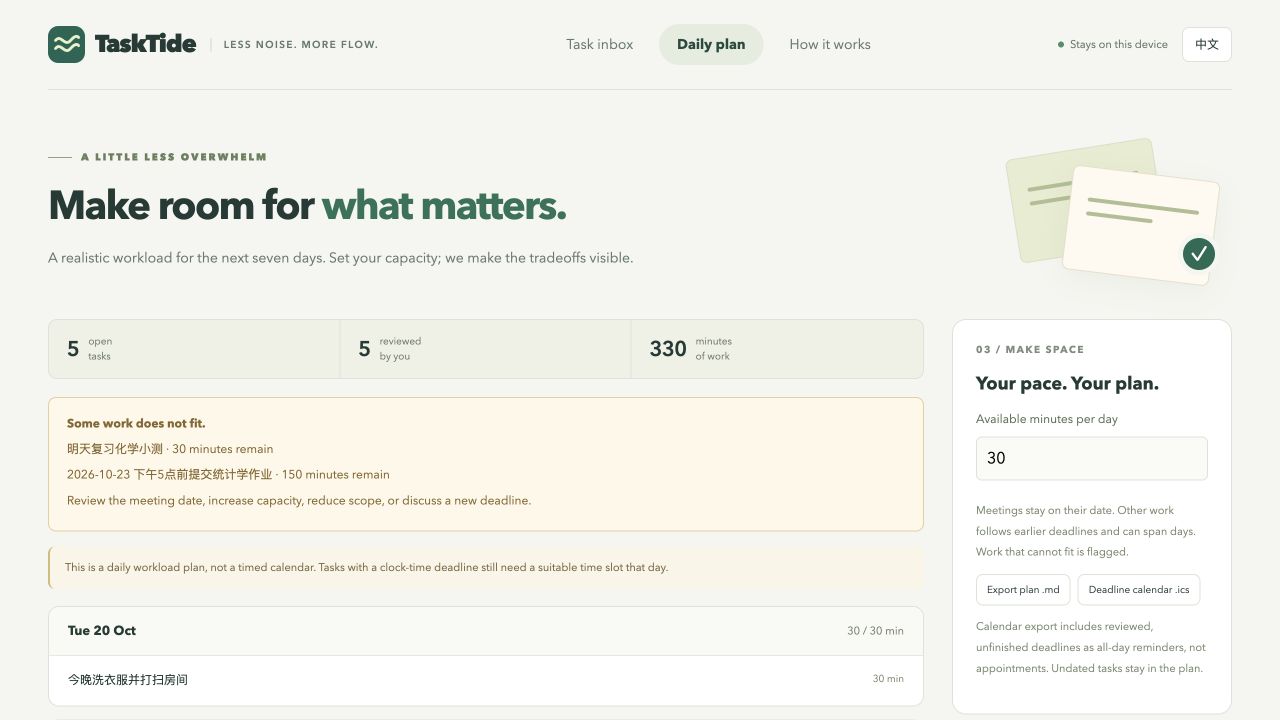
Challenges: Relative dates depend on a reference day, and phrases such as “next Friday” can be ambiguous. TaskTide exposes its interpretation and asks for review. Another challenge is making time limits visible: if work cannot fit, the planner reports the remaining effort instead of silently assigning it after a future deadline.
Accomplishments: A complete notice-to-plan workflow runs locally in a bilingual interface. The model has reproducible training and evaluation; browser inference matches every Python test prediction. Human review and explicit overload warnings are part of the working product.
What was learned: Implementation and regression testing showed that fixed-date meetings need a different scheduling path from flexible work. Reserving meeting capacity first prevents a planner from moving an event just because another day has room. The review workflow also makes model mistakes recoverable: suggestions remain editable, and changing a reviewed task requires review again. Finally, a high score on a small synthetic dataset is useful for checking a prototype, but does not establish real-world reliability.
What's next: Evaluate consented real notices with independent annotations, improve language coverage, and measure whether the review workflow reduces task-entry time and errors.
Built With
- css
- html
- icalendar
- javascript
- local-storage
- logistic-regression
- numpy
- python
- tf-idf


Log in or sign up for Devpost to join the conversation.